Table of Contents >> Show >> Hide
- 1) A Planetwide Magma Ocean (Earth’s “Oops, All Lava” Era)
- 2) The Sky Was Steam, Ash, and Chemical Chaos (No “Blue Sky” Included)
- 3) Earth as a Cosmic Dartboard (Late Heavy Bombardment Vibes)
- 4) A “Pale Orange Dot” World (When Earth Looked Like Titan’s Cousin)
- 5) Earth Might Have Been… Purple (Yes, Really)
- 6) Oceans That Were Not Blue (When Iron and Chemistry Recolored the Seas)
- 7) When Oxygen Crashed the Party and Painted the Planet (The Great Oxidation Shift)
- 8) Snowball Earth (A Planet That Forgot It Was Supposed to Be Blue)
- 9) One Giant Supercontinent and One Giant Attitude (Pangaea Time)
- 10) Swamp Forests, Sky-High Oxygen, and Bugs with Main-Character Energy
- Bringing It Back to the Present
- Experiences to Make “Alien Earth” Feel Real (Without a Time Machine)
If you could time-travel across Earth’s deep past, you’d spend a lot of time squinting and saying,
“Are we sure this is the same planet?” The familiar blue oceans, green continents, and breathable air are
recent upgrades on a world that has repeatedly reinvented itselfsometimes dramatically, sometimes gradually,
and often in ways that would look downright extraterrestrial to modern eyes.
Below are ten moments (and long stretches) when Earth’s surface, skies, and chemistry could have looked more
like a sci-fi set than your current weather app. This isn’t just a parade of weirdness, either: each “alien Earth”
phase left clues in rocks, minerals, fossils, and chemical signatures that scientists use to reconstruct what our
planet used to be.
1) A Planetwide Magma Ocean (Earth’s “Oops, All Lava” Era)
What it would have looked like
Early Earth likely spent time as a glowing, molten worldmore “lava lamp” than “landscape.” Imagine a surface
that isn’t really “ground” so much as a churning sea of magma, with volcanic gases and heat shimmering above it.
If you were hoping for a picnic spot, the best you could do would be “not currently on fire.”
Why it happened
Planet formation is violent business. Accretion (lots of impacts), intense internal heat, and at least one colossal
collision early on meant Earth started out extremely hot. Over time, cooling allowed a crust to form and, eventually,
liquid water to persist. But before that? Earth wore molten like a fashion statement.
2) The Sky Was Steam, Ash, and Chemical Chaos (No “Blue Sky” Included)
What it would have looked like
Even after the surface began cooling, the atmosphere would have been thick with water vapor, carbon dioxide, and
other volcanic gases. The horizon would look hazy, heavy, and bright in a harsh wayless “gentle sunrise,” more
“industrial sauna with lightning.”
Why it happened
Volcanoes and degassing from the young planet supplied much of the early atmosphere. If oceans formed, they likely
formed from condensing water vapor once the planet cooled enoughmeaning the “weather” could have included long,
dramatic cycles of condensation and precipitation on a scale we don’t experience today.
3) Earth as a Cosmic Dartboard (Late Heavy Bombardment Vibes)
What it would have looked like
During periods of intense impacts in the early solar system, Earth could have looked like a world under constant
bombardmentflashy streaks across the sky, frequent impacts, and a surface repeatedly reworked by energy from above.
If you’ve ever watched a meteor shower and thought, “Wow, that’s a lot,” early Earth might have replied, “Cute.”
Why it happened
The early solar system had leftover debrisasteroids and cometson unstable paths. Evidence for heavy impact periods
comes largely from lunar records, plus rare terrestrial clues that survive Earth’s recycling crust. These impacts
didn’t just make craters; they helped shape surface conditions, chemistry, and possibly the timing of habitability.
4) A “Pale Orange Dot” World (When Earth Looked Like Titan’s Cousin)
What it would have looked like
For a large chunk of the Archean Eon, Earth may have had a hydrocarbon hazean atmospheric smog that could tint the
planet orange. From space, Earth might have looked less like a blue marble and more like a muted amber orb with a
soft, diffuse glow.
Why it happened
Without much oxygen, methane could build up more easily. In the right chemical mix, sunlight can drive reactions that
form haze particles (think “planet-sized photochemistry project”). This haze could also affect climate by filtering
sunlightmeaning Earth’s “alien look” wasn’t just cosmetic; it influenced temperature and surface conditions.
5) Earth Might Have Been… Purple (Yes, Really)
What it would have looked like
Today, green is the signature color of photosynthesis because chlorophyll reflects green light. But some scientists
have explored the idea that early light-harvesting life could have leaned on retinal-based pigments (think: purple-ish
microbes) before oxygenic photosynthesis took over. If widespread, that could make coastlines, shallow seas, or microbial
mats look purplishlike Earth was trying out a bold new paint job.
Why it happened
Retinal-based phototrophy is simpler in some ways than chlorophyll-based systems and exists in certain microbes today.
The “purple Earth” idea is partly about what early metabolisms were plausibleand what that would mean for the colors
a distant observer might detect on an exoplanet. Earth, in other words, may have worn different “biosignature fashion”
before settling on chlorophyll green.
6) Oceans That Were Not Blue (When Iron and Chemistry Recolored the Seas)
What it would have looked like
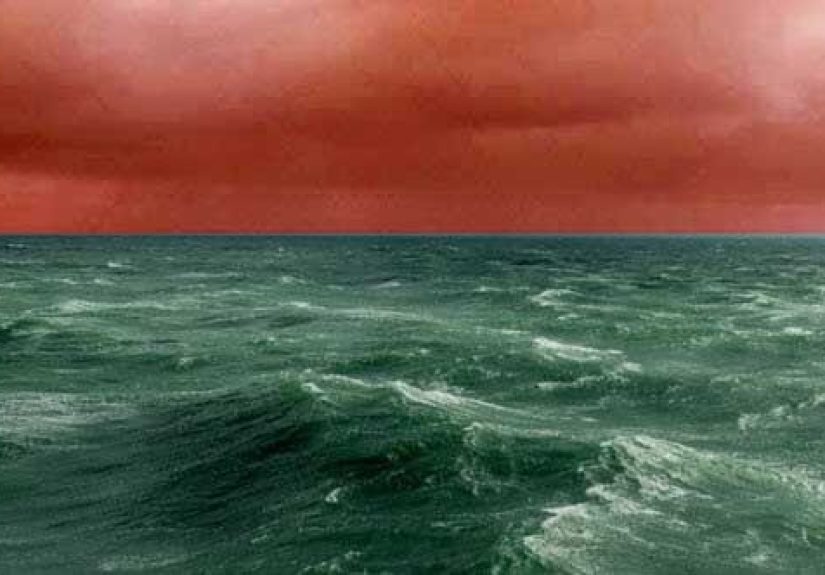
Early oceans weren’t guaranteed to be the crisp blue we know. Under low-oxygen conditions, dissolved iron could be far
more abundant in seawater. Depending on chemistry, particles, and microbial life, seas could plausibly appear darker,
greener, or otherwise “wrong” compared to modern expectations.
Why it happened
In an anoxic world, iron remains dissolved more readily. Once oxygen increased, iron tended to oxidize and drop out,
contributing to banded iron formationsstriped rocks that act like a geologic receipt for ancient ocean chemistry.
The big lesson: the color of “the ocean” isn’t fixed; it’s a consequence of atmosphere, biology, and geochemistry
negotiating over billions of years.
7) When Oxygen Crashed the Party and Painted the Planet (The Great Oxidation Shift)
What it would have looked like
Oxygen didn’t politely knock and enter. As oxygen levels rose dramatically compared to earlier eras, the planet’s
chemistry changedoceans and rocks began to oxidize more widely, and atmospheric composition shifted. You’d see more
“rust” signatures on land over time, and the sky’s filtering properties would change as oxygen and, later, ozone became
significant players.
Why it happened
Oxygenic photosynthesis (especially by cyanobacteria) introduced large new amounts of O2. For a long time,
oxygen got “used up” by reacting with iron and other sinks. Eventually, oxygen began accumulating more noticeably.
This wasn’t a single overnight makeovermore like a long renovation with a few dramatic momentsbut it fundamentally
changed what could live on Earth and what Earth looked like from the outside.
8) Snowball Earth (A Planet That Forgot It Was Supposed to Be Blue)
What it would have looked like
Picture Earth as a bright, reflective ice worldglaciers reaching far toward the equator, oceans capped or largely
covered, and the overall planet looking more like a glistening white sphere than a blue marble. If aliens flew by,
they might log it as “Ice Planet #47” and keep going.
Why it happened
Evidence suggests at least two major Cryogenian glaciations when ice advanced to very low latitudes. Once ice spreads,
it reflects sunlight (high albedo), which can cool the planet furtheran amplifying feedback loop. Scientists debate
details (hard snowball vs. slushball scenarios), but either way, it’s one of Earth’s most dramatic “alien planet”
looks on record.
9) One Giant Supercontinent and One Giant Attitude (Pangaea Time)
What it would have looked like
When most land was stitched into a single supercontinent, Earth’s map looked aggressively simplified: one vast landmass,
huge coastlines, and an enormous interior far from moderating ocean influence. Think mega-deserts, strong seasonal extremes,
and long stretches of “land, land, more land” where today you’d expect seas.
Why it happened
Plate tectonics continuously rearranges continents. Pangaea assembled roughly in the late Paleozoic and persisted into the
early Mesozoic before breaking apart. A supercontinent changes ocean currents, climate patterns, and the distribution of
habitatsso it’s not just a different-looking globe on a classroom poster; it’s a different operating system for the planet.
10) Swamp Forests, Sky-High Oxygen, and Bugs with Main-Character Energy
What it would have looked like
In parts of the Carboniferous, dense wet forests spread across warm regions, creating landscapes dominated by giant club
mosses, tree ferns, and sprawling swamp ecosystems. Add higher atmospheric oxygen than today, and suddenly arthropods can
get unreasonably large. The vibe? “Jungle planet” meets “why is that insect the size of a small drone?”
Why it happened
Oxygen levels appear to have been significantly higher during parts of the late Carboniferous than today. That matters
because many insects rely on diffusion through tracheal systems; more oxygen can make larger body sizes easier to support.
Meanwhile, vast plant growth and carbon burial helped reshape the atmosphere. Earth didn’t just look alienit may have felt
alien to breathe (in a “wow, everything burns easier” kind of way).
Bringing It Back to the Present
The punchline of deep time is that “normal Earth” is not the default setting. The planet has swung between extremesmolten
surfaces, weird skies, chemically unusual seas, icehouse locks, and greenhouse surgesthen kept going. If Earth sometimes
seems dramatic now, that’s only because you haven’t met its billion-year mood swings.
Experiences to Make “Alien Earth” Feel Real (Without a Time Machine)
You can’t book a weekend getaway to the Archean, but you can build experiences that help your brain “see” these ancient
worlds more vividly. Start with heat. The next time you stand near a lava flow video feed, a geothermal vent, or even a roaring
industrial furnace (from a safe distance, please), notice how quickly your imagination gives up on the idea of a comfortable
surface. That’s the mental trick behind early Earth: scale the heat up, stretch it across an entire planet, and remove the
comforting concept of a stable sidewalk. Suddenly “magma ocean” stops being a phrase and starts being a sensory picture.
Next, try the sky. On a hazy daywildfire smoke, heavy humidity, or urban smogthe sunlight changes character. Colors flatten.
The horizon blurs. You can’t see “forever” anymore. That’s a small, modern echo of how an atmospheric haze could make Earth look
like an orange-tinted world. Pair that with a night under a meteor shower and imagine it multiplied: not a charming celestial show,
but a persistent reminder that the early solar system was busy throwing rocks around like it had something to prove.
Then go to color. Visit any place where water looks “wrong”greenish, rusty, milky, or stained by mineralsand you’ll understand
how easily oceans can shift appearance when chemistry changes. You don’t need a literal iron-rich Archean sea to grasp the concept;
you just need the moment of cognitive dissonance when your eyes say “this is water” and your brain says “why isn’t it blue?”
That split-second is basically a field lesson in geochemistry.
For Snowball Earth, lean into bright winter landscapes or high-albedo scenessun on fresh snow, glare off ice, the way your eyes squint
because the world is too reflective. Imagine that glare stretching from pole to equator. Your sense of “Earthness” starts to wobble.
Add supercontinent thinking by looking at maps differently: instead of continents as permanent shapes, picture them as puzzle pieces
that wander. When you hold that idea long enough, a single landmass doesn’t feel weird; what feels weird is our current arrangement,
with its familiar coastlines that only seem inevitable because you grew up with them.
Finally, make the Carboniferous come alive by paying attention to scale in nature. Stand next to an old-growth tree, then imagine a swamp
forest where the plant lineup is differenttowering lycopsids and tree ferns, thick humidity, oxygen-rich air. Now picture the insects
as the loudest supporting cast. Not movie-monster bugsreal arthropods, just pushed bigger by atmospheric conditions and ecology.
The “experience” here is a mindset shift: Earth has always been a physics-and-chemistry machine, and life adapts to whatever settings the
machine is currently running. Once you feel that, the phrase “Earth once looked like an alien planet” stops sounding clickbaity and starts
sounding… accurate.