Table of Contents >> Show >> Hide
- What “essential” really means (so you don’t buy a gadget museum)
- Precision tools that prevent “mystery results”
- Mixing and prep tools that do the heavy lifting
- Dough and pastry tools for shaping, rolling, and staying sane
- Liners and surfaces that prevent sticking and heartbreak
- Core bakeware that covers 90% of home baking
- How to build your baking kit without buying everything at once
- Conclusion
- Kitchen-Real Baking Experiences (the kind you only learn mid-batch)
Baking is basically delicious scienceexcept your lab partner is a warm oven that lies about its temperature and your “measuring device” is sometimes a mug that once held pens. If you’ve ever made cookies that spread into one giant cookie continent, you already know: the right tools don’t just make baking easier, they make it repeatable. And repeatable is the difference between “nailed it” and “why is my cake auditioning as a doorstop?”
Below are 22 genuinely useful baking tools (not novelty gadgets shaped like unicornsunless that unicorn also calibrates to one gram). You’ll get what each tool does, how to choose a good one, and real examples of when it saves your batch.
What “essential” really means (so you don’t buy a gadget museum)
An essential baking tool does at least one of these things:
- Improves accuracy (because baking loves precision).
- Improves consistency (so your “best-ever muffins” can happen twice).
- Saves time or mess without compromising results.
- Solves a common baking problem (sticking, uneven baking, collapsed cakes, overbrowned bottoms).
If a tool only does one hyper-specific thing and you bake that thing once a year, it’s not essential. It’s a cute souvenir from the land of overconsumption.
Precision tools that prevent “mystery results”
1) Digital kitchen scale
If you buy one upgrade, make it a scale. Measuring flour by volume can vary wildly depending on scooping, packing, humidity, and the general mood of your kitchen. A scale keeps your ratios consistent because grams don’t do improv. Many baking educators recommend scales because they give reliable precision (often down to 1 gram) and remove the “was that a heaping cup?” chaos.
Example: Your brownies turn out perfect one week and cakey the next? A scale helps you stop accidentally adding an extra 20–40 grams of flour without realizing it.
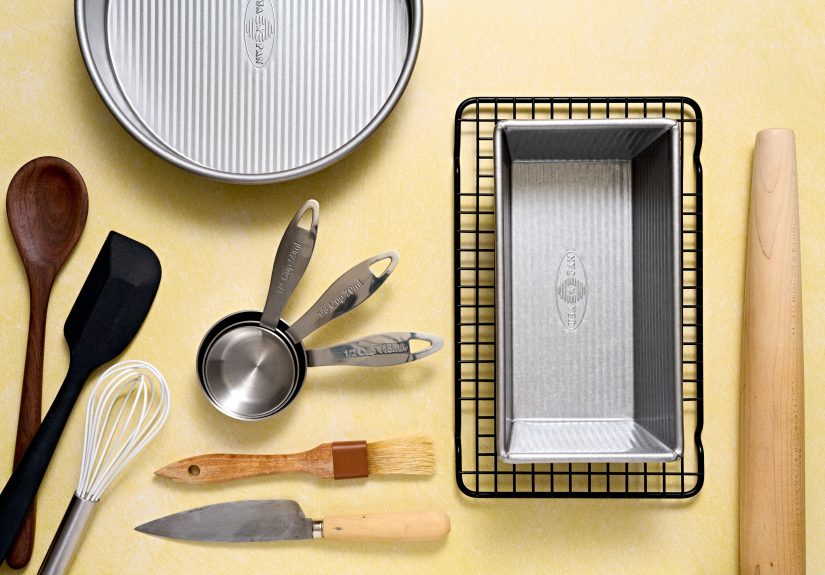
2) Measuring cups (dry + liquid)
Yes, you still want measuring cupseven if you use a scale. They’re handy for quick recipes, liquids, and when a recipe is written in cups. The key: use the right style.
- Dry cups: level-off ingredients like flour, sugar, cocoa.
- Liquid cup: pour to a line at eye level (oil, milk, water).
Choose sturdy sets with clear markings. If you can’t read the lines, you’ll “approximate,” and baking will “respond.”
3) Measuring spoons
Baking powder, baking soda, salt, spices, vanillasmall amounts matter. A slight extra shake of baking soda can turn cookies soapy or bitter. Look for spoons that fit into spice jars and have easy-to-read labels.
Pro tip: Keep a dedicated teaspoon/tablespoon set for baking so you’re not digging through a drawer like it’s an archaeological site.
4) Oven thermometer
Ovens are notorious for running hot, cold, or unevensometimes all in the same afternoon. An oven thermometer tells you what’s actually happening in there, so you can adjust time or temperature. This is especially helpful for delicate bakes like macarons, custards, and anything that burns if you blink.
Example: Your banana bread is done on the outside but gummy inside? Your oven may be hotter than the dial says, browning too fast before the center sets.
5) Instant-read thermometer
Thermometers aren’t just for steak. In baking, they help you confirm doneness (especially for bread), avoid overbaking cakes, and nail candy or syrup stages. A fast, accurate instant-read thermometer removes guessworkbecause “looks done” is not a temperature.
Example: Many enriched breads are beautifully baked when the center hits roughly the high 190s to low 200s °F; a thermometer helps you avoid slicing into a loaf that’s still secretly doughy.
Mixing and prep tools that do the heavy lifting
6) Mixing bowls (nesting set)
You want at least three sizes: small (whisking an egg wash), medium (cookie dough), and large (bread dough or big batters). Stainless steel is lightweight and durable; glass is heavy but stable. Bonus points if they have non-slip bottoms.
Example: Ever tried folding whipped egg whites into batter in a too-small bowl? That’s how you invent new swear words.
7) Electric mixer (hand mixer or stand mixer)
For many home bakers, a hand mixer is the sweet spot: affordable, compact, and great for cookies, whipped cream, and frosting. A stand mixer is a powerhouse for frequent baking, bread dough, and large batches. Either way, the goal is consistent aeration and thorough mixing without exhausting your arms.
Example: Creaming butter and sugar by hand can be done, but your frosting shouldn’t require a gym membership.
8) Whisk
A balloon whisk is ideal for aerating wet ingredients, smoothing batters, and avoiding lumps in cocoa or cornstarch mixtures. It’s the easiest way to make your batter cohesive without overmixing.
Example: A whisk beats a fork when you’re trying to fully combine eggs and sugar for a custard basefewer streaks, better texture.
9) Silicone spatulas
A good silicone spatula is part mixer, part scraper, part “get every last drop because butter is expensive.” Use it to fold batters gently, scrape bowls clean, and stir on the stovetop without melting your tool into modern art.
Example: Folding chocolate chips into thick cookie dough with a spoon can leave pockets of flour; a flexible spatula helps you reach the bottom corners.
10) Fine-mesh sieve (or sifter)
A fine-mesh sieve does more than make flour look fancy. It breaks up clumps in powdered sugar and cocoa, helps you mix dry ingredients evenly, and can strain custards for an ultra-smooth finish. Stainless steel is a smart choice, especially when straining acidic mixtures, because reactive metals can affect flavor or color.
Example: Dusting a cake with powdered sugar without a sieve is basically “snowstorm in one spot, nothing elsewhere.”
Dough and pastry tools for shaping, rolling, and staying sane
11) Rolling pin
Whether you’re rolling pie dough, sugar cookies, or cinnamon roll dough, a rolling pin gives you even thicknessaka even baking. Choose a style that feels comfortable:
- French pin: tapered ends, great control.
- Handled pin: familiar feel, often easier for beginners.
Example: Uneven cookie dough thickness = some cookies burnt, some pale, all of them judging you.
12) Bench scraper
A bench scraper is the unsung hero of baking: it cuts dough, lifts sticky pastry off the counter, scrapes floury mess into the trash, and helps portion bread dough cleanly. Many cooks end up using it for far more than baking because it’s basically a wide, safe extension of your hand.
Example: Making scones? Use the scraper to cut butter into flour, then to divide the dough into neat wedges without compressing it.
13) Pastry brush
For egg wash, melted butter, glaze, and simple syrup, a pastry brush gives you control and even coverage. Silicone brushes are easy to clean; natural bristles hold more liquid but need more care.
Example: Brushing egg wash on pie crust edges helps you get that glossy, golden finish that looks “bakery” instead of “I tried.”
Liners and surfaces that prevent sticking and heartbreak
14) Rimmed sheet pans
Rimmed sheet pans are the workhorses: cookies, roasted nuts, granola, slab pies, even catching drips under bubbling fruit pies. Choose sturdy, warp-resistant pans (thin pans can twist at high heat like they’re trying to escape).
Example: Baking bacon or toasting coconut on a flimsy pan can lead to uneven browning and a pan that wobbles forever after.
15) Parchment paper
Parchment paper reduces sticking, encourages more even baking, and makes cleanup drastically easier. It’s especially helpful for cookies, meringues, and anything with melted sugar that wants to become one with your pan.
Example: Chocolate chip cookies release cleanly, keep their shape better, and you don’t have to chisel caramelized sugar off the tray later.
16) Silicone baking mat
A silicone mat is reusable, nonstick, and great for cookies, sticky candies, and messy projects like brittle or candied nuts. It also helps promote more consistent browning because it creates a stable surface between dough and pan.
Example: If you bake lots of cookies, a silicone mat can reduce the “bottoms too dark” problem and save a lot of parchment over time.
17) Cooling racks
Cooling racks let air circulate under baked goods, preventing soggy bottoms and helping textures set properly. They’re also useful for glazing (the extra drips fall away instead of pooling).
Example: Move cookies from the hot pan to a rack after a short rest so they stop cooking and keep the perfect chewy center.
Core bakeware that covers 90% of home baking
18) Round cake pans (8- or 9-inch set)
A matching pair of round cake pans is your gateway to layer cakes, birthday cakes, and anytime-you-need-a-reason cakes. Light-colored metal pans tend to bake more evenly; dark pans brown faster and may require slight temp/time adjustments.
Example: Two pans let you bake both layers at once, so your second layer isn’t waiting around while the first cools and you question your life choices.
19) 9×13-inch baking pan
This pan is the definition of “always useful”: brownies, sheet cakes, bars, bread pudding, baked French toast, cinnamon roll casseroles, you name it. It’s also great for transporting desserts because it’s sturdy and stackable.
Example: Potluck baking becomes simple: one pan, one frosting, twelve compliments.
20) Muffin/cupcake pan
Muffins, cupcakes, mini quiches, egg bitesthis pan does more than you think. A standard 12-cup tin is the most versatile. Pair it with liners for easy release and quick cleanup.
Example: Portion control without sadness: muffins bake evenly because each cup is the same size (unlike “free-pour muffin blobs”).
21) Loaf pan
Banana bread, pound cake, sandwich bread, meatless loaf… okay, that last one is a different party, but the pan still shows up. A metal loaf pan bakes efficiently; glass can work but may change browning dynamics.
Example: A loaf pan gives quick breads structure so they rise upward instead of spreading into a flat, confused rectangle.
22) Offset spatula
If you frost cakes, spread batter smoothly, or want neat layers, an offset spatula is your best friend. The bent blade keeps your knuckles out of the frosting (and out of the photo).
Example: Use it to level cake batter in the pan, then later to spread buttercream without tearing the cakeless crumb drama, more smooth finish.
How to build your baking kit without buying everything at once
If you’re starting from scratch, prioritize tools that improve accuracy and prevent common failures:
- First buys: scale, measuring tools, sheet pan, parchment, mixing bowls, silicone spatula.
- Next: oven thermometer, cooling rack, fine-mesh sieve, electric mixer (if you bake often).
- Then add bakeware: cake pans, 9×13, loaf pan, muffin tin (based on what you actually bake).
You don’t need a specialty gadget for every dessert. You need a small set of dependable tools that make your results consistentand your cleanup less tragic.
Conclusion
Great baking isn’t about owning every shiny gadget; it’s about removing the little uncertainties that mess with your results. A scale keeps measurements honest, thermometers keep temperatures truthful, and simple workhorsessheet pans, parchment, mixing bowls, spatulaskeep your process smooth. Build your kit around what you bake most, upgrade where you feel friction (sticky pans, uneven ovens, lumpy frosting), and you’ll bake with more confidence and fewer surprise “experiments.”
As promised, SEO metadata (meta title, meta description, sapo, and keywords) appears in JSON at the very end of this article.
Kitchen-Real Baking Experiences (the kind you only learn mid-batch)
There’s a special moment in every baker’s life when you realize the recipe wasn’t the problemyou were. Or, more kindly: your tools were setting you up for chaos.
Experience #1: The Cookie Pancake Incident. You follow the recipe, you chill the dough, you feel smug… and then your cookies spread like they’re trying to become a single, unified cookie nation. This is usually where a sheet pan and liner combo quietly steps forward as the hero. A warped pan can heat unevenly, and a bare pan can encourage over-browning. Parchment paper or a silicone mat gives you a more predictable surface, and suddenly your cookies look like cookies againnot edible cartography.
Experience #2: The “My Oven Runs Hot” Denial Phase. Many home bakers spend months blaming themselves before realizing their oven is freelancing. An oven thermometer is the relationship counselor here. Once you learn your oven is consistently 25°F hotter than the dial, you stop “mysteriously” burning the edges of brownies while the middle sulks. You adjust, and your bakes become calmer, more consistent, and far less dramatic.
Experience #3: The Flour Measurement Whiplash. One day your banana bread is perfect. Next time it’s dry enough to qualify as a building material. Often, it’s the flour. Scooped flour can pack down, and that “one cup” turns into “one and a half cups in disguise.” Using a scale is the baking equivalent of turning on the lights. Suddenly your results match your expectations. It’s not magicit’s just math that behaves.
Experience #4: The Frosting Crumb Avalanche. You spread frosting with a regular knife, crumbs get everywhere, and your cake looks like it rolled through a cookie sandbox. Enter the offset spatula: it keeps your hand steady and your blade flat, so you glide frosting instead of scraping the cake’s soul. Pair that with a silicone spatula to fold your frosting without deflating it, and you’ll wonder how you ever lived without these two.
Experience #5: The “Is It Done?” Spiral. Bread can look gorgeously browned and still be underbaked inside. Cakes can spring back and still be a touch raw in the center. This is where an instant-read thermometer turns panic into certainty. Instead of poking, guessing, and reopening the oven twelve times, you check once and move on. Your bake stays hot, your confidence stays intact, and your dessert doesn’t suffer death by a thousand peeks.
Experience #6: The Cleanup That Changes Your Personality. Sticky dough on the counter, flour everywhere, and you’re scraping with the edge of a spoon like a medieval toolmaker. A bench scraper is one of those “why didn’t anyone tell me?” items: it lifts dough, divides portions, and scrapes the counter clean in seconds. It doesn’t just help your baking; it helps your mood. And honestly, that’s priceless.
After enough batches, you start to notice a pattern: the best baking tools don’t “do the baking” for you. They simply remove the random variables. Less guessing. Less mess. More consistency. More “I made this on purpose” energy.