Table of Contents >> Show >> Hide
- Before You Touch the Vinyl: What “Vinyl Wrap” Can Mean
- The Wrap-Win Checklist: Tools and Prep That Matter for All 3 Methods
- Method 1: Dry Application (The Standard for Wrap Films)
- Method 2: Wet Application (Best for Decals, Lettering, and Some Large Graphics)
- Method 3: The Knifeless Tape + Panel/Seam Method (Clean Cuts Without Blade Drama)
- Which Method Should You Use? A Quick Decision Guide
- Troubleshooting: Common Problems (and Fixes That Work)
- Aftercare: Let the Adhesive “Set” Before You Stress It
- Real-World Wrap Experiences: 10 Lessons People Learn the Fun Way (About )
- 1) The “One Speck of Dust” phenomenon
- 2) Overconfidence is a leading cause of wrinkles
- 3) The “I thought I post-heated” regret
- 4) Wet installs feel magical… until they feel slow
- 5) Seams are emotional support for beginners
- 6) Knifeless tape saves relationships
- 7) Your hands learn “pressure feel” over time
- 8) Curves teach humility
- 9) Edges are where shortcuts come back to collect
- 10) The best wraps come from a calm pace
- Conclusion
Vinyl wrap is basically the adult version of putting a screen protector on your phoneexcept the “phone” might be your car,
your kitchen cabinets, your laptop, or that mini fridge you swear you only bought for “sparkling water.” Done right, vinyl wrap
looks factory-smooth and lasts. Done wrong, it looks like your surface is wearing a wrinkled raincoat.
The good news: most wrap disasters come from using the wrong method (or skipping boring steps like cleaning). Below are three
reliable ways to apply vinyl wrap, how to pick the right one, and the little pro habits that keep edges from lifting and bubbles
from multiplying like they’re paying rent.
Before You Touch the Vinyl: What “Vinyl Wrap” Can Mean
“Vinyl wrap” is a catch-all phrase. In the real world, it usually falls into one of these buckets:
- Wrap films for vehicles and objects: typically installed dry, shaped with heat, and finished with post-heating.
- Decals/lettering and printed graphics: can be installed dry or wet depending on size, surface, and tape/adhesive.
- Protection films (like some paint-protection-style products): may use wet or hybrid techniques, depending on the film.
That’s why “one universal method” doesn’t exist. The right technique depends on the film type, the surface, and how much
repositioning you need.
The Wrap-Win Checklist: Tools and Prep That Matter for All 3 Methods
1) Clean like your wrap depends on it (because it does)
Vinyl adhesive is picky. Dirt, wax, oils, polish, and even some ceramic coatings can keep the adhesive from making full contact.
In plain English: if the surface is slick, the edges may lift later. A solid cleaning routine means removing grime first, then
chasing residues (especially around seams, handles, and rubber trim).
For automotive surfaces, the gold-standard advice is: start with a detergent wash, remove coatings if present, avoid wax/polish
afterward, and make sure hidden water is gone before you wrap. If moisture is trapped in seals or behind handles, it can sabotage
adhesion later.
2) Set up your workspace temperature (yes, it’s a real thing)
Vinyl behaves best when the environment, film, and substrate are in a comfortable rangethink “light jacket weather,” not “arctic
garage” or “parking-lot skillet.” Many wrap guidelines recommend working in a clean, dry, enclosed area, and keeping materials
within a moderate temperature range (roughly 61–77°F / 16–25°C) for predictable tack and handling.
3) The short list of tools that actually earn their keep
- Squeegee (with a felt/buffer edge): for smooth pressure without scratching.
- Heat gun + IR thermometer: for controlled shaping and accurate post-heating.
- Wrap glove: for “glass-out” smoothing on curved areas without drag marks.
- Masking tape/magnets: for positioning and hinge methods.
- Knifeless tape (optional but awesome): clean cuts without blade-on-paint stress.
- Lint-free towels + isopropyl alcohol (IPA): final wipe-down and edge prep.
One squeegee habit that shows up across professional install guidance: use firm pressure and overlap strokes. Overlapping
by about half the squeegee width helps ensure you don’t leave unbonded “lanes” where air or fluid can hide.
Method 1: Dry Application (The Standard for Wrap Films)
Dry application is the go-to method for most vehicle wrap films and many architectural-style wraps. It’s fast, clean, and works
with modern air-release adhesives designed to let trapped air escape while you squeegee.
When to use dry application
- Full or partial car wraps (hoods, roofs, doors, mirrors)
- Furniture wrap projects (desktops, cabinet doors, appliances)
- Any film that the manufacturer expects to be installed dry (which is most wrap film)
Step-by-step: a dry install that doesn’t hate you later
-
Plan your panel strategy. Decide where seams will land and where you’ll hide edges (under trim, inside door jambs,
or on natural body lines). The best seam is the one no one can find. -
Position the film and create a hinge. Use masking tape or magnets to hold the film where you want it. A hinge lets you
flip the vinyl up, peel liner, then lay it back down in a controlled way. -
Peel liner gradually; keep the film taut. Don’t yank the backing off like you’re starting a lawn mower. Work in sections.
Keeping the film slightly tensioned reduces wrinkles. -
Squeegee from the center out with overlapping strokes. Use firm pressure and overlap your passes so you don’t miss
micro-channels. Think “mowing the lawn,” not “painting a fence.” -
Use heat to help the film conformcarefully. On curves, warm the vinyl to increase pliability. For certain wrap films,
a “working warmth” around 40–55°C (about 105–131°F) is often recommended for conformability while you shape the material. -
Handle recesses and channels with patience, not brute force. Recesses are where wraps go to die. Use a glove to
“glass” the film over the area first, then gently feed it in. Avoid overstretching. If you see “fingers” or “edge fingering,” that’s
your wrap politely asking you to relax. -
Re-squeegee edges, seams, and overlaps. Final passes matter. Edges are the first place contamination shows up and the
first place wind tries to start a peel party. -
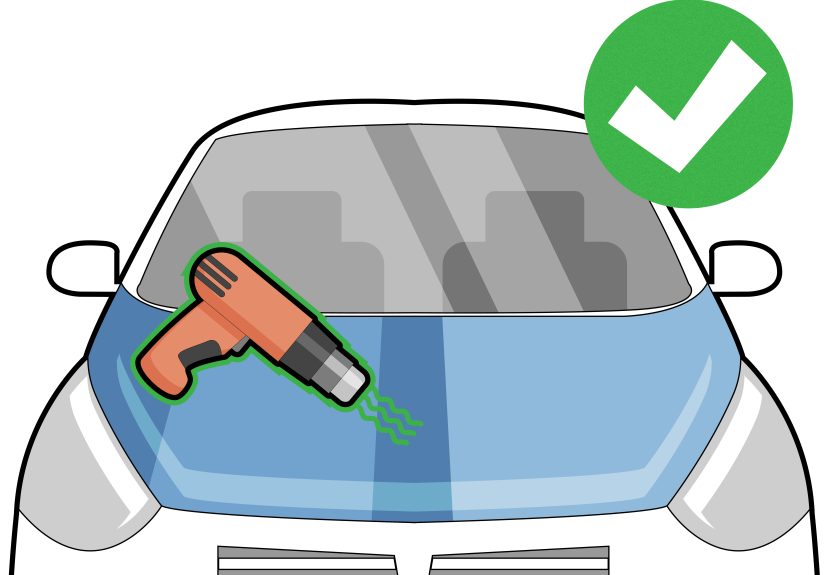
Post-heat stretched areas (this is the secret handshake). After the film is fully applied, post-heating helps “lock in” the
new shapeespecially on convex/concave curves and compound areas. Many professional wrap instructions call for post-heating in the
neighborhood of 175–194°F (80–90°C) on stretched zones, using an IR thermometer to verify temperature.
Dry application example: wrapping a car roof
A roof is a classic “dry method” panel: large, mostly flat, with edges that can tuck under trim. You’d typically position the sheet,
hinge it, work from the center outward, then warm and wrap the edges. The final steppost-heating the perimeter and any stretched
zonesoften makes the difference between “still perfect in a year” and “mysteriously lifting after two rainstorms.”
Pros and cons of dry application
- Pros: fast, clean, ideal for wrap films, less curing time than wet installs.
- Cons: requires good technique; less forgiveness for alignment if you rush placement.
Method 2: Wet Application (Best for Decals, Lettering, and Some Large Graphics)
Wet application uses a light mist of fluid to temporarily reduce initial tack so you can slide and reposition vinyl before it bonds.
It’s common for window decals, large flat graphics, and some tape-and-decal workflows. It can also appear in certain protection-film
installs where “slip” is needed.
Important reality check: many wrap films are designed for dry installation. Wet methods can interfere with adhesion if the
adhesive isn’t meant for it. Always match the method to the film’s guidance.
When to use wet application
- Large decals on glass or smooth painted surfaces
- Vinyl lettering and graphics using transfer tape (when the job is big enough to need repositioning)
- Select films that explicitly allow wet or “hybrid” installation on large areas
Step-by-step: a wet install that doesn’t trap a swimming pool underneath
-
Mix a simple application fluid. A common DIY mix is water with a tiny amount of dish soap (think 1–2 drops in a spray
bottle). The goal is “light slip,” not “bubble bath.” -
Clean, mark, and stage your placement. Use small pieces of tape as guides so you can land the decal where you want it
without guessing. - Mist the surface lightly. Emphasis on lightly. Too much fluid increases setup time and can make transfer tape behave badly.
- Apply the vinyl and slide into position. Once it’s lined up, hold it steady and start the next step right away.
- Squeegee from the center outward to push fluid out. Work toward the edges until the graphic looks uniformly bonded.
-
Let the adhesive set before removing transfer tape. Peel tape back on itself (not straight up) to reduce lift risk. If the
vinyl tries to come with the tape, give it more time. - Dry and re-squeegee edges. Especially outdoors, edges are the first place water can linger and the first place lifting starts.
A note on “hybrid” wet installs for large sections
Some films allow optional wet installation to help with static or to provide more “slide” on large areas. When permitted, guidance
may specify using deionized water or a controlled tack solutionand to squeegee thoroughly so no water remains under the film, then
dry edges before using heat on wraps and corners.
Pros and cons of wet application
- Pros: excellent repositioning; great for big flat decals and glass installs.
- Cons: longer setup/curing time; can cause adhesion issues if used on the wrong vinyl.
Method 3: The Knifeless Tape + Panel/Seam Method (Clean Cuts Without Blade Drama)
If dry application is the “how,” and wet application is the “when,” knifeless tape is the “how to cut without sweating.”
This method is perfect when you want precise seams, stripes, inlays, or two-tone designswithout running a knife on paint.
When to use the knifeless tape method
- Two-tone wraps and color break lines (roof-to-pillar transitions, beltline accents)
- Racing stripes and long straight cuts
- Tricky edges where a blade could gouge paint or trim
Step-by-step: the clean-cut workflow
-
Apply knifeless tape on a clean, dry surface along your intended cut line. Leave accessible ends so you can grab and pull the
filament. Press it down firmly so it stays put under the vinyl. - Lay your vinyl over the tape and apply with firm pressure. You want solid contact over the tape so the cut is crisp.
-
Pull the filament correctly. For many knifeless systems, best practice is to pull the line back and not upward, staying in
the direction of the cut line to slice cleanly through the film. -
Remove excess vinyl and the carrier. Take your timerushing here is how you create a jagged edge that will haunt you in
direct sunlight. - Heat and reapply the cut edges. After trimming, heat the edges and re-squeegee with firm pressure to seal them down.
Knifeless tape example: a two-tone hood accent
Want a matte-black center stripe on a glossy hood? You can lay knifeless tape lines for both stripe edges, apply the stripe vinyl,
pull the filament for razor-clean cuts, then post-heat and re-squeegee the edges. The result looks “painted,” minus the permanent
commitment.
Pros and cons of the knifeless tape method
- Pros: extremely clean cuts; safer on paint; great for design work and seams.
- Cons: requires planning; adds steps and materials.
Which Method Should You Use? A Quick Decision Guide
- Wrapping a car panel (hood/roof/door)? Start with dry application, finish with post-heat.
- Installing a big window decal or flat graphic? Consider wet application for repositioning.
- Doing stripes, two-tone, or complex seams? Combine dry application with the knifeless tape method.
If you’re ever unsure, treat “wet vs. dry” like “shampoo vs. dish soap.” Both are liquids, but only one belongs on your hair.
Match the method to the film’s intended use.
Troubleshooting: Common Problems (and Fixes That Work)
Bubbles
Small bubbles sometimes settle as the adhesive bonds, especially with air-release channels. If a bubble persists, pros often use an
air-release tool to pierce and push air outthen re-squeegee. The key is not to “chase” bubbles aggressively and create stretch
marks.
Wrinkles or “fingers” in recesses
Lift the vinyl back up to a stable position, warm it gently, and reapply with less tension. Recesses punish impatience. If you force
it, the vinyl remembersand later it tries to return to its old shape (usually by lifting).
Edges lifting a day later
Edge lifting is almost always one of three things: contamination, insufficient pressure, or skipped post-heat. Clean edges thoroughly,
re-squeegee with firm pressure, and post-heat stretched zones to the specified temperature range using an IR thermometer. Many wrap
instructions also emphasize re-squeegeeing edges, overlaps, and seams as a “must,” not a “nice to have.”
Aftercare: Let the Adhesive “Set” Before You Stress It
A wrap that looks perfect at hour one can still fail if you immediately pressure-wash seams, soak it, or expose it to wild temperature
swings. Many installers recommend giving the film time to build adhesion before heavy useespecially around edges and recesses.
For protective films and similar products, it’s common guidance to avoid washing for at least 48 hours after installation to allow
proper adherence and curing. For wrap film, a cautious approach is still smart: avoid aggressive washing immediately, and treat edges
gently for the first couple days.
Real-World Wrap Experiences: 10 Lessons People Learn the Fun Way (About )
If vinyl wrap tutorials were entirely honest, they’d include a “blooper reel” section. Not because wrapping is impossible, but because
it’s the kind of skill that rewards calm hands and punishes chaos energy. Here are common, real-life experiences installers talk about
the ones that don’t show up in the glamorous before-and-after photos.
1) The “One Speck of Dust” phenomenon
You can clean a panel, blink once, and suddenly a dust speck appears under the vinyl like it teleported from another dimension. The
lesson: do a final wipe right before you lay the film, and keep linty towels far away from edges.
2) Overconfidence is a leading cause of wrinkles
People often start a panel gently, see how smooth it looks, then speed up. That’s when the vinyl grabs, stretches, and forms a wrinkle
that refuses to disappear. The fix: slow down, lift back to a safe point, and re-lay the film with controlled tension.
3) The “I thought I post-heated” regret
Many first-timers warm the vinyl and assume that counts as post-heating. Then a recessed edge lifts a week later. The experienced
takeaway is simple: post-heating isn’t “it felt warm.” It’s hitting the target temperature on the stretched zoneverifiedthen letting it
cool and re-squeegeeing if needed.
4) Wet installs feel magical… until they feel slow
Wet application is awesome for alignment. But beginners sometimes use too much fluid, turning a quick decal into a long waiting game
where the transfer tape won’t release and the vinyl keeps shifting. “Light mist” is the grown-up setting.
5) Seams are emotional support for beginners
There’s no shame in using seams strategically. Trying to wrap one giant piece around a complex surface is like trying to wrap a fitted
sheet around a mattress while riding a bicycle. Breaking the job into clean, intentional sections often produces a better-looking result.
6) Knifeless tape saves relationships
Nothing spikes stress like cutting vinyl on paint with a bladeespecially when someone says, “Are you sure that won’t scratch?”
Knifeless tape is the quiet hero: you plan your line, apply the film, pull the filament properly, and the cut looks professional without
the blade drama.
7) Your hands learn “pressure feel” over time
People often start with either feather-light squeegee passes (leaving unbonded zones) or Hulk-smash pressure (creating stretch marks).
The sweet spot is firm, consistent pressure with overlapping strokesenough to bond the adhesive without distorting the film.
8) Curves teach humility
Flat panels make you feel like a pro. Curves remind you you’re a beginner. Most wrap success stories include the moment someone learned
to warm the film gradually, keep tension controlled, and never “force” a recess.
9) Edges are where shortcuts come back to collect
You can get away with a slightly imperfect middle area. Edges, seams, and overlaps? They report every shortcut directly to the laws of
physics. Cleaning and re-squeegeeing edges feels boringuntil it saves the wrap.
10) The best wraps come from a calm pace
The most consistent “pro difference” is not a magic tool. It’s tempo. Experienced installers pause, check alignment, re-squeegee, verify
heat, and finish intentionally. Vinyl wrap rewards the energy of “I have time,” even when you don’t.