Table of Contents >> Show >> Hide
- Quick Oak-Leaf Cheat Sheet (Pin This to Your Brain)
- Way 1: Read the “Edge Story” Lobes, Sinuses, and Bristle Tips
- Way 2: Zoom In on Texture, Undersides, and “Weird Oak” Shapes
- Way 3: Pair the Leaf With the Rest of the Oak Evidence (Acorns, Buds, Bark)
- Common Mix-Ups (and How to Stop Them)
- A Simple Step-by-Step Workflow (So You Don’t Spiral)
- of Real-World “Oak Leaf Detective” Experiences
- Conclusion
Oak leaves are the choose-your-own-adventure book of the tree world. Some are deeply lobed like a leafy hand, some are narrow like a willow’s, and a few look like they couldn’t commit to a shape and just… improvised. But you don’t need a botany PhD (or a dramatic montage with a magnifying glass) to identify oak leaves confidently.
The trick is to stop asking, “What exact oak is this?” and start with, “What kind of oak leaf is this?” Once you can place a leaf into the right group and spot a few key features, your accuracy jumps fastwithout you having to whisper scientific names at random park visitors.
Quick Oak-Leaf Cheat Sheet (Pin This to Your Brain)
- Most oaks have simple, alternate leaves (one blade per leaf; leaves stagger along the twig).
- White oak group: lobes are usually rounded and don’t end in bristles.
- Red oak group: lobes/teeth usually have tiny bristle tips (pointy ends that can feel slightly spiky).
- Not all oaks have classic “lobes”some have smooth-edged or lightly lobed leaves (hello, willow oak and water oak).
- One leaf is a clue, not a verdict: collect a few mature leaves from the same tree for a fair test.
Way 1: Read the “Edge Story” Lobes, Sinuses, and Bristle Tips
If oak leaves had business cards, the margin (the outer edge) would be printed in bold. The fastest way to narrow oak leaves is to read what the edge is “saying”rounded vs. bristly, deep vs. shallow lobes, and how the cutouts between lobes behave.
Step 1: Confirm the basics (so you don’t accidentally interview a maple)
Many oaks have simple leaves (a single blade, not multiple leaflets). They’re usually alternate on the twigmeaning leaves don’t sit directly opposite each other like a neat pair of socks. If you’ve got an opposite-leaved, sharply pointed, star-shaped situation, you might be holding maple or sweetgum instead of oak.
Step 2: Sort it into the big two: white oak group vs. red oak group
This is the classic “rounded vs. bristled” split:
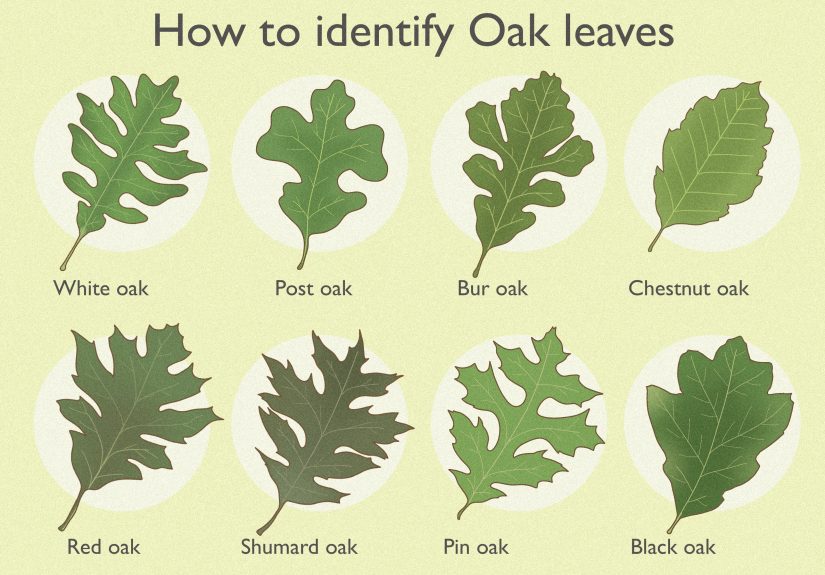
- White oak group leaves usually have rounded lobes and no bristle tips. Even if a lobe looks slightly pointy, it typically won’t have a tiny spine at the very end.
- Red oak group leaves usually have lobes or teeth that end in bristle tipssmall, hair-like points that give the leaf a sharper, more “spiky” look.
A quick field trick: run your finger (gently) along a lobe tip. If it feels like a polite leaf, it’s likely white-oak-group. If it feels like it’s trying to file your fingerprint off, it’s likely red-oak-group. (Use this method responsibly. Oaks do not pay your medical copay.)
Step 3: Use lobe count and sinus depth as extra “fingerprints”
Now zoom in on the leaf’s architecture:
- Lobes are the outward bumps (like leafy hills).
- Sinuses are the inward valleys between lobes.
- Midrib is the main vein running up the center.
Example patterns you’ll see often:
- White oak (Quercus alba) style: typically 7–10 rounded lobes and a pale/whitish underside. Lobes can look “finger-like,” and sinus depth can vary from shallow to deep on different leaveseven on the same tree.
- Northern red oak (Quercus rubra) style: commonly 7–11 lobes with bristle tips. In many leaves, the sinuses cut inward about around halfway toward the midrib (not all the way in).
Don’t get hung up on exact lobe numbers like it’s a leaf-counting contest at the state fair. Focus on the combination: lobe shape + bristle presence + how deep the sinuses go.
Way 2: Zoom In on Texture, Undersides, and “Weird Oak” Shapes
Once you’ve used the margin to place the leaf in a broad group, the next step is to look for smaller, quieter cluestexture, underside color, hairs, and overall silhouette. These details help when the leaf refuses to look like the “classic oak leaf” you expected.
Flip it over: the underside is where the secrets live
Many oaks show meaningful differences between the top and underside of the leaf:
- Color contrast: some have a darker green top and a noticeably paler underside.
- Hairiness (pubescence/tomentum): a fuzzy underside, or tiny hair tufts where veins meet, can be a helpful clue.
- Texture: leathery vs. thin; glossy vs. dull.
Practical tip: look at a mature leaf (fully expanded, not the flimsy baby leaf). Young leaves can be extra hairy or oddly shaped and will absolutely lie to you.
Meet the “not-so-lobed” oaks (yes, they’re still oaks)
Some oak leaves are only lightly lobedor not lobed at all. That can throw beginners because the mental image of an oak leaf is basically “cartoon lobes with confidence.”
- Willow oak type: long, narrow, and smooth-edgedmore like a willow leaf, just attached to an oak tree that enjoys confusion.
- Water oak type: often spatula- or spoon-shaped, sometimes with shallow lobes; leaf shape can vary a lot on the same tree.
- Post oak type: often shows a distinctive “cross-like” look, with broad, squarish middle lobesan oak leaf silhouette you can recognize from across a picnic table.
If your leaf doesn’t look lobed enough to be “oak,” don’t panic. Use the bristle test (if present), check leaf arrangement on the twig, and then move to Way 3 for confirmation.
Measure like a calm person with a ruler (not like a frantic scientist)
A few basic measurements can turn “maybe oak?” into “pretty sure oak”:
- Leaf length and width: some common species have typical ranges (for example, several well-known oaks often fall in the 4–8 inch zone).
- Petiole (leaf stem) length: short vs. longer stems can help in certain IDs.
- Base shape: wedge-shaped, rounded, or uneven bases can be clues in field guides and keys.
Bonus: if you’re using a dichotomous key, measurements are not “extra credit.” They’re the main plot.
Way 3: Pair the Leaf With the Rest of the Oak Evidence (Acorns, Buds, Bark)
Leaves are powerful, but oaks are famous for varietyand sometimes for hybrids. When the leaf alone feels ambiguous, use the rest of the tree like a detective who enjoys closure.
Acorns: the oak’s ID badge (and also squirrel currency)
Acorns vary by species in size, shape, and cap style. But even at the group level, they’re helpful:
- White oak group acorns typically mature in one season and often germinate in the fall.
- Red oak group acorns typically take two growing seasons to mature and often germinate in the spring after they’re mature.
If you can find acorns under the tree, compare a few: look at cap coverage (does it cover a little or a lot?), cap texture (warty? scaly?), and nut shape. Even if you can’t name the exact species, you can often confirm the oak groupand avoid mislabeling a tree because one leaf was having a weird day.
Buds and twigs: your backup plan for winter (or for trees that ate their own leaves)
When leaves are gone, buds and twigs step in. Some oaks have distinctive buds (size, shape, hairiness), and many field guides describe these traits clearly. If you’re serious about oak identification, learning a few bud and twig cues is like adding GPS to a paper map.
Bark and habitat: confirmation, not the starting line
Bark can help, but it’s not always beginner-friendly. Still, general patterns can support your leaf ID:
- Some red oak group members often show darker, more ridged bark.
- Some white oak group members often show lighter, scaly or flaky bark.
Habitat can also helpsome oaks favor wetter areas, others prefer dry uplands. Use site clues as supporting evidence, not as your only proof (because trees love breaking “rules” when no one is watching).
Common Mix-Ups (and How to Stop Them)
Oak vs. maple
Maples usually have opposite leaf arrangement and their lobes often look more symmetrical, like a carefully cut paper snowflake. Oaks are more “organic,” with alternate leaves and lobes that can vary in depth and spacing.
Oak vs. sweetgum
Sweetgum leaves look like sharp, starry hands and usually have a more uniform, pointed geometry. Oak lobes tend to be less star-shaped, and many oaks have rounded lobes or bristle tips rather than a whole star situation.
“But this oak has different leaves on the same tree!”
Totally possible. Sun leaves (outer canopy) can look smaller, thicker, and sometimes more deeply cut than shade leaves (inner canopy). Some species also vary naturally. That’s why you collect multiple mature leavesoak ID is a team sport.
A Simple Step-by-Step Workflow (So You Don’t Spiral)
- Collect 3–5 mature leaves from the same tree (not the baby leaves).
- Check arrangement: alternate is a strong oak signal.
- Look for bristles: bristle tips suggest red oak group; rounded tips suggest white oak group.
- Scan overall shape: classic lobes vs. narrow/smooth “weird oak” shapes.
- Confirm with acorns or buds if the leaf is ambiguous.
- Use a reputable key or field guide if you want species-level certainty.
of Real-World “Oak Leaf Detective” Experiences
If you’ve ever tried to identify oak leaves in the wild, you already know the first emotional stage: confidence. You spot a leaf with lobes and think, “Oak! Nailed it!” Then you find another leaf under the same tree that looks completely different and suddenly you’re negotiating with reality. This is normal. Oaks are not here to support your personal brand of certainty.
One common experience: you pick up a leaf that looks “round-lobed,” you declare it a white oak, and then you notice tiny points on the lobes. Panic ensues. Here’s the calming truth: the important detail isn’t “pointy-ish” vs. “not pointy-ish.” It’s whether those tips end in true bristlesthe little hair-like spines that make red oak group leaves look sharper. The first time you use the bristle test correctly, it feels like unlocking a cheat code. The second time, you realize you need your reading glasses. The third time, you start carrying a small hand lens like a botanical wizard.
Another real-life moment happens in autumn when the ground is basically a leaf buffet. You’ll grab the prettiest, reddest leaf and try to ID itonly to discover that fall color is a terrible witness. Some oaks turn rusty brown, some go red, and some cling to dry, papery leaves into winter (a behavior called marcescence). The lesson most people learn quickly: choose leaves that are intact, mature, and ideally still attached to a twigor at least gathered directly under a single tree you can point to without hesitation.
Then there’s the “weird oak” encounter. You expect cartoon lobes, but you find long, narrow leaves that look like they belong on a willow. Or you find spoon-shaped leaves that can’t decide whether they want lobes at all. This is where you feel betrayed by every elementary school drawing of an oak leaf. The fix is simple: stop relying on the stereotype and start relying on the system. Check alternate leaf arrangement. Look for any bristle tip at the apex. Pair the leaf with acorns if they’re available. In many cases, the acorns settle the argument fastespecially if you can tell whether they’re the kind that mature in one season (white oak group) or take two seasons (red oak group).
Finally, there’s the satisfying “confirmation moment”: you think you’ve got a red oak group leaf (bristles present), and you spot the classic bark pattern some red oaks showlong, flatter ridges that can look lightly striped. Or you think white oak group, and the bark looks lighter and scaly. It’s not foolproof, but it feels like the tree is finally cooperating. The best part? After a handful of these real-world checks, you stop guessing and start recognizing. Oak leaves go from “mystery salad greens” to “oh, I know your type.”
Conclusion
Oak leaf identification gets easier when you approach it like a process, not a trivia question. Start with the edge (lobes, sinuses, bristles), refine with texture and underside clues, and confirm with acorns, buds, and bark when the leaf is being dramatic. Do that consistently, and you’ll be identifying oak leaves with the calm confidence of someone who definitely doesn’t argue with trees anymore. (You’ll still argue with squirrels, though. That’s unavoidable.)