Table of Contents >> Show >> Hide
- Why Measuring Angles Without a Protractor Actually Works
- Method 1: Use Paper, a Square Corner, and Benchmark Angles
- Method 2: Construct Exact Angles with a Ruler, Compass, or Folding
- Method 3: Measure the Sides and Calculate the Angle
- Which Method Should You Use?
- Common Mistakes to Avoid
- Specific Examples of Measuring Angles Without a Protractor
- Hands-On Experiences: What It’s Like to Use These Methods in Real Life
- Final Thoughts
Let’s be honest: the protractor is one of those school tools that disappears the moment you actually need it. It lives in the same mysterious universe as missing socks, spare batteries, and that one screwdriver that was definitely on the table five minutes ago. The good news is that you can still measure an angle without a protractor, and in some cases, you can do it surprisingly well.
Whether you’re working on homework, building something in the garage, sketching a layout, checking a roof pitch, or just trying to settle a dramatic family argument about whether a corner is “basically 45 degrees,” there are practical ways to get the job done. Some methods are quick and approximate. Others are exact. A few make you feel like an old-school geometer with excellent posture.
In this guide, you’ll learn three reliable ways to measure an angle without a protractor: using paper and benchmark angles, constructing exact angles with simple geometry tools, and calculating the angle with side measurements and a calculator. Along the way, we’ll cover when each method works best, how accurate it is, and how to avoid the little mistakes that turn a clean angle into a mathematical plot twist.
Why Measuring Angles Without a Protractor Actually Works
An angle is simply the amount of turn between two rays or lines. Once you understand a few benchmark angles and angle relationships, you do not always need a protractor’s printed degree marks. A right angle is 90 degrees. A straight line is 180 degrees. A full turn is 360 degrees. Triangles add up to 180 degrees. And in right triangles, the side lengths can tell you the angle through trigonometry.
That means measuring an angle without a protractor is less about owning a particular plastic tool and more about using geometry intelligently. In other words, math is not trying to ruin your afternoon. It is trying to save it.
Method 1: Use Paper, a Square Corner, and Benchmark Angles
This is the fastest method when you need a solid estimate or a simple reference. A standard sheet of paper, index card, book corner, sticky note, or any object with a true square corner gives you a built-in 90-degree angle. From there, you can create other common angles by folding or comparing shapes.
Start with the Angles You Already Know
The corner of a sheet of paper is a right angle, which means it measures 90 degrees. If the angle you are checking matches that corner exactly, congratulations: you have found a right angle without a protractor and without breaking a sweat.
Now fold that square corner diagonally so one edge lines up with the other. The fold splits the 90-degree angle into two equal parts, giving you a 45-degree angle. Fold it again, and you get 22.5 degrees. Suddenly, your humble sheet of paper is doing geometry like it has something to prove.
How to Use the Paper Method
Place the paper corner at the angle’s vertex. Line one edge of the paper up with one side of the angle. Then compare the other side of the angle to the paper’s reference edge or fold line. If it lands close to the corner’s edge, the angle is close to 90 degrees. If it lines up with a diagonal fold, it is close to 45 degrees. If it sits somewhere between 45 and 90, you can estimate from there.
For example, suppose you are checking a picture frame brace and the angle seems steeper than 45 degrees but clearly smaller than 90 degrees. You can fold a sheet to make a 45-degree line, compare it, and judge whether the actual angle is closer to 50, 55, or 60 degrees. That will not give you lab-grade precision, but it is often accurate enough for crafts, layout work, or sanity checks.
What This Method Is Best For
This is the best method for quick comparisons and rough measurements. It works especially well when you only need to know whether an angle is close to 90 degrees, about halfway to 90, or obviously larger or smaller. It is also great when you have no math tools handy and need an answer right now.
The tradeoff is precision. This method is excellent for estimating, but not ideal when you need an exact value like 37 degrees or 68 degrees. If accuracy matters more than speed, move to Method 2 or Method 3.
Method 2: Construct Exact Angles with a Ruler, Compass, or Folding
If you need exact angles without a protractor, classical geometry is your friend. With a straightedge and compass, or in some cases careful folding, you can construct angles like 60 degrees, 90 degrees, and 45 degrees with impressive accuracy. Then you can combine or bisect them to make more angles.
Construct a 60-Degree Angle
One of the cleanest constructions comes from an equilateral triangle. Draw a ray from a point. Set your compass to any convenient width and draw an arc centered at the angle’s vertex so it crosses the ray. Without changing the compass width, place the compass point where the arc crossed the ray and draw a second arc that intersects the first arc. Connect the vertex to that new intersection point. The angle formed is 60 degrees.
This works because all sides of an equilateral triangle are equal, and each interior angle is 60 degrees. Geometry can be delightfully efficient when it is in the mood.
Construct a 90-Degree Angle
You can create a right angle by constructing a perpendicular line. There are several ways to do it, but the general idea is to use equal arcs from points on a line so that the intersection above or below the line determines a perpendicular direction. Once you have that perpendicular ray, the angle is exactly 90 degrees.
Paper folding can do something similar. If you fold a line onto itself so the crease is perfectly perpendicular, the fold creates a right angle. That is one reason paper folding shows up so often in geometry teaching: it turns abstract ideas into something your hands can verify.
Construct a 45-Degree Angle
Once you have a 90-degree angle, bisect it. Use your compass to mark equal arcs on both rays, then draw arcs from those points so they intersect. Connect the vertex to that intersection, and you divide the 90-degree angle into two equal 45-degree angles.
Build More Angles from These
This is where the method gets especially useful. Once you can make 45, 60, and 90 degrees, you can combine or split them to create many other common angles. A 30-degree angle is half of 60. A 15-degree angle is half of 30. A 75-degree angle is 45 plus 30. A 135-degree angle is 90 plus 45. A 120-degree angle is 60 plus 60 or 180 minus 60.
If your angle matches one of these constructed references, you have an exact measurement. If it falls between them, you at least have a much better estimate than a random guess and a hopeful expression.
What This Method Is Best For
This is the best method for geometry problems, drafting, classroom work, and situations where you want exact benchmark angles without relying on a protractor. It is slower than the paper-corner method, but much more precise. It also teaches you something important: angles are relationships, not just numbers printed on a tool.
Method 3: Measure the Sides and Calculate the Angle
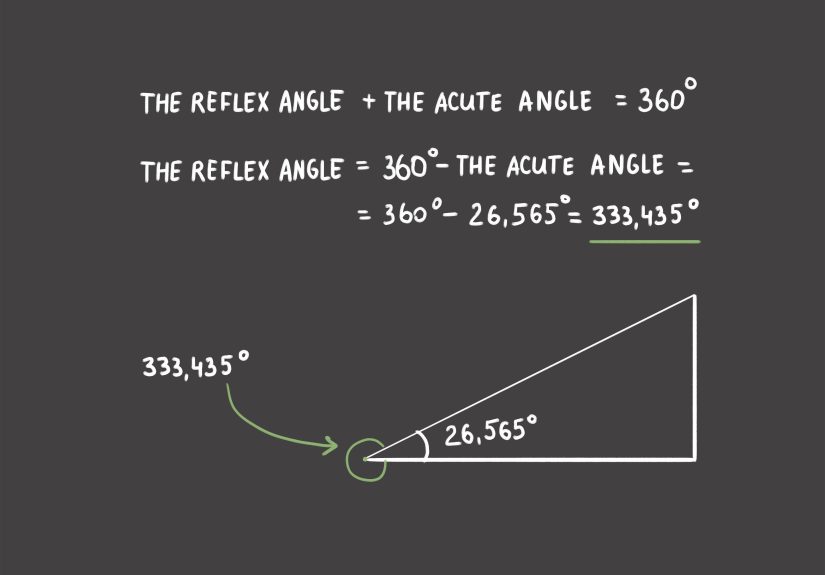
When the angle is part of a right triangle, or can be turned into one, you can measure two side lengths and calculate the angle using trigonometry. This is the most powerful method for odd angles like 27 degrees, 38 degrees, or 63 degrees. It is also extremely practical in real life.
The Basic Idea
If you know the vertical rise and horizontal run of a slope, ramp, brace, or line segment, you can use tangent:
tan(angle) = opposite / adjacent
Then solve for the angle using inverse tangent, often written as arctan or tan-1:
angle = arctan(opposite / adjacent)
A Simple Example
Imagine a board rises 4 inches over a horizontal distance of 7 inches. The angle it makes with the ground is:
angle = arctan(4 / 7)
Using a calculator, that comes out to about 29.7 degrees. In practical terms, you would call that roughly 30 degrees.
This method is excellent for stairs, roof lines, ramps, saw cuts, furniture braces, camera setups, and DIY projects where measuring side lengths is easier than measuring the angle directly.
How to Use This in Real Life
Measure the vertical distance and horizontal distance as accurately as you can. Make sure you are measuring a right triangle, not just two random lengths that looked convincing in the moment. Then plug the numbers into a calculator with inverse tangent.
If your calculator is in degree mode, you will get the answer in degrees. If it is in radian mode, it will give you a result that makes sense to your calculator but not to your shelf bracket. Check the mode first unless you enjoy avoidable confusion.
What This Method Is Best For
This is the best method when you need a nonstandard angle and can measure side lengths accurately. It is often more useful than a protractor in construction, engineering, design, and real-world problem solving because it works even when the angle is too big, too awkward, or too inaccessible to place a tool directly on it.
Which Method Should You Use?
If you need a fast estimate, use paper and benchmark angles. If you need an exact classic angle like 45, 60, or 90 degrees, construct it with a compass, straightedge, or folding. If you need a strange angle that doesn’t fit a clean construction, measure the sides and calculate it.
In short, the best method depends on your goal. Speed, precision, and convenience do not always ride in the same car.
Common Mistakes to Avoid
The biggest mistake is confusing an estimate with an exact measurement. A folded sheet of paper can get you close, but it is not a magic degree machine. Another common issue is poor alignment. If the edge of your paper or ruler does not line up exactly with the angle’s side, your result drifts fast.
With constructions, the main problem is changing the compass width by accident. With trigonometry, the classic disaster is using the wrong ratio or leaving the calculator in radian mode. There is also the old favorite of measuring the rise and run from slightly crooked reference points, which turns a reasonable answer into a creative writing exercise.
Specific Examples of Measuring Angles Without a Protractor
Example 1: Checking a Right Corner in a Room
Use a sheet of paper or a framing square. If the corner matches perfectly, it is 90 degrees. If the wall drifts away from the reference edge, the corner is not square.
Example 2: Making a 45-Degree Craft Cut
Fold a square corner diagonally and use that fold as your guide. This works well for paper crafts, cardboard mockups, and simple trim planning.
Example 3: Finding the Angle of a Ramp
Measure the rise and run, then calculate the angle with inverse tangent. This gives you a practical result even when the ramp is too large or awkward to check directly.
Example 4: Solving a Triangle Problem
If two angles in a triangle are 35 degrees and 65 degrees, the third angle must be 80 degrees because triangle angles add to 180 degrees. No protractor required, just a working relationship with arithmetic.
Hands-On Experiences: What It’s Like to Use These Methods in Real Life
In practice, measuring an angle without a protractor feels a lot less dramatic than it sounds. Most people imagine some heroic geometry performance involving candlelight, ancient symbols, and a compass made of brass. The reality is usually much simpler. You grab paper, a ruler, maybe a calculator, and start comparing, folding, or measuring.
The paper method is usually the first one people trust because it feels immediate. When you place a square corner against a wall edge, tabletop joint, or notebook sketch, the result is visual and satisfying. You can see right away whether the angle is square, too open, or too tight. It is especially useful for home tasks, such as checking whether a shelf bracket looks level enough, whether a picture frame corner is actually 90 degrees, or whether a folded craft template is close to 45 degrees. The experience is intuitive, fast, and pleasantly low-tech.
The construction method feels different. It is slower, more deliberate, and oddly calming. Drawing arcs with a compass and watching them intersect gives you the sense that geometry has been quietly waiting for you to notice how elegant it is. This method tends to shine in schoolwork, technical drawing, quilting, layout planning, and any project where exact angles matter more than speed. It also teaches patience. If your arcs miss because your compass slipped, the math did not betray you. Your hand just got a little ambitious.
The trigonometry method is often the one people end up using most in real-world problem solving, even if they do not call it trigonometry at first. A person building a ramp measures rise and run. A photographer checks the tilt of a support arm. A woodworker measures the slope of a brace. A homeowner estimates the angle of a ladder or roof edge. In all of these situations, it is often easier to measure distances than to reach the angle itself. Once you understand that the angle can be calculated from side lengths, the process becomes practical instead of intimidating.
There is also a confidence boost that comes with these methods. You stop thinking, “I can’t do this because I don’t have a protractor,” and start thinking, “I have three backup plans and at least one sheet of paper.” That shift matters. It turns geometry from a school memory into a usable tool.
Another real-life lesson is that accuracy depends less on fancy equipment and more on careful setup. A folded paper guide can outperform a cheap plastic protractor if it is aligned well. A ruler-and-calculator method can beat a visual estimate by a mile if the measurements are clean. Even exact constructions, which are beautifully reliable in theory, only work well when you keep the compass width steady and mark intersections carefully.
So the real experience of measuring an angle without a protractor is not one of limitation. It is one of flexibility. You learn that geometry is built on relationships, not gadgets. And once that clicks, a missing protractor stops feeling like a problem and starts feeling like a mildly inconvenient plot device.
Final Thoughts
You do not need a protractor to measure an angle well. You need the right strategy. A paper corner and folds can give you quick benchmark angles. Classical constructions let you build exact angles like 45, 60, and 90 degrees. Trigonometry lets you calculate almost any angle when you can measure side lengths.
That means the next time a protractor is nowhere to be found, you can keep moving instead of pausing the project. Geometry is still on your side, even when your school supplies are not.