Table of Contents >> Show >> Hide
- What you’ll need (nothing fancy, promise)
- Step 1: Pick a “vibe” before you pick a stem
- Step 2: Choose the right vase (your flowers are not psychic)
- Step 3: Clean everything like you’re cooking for your in-laws
- Step 4: Condition your flowers (aka: give them a fighting chance)
- Step 5: Add simple mechanics for instant “florist energy”
- Step 6: Build the base with greenery (your arrangement’s “skeleton”)
- Step 7: Add focal flowers first, then secondary flowers (layer like a pro)
- Step 8: Finish with filler, refine the shape, and “walk away then return”
- Pro tips to keep your arrangement fresh longer
- of real-life experience: what actually made me better at arranging
- Conclusion
Flower arranging looks like magic when a florist does it: a quick snip, a casual twist of the wrist, and suddenly your grocery-store bouquet
looks like it has a publicist. The good news? Professional-looking flower arrangements aren’t reserved for people who own twelve pairs of
“shears” and say things like “negative space” without blinking.
With a few simple mechanics (translation: tiny tricks that keep stems from flopping like tired noodles), you can learn how to arrange flowers
like a proright on your kitchen counterusing the same principles florists rely on every day: clean tools, properly conditioned stems,
smart structure, and intentional layering.
Below are eight simple steps to arrange flowers like a pro, plus specific examples, troubleshooting tips, and a real-world “what I learned
the hard way” section at the end. Consider this your friendly guide to making a DIY flower arrangement that looks expensivewithout actually
being expensive.
What you’ll need (nothing fancy, promise)
- Fresh flowers (a mixed bouquet or your own picks)
- Greenery (eucalyptus, ruscus, ferns, or whatever came in the bunch)
- A vase or vessel (glass, ceramic, pitcher, jarno judgment)
- Sharp scissors or floral shears (sharp matters more than “floral”)
- Clean water + flower food (or a DIY preservative if needed)
- Optional mechanics: clear floral tape (or any clear tape), chicken wire, or a flower frog
Step 1: Pick a “vibe” before you pick a stem
Pros don’t start by jamming flowers into a vase and hoping for the best (that’s a hobby; it’s also how you end up with a bouquet that looks
like it lost a fight). They start with a plan: a shape, a color direction, and a mood.
Choose one of these simple shapes
- Rounded dome: classic centerpiece, neat and balanced
- Airy garden style: loose, slightly wild, lots of movement
- Modern minimal: fewer stems, strong silhouette, intentional spacing
Then choose a color approach: monochrome (all one color family), complementary (colors across the wheel), or “market bouquet” (a little
everything, but unified by greenery and repetition).
Quick example: Want “cozy winter”? Do white + green with a pop of berry. Want “Sunday brunch”? Do yellow + white with lots of soft greens.
Step 2: Choose the right vase (your flowers are not psychic)
A pro-looking arrangement starts with the right vessel. The vase should support the stems and match the style you want:
- Tall, straight vase: great for tulips, long stems, and modern looks
- Wide mouth vase: good for lush, full arrangements (but needs mechanics to prevent flopping)
- Low bowl: perfect for centerpieces (often needs a frog, chicken wire, or a foam alternative)
- Pitcher or ceramic crock: farmhouse charm, hides messy stems (a gift to humanity)
Pro tip: If your bouquet is falling apart, the problem is often the vase opening. A too-wide opening makes stems splay; a narrow opening
naturally “gathers” them.
Step 3: Clean everything like you’re cooking for your in-laws
Bacteria is the villain in the cut-flower story. It clouds water, clogs stems, and turns your bouquet into a dramatic “before and after”
in 48 hours.
Do this first
- Wash the vase with hot soapy water (or vinegar + baking soda if it’s funky).
- Rinse wellno soap film.
- Use clean, sharp tools (wipe blades with rubbing alcohol if you want extra credit).
Add fresh water to the vase and mix in flower food (often included with store bouquets). If you don’t have it, a simple DIY preservative can
help, but commercial packets are easy and designed to balance nutrients and water pH.
Step 4: Condition your flowers (aka: give them a fighting chance)
“Conditioning” sounds fancy, but it’s just proper prep so flowers drink water efficiently and last longer.
Conditioning checklist
- Unwrap bouquets so stems aren’t trapped and crushed.
- Strip leaves below the water line so they don’t rot in the vase.
- Re-cut stems 1–2 inches at a 45-degree angle with sharp shears (crushed stems = sad stems).
- Hydrate ASAP: put them in water quickly after cutting.
Optional pro move: If you’re harvesting from your garden, bring a bucket of water with you and place stems in it immediately. Flowers last
longer when they don’t spend time dehydrating in the sun like tourists without sunscreen.
Step 5: Add simple mechanics for instant “florist energy”
Mechanics are the hidden structure that makes an arrangement look intentional and stay put. The easiest home-friendly mechanic is a
tape grid.
How to make a tape grid (in 30 seconds)
- Place parallel strips of clear tape across the vase opening.
- Repeat in the other direction to create a checkerboard grid.
- Each “square” becomes a stem slot, helping spacing and support.
Other options: a flower frog (excellent for low arrangements), or chicken wire gently tucked into a bowl (often secured with tape). Many
florists also prefer foam alternatives for everyday arranging because they’re reusable and less wasteful.
Step 6: Build the base with greenery (your arrangement’s “skeleton”)
Pros often start with greenery because it establishes shape and gives you a framework to build on. Think of it as the bouquet’s posture.
Greenery placement tips
- Start with 3–5 stems to map your outline (round, airy, or modern).
- Angle stems outward slightly to create a pleasing silhouette.
- Keep some airan arrangement that’s too packed can look heavy and flat.
Mini example: For a relaxed “garden” look, place two longer greenery stems in the back, two medium on the sides, and one
shorter in front. You’ve just drawn a shape without drawing anything.
Step 7: Add focal flowers first, then secondary flowers (layer like a pro)
Here’s the florist layering strategy that upgrades everything:
focal flowers → secondary flowers → filler flowers.
Focal flowers
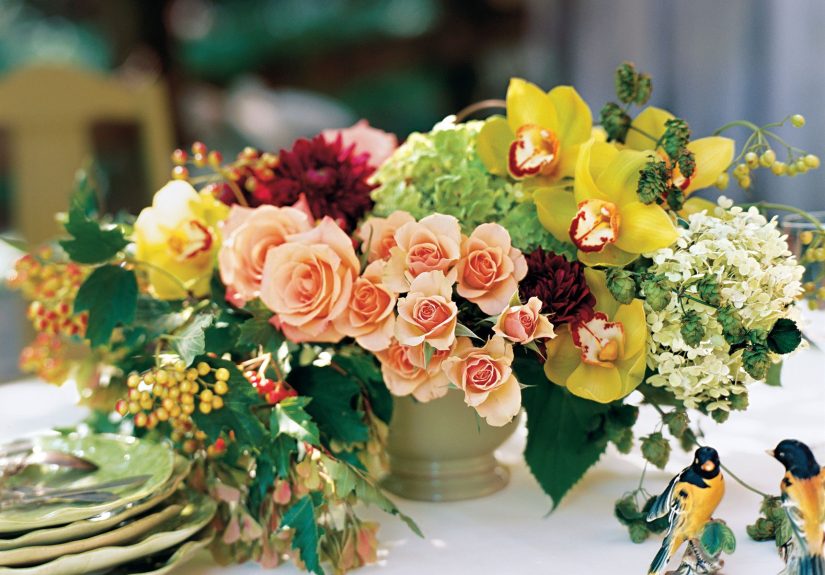
These are your “wow” blooms: roses, peonies, dahlias, hydrangeas, sunflowers, ranunculusbig, showy, or strongly shaped.
Place them deliberately, often in odd numbers (3 or 5) for a natural look.
Secondary flowers
These support the focal blooms and add depth: spray roses, stock, alstroemeria, lisianthus, snapdragons. Put them around and between focal
flowers to create layers and soften transitions.
Height trick that looks expensive
Cut some stems shorter and some longer. A pro arrangement has depthflowers shouldn’t line up like they’re waiting for a group photo.
Quick “recipe” to try:
- Focal: 3 hydrangea heads
- Secondary: 5–7 stems of stock or spray roses
- Filler: 3–5 stems of limonium or baby’s breath
- Greenery: 5 stems eucalyptus + ruscus
Step 8: Finish with filler, refine the shape, and “walk away then return”
Filler flowers do two jobs: they fill gaps and add texture. Use them lightlytoo much filler can turn your bouquet into a fluffy cloud
that ate your focal flowers.
Refinement checklist
- Rotate the vase as you work (arrange in 360°, not “front-facing only”).
- Check negative space: small breathing pockets make flowers look more intentional.
- Adjust the “collar”: greenery or leaves near the rim can create a clean edge.
- Step back: leave the room for 30 seconds, come back, and you’ll instantly see what’s off.
The “walk away then return” trick sounds silly, but it works because your brain stops obsessing over one bloom and starts seeing the whole
composition again. Florists do this constantlyjust with better lighting and fewer distractions from the dishwasher.
Pro tips to keep your arrangement fresh longer
Daily-ish care (low effort, high reward)
- Keep it cool: away from direct sun, heaters, and hot kitchen corners.
- Avoid fruit bowls: ripening fruit releases ethylene gas that can age flowers faster.
- Refresh water every 2–3 days (more often if it gets cloudy).
- Re-cut stems when you change water to improve hydration.
- Remove fading blooms to keep bacteria down and the bouquet looking intentional.
Fast fixes for common problems
- Drooping tulips: use a taller straight vase, rotate daily, and re-cut stems.
- Cloudy water: wash the vase, replace water, and remove any submerged leaves.
- Top-heavy flowers tipping: add a tape grid or switch to a narrower opening.
- “Flat” arrangement: add height variation and a few airy stems (greenery or line flowers).
of real-life experience: what actually made me better at arranging
The first time I tried to “arrange flowers like a pro,” I did what many optimistic humans do: I bought a big, beautiful mixed bouquet,
put it in a vase, and expected applause. What I got was a floral traffic jam. The stems fought for space, the water turned cloudy faster
than my willpower in a bakery, and by day three, the bouquet looked like it had taken up a second job and was exhausted.
The biggest turning point wasn’t learning a fancy spiral technique or memorizing flower namesit was understanding that
structure beats guesswork. The tape grid alone changed everything. The first time I taped a simple checkerboard across the
vase opening, I felt like I’d been given a backstage pass to florist secrets. Suddenly the flowers stayed where I put them. Even more
surprising: I used fewer stems to make the arrangement look full, because the grid helped with spacing and height control.
The second lesson I learned the hard way: cleanliness is not optional. I used to think “fresh water” meant topping off the
vase when it looked low. Nope. It means dumping the old water (and the invisible bacteria party happening in it), rinsing the vase, and
starting again. When I began doing full water changes every couple of days, my arrangements lasted noticeably longerand didn’t develop that
mysterious “pond ambiance” smell.
Another surprising improvement came from treating flower arranging like cooking: you need a plan and you need to taste as you go. With
flowers, “tasting” looks like stepping back, rotating the vase, and adjusting one stem at a time. If I tried to fix everything at once,
I’d overcorrect and end up with a bouquet that looked overly symmetricalpretty, but slightly suspicious, like it was made by a robot who
loves rules. Layering one ingredient at a timegreenery first, then focal flowers, then secondary, then fillerhelped me build a more
natural, dimensional arrangement.
And finally: not every flower wants to be in the same group project. Some blooms drink fast, some are sensitive, and some
(looking at you, tulips) keep growing and leaning like they’re trying to escape the vase. I now pay attention to stem behavior and choose
a vase that matches it. Tall, straight vase for movers and shakers. Narrow opening for floppy stems. A supportive mechanic when the bouquet
is heavy. Once I stopped blaming myself for “doing it wrong” and started adjusting the setup, arranging felt easierand the results looked
more professional.
If you’re new to DIY flower arrangements, here’s the most comforting truth: pros aren’t “magical.” They’re consistent. They clean the vase.
They re-cut stems. They use mechanics. They layer with intention. Do those four things, and you’ll be shocked how quickly your arrangements
start looking like they belong on a coffee table next to a fancy book you pretend you’ve read.
Conclusion
Arranging flowers like a pro is less about talent and more about technique. With a clean vase, properly conditioned stems, a simple mechanic
like a tape grid, and a layered approach (greenery → focal → secondary → filler), you can turn everyday blooms into a centerpiece that looks
deliberate, balanced, and seriously “where did you buy that?”
Start simple. Keep it fresh. And remember: if a stem misbehaves, it’s not a personal attackit’s just a flower having a day.