Table of Contents >> Show >> Hide
- Quick Jump Guide
- Types of Artificial Christmas Trees by Material
- Types of Artificial Christmas Trees by Branch Construction
- Types of Artificial Christmas Trees by Lighting
- Types of Artificial Christmas Trees by Shape & Footprint
- Types of Artificial Christmas Trees by Style & Finish
- How to Choose the Right Artificial Christmas Tree
- 1) Measure like a person who wants a tree topper
- 2) Decide what matters most: realism, fullness, speed, or price
- 3) Tip count is helpfulbut not the whole story
- 4) Pre-lit vs. unlit: choose based on your decorating personality
- 5) Pay attention to the stand and stability
- 6) Storage and care: protect your future self
- 7) Safety checks that aren’t boring (because fire isn’t festive)
- So… What Type of Artificial Christmas Tree Should You Buy?
- Real-World Experiences: What People Learn the Hard Way (and Then Laugh About Later)
- Conclusion
Artificial Christmas trees used to be the holiday equivalent of a green bottle brush: functional, a little poky, and absolutely not fooling anyone.
Now? Fake trees can look shockingly lifelike, arrive pre-lit with “twinkle” modes, and come in silhouettes slim enough to squeeze into an apartment corner
without starting a feud with your couch.
But the modern artificial tree aisle can feel like a festive identity crisis: PE, PVC, “Feel Real,” hinged, hook-in, flocked, pencil, quick-connect, LED,
color-changing… suddenly you’re reading product specs like you’re buying a car.
This guide breaks down all the main types of artificial Christmas treeshow they’re built, what they’re best for, and which ones are worth your
time (and storage space) after the ornaments come down.
Quick Jump Guide
- Types by Material (PVC, PE, mixed, and more)
- Types by Branch Construction (hinged vs. hook-in)
- Types by Lighting (pre-lit, unlit, LED, smart features)
- Types by Shape & Footprint (full, slim, pencil, half, tabletop)
- Types by Style & Finish (flocked, frosted, tinsel, colored)
- How to Choose the Right Artificial Tree
- Real-World Experiences (what people learn the hard way)
Types of Artificial Christmas Trees by Material
If you’ve ever seen “PE tips” or “PVC needles” in a product description and thought, “Is my Christmas tree made of plumbing?”you’re not alone.
Material is one of the biggest factors in how a tree looks, feels, and holds up year after year.
PVC Trees (Polyvinyl Chloride): the classic “traditional” fake tree
PVC is the longtime standard for artificial Christmas trees. PVC needles are typically made from thin plastic strips that are cut and wrapped onto branches.
The result is a full, dense lookoften at a more budget-friendly price point.
- Best for: Families who want a full tree, don’t need ultra-realism up close, or plan to decorate heavily (ornaments hide a lot).
- Look & feel: A bit “bristly” and uniform. From a few steps back, it can still look greatespecially once lit and decorated.
- Value note: Many affordable trees are mostly PVC, which is why PVC still dominates big-box selections.
PE Trees (Polyethylene): the most realistic needle style
PE trees use molded tips (often based on real branch shapes) to mimic true evergreen needles. That extra dimensionneedle texture, color variation,
and more natural shapestends to look more like the real deal, especially in close-up photos and bright rooms.
- Best for: Anyone who wants realism, takes lots of holiday photos, or prefers a “minimal ornament” look where branches are visible.
- Look & feel: More lifelike needles and branch tips, often softer-looking and less uniform.
- Tradeoff: Typically costs more than PVC-only trees.
Mixed PE + PVC Trees: the “best of both worlds” crowd favorite
Many of today’s most popular trees combine PE tips on the outside (where you see them) with PVC fill closer to the trunk (where you mostly don’t).
This combo can look realistic and full, without pushing the price into “this tree needs its own insurance policy” territory.
- Best for: Most householdsespecially if you want realism without paying top dollar for 100% PE everywhere.
- Pro tip: Look for descriptions that mention PE on the “outer tips” or “front-facing branches.” That’s where it counts visually.
Brand-style “realism” technologies (molded tips / “Feel Real”)
Some manufacturers brand their molded-tip realism. For example, you may see language about “crush-resistant” tips molded from real branches or proprietary
needle tech. These are typically PE-based approaches that focus on making the outer silhouette look more natural.
Translation: if you want a tree that makes guests squint and ask, “Wait… is that real?” you’re usually shopping in this category.
Types of Artificial Christmas Trees by Branch Construction
Branch construction determines setup time, storage, and how much “tree wrestling” you’ll do before the lights go on.
There are two major types, plus a few modern conveniences worth knowing.
Hinged-branch trees: fast setup, fewer parts
Hinged trees have branches permanently attached to the trunk sections. You connect the sections, then the branches fold down and you fluff them into shape.
This is popular because it reduces loose parts and speeds up assembly.
- Best for: Anyone who values quick setup, stores the tree in a box/bag, or just doesn’t want a hundred separate branches to label.
- What to expect: Less “construction,” more “fluffing.” Plan time to shape branches for the best look.
Hook-in (hook-on) trees: more time, usually more budget-friendly
Hook-in trees come with individual branches that you insert into designated slots on the center pole. They can take longer to assemble,
but they’re often priced lower and can be easier to replace if a branch is damaged.
- Best for: Budget-focused shoppers, people who don’t mind a longer setup, or anyone who likes controlling branch placement.
- Heads-up: Some guides note hook-in trees are typically unlit because wiring is harder with fully removable branches.
Quick-connect power poles (for many pre-lit trees)
Many pre-lit trees use a “power pole” or quick-connect system where plugging the trunk sections together also connects the lights internally.
This reduces cable chaos and the annual tradition of asking, “Which plug goes to which section?”
Memory wire branches: “fluffing, but make it easier”
Some trees use memory wire so branches naturally spring toward a set shape. You’ll still do some arranging, but it can cut down the time you spend
sculpting the silhouette.
Types of Artificial Christmas Trees by Lighting
Lighting is where artificial trees can feel like either a holiday miracle or a very pretty troubleshooting session.
The key decision: pre-lit vs. unlit.
Unlit trees: maximum control, zero built-in wiring drama
Unlit trees come without lights, which means you choose your own style: classic mini lights, big bulbs, warm white, multicolor, smart lights
even that one strand you refuse to throw away because “it still works if you jiggle it.”
- Best for: Decorators who change themes often, want specialty lights, or hate dealing with built-in electrical components.
- Bonus: If a light strand fails, you replace the strand, not the tree.
Pre-lit trees: convenience and a cleaner look
Pre-lit trees save time and can look more seamless because the lights are woven throughout the branches. Many are designed so if one bulb fails,
the rest of the strand stays lithelpful for keeping the holiday mood intact.
- Best for: Busy households, anyone who wants faster setup, or people who never want to untangle lights again (valid).
- Check for: Replaceable bulbs (if applicable), spare fuses, and how the tree behaves if a bulb goes out.
LED vs. incandescent pre-lit trees
LED lights are typically more energy-efficient, cooler to the touch, and longer-lasting than incandescent. Incandescent tends to give a classic warm glow
but uses more energy and generates more heat. If you’re choosing a pre-lit tree for long-term use, LED is often the practical pick.
Light color and “modes”
Today’s pre-lit trees often offer options like warm white, cool white, multicolor, and color-changing effects. Some include remote controls, timers,
foot pedals, or app-based controls. If you love twinkle lights but hate fiddly controls, prioritize user-friendly switching (remote/app) over
“27 modes you’ll never use.”
Types of Artificial Christmas Trees by Shape & Footprint
Shape is the secret weapon for making a room feel festive without sacrificing your ability to walk through it.
Look at height and base diameter togetherbecause a “7.5-foot tree” can still dominate a room if it’s extra wide.
Full / traditional profile trees
The classic wide-bottom silhouette. Great for living rooms, family rooms, and any space where the tree is the main character.
Slim trees
Slim trees keep the height but shrink the footprintperfect for apartments, narrow rooms, or anyone who wants to keep walkways clear.
Pencil trees (skinny-skinny)
Pencil trees are the ultra-narrow version, often designed for corners, entryways, bedrooms, or small offices.
They’re also a smart pick if you want multiple trees (one in the living room, one in the dining area) without turning your home into a pine-themed maze.
Half / flatback trees
These are designed to sit against a wallthink “tree silhouette” rather than a full 360-degree model.
They’re ideal for tight spaces, small apartments, or placing behind a sofa table.
Corner trees
Some designs are specifically engineered to tuck into corners and still look full from the front.
If your square footage is limited, this shape can feel like you unlocked a cheat code.
Tabletop, mini, and potted trees
Small artificial Christmas trees work beautifully in offices, dorms, kitchens, and kids’ roomsor as a secondary tree for themed decor.
Potted versions can look especially polished because the base feels “finished” without needing a tree skirt.
Outdoor artificial trees
If you’re decorating a porch or patio, look for trees specifically rated for outdoor use (materials and lights matter).
Outdoor trees are built to handle moisture and temperature swings better than indoor-only options.
Types of Artificial Christmas Trees by Style & Finish
This is where artificial trees get fun. Some finishes are subtle. Some are… aggressively magical.
Flocked trees (snow-dusted branches)
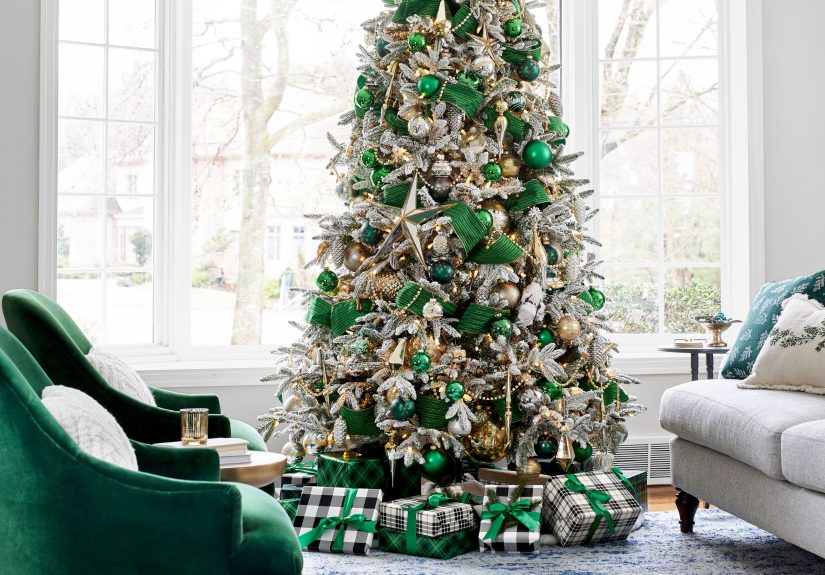
Flocked trees have a white “snow” coating on the branches, creating an instant winter-wonderland vibe.
They’re great if you want a styled look without adding extra picks, sprays, or faux snow yourself.
- Best for: Cozy, cottage, or “Silent Night” aesthetics; white ornaments; warm lights; natural wood decor.
- Reality check: Flocking can shed a bit during setup and storage. A good tree bag helps.
Frosted or “snow-tipped” trees (lighter, more subtle)
These trees use a lighter white effectmore like icy tips than full-on blizzard branches. If you want winter vibes without looking like the tree fought
a snowplow, start here.
Tinsel trees (retro shimmer)
Tinsel trees deliver serious vintage sparkle. They’re dramatic, photo-friendly, and not exactly subtlelike a disco ball that decided to be festive.
They tend to look best with minimal ornaments and a color theme.
Fiber-optic trees (built-in color effects)
Fiber-optic trees glow from within, often cycling colors automatically. They’re a popular choice for kid-friendly spaces or anyone who wants a big visual
effect with minimal decorating effort.
Colored trees (white, black, pink, and everything in between)
Colored artificial trees can be elegant (white with gold ornaments), modern (black with metallics), or playful (pink with candy-themed decor).
If you’re aiming for a specific style statement, a colored tree can do a lot of heavy lifting.
Decorated trees (built-in pinecones, berries, or mixed foliage)
Some trees include attached pinecones, faux berries, or mixed greenery for a more “arranged” look. These can feel more designer-like without requiring
you to add picks by hand.
How to Choose the Right Artificial Christmas Tree
1) Measure like a person who wants a tree topper
Don’t just measure ceiling heightleave space for a topper. A common planning tip is to allow roughly 6–12 inches above the tree for a star, angel,
or whatever glorious thing you put at the top each year.
Also measure the base diameter. A tree can be the “right height” and still eat your room if it’s extra wide.
2) Decide what matters most: realism, fullness, speed, or price
- Most realistic: Primarily PE tips (or branded molded-tip realism tech).
- Best value balance: Mixed PE + PVC.
- Most budget-friendly: PVC-dominant trees.
- Fastest setup: Hinged branches + quick-connect lighting.
3) Tip count is helpfulbut not the whole story
Tip count (the number of branch tips) is often used as a fullness metric, but it’s not a magic number.
Two trees with the same tip count can look different depending on branch placement, needle style, and how well the branches are shaped.
Think of tip count as a clue, not a guarantee.
4) Pre-lit vs. unlit: choose based on your decorating personality
If you change your decor theme yearly or love a specific bulb style, unlit can be the better long-term decision.
If you want quick setup and a clean look, pre-lit is hard to beatespecially with LED.
5) Pay attention to the stand and stability
A gorgeous tree that wobbles is basically a holiday suspense thriller. Look for sturdy metal stands, a stable footprint,
and a trunk that doesn’t lean once decoratedespecially if you use heavier ornaments.
6) Storage and care: protect your future self
A good storage bag (or upright storage solution, if you have space) can protect branches and lights from being crushed or snagged.
Before storing, make sure the tree is clean and dry, and avoid yanking on wired branchesespecially on pre-lit trees.
For cleaning, gentle dusting and careful wiping are usually safer than aggressive vacuuming on delicate tips or wired sections.
7) Safety checks that aren’t boring (because fire isn’t festive)
If you’re buying a pre-lit tree, look for reputable safety testing marks and follow the manufacturer’s use and storage instructions.
Also consider where you’ll place it: away from heat sources, with cords routed safely, and with a stable base.
So… What Type of Artificial Christmas Tree Should You Buy?
If you want the simplest “good choice” without overthinking: a mixed PE + PVC hinged tree in the right height and width for your room,
with pre-lit LED lights if convenience matters (or unlit if you love customizing).
Then pick your silhouettefull, slim, or pencilbased on your floor plan and how many times you’d like to stub your toe in December.
The best artificial Christmas tree is the one that fits your home, your style, and your patience level. (Patience is a real measurement. It’s right next
to “base diameter” on the advanced holiday decorating chart.)
Real-World Experiences: What People Learn the Hard Way (and Then Laugh About Later)
Here are some common, very relatable experiences households run into when choosing and living with artificial Christmas treesespecially when upgrading
from “whatever was on sale” to “a tree I actually like looking at every day.”
The fluffing surprise: Many people expect a tree to look “finished” right out of the box. In reality, even high-end artificial trees need
fluffingspreading branches, shaping tips, and filling gaps. The first setup can take the longest, and it’s normal. The payoff is that once you learn your
tree’s shape, next year goes faster. A helpful mindset: setup is part assembly, part sculpting, part light cardio.
The pre-lit puzzle: Pre-lit trees feel magicaluntil someone plugs in only half the sections and declares the tree “broken.”
A common lesson is to check trunk connections, confirm each section’s plug is seated, and make sure any foot pedal or control box is in the correct mode.
Also: some trees have multiple light functions, and it’s surprisingly easy to flip into a “no lights” setting accidentally. (It’s not hauntedusually.)
The “slim” revelation: People in smaller homes often discover that a slim or pencil tree can feel just as festive as a full one,
without blocking walkways or swallowing a room. Slim trees are especially popular in apartments, bedrooms, and open-plan spaces where the tree needs to live
near furniture. A pencil tree can also be a clever “second tree” for themed ornamentskids’ ornaments, travel ornaments, or that collection you’re proud of
but don’t want to mix with your main aesthetic.
The ornament weight reality: Trees vary a lot in branch strength. A tree can look full and still have flexible tips that droop under heavy
ornaments. Many decorators learn to match ornament weight to branch sturdiness: heavier ornaments closer to the trunk on stronger branches, lighter ornaments
toward the tips. If you love big statement ornaments, it’s worth prioritizing a tree known for sturdy branches and a stable stand.
The storage upgrade nobody regrets: A quality storage bag or upright storage option often becomes the quiet hero of the holiday season.
People who upgrade storage tend to report less damage, less shedding, and faster setup the next year because branches aren’t crushed into weird angles for
months at a time. It also makes the “put-away” day less stressfulbecause the tree isn’t fighting the box like it’s auditioning for a wrestling show.
The “realistic” sweet spot: Not everyone needs a fully PE tree to be happy. A very common experience is finding that a mixed PE + PVC tree
hits the perfect balancerealistic enough in photos and up close, full enough to look lush, and priced in a way that doesn’t make you whisper,
“This thing better come with emotional support.”
In other words, the best artificial Christmas tree isn’t just about the label. It’s about how it behaves in your real life: how it fits your space,
how long it takes to set up, how it looks once decorated, and how easy it is to pack away without drama.
Conclusion
Artificial Christmas trees come in more varieties than holiday cookie tins: different materials (PVC, PE, and mixed), different branch systems (hinged or
hook-in), different lighting setups (unlit, pre-lit, LED, and multi-function), and shapes for every homefrom grand full silhouettes to slim, pencil,
tabletop, and wall-friendly options.
The smartest way to choose is to start with your space (height + base diameter), decide how much realism you want, then pick the setup style you’ll
actually enjoy repeating every year. Because holiday magic is wonderfulbut it’s even better when it doesn’t come with a 45-minute untangling session.