Table of Contents >> Show >> Hide
- Florida: A Southern Detour on the Road to Freedom
- Who Were the Seminoles and Who Were the Black Seminoles?
- Why the Alliance Made Sense
- Fortresses, Swamps, and the First Seminole War
- Fighting Removal Together: The Second and Third Seminole Wars
- From Florida to Indian Territory and Mexico
- Legacy, Memory, and Ongoing Debates
- Experiences Connected to the Alliance Today
Long before the Civil War, before the Mason–Dixon line became shorthand for freedom versus slavery, there was another border that terrified Southern slaveholders: the invisible line between the plantation South and Spanish Florida. South of that line, Seminole Indians and escaped slaves built something extraordinary a fragile but determined alliance that challenged slavery, U.S. expansion, and the idea that power only flowed in one direction.
That alliance produced the people we now call Black Seminoles: communities of African-descended freedom seekers who lived alongside Seminole Indians, farmed, traded, fought, and negotiated as partners more than as dependents. Their story runs through swamps and forts, war and diplomacy, all the way to Oklahoma, Texas, Mexico, and the Bahamas. It’s one of the most dramatic and most overlooked chapters in American history.
Florida: A Southern Detour on the Road to Freedom
The alliance between Seminole Indians and escaped slaves didn’t appear out of nowhere. It grew out of Spanish policy and geography. In 1693, the Spanish crown ordered that enslaved people fleeing from English colonies to Florida could gain asylum and freedom if they converted to Catholicism and served the Spanish military. For enslaved Africans in Georgia and the Carolinas, Florida became a kind of early “southbound Underground Railroad,” a place where bondage might actually end instead of tighten.
Over the 1700s, maroon communities settlements of self-emancipated people emerged in Spanish Florida. One of the best known was Fort Mose, near St. Augustine, recognized as the first legally sanctioned free Black town in what would become the United States. There, formerly enslaved people served as Spanish militia and guarded the frontier, proving that Black military skill could defend an empire instead of just work its fields.
At the same time, Native communities in Florida were changing fast. Groups of Creek and other Muskogee-speaking peoples moved south, merging and shifting into a loose confederation that outsiders eventually called the Seminoles. The very word “Seminole” is often traced to the Spanish cimarrón “wild,” “untamed,” or “runaway” the same root as the word “maroon.” In other words, both the Native people and many of the Africans making their way to Florida were, quite literally, the “runaways” of the Southeast.
Who Were the Seminoles and Who Were the Black Seminoles?
By the late 18th and early 19th centuries, Seminole bands and African-descended maroons were living in overlapping, sometimes interwoven communities across north and central Florida. The Africans who joined them came from rice plantations in South Carolina and Georgia, from coastal communities with strong Gullah–Geechee roots, and from interior plantations in Alabama and Georgia. Over time they were known to outsiders as “Seminole Negroes,” “Seminole maroons,” or simply Black Seminoles.
Unlike the brutal chattel slavery of the U.S. South, Seminole “slavery” was closer to a feudal or client relationship. Black villages were separate, with their own leaders and fields. They paid annual tribute in crops or livestock to Seminole headmen in exchange for protection and political cover. Within their own towns, Black Seminoles managed their internal affairs, negotiated with U.S. officials, and made independent military decisions. The alliance was unequal, but it was dramatically more autonomous than plantation life and plantation owners knew it.
Cultural exchange ran both ways. African farming techniques, foods, and spiritual practices blended with Native traditions. Dress, hair styles, and language reflected this mix; some Black Seminoles spoke multiple languages, including English, Spanish, and Seminole dialects. Intermarriage occurred, and children of mixed ancestry often became key intermediaries in diplomacy and war.
Why the Alliance Made Sense
If you were a Seminole leader in Florida around 1800, you had problems: American settlers pushing south, U.S. officials demanding land cessions, and slave-catching expeditions slipping over the border looking for runaways. If you were an enslaved person on a Georgia plantation, you had a different version of the same problem: a system determined to keep you in chains forever.
Cooperation was the logical answer. For Seminoles, Black allies meant more farmers, more fighters, and more trade partners. For escaped slaves, Seminole territory offered land, relative safety, and a political shield. U.S. authorities understood the danger: a stable refuge for runaways in Spanish Florida, backed by determined Native resistance, could destabilize the entire slave system of the Deep South.
That’s exactly what began to happen. Black and Native warriors fought side by side, and maroon settlements grew in size and sophistication. Some, like the town of Peliklakaha in central Florida, featured substantial houses, large corn cribs, and rich fields of corn, beans, squash, and rice. To American officers used to Black people only as enslaved labor, the sight of prosperous, armed Black farmers living as near equals with Native allies was alarming and politically explosive.
Fortresses, Swamps, and the First Seminole War
The alliance became impossible for U.S. leaders to ignore during and after the War of 1812. The British, eager to harass the United States, built and armed a fort on the Apalachicola River later called Negro Fort and invited Native and African allies to join them. When the British left, hundreds of Black maroons and some Native warriors stayed, turning the place into one of the most heavily armed free Black communities in the Americas.
For U.S. slaveholders, the idea of a fortified, Black-controlled stronghold just over the border was a nightmare. In 1816, American forces destroyed Negro Fort with a single cannon shot that hit the powder magazine, killing almost everyone inside. The explosion sent a brutal message: the United States was willing to cross Spanish borders and use overwhelming force to crush free Black enclaves. But it didn’t end the alliance. Instead, it helped set the stage for the First Seminole War (1817–1818), when Andrew Jackson invaded Spanish Florida, attacking Seminole and maroon settlements in the name of national security and slave recovery.
Fighting Removal Together: The Second and Third Seminole Wars
The United States acquired Florida from Spain in 1819, and from that moment, pressure on the Seminole–Black alliance intensified. American officials wanted two things: Seminoles removed west of the Mississippi and Black Seminoles either enslaved or tightly controlled. The presence of independent Black communities that had already proven they could fight was simply incompatible with a slaveholding republic bent on expansion.
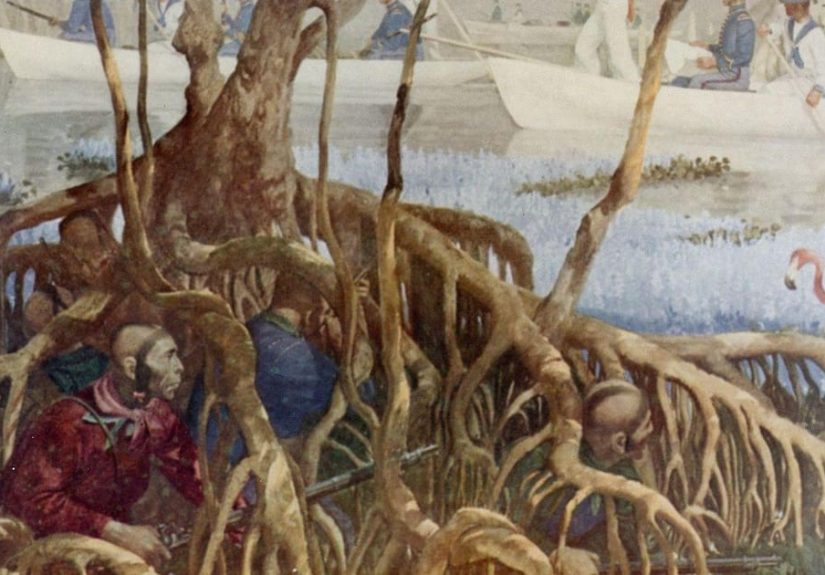
During the Second Seminole War (1835–1842), Black Seminoles played a crucial strategic role. They scouted terrain, organized supply lines, and helped plan ambushes in the dense Florida interior. Battles like those around the Withlacoochee River and Wahoo Swamp involved Black and Native fighters working in close coordination, using the landscape as their best weapon. Some historians argue that the conflict, which drew in hundreds of freedom seekers and tied down thousands of U.S. troops for years, amounts to the largest sustained slave rebellion in U.S. history.
U.S. commanders understood that if they could separate Black Seminoles from their Native allies, resistance would weaken. They tried a mix of promises and threats: offers of freedom in exchange for surrender, alongside deals with slaveholders and Creek leaders to re-enslave as many people as possible. Families were torn apart; some Black Seminoles trusted U.S. assurances and were later captured and sold. Others refused to believe anything they heard from American officers and chose continued resistance instead.
The Third Seminole War (1855–1858) was smaller and more sporadic, but by then the basic pattern was clear. Most Seminoles and many Black Seminoles had already been forced west. Those who remained in Florida a small, stubborn group mainly in the Everglades kept their distance from U.S. authorities for generations.
From Florida to Indian Territory and Mexico
Removal did not end the alliance; it relocated it. In Indian Territory (present-day Oklahoma), Seminoles and their Black allies found themselves surrounded by new dangers. Nearby Creek communities and slave catchers tried to claim Black Seminoles as property. The U.S. government’s promises of protection were inconsistent at best.
Facing renewed attempts at enslavement, leaders like John Horse (also known as John Cavallo or Gopher John) and the Seminole chief Wild Cat engineered one of the most remarkable escapes in North American history. In 1849–1850, they led hundreds of Seminoles and Black Seminoles south, across Texas and into northern Mexico. After grueling travel and tense negotiations, the Mexican government granted them land in Coahuila in exchange for defending the border against Comanche and Apache raids. There, their descendants became known as the Mascogos.
Meanwhile, Black Seminoles who remained in U.S. territory carved out new roles. Some became Seminole–Negro Indian Scouts, serving the U.S. Army on the Texas frontier after the Civil War. Their tracking skills and combat experience earned them respect and several Medals of Honor though the federal government later failed to fully deliver promised pensions and land.
Today, Black Seminole descendants live in Oklahoma, Texas, Florida, the Bahamas, and Mexico. Their communities preserve a mix of African American, Native, and Spanish-language traditions, from distinctive foods and music to annual celebrations that keep the memory of the alliance alive.
Legacy, Memory, and Ongoing Debates
The alliance between Seminole Indians and escaped slaves has left a complicated legal and political legacy. After the Civil War, an 1866 treaty recognized formerly enslaved people and their descendants (often called Freedmen) as part of the Seminole Nation. But in the late 19th and 20th centuries, allotment policies, racial politics, and struggles over tribal sovereignty led to repeated disputes about who counted as a tribal citizen. Those debates over Black Seminole identity and rights continue in various forms today.
On the historical side, scholarship and archaeology are finally catching up. Excavations at former Black Seminole towns in Florida, research on Fort Mose and Prospect Bluff, and community-based projects in Oklahoma and Mexico are revealing daily life as well as battlefield heroics. The picture that emerges is not of a side story to U.S. history, but of a central thread in the story of resistance to slavery and settler expansion.
For educators and readers, the alliance challenges simple narratives. It asks us to think beyond rigid categories of “Black history” versus “Native history” and see how oppressed groups sometimes cooperated to create new, hybrid communities. It reminds us that freedom journeys didn’t all go north; some went south into swamps, pine forests, and borderlands where the U.S. flag did not yet fly.
Experiences Connected to the Alliance Today
So what does this history feel like on the ground outside the pages of a book or a browser window? If you visit the sites where Seminoles and Black Seminoles lived, fought, and negotiated, the story becomes much more than dates and treaties.
Imagine walking through the marshes near St. Augustine at Fort Mose Historic State Park. The fort itself is gone, but boardwalks and interpretive signs bring the free Black community to life. You can picture militia drills in the humid air, the sound of Spanish commands, and the quiet relief of people who, for the first time in their lives, were legally recognized as free. It’s an early chapter in the same long story of Black–Native cooperation that later plays out with the Seminoles.
Travel west to the Prospect Bluff Historic Sites (the former Negro Fort) in Florida’s Apalachicola National Forest and the mood shifts. Here the landscape is deceptively calm: a grassy clearing, a river bending around the bluff, birds calling from the trees. Only markers and earthworks hint that hundreds of people once lived and died here in a fortified maroon community. Reading the history while standing on that bluff, you feel the tension between hope and danger: this was a place where formerly enslaved people believed they had finally found a secure home, only to be destroyed by a single exploding cannonball.
In central Florida, near the old Seminole heartland, archaeologists have identified sites of Black Seminole towns like Peliklakaha. When you look at maps or reconstructions of these communities, you see something that looks nothing like a stereotypical slave quarter. Instead you see substantial houses, organized fields, and storage structures for corn and rice. Teachers who bring students into this history often use these visuals to challenge assumptions: What does it do to our understanding of slavery and resistance when we see Black farmers building prosperous, semi-autonomous towns in alliance with Native neighbors?
If you follow the story westward, you might visit Black Seminole descendant communities in Oklahoma or the small Texas towns near the former posts where Seminole–Negro Indian Scouts once served. Local cemeteries, churches, and family reunions preserve names and stories that connect back to Florida and forward to contemporary fights over identity and recognition. Oral histories from elders describe grandparents who still spoke some Seminole words or remembered songs sung in camps on the march to Indian Territory.
Cross the border into northern Mexico, and the story takes yet another turn. In Coahuila, the village of El Nacimiento de los Negros is home to Mascogo descendants of Black Seminoles who settled there in the 19th century. Community celebrations blend Mexican, African American, and Native elements; some songs are still sung in an old English dialect passed down through generations. Standing in the plaza during a festival day, you’re watching the Seminole–Black alliance echo across time and national boundaries.
Even if you never leave your desk, you can connect to this history in other ways. Genealogists with Southern roots may discover ancestors who “disappeared” from plantation records around the same time maroon settlements in Florida were growing. Educators might design lessons that compare the northbound Underground Railroad with the southbound routes to Florida and Mexico, asking students to think about why some people chose one path over the other. Museum curators increasingly partner with Black Seminole and Seminole communities to co-create exhibits, ensuring the story is told by descendants as well as scholars.
However you encounter it walking a swamp trail in Florida, reading treaty texts in a classroom, or listening to a descendant’s story at a family gathering the alliance between Seminole Indians and escaped slaves asks the same question: what are people willing to risk for freedom, and who will stand with them when they decide they will not live in chains? The answers, written in the lives of Seminoles and Black Seminoles, still matter today.