Table of Contents >> Show >> Hide
- First, a quick reality check: When is it actually “Mayday”?
- Before you transmit, do these “tiny actions” that save huge time
- The 11 Steps to Call Mayday from a Marine Vessel
- Step 1) Stay calm and commit to being the “radio person”
- Step 2) Turn the radio on and set it up to be heard
- Step 3) Switch to VHF Channel 16
- Step 4) If you have DSC, send the DSC distress alert (then still do the voice Mayday)
- Step 5) Say “Mayday” three times (yes, threeno, not two-and-a-half)
- Step 6) Identify yourself clearly: “This is…” + vessel name (repeat it) + call sign/registration/MMSI
- Step 7) Repeat “Mayday” and your vessel name once more
- Step 8) Give your position in the most “findable” way possible
- Step 9) State the nature of distress (what’s wrong, in plain English)
- Step 10) Say what assistance you need and how many people are onboard
- Step 11) Add any extra details that help rescuers spot you, then say “Over”
- A simple Mayday script you can copy (and keep near your radio)
- What happens after you call Mayday?
- Common mistakes that slow rescues (and how to avoid them)
- DSC and GPS: the “quiet superpower” most boaters forget to set up
- Practice without being “that person” on Channel 16
- Extra backup options (because redundancy is boating’s love language)
- Real-World Scenarios and Lessons (Experience-Based, 500+ Words)
- 1) The “We’re Not Sinking… We’re Just Becoming One with the Ocean” Leak
- 2) The Engine Failure Near a Bad Place (Rocks, Inlets, Traffic, or All of the Above)
- 3) The Fire That Starts Small (and Then Auditions for a Bigger Role)
- 4) The Medical Emergency When You’re Farther Than You’d Like to Be
- 5) The “We Called… But Nobody Answered” Moment
- Conclusion
When your boat is having a “main character in a disaster movie” moment, you don’t need poetryyou need a clear Mayday call.
A good distress call is short, structured, and packed with the exact details rescuers need to find you fast.
The goal isn’t to sound cool on the radio (spoiler: nobody does); the goal is to be found.
In U.S. coastal and inland waters, a VHF marine radio is still one of the most reliable ways to get help, because it broadcasts to nearby vessels and the U.S. Coast Guard at the same time.
And when seconds matter, “everyone who can hear you” is exactly the audience you want.
First, a quick reality check: When is it actually “Mayday”?
Mayday is for grave or imminent dangerto people or the vesselwhen you need immediate assistance.
If the situation is urgent but not yet life-threatening, you may hear mariners use Pan-Pan instead.
And Sécurité is for safety/navigation warnings (think hazards or weather alerts), not personal emergencies.
Translation: Mayday is the big red button in your brainuse it when it’s truly an emergency, not when the cooler ran out of ice.
Before you transmit, do these “tiny actions” that save huge time
- Get your location. Look at your GPS/chartplotter and be ready to read it out loud.
- Put on life jackets. If you’re in danger, your wardrobe should immediately become “PFD chic.”
- Assign roles. One person radios, one handles the boat/crew, one monitors the situation (leak, fire, injuries, etc.).
- Don’t wait for perfect. If you’re sinking, “perfect” is a luxury item. Call early.
The 11 Steps to Call Mayday from a Marine Vessel
These steps are written so you can follow them under stress. If you want to be extra-prepared, print this section and keep it near your radio.
Step 1) Stay calm and commit to being the “radio person”
Panic makes people whisper, ramble, or forget the one detail rescuers need most: your position.
Take one breath. Speak slowly. You’re not auditioning for a dramayour job is clarity.
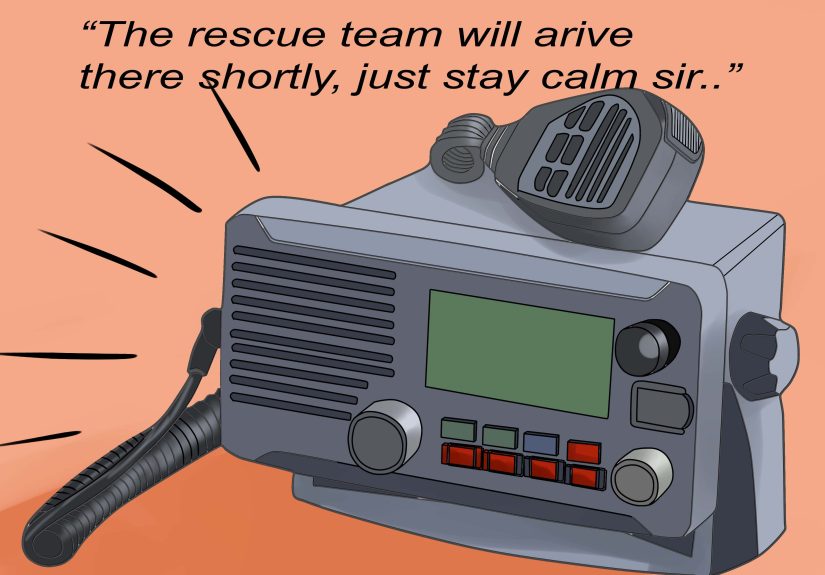
Step 2) Turn the radio on and set it up to be heard
Make sure the VHF radio is on, the volume is up, and squelch is adjusted so you can hear replies.
If your radio has power settings, use high power for an emergency.
Step 3) Switch to VHF Channel 16
Channel 16 is the international distress, safety, and calling channel.
In an emergency, start here so nearby vessels and the Coast Guard can hear you.
Step 4) If you have DSC, send the DSC distress alert (then still do the voice Mayday)
Many modern VHF radios include DSC (Digital Selective Calling). If yours does, sending the distress alert can broadcast your identity and (if connected to GPS) your position.
After the alert, you still follow up with a voice Mayday on Channel 16 so humans get the full story.
Step 5) Say “Mayday” three times (yes, threeno, not two-and-a-half)
Start with: MAYDAY, MAYDAY, MAYDAY. This flags your transmission as a distress call that takes priority over everything else.
Step 6) Identify yourself clearly: “This is…” + vessel name (repeat it) + call sign/registration/MMSI
Next say “THIS IS” followed by your vessel name three times, plus your call sign or registration number (and MMSI if you have it).
Why repeat? Because radios cut out, people mishear, and you want your name to stick like gum on a deck shoe.
Step 7) Repeat “Mayday” and your vessel name once more
This reinforces that the call is a distress call and helps anyone who tuned in mid-transmission understand what’s happening.
Step 8) Give your position in the most “findable” way possible
Best: latitude/longitude read directly from GPS. Also helpful: bearing and distance from a known landmark, navigational aid, or inlet.
If you’re moving, include course, speed, and destination. Your position is your rescue addressmake it deliverable.
Step 9) State the nature of distress (what’s wrong, in plain English)
Examples: taking on water, fire onboard, collision, grounding with rising water, man overboard, medical emergency, loss of propulsion in dangerous conditions.
Keep it direct. “We are sinking” beats “Well, it started with a weird noise…” every time.
Step 10) Say what assistance you need and how many people are onboard
Tell rescuers what you need: immediate rescue, medical assistance, pumps, towing, evacuation, etc.
Include number of people onboard and whether anyone is injured (and how severely, in simple terms).
Step 11) Add any extra details that help rescuers spot you, then say “Over”
Useful details: boat type/length, hull color, cabin/mast description, current conditions, what you’re doing now (anchored, abandoning ship, in a life raft),
and any signaling gear you can safely use.
End with “OVER” and then listen.
If you don’t get a response, repeat the Mayday call at intervals.
A simple Mayday script you can copy (and keep near your radio)
This is an easy structure that matches what rescuers expect to hear. Fill in the blanks ahead of time if you can.
What happens after you call Mayday?
If you reach the Coast Guard (or another station), they may ask follow-up questions and may direct you to shift to a working channel to keep Channel 16 clear.
Do exactly what they ask, answer calmly, and keep updates comingespecially if your position changes.
Common mistakes that slow rescues (and how to avoid them)
- Waiting too long. Call earlysituations on water rarely improve out of politeness.
- Not giving a position. “Somewhere off the coast” is not a location; it’s a mystery novel.
- Telling a long backstory. Lead with the essentials first: Mayday, ID, position, distress, people, needs.
- Forgetting to listen. After you transmit, stop talking and let rescuers respond.
- Using Channel 16 for non-emergencies. Save it for calling/distress; move routine chatter elsewhere.
- Assuming a cell phone will save the day. Coverage can fail, batteries die, and phones don’t automatically alert nearby vessels.
DSC and GPS: the “quiet superpower” most boaters forget to set up
A DSC distress alert is far more valuable when the radio has a built-in GPS or is connected to your GPS/chartplotter, because it can include your position automatically.
That setup stepdone on a calm day at the dockcan pay off massively on a rough day offshore.
Also: make sure your MMSI is properly programmed and your radio is installed correctly (fixed-mount radios typically have better range than handheld units).
Practice without being “that person” on Channel 16
Practice is smart. But do it the right way:
- Don’t do radio checks on Channel 16. Use appropriate channels for radio checks in your area (often Channel 9 or another local channel).
- Do dry runs. Stand at the helm and read the script out loud without transmitting. It feels sillyuntil it doesn’t.
- Make a Mayday card. Tape a waterproof “fill-in-the-blanks” card near the radio.
- Run a 60-second drill. Once a month, have someone point at the GPS and you practice reading the position aloud.
Extra backup options (because redundancy is boating’s love language)
A Mayday call is powerful, but it’s not your only tool. Consider layered safety:
- EPIRB/PLB: Beacons can alert rescuers even when voice communication is difficult.
- Visual signaling devices: Helpful when rescuers are near and need to identify you (follow all safety instructions for any equipment).
- AIS/Man-overboard tech: Useful for crew overboard scenarios and close-range locating.
- Float plan: Tell someone on land where you’re going and when you’ll return.
Real-World Scenarios and Lessons (Experience-Based, 500+ Words)
Below are experience-based scenarios drawn from common boating training drills, incident patterns, and the kind of “I can’t believe that just happened” stories you hear at marinas.
They’re not here to scare youthey’re here to make the steps feel real, because under stress your brain loves to delete important files.
1) The “We’re Not Sinking… We’re Just Becoming One with the Ocean” Leak
A small runabout hits something submergednothing dramatic, no fireworks, just a new sound you’ve never heard before: water. At first, it looks manageable.
Someone grabs a bucket; someone else checks the bilge pump; the captain tries to convince everyone this is “fine.”
The lesson: call for help before “manageable” becomes “memorable.”
In drills, the fastest Mayday calls happen when the crew commits early: position, distress, people onboard, and the request for pumps/tow/assistance.
Even if you later downgrade the situation, it’s better to be slightly embarrassed than slightly underwater.
2) The Engine Failure Near a Bad Place (Rocks, Inlets, Traffic, or All of the Above)
Engine failure is not automatically a Maydayuntil it is.
The difference is location and conditions: drifting toward rocks, shoals, a busy shipping lane, or a breaking inlet can turn a “mechanical problem” into an urgent rescue.
The best crews immediately state movement info: “We are drifting,” plus course/speed if available.
It’s shocking how often training scenarios reveal the crew knows they’re moving but can’t describe how.
If you can’t give GPS speed/course, say what you can: “We are being set toward the jetty,” or “We are drifting east with the wind.”
That helps rescuers predict where you’ll be when they arrive.
3) The Fire That Starts Small (and Then Auditions for a Bigger Role)
Fire onboard is one of the clearest Mayday triggers because it can escalate fast and force abandonment.
In practice drills, people tend to do two unhelpful things: speak too fast and forget the number of people onboard.
A simple “Mayday… fire onboard… [position]… [number] persons” is gold.
Your follow-up detailsboat description, what you’re doing now, whether you’re preparing to abandonmake the rescue response smarter.
Also, once you transmit, listening matters: rescuers may direct you to a working channel or ask clarifying questions to decide what to send first.
The “experience” takeaway: structure beats adrenaline. Always.
4) The Medical Emergency When You’re Farther Than You’d Like to Be
Medical issues feel awkward on the radio because people worry about privacy. In real life, rescuers care about urgency.
Training emphasizes plain language: “medical emergency,” the person’s condition in simple terms, and whether you need immediate evacuation or medical advice.
You don’t need a perfect diagnosis; you need a clear description of symptoms and the patient’s status.
Crews who do best in scenarios are the ones who prepared a short script and can answer: position, number onboard, and whether everyone has life jackets on (because if evacuation becomes necessary, that detail matters).
5) The “We Called… But Nobody Answered” Moment
Sometimes there’s radio silence after your first transmissionmaybe you were briefly out of range, maybe interference, maybe timing.
The lesson from drills is simple: repeat at intervals, stay on Channel 16, and keep your message consistent.
People tend to change wording when they repeat, which can confuse listeners who caught only part of the call.
Repetition is not annoying in an emergencyit’s responsible.
And if you sent a DSC distress alert, follow up with the voice Mayday anyway; the voice call provides the context (what’s happening, how many people, what you need) that a digital alert can’t fully capture.
In other words: your radio call is your lifeline. Don’t abandon it just because the first toss didn’t hook.
The big theme across all these scenarios is boringbut lifesaving: prepare the script, know your position, and speak slowly.
When things go sideways on the water, “calm and clear” becomes a form of courage.
Conclusion
A Mayday call is not about sounding officialit’s about getting found.
If you remember only one thing, make it this: Mayday + who you are + where you are + what’s happening + how many people + what you need.
Keep a printed script near the radio, make sure your DSC/GPS setup is correct, and practice the steps before you ever need them.
In a real emergency, that preparation turns chaos into a message rescuers can act on immediately.