Table of Contents >> Show >> Hide
- What Is the Federal Register, Exactly?
- Core Elements of a Federal Register Citation
- How to Cite the Federal Register in APA Style (7th Edition)
- Citing the Federal Register in MLA Style (9th Edition)
- Citing the Federal Register in Chicago Style
- When Do You Need Bluebook Format?
- Quick Comparison: APA vs. MLA vs. Chicago
- Real-World Lessons from Actually Citing the Federal Register
If you’ve ever tried to cite the Federal Register and felt like you were decoding a secret government message, you’re not alone. Between volume numbers, page ranges, agencies, and those mysterious abbreviations like “Fed. Reg.,” it can feel like the citation version of alphabet soup.
The good news? Once you understand a few core rules, citing the Federal Register in APA, MLA, and Chicago style is actually pretty straightforward. Think of it as learning three different “dialects” for saying the same thing: APA for social sciences, MLA for humanities, and Chicago for historians, legal-adjacent work, and lots of professional publishing.
This guide walks you through exactly how to cite the Federal Register step by step, with templates, full examples, and quick tips. By the end, you’ll be able to create clean citations without staring at your screen wondering where on earth the volume number is hiding.
What Is the Federal Register, Exactly?
The Federal Register is the official daily publication of the U.S. federal government for rules, proposed rules, and notices from federal agencies, as well as executive orders and other presidential documents. It’s published by the Office of the Federal Register, part of the National Archives and Records Administration (NARA).
In practical terms, if you’re citing a new regulation, a proposed rule, or an executive order that appears in that daily publication, you’re probably dealing with the Federal Register. Once final rules are codified, they move into the Code of Federal Regulations (CFR), which is cited differentlyso always double-check that what you have in front of you is actually a Federal Register entry and not a CFR citation.
Core Elements of a Federal Register Citation
No matter which style guide you’re using, most Federal Register citations rely on a similar core set of elements:
- Issuing agency (for example, Environmental Protection Agency, Department of Labor)
- Year of publication (and often the full date)
- Title of the rule, notice, or document
- Volume number of the Federal Register
- Abbreviation: Fed. Reg.
- Page range where the item begins (and sometimes full range)
- URL (for online access, when required by the style)
In a very basic legal-style format, a Federal Register citation might look like this:
Example (legal-style):
Importation of Fruits and Vegetables, 60 Fed. Reg. 50,379 (Sept. 29, 1995).
APA, MLA, and Chicago take that same core information and rearrange it to match their own rules.
How to Cite the Federal Register in APA Style (7th Edition)
APA treats the Federal Register like a government publication or legal document. You’ll usually cite it in the reference list as a work with a corporate author (the agency) and a descriptive title.
Basic APA Reference List Format
Use this general pattern for a Federal Register rule or notice:
If the issue number isn’t easily available, APA often allows you to omit it as long as the volume and page range are present and the item is uniquely identifiable.
Example (APA reference):
Environmental Protection Agency. (2020). National emission standards for hazardous air pollutants. Federal Register, 85(150), 45,112–45,120.
APA In-Text Citations
For in-text citations, use the agency name and year, like any other corporate author:
- Parenthetical: (Environmental Protection Agency, 2020)
- Narrative: According to the Environmental Protection Agency (2020), the revised standards…
If your sentence clearly identifies the agency, you can sometimes just include the year in parentheses.
APA Format for Executive Orders in the Federal Register
For an executive order published in the Federal Register, you’ll typically list the president as the author, followed by the year, title, and publication details:
Example:
Biden, J. R. (2021). Advancing racial equity and support for underserved communities through the federal government (Exec. Order No. 13,985). Federal Register, 86, 7,009–7,013.
Common APA Mistakes to Avoid
- Skipping the agency name. Don’t just start with the titleAPA wants an author, and for government rules that’s usually the agency.
- Forgetting italics. The words Federal Register should be italicized, just like a journal title.
- Mixing in CFR citations. Remember: CFR is for codified rules; the Federal Register is where proposed and new rules appear first.
Citing the Federal Register in MLA Style (9th Edition)
MLA is flexible with government documents, but for most student papers, it’s easiest to treat the Federal Register like a periodical (journal or newspaper) with a government author.
MLA Works Cited Entry: Basic Pattern
Here’s a simple pattern for a rule or notice from the Federal Register:
Example (MLA Works Cited):
Environmental Protection Agency. “National Emission Standards for Hazardous Air Pollutants.” Federal Register, vol. 85, no. 150, 13 Aug. 2020, pp. 45112–20.
If you accessed the rule online, MLA 9 lets you add the URL at the end of the citation (without “http://” or “https://”) and omit the access date unless your instructor requires it.
Example with URL:
Environmental Protection Agency. “National Emission Standards for Hazardous Air Pollutants.” Federal Register, vol. 85, no. 150, 13 Aug. 2020, pp. 45112–20.
www.federalregister.gov/documents/2020/08/13/example-rule.
MLA In-Text Citations
In MLA, in-text citations usually use the first element of the Works Cited entry and a page number when applicable.
- Parenthetical: (Environmental Protection Agency 45115)
- Narrative: As the Environmental Protection Agency notes, stricter standards were adopted (45115).
If your Works Cited starts with the name of the agency, use that name in your in-text citation. If it instead starts with the title, you’d use a shortened version of the title in quotation marks.
MLA and Presidential Executive Orders in the Federal Register
When citing an executive order in MLA, you can treat the president as the author and the Federal Register as the container:
Example:
Biden, Joe. “Advancing Racial Equity and Support for Underserved Communities Through the Federal Government.” Federal Register, vol. 86, no. 14, 26 Jan. 2021, pp. 7009–13.
Citing the Federal Register in Chicago Style
Chicago has two main systems: Notes and Bibliography (often used in history and some humanities) and Author-Date (more common in social sciences and some professional writing). You can cite the Federal Register using either system.
Chicago Notes and Bibliography: Basic Pattern
In the notes-and-bibliography system, you’ll use footnotes or endnotes plus a bibliography. A Federal Register rule often looks like this in a note:
Example Note:
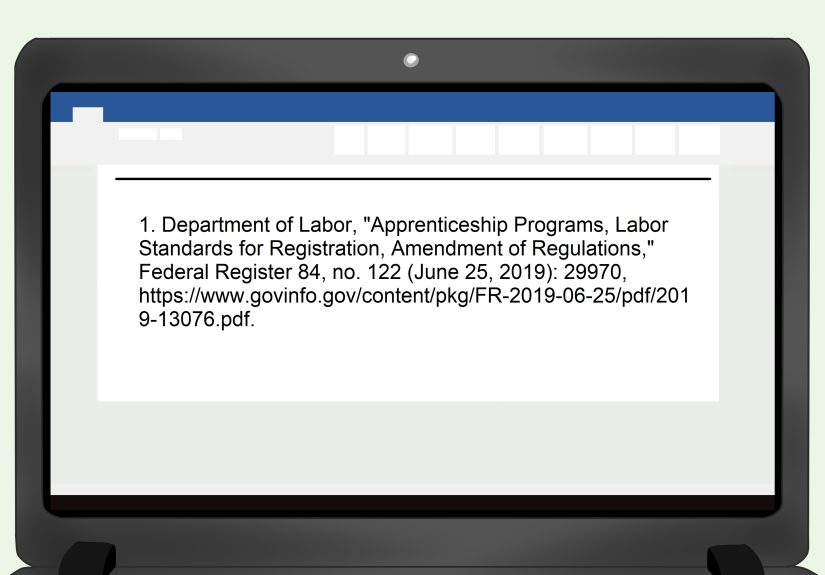
1. Environmental Protection Agency, “National Emission Standards for Hazardous Air Pollutants,” Federal Register 85, no. 150 (13 August 2020): 45112.
Example Bibliography Entry:
Environmental Protection Agency. “National Emission Standards for Hazardous Air Pollutants.” Federal Register 85, no. 150 (13 August 2020): 45112–20.
If you use the online version, you can add the URL at the end of the note and bibliography entry. Some instructors also want an access date; follow their preference or your institution’s guide.
Chicago Author-Date for the Federal Register
In the author-date system, the entry moves to your reference list, and you use parenthetical citations in the text.
Example (reference list):
Environmental Protection Agency. 2020. “National Emission Standards for Hazardous Air Pollutants.” Federal Register 85, no. 150 (August 13): 45112–20.
Example (in-text): (Environmental Protection Agency 2020, 45115)
Chicago and Executive Orders Published in the Federal Register
Chicago also lets you cite executive orders using the president’s name and the Federal Register information:
When Do You Need Bluebook Format?
If you’re in law school, writing a law review note, or working in a legal clinic, your professor or editor will probably require Bluebook format instead of APA, MLA, or Chicago. Bluebook has its own rule (often cited as Rule 14) for administrative and executive materials, including the Federal Register.
In Bluebook style, a Federal Register citation usually looks like this:
Bluebook-style example:
Importation of Fruits and Vegetables, 60 Fed. Reg. 50,379 (Sept. 29, 1995).
APA, MLA, and Chicago are more common for non-law assignments. When in doubt, follow whatever your professor, journal, or style sheet specifiesand if they say “use Bluebook,” then this article becomes your warm-up before you dive into the big blue book itself.
Quick Comparison: APA vs. MLA vs. Chicago
Here’s a simplified comparison using the same fictional rule:
Example Rule: “National Emission Standards for Hazardous Air Pollutants,” Environmental Protection Agency, 85 Fed. Reg. 45,112–45,120 (Aug. 13, 2020).
| Style | Reference / Works Cited / Bibliography Entry | In-Text or Note |
|---|---|---|
| APA (7th ed.) | Environmental Protection Agency. (2020). National emission standards for hazardous air pollutants. Federal Register, 85(150), 45,112–45,120. | (Environmental Protection Agency, 2020) |
| MLA (9th ed.) | Environmental Protection Agency. “National Emission Standards for Hazardous Air Pollutants.” Federal Register, vol. 85, no. 150, 13 Aug. 2020, pp. 45112–20. | (Environmental Protection Agency 45115) |
| Chicago Notes-Bibliography | Environmental Protection Agency. “National Emission Standards for Hazardous Air Pollutants.” Federal Register 85, no. 150 (13 August 2020): 45112–20. | 1. Environmental Protection Agency, “National Emission Standards for Hazardous Air Pollutants,” Federal Register 85, no. 150 (13 August 2020): 45115. |
Real-World Lessons from Actually Citing the Federal Register
It’s one thing to see perfect textbook examples and another thing entirely to be sitting at your laptop at 1:43 a.m. trying to remember whether the volume number goes before or after the words Federal Register. Here are some real-world lessons that students, researchers, and legal interns learn the hard wayso you don’t have to.
1. Start with the Federal Register Entry, Not a Secondary Source
One common mistake is trying to build a citation from a textbook or a blog post that quotes a rule. That’s like trying to reconstruct a cake recipe from a photo: you’ll guess some of it, but you’ll miss key details. Whenever possible, go straight to the official Federal Register entry. The online version usually gives you the title, agency, volume, page, and publication date clearly at the top, which makes citing it much faster and more accurate.
In practice, that means: if you find a rule referenced in a news article or policy report, grab the rule’s title or citation and plug it into the FederalRegister.gov search bar. From there, you’ll see the official publication data you need for APA, MLA, or Chicago.
2. Don’t Confuse the Federal Register with the CFR
Ask any law librarian how often students mix these up and you’ll probably get a pained expression. The Federal Register is the daily chronological record; the Code of Federal Regulations (CFR) is the subject-organized codification of final rules. They often appear together in documents, which can trick you into citing the wrong thing.
A practical trick: if you see something like “40 CFR § 63.1,” that’s a CFR citation, not a Federal Register citation. A Federal Register citation will have a volume number followed by “Fed. Reg.” and a page, like “85 Fed. Reg. 45,112.” If your assignment specifically says “cite the Federal Register,” make sure that phrase actually appears in your source.
3. Copy the Capitalization and Spelling Carefully
Regulatory titles are often long and weirdly specific. In APA and Chicago, you normally use sentence case for titles, but you still need to keep all proper nouns and acronyms correct. That means checking capitalization for terms like “National Ambient Air Quality Standards” or specific program names.
It’s worth the extra five seconds to copy and paste the title into your document and then adjust it to the correct capitalization style, rather than retyping it from memory after your third cup of coffee.
4. Build Your Own Citation Template Cheat Sheet
Once you’ve created a few correct Federal Register citations, save them somewhere you can easily grab themyour notes app, a citation reference document, or a dedicated “nerd folder” on your desktop. Have one example each for APA, MLA, and Chicago that you know is right.
The next time you need to cite a new rule, just swap in the new agency, title, volume, page, and date. This is not “cheating”; it’s exactly how professionals work. Style guides exist so you don’t have to reinvent the wheel every time you cite a government document.
5. Ask Your Professor Which Style They Actually Want
Some assignments say “Use APA,” but the instructor quietly expects something closer to Bluebook for legal materials. Others tell you to “follow Chicago” but don’t care if you’re slightly informal with the URL or access date as long as your citations are consistent and readable.
If the stakes are highcapstone project, thesis, law review write-onsend a quick email or ask during office hours: “When I cite the Federal Register, do you want APA/MLA/Chicago, or do you prefer Bluebook format?” That 30-second question can save hours of rewriting later.
Over time, you’ll notice that the stress level around Federal Register citations drops dramatically. You’ll recognize where the volume number lives, when to italicize the title, and how each style rearranges the same core information. Once that clicks, the Federal Register stops feeling like a mysterious government labyrinth and starts behaving like just another source you can cite confidently and consistently.