Table of Contents >> Show >> Hide
- What “Book Nook” Means Here (and Why You’ll Love It)
- Step 1: Choose the Right Location (Hint: Your House Has Hidden Nook Potential)
- Step 2: Pick Seating That Feels Cozy and Lets You Read Longer
- Step 3: Nail the Lighting (So Your Eyes Don’t File a Complaint)
- Step 4: Add a “Hard Surface” (Because Books + Coffee Deserve Boundaries)
- Step 5: Build Smart Storage (So Your Nook Stays Inviting, Not Chaotic)
- Step 6: Layer in Comfort (Texture, Warmth, Sound, and That “Ahhh” Feeling)
- Step 7: Style It Without Sacrificing Function
- Step 8: Make It Family-, Kid-, and Pet-Friendly (Without Ruining the Vibe)
- Three Book Nook Setups You Can Copy (With Realistic Details)
- Budget Tips and DIY Upgrades That Actually Matter
- Keep It a Book Nook (Not a Laundry Chair) With One Simple Habit
- Conclusion: Your Home Book Nook Is a Tiny Upgrade With Big Payoff
- Experiences: What It’s Like Living With a Book Nook (The Good, the Funny, and the Surprisingly Useful)
A book nook is basically a tiny, cozy treaty you sign with yourself: “I promise to sit down for five minutes,”
and then (shockingly) you look up an hour later with a finished chapter, a calmer nervous system, and a new opinion
about fictional people who don’t pay your bills.
If you’ve been thinking a book nook requires a built-in bench, custom millwork, and a latte budget that has its own
spreadsheetgood news. The best reading nooks are often the simplest: a comfortable perch, light that doesn’t make you
squint, a place to set your drink, and just enough “this is mine” styling to make you actually use it. Let’s build yours.
What “Book Nook” Means Here (and Why You’ll Love It)
The internet sometimes uses book nook for miniature diorama inserts you put between books on a shelf (adorable).
In this article, we mean a reading nook: a dedicated spot in your home designed for reading, journaling,
audiobook lounging, or quietly staring into space while holding a book like a responsible adult.
Done right, a home book nook helps you read more because it removes friction. Instead of “Where should I sit?” you have
“My spot.” And that tiny switch is basically habit magic… but with pillows.
Step 1: Choose the Right Location (Hint: Your House Has Hidden Nook Potential)
Your future book nook is probably already living in your home, paying zero rent. The trick is spotting it.
Look for: decent natural light, low traffic, and enough room for a seat plus a little surface.
Best “book nook” locations that usually work
- By a window: Natural light is flattering and practical. Bonus points if you can add a curtain or shade to control glare.
- Under the stairs: A classic for a reasoncozy, tucked away, and very “main character.”
- Bedroom corner: Great for nighttime reading; choose warm lighting to keep the vibe sleepy instead of stadium-bright.
- Hallway or landing: Often ignored square footage. A slim chair or built-in bench can turn “pass-through” into “pause here.”
- A closet conversion: Not the one holding your winter coats hostagean underused closet can become a quiet cave of books.
- Living room edge: A chair angled slightly away from the TV can feel separate without building walls (or resentment).
Quick “spot test” before you commit
- Sit there for 3 minutes at the time you’ll actually read (morning? evening?).
- Check the light: Can you read without squinting? Is there glare?
- Listen: Is it peaceful-ish, or do you hear the fridge narrating your life choices?
- Check outlets: If you use an e-reader, lamp, or phone timer, you’ll want power nearby.
Step 2: Pick Seating That Feels Cozy and Lets You Read Longer
The #1 book nook mistake is choosing a chair that looks amazing but feels like a polite punishment. Your seat should
support your back, let your feet rest comfortably, and make it easy to change positions without performing a three-point turn.
Seating options (and who they’re best for)
- Upholstered armchair: The most reliable all-rounder. Add a lumbar pillow if you’re a “one more chapter” type.
- Chaise or daybed: Ideal if you like stretching out. Great for reading + naps that were “not planned.”
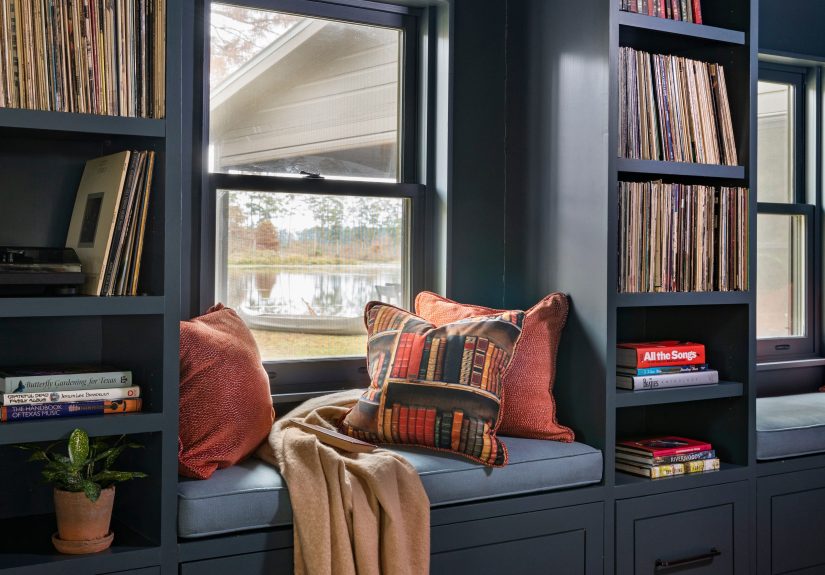
- Window bench / built-in seat: A space-saver with major charm. Use a thick cushion and pillows so it doesn’t feel like a museum display.
- Floor lounge setup: Perfect for casual reading (and kids). Use a large floor cushion + back support + a soft rug.
- Small loveseat: If you read with a partner, a child, or a pet who believes personal space is propaganda.
Comfort checklist (steal this)
- Back support: either built-in or added with a pillow
- Feet support: ottoman, pouf, stool, or a sturdy stack of “books I swear I’ll read”
- Seat depth: deep enough to relax, not so deep your neck becomes a question mark
- Fabric: cozy and durable (because real life includes snacks)
Step 3: Nail the Lighting (So Your Eyes Don’t File a Complaint)
A book nook without good lighting is just a place to hold a book while guessing the words. Ideally, you’ll combine:
natural light, task lighting (for reading), and ambient light (for mood).
Simple lighting setup that works in most homes
- Task lamp: A floor lamp beside the chair, a table lamp on your side table, or a wall sconce if you want a built-in look.
- Warm bulb temperature: Especially if your nook is for evenings. Warm light feels cozy and less “time to do taxes.”
- Adjustability: A swivel head or dimmer helps you avoid glare and shadows.
Small detail that makes a big difference
If you’re right-handed, place the reading lamp slightly to your left (and vice versa) to reduce shadows on the page.
If you use an e-reader, angle the light to avoid screen glare.
Step 4: Add a “Hard Surface” (Because Books + Coffee Deserve Boundaries)
The unsung hero of every good book nook is a place to set things down. Even a tiny one. Without it, you’ll balance
your drink on a pillow and invent a new genre: thriller, but make it sticky.
What counts as a hard surface
- Small side table
- C-shaped couch table that slides under a chair
- Wall-mounted shelf ledge (great for tight spots)
- Storage ottoman with a flat tray on top
What to keep within arm’s reach
- Reading glasses (or your future self will wander the house like a confused librarian)
- Bookmark
- Notebook/pen for “I must remember this quote” moments
- A coaster (your table deserves dignity)
Step 5: Build Smart Storage (So Your Nook Stays Inviting, Not Chaotic)
You don’t need a full home library, but you do want your current reads close by. Storage is what turns “cute corner”
into “this is a functional reading station.”
Storage ideas by space size
- Micro space: A small basket for 5–10 books + a wall ledge for a rotating “currently reading” stack.
- Medium space: A slim bookcase, floating shelves, or a cube unit with bins.
- Built-in dream: Bench with drawers underneath, bookcases flanking a window seat, or shelves wrapping a corner.
Pro tip: curate what lives in the nook. Keep “next up” books nearby, and store everything else elsewhere.
Your nook should feel like a bookstore display, not a guilt pile.
Step 6: Layer in Comfort (Texture, Warmth, Sound, and That “Ahhh” Feeling)
This is where your book nook becomes irresistible. Layering is also how you fake luxury on a budget.
Soft textures tell your brain: we rest here.
Comfort layers that pay off immediately
- Rug: Defines the nook and softens sound (especially on hard floors).
- Throw blanket: Because the human body is never the correct temperature.
- Pillows: Mix one supportive lumbar pillow with one squishy “cozy” pillow.
- Window treatment: Sheer curtain for glow, blackout option if you read at night and want less glare.
- Optional sound buffer: A fabric wall hanging, curtains, or even a bookshelf can reduce echo in open rooms.
Step 7: Style It Without Sacrificing Function
Yes, you can make it pretty. No, you don’t need to turn it into a showroom that makes you afraid to touch anything.
The goal is a nook that looks great and gets used.
Easy style upgrades (choose 2–4)
- Color zone: Paint the nook area a different color, or “color drench” the corner for a cocoon feel.
- Wallpaper accent: One wall behind the chair adds instant personality.
- Art and prints: Hang something you actually like, not something you feel you “should” like.
- Plant buddy: A small plant softens the space (real or fauxno judgment).
- Personal object: A candle warmer, framed photo, or souvenir that makes the nook feel like yours.
Keep the styling simple: if it takes more than 10 seconds to sit down and start reading, your nook is auditioning
for “decor corner,” not “book nook.”
Step 8: Make It Family-, Kid-, and Pet-Friendly (Without Ruining the Vibe)
A book nook can absolutely coexist with real life. You just plan for it.
If kids will use it
- Use a floor cushion or low chair, plus soft lighting
- Add a small bin for books (front-facing covers help younger kids choose)
- Skip sharp-edged tables; choose rounded corners or a sturdy ottoman + tray
If pets will claim it
- Pick a fabric that’s easy to vacuum (or at least doesn’t “hold” fur like it’s a hobby)
- Add a washable throw on the seat
- Place a small pet bed nearby so you can negotiate territory
Three Book Nook Setups You Can Copy (With Realistic Details)
1) The small-apartment corner nook
- Location: living room corner near a window
- Seating: compact armchair + pouf
- Lighting: slim floor lamp with adjustable head
- Surface: C-table that slides under the chair
- Storage: one basket + 2 floating shelves
Styling tip: add a rug that’s slightly bigger than the chair footprint so the nook looks intentional, not accidental.
2) The “under the stairs” hideaway
- Location: under-stair alcove
- Seating: built-in bench or loveseat-size cushion
- Lighting: wall sconce or plug-in sconce (clean look without hardwiring)
- Surface: small shelf ledge built into the side wall
- Storage: drawers under the bench or cubes with bins
Add a curtain if you want extra privacy. Yes, it’s slightly dramatic. No, you should not be talked out of it.
3) The closet-to-book-nook conversion
- Location: a spare or underused closet
- Seating: thick cushion on a bench base, or a small armless chair
- Lighting: battery puck lights or a plug-in sconce + warm bulb
- Surface: narrow wall shelf for drink + book
- Storage: shelves above the seat (keep the lowest shelf high enough to avoid head bumps)
Safety note: avoid open flames (candles) in tight spaces. Choose LED lighting and keep airflow comfortable.
Budget Tips and DIY Upgrades That Actually Matter
You can build a satisfying book nook at almost any budget. Instead of spreading money across a dozen “cute” items,
spend on the pieces that affect comfort the most: seating, lighting, and a surface.
Budget-friendly upgrades
- Upgrade the bulb to warm, comfortable light (big impact, small cost)
- Add a lumbar pillow and a throw (instant “cozy”)
- Use peel-and-stick wallpaper on one wall for a quick style hit
- Swap a wobbly side table for a stable, small footprint table
- Use a tray to turn an ottoman into a table
If you want one “weekend project”
Build (or hack) a window bench seat. Even a simple bench with a cushion can create that iconic book nook lookespecially
if you add storage underneath. Measure carefully, plan for comfortable cushion thickness, and don’t forget to think through
outlet access and lighting placement before you start.
Keep It a Book Nook (Not a Laundry Chair) With One Simple Habit
Every cozy nook risks turning into a holding zone for random socks and unopened mail. The cure is a tiny ritual:
keep a “current stack” of 3–7 books and reset the nook once a week (30 seconds).
If you want to be extra, put a small basket nearby labeled “return to elsewhere” and toss clutter in it like you’re
a magician who hates mess.
Conclusion: Your Home Book Nook Is a Tiny Upgrade With Big Payoff
Creating a book nook isn’t about copying a perfect Pinterest photo. It’s about designing a small space that makes reading
feel easy. Choose a spot with decent light, add a comfortable seat, layer lighting, give yourself a hard surface, and keep
books within reach. Then style it just enough that you smile when you walk past… and sit down instead of scrolling.
Experiences: What It’s Like Living With a Book Nook (The Good, the Funny, and the Surprisingly Useful)
Once a book nook exists, you start noticing the tiny ways it changes your day. Not in a “your life is now a movie montage”
waymore like “wow, I read 10 pages while my pasta water boiled” kind of way. People often report the first surprise is
how quickly the nook becomes a default destination. You don’t have to plan a whole Reading Event. You just sit. The chair
is already there. The light is already right. Your brain goes, “Oh, we do that here,” and you start reading before you can
overthink it.
The second surprise is that you’ll fine-tune the nook after real use. On day one, you might think, “This lamp is perfect!”
On day three, you realize the light creates a glare that turns every page into a shiny little mirror. So you angle the lamp,
swap the bulb, or move it six inches. Those tiny adjustments are normaland honestly, kind of satisfying. A book nook isn’t
a sculpture; it’s a tool you live with.
Then there’s the “hard surface lesson.” Many people try to skip the side table at first because the nook looks cleaner
without it. This works until you need somewhere to put tea, a phone timer, reading glasses, a pen, and the sudden emotional
weight of the last chapter. That’s when a small table (or a wall shelf ledge) becomes the unsung hero. It’s not glamorous,
but it prevents the classic move where you set your drink on the floor and immediately forget it exists until your sock
finds it.
Another real-life experience: the book nook tries to become a “laundry chair.” This is a universal law, like gravity.
The way people successfully fight it is not with willpower (because the sweater is persuasive), but with a system:
a small basket nearby for “things that don’t belong,” plus a quick weekly reset. Once the nook stays clear most of the time,
you’re more likely to use it. And the more you use it, the less likely you are to disrespect it with a pile of jeans.
(Your nook has feelings. Probably.)
Book nooks also tend to change family rhythms in small ways. In homes with kids, a dedicated reading corner often becomes
a cue: “This is a quiet space.” Not silentreal life isn’t a monasterybut quieter. Kids may start by flopping in with a
picture book and leaving after three minutes, then gradually linger longer because the space feels special. In homes with
partners or roommates, the nook can become a subtle signal that you’re taking a mini-break. It’s a gentle boundary that says,
“I’m here, I’m okay, and I’m temporarily unavailable for loud debates about what’s for dinner.”
Finally, there’s the best part: the emotional experience of having a place that’s “yours,” even if it’s only a corner.
People often describe a book nook as a tiny retreat that makes the whole home feel more supportive. It’s not about escape
from your life; it’s about returning to it with a slightly fuller battery. And yessometimes it’s also about sitting in a
very cozy chair and dramatically sighing like you’re in a period drama. That’s allowed. Encouraged, even.