Table of Contents >> Show >> Hide
- Why Wood Slats + LEDs Look So Good
- Plan First (Because “Wing It” Is How You End Up Re-Doing It)
- Materials and Tools Checklist
- Step-by-Step: Build the Wood Slat Wall
- 1) Prep the wall
- 2) Paint (or add a backer) for contrast
- 3) Cut, sand, and finish your slats before installation
- 4) Mark your starting line (your entire wall depends on this)
- 5) Decide where the LEDs will live
- 6) Install LED channels (if using them) and run wiring
- 7) Attach the first slat
- 8) Use a spacer block for perfect gaps
- 9) Continue across the wall (and keep checking level)
- 10) Add finishing touches
- LED Setup: Make It Bright, Even, and Safe
- Design Upgrades That Make Your Slat Wall Look Custom
- Common Mistakes (So You Don’t Join the “I Had to Rip It Off” Club)
- Maintenance and Longevity
- Experiences and Real-World Lessons (About )
- Conclusion
A wood slat wall is basically the home-improvement equivalent of putting on a tailored jacket: the room instantly looks sharper,
more expensive, and like you definitely have your life together (even if your “tool organizer” is a cardboard box labeled “stuff”).
Add LED lights behind or between the slats, and now you’ve got depth, glow, and that modern “boutique hotel” vibewithout paying boutique hotel prices.
This guide walks you through planning, building, and lighting a wood slat accent wall the right wayso it looks clean in daylight
and downright magical at night. We’ll cover spacing math, wood options, installation steps, LED setup, and the little design tricks that
separate “DIY project” from “wait, you hired someone, right?”
Why Wood Slats + LEDs Look So Good
Slats add texture and vertical lines that can make a room feel taller and more intentional. LEDs add dimension by creating shadows and glow.
Together, they deliver:
- Depth: The light rakes across the slats, showing off texture instead of a flat wall.
- Warmth: Wood tones soften modern spaces (goodbye, “sterile dentist lobby” energy).
- Flexibility: You can go subtle (soft warm-white backlight) or bold (color-changing scene lighting).
Plan First (Because “Wing It” Is How You End Up Re-Doing It)
Pick the wall and decide the vibe
Great candidates: behind a bed, TV wall, entryway focal wall, home office backdrop, or around a fireplace (with proper clearances).
Decide if you want:
- Full-height slats: floor to ceiling (most dramatic)
- Half-wall treatment: like wainscoting height (more casual)
- “Panel” look: slats installed inside a framed border (clean and architectural)
Choose slat size and spacing (and do the easy math)
Many DIY slat walls use 1×2 boards or ripped MDF/plywood strips. Visually pleasing setups often have a consistent gap,
typically between 1/4 inch and 3/4 inch. Your exact spacing depends on the look you want and how bold you want the shadows to be.
Quick material calculator:
- Measure your wall width in inches.
- Pick a slat width and a gap width.
- Add them together to get the “repeat unit.”
- Wall width ÷ repeat unit = approximate number of slats.
Example: A 96-inch wide wall. Slats are 1.5 inches wide, gaps are 0.5 inches.
Repeat unit = 2 inches. 96 ÷ 2 = about 48 slats.
Select your build style
There are three popular approachespick the one that matches your budget, time, and “how much sawdust can my household emotionally handle?” level.
- Individual slats on the wall: The classic DIY approach. Best for custom spacing and tight budgets.
- Slats on a backer panel (pre-built sections): Build panels on plywood, then mount panels to the wall. Faster install, easier to keep straight.
- Pre-made slat panels: Quickest, often pricier, but very cleanespecially if you want felt backing for acoustics.
Materials and Tools Checklist
Wood + wall materials
- Slats: 1×2 boards, MDF strips, or plywood strips
- Backer option: paint (often black), thin plywood, or acoustic felt panel
- Construction adhesive (heavy-duty)
- Brad nails (often 18-gauge) or finish nails (for thicker/heavier slats)
- Wood filler, caulk (optional), sandpaper
- Primer/paint or stain + clear coat
LED materials
- LED strip lights (white, tunable white, or RGB/RGBW)
- Matching power supply (voltage must match the strip: usually 12V or 24V)
- Controller/dimmer (especially for RGB or smart control)
- Aluminum LED channels + diffusers (highly recommended for a polished look)
- Wire, connectors, cable clips, and a plan for hiding the driver
Tools
- Tape measure, pencil, level (or laser level), stud finder
- Miter saw or circular saw (for cuts), or table saw if ripping sheets into strips
- Brad nailer (or finish nailer), caulk gun
- Drill/driver (for mounting channels and cable pass-through holes)
- Sanding block or sander
Step-by-Step: Build the Wood Slat Wall
1) Prep the wall
Remove nails and hooks, patch holes, and sand smooth. If you’re painting the wall behind the slats (recommended),
do it nowtouch-ups later are annoying when the wall has a “wood fence” installed on it.
2) Paint (or add a backer) for contrast
A dark matte paint behind the slats makes the gaps visually disappear and helps the LEDs read as a glow, not a “line of dots.”
Black and deep charcoal are classics, but you can match your room palette.
3) Cut, sand, and finish your slats before installation
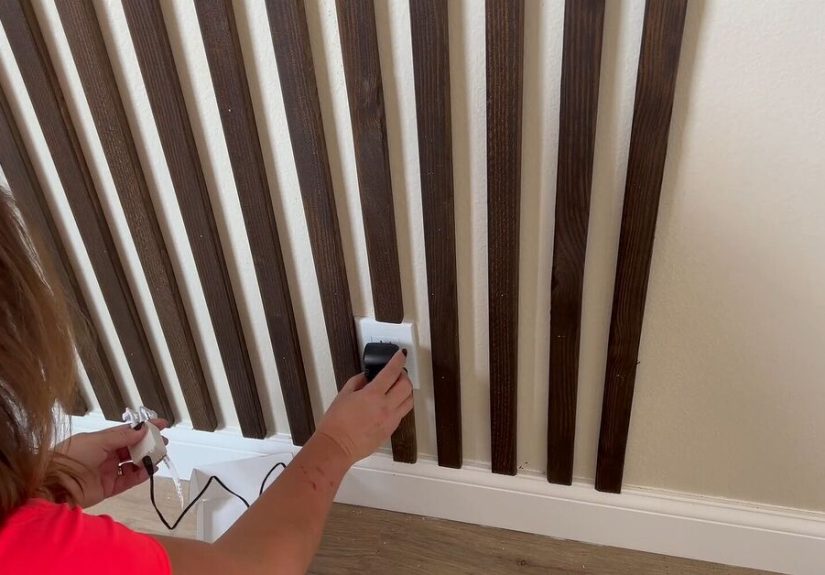
Pre-finishing is a big quality upgrade: it’s easier to stain/paint slats flat than to do it on the wall while balancing on a ladder.
Sand edges so the slats look intentionalnot like they were chewed by an anxious beaver.
Finish options:
- Natural + clear coat: warm, modern, shows grain
- Stain: consistent tone (great if boards vary)
- Paint: bold, graphic, easy to match trim
4) Mark your starting line (your entire wall depends on this)
Draw a perfectly plumb vertical line where your first slat will go. If the first slat is off,
the last slat will be off in a way that feels personal.
5) Decide where the LEDs will live
Before you attach any wood, plan the lighting route:
- Between slats: LED strip runs in a channel in the gap for a “floating glow” effect.
- Behind slats: LED strip mounted on the wall/backer, washing light sideways through the gaps.
- Edge backlighting: LEDs around the perimeter, lighting the wall behind the slat field.
Pro look tip: Aluminum channels with diffusers help prevent hotspots, keep strips straighter, and can improve heat management.
6) Install LED channels (if using them) and run wiring
Mount channels straight and secure (screws often beat sticky tape on textured walls). Pre-plan where the power supply
and controller will sitideally accessible (like inside a media console, cabinet, or a discrete access panel).
If you need to pass wires through the wall, consider local electrical rules and use appropriate in-wall wiring methods.
When in doubt, consult an electricianLEDs are low voltage, but wall cavities are not the place for mystery setups.
7) Attach the first slat
Apply construction adhesive to the back of the slat (a zig-zag or wave pattern helps with coverage),
press it onto the wall aligned with your plumb line, then tack it with nails to hold it while the adhesive cures.
8) Use a spacer block for perfect gaps
The secret to a clean, professional slat wall is consistency. Cut a small piece of scrap wood to your chosen gap width
and use it as a spacer for every slat. Repeat: every slat. Yes, even when you “think it’s close enough.”
Close enough is how gaps start telling on you in direct sunlight.
9) Continue across the wall (and keep checking level)
Work steadily, checking alignment every few slats. Walls aren’t always straight, floors aren’t always level,
and reality rarely reads the same blueprint you drew in your head at 1 a.m.
10) Add finishing touches
- Fill nail holes, sand lightly, and touch up paint/stain.
- Caulk edges if needed for a built-in look (especially where slats meet trim).
- Consider a slim border trim to “frame” the slat area if you want a more architectural finish.
LED Setup: Make It Bright, Even, and Safe
Choose the right voltage and brightness
Most LED strips are 12V or 24V. For longer runs, 24V is often easier to manage because it can reduce visible voltage drop
(dimming toward the end). No matter what you choose, the strip voltage and power supply voltage must matchno improvising.
Brightness tip: For an accent glow, you usually want “pleasant,” not “interrogation room.” A dimmer or smart controller makes a huge difference.
Power supply sizing (don’t underfeed your LEDs)
Add up the total wattage your strips will use (watts per foot × total feet). Then choose a power supply rated higher than that total.
A common rule is to give yourself about 20% headroom so the power supply isn’t running at its limit.
Example: Your LED strip is 4 watts/ft and you’re using 16 ft. Total = 64 watts. Add headroom: 64 ÷ 0.80 ≈ 80W minimum.
Run length and wiring layout
Many LED strips have a recommended maximum continuous run length. If your wall needs more, you’ll often get better brightness and consistency by wiring
in parallel (multiple shorter runs fed from the power supply/controller) instead of one very long chain.
Diffusion: the difference between “glow” and “visible dots”
If your LEDs are visible through gaps, a diffuser channel can help smooth the light. Another option is using “COB” style LED strips,
which can appear more continuous. If your design is all about a clean line of light, diffusion is your best friend.
Driver location and accessibility
Keep the driver/power supply in a spot with ventilation and access. You may need to reset or replace it eventually, and you don’t want your future self
opening the wall like a piñata. Also, look for quality components (many homeowners prefer UL-listed components for peace of mind).
Smart control options
- Dimmer switch: simplest for single-color strips
- Remote or app controller: great for RGB/RGBW
- Smart home integration: scenes like “Movie Night,” “Focus Mode,” and “Pretend I’m Not Home”
Design Upgrades That Make Your Slat Wall Look Custom
- Wrap a corner: Continue slats onto an adjacent wall for a high-end architectural vibe.
- Mix widths: Alternate slat widths for a more designer pattern (measure carefully).
- Frame it: Add a clean border trim to make it look like a built-in wall feature.
- Integrate a shelf or media console: Let lighting wash behind furniture for layered depth.
Common Mistakes (So You Don’t Join the “I Had to Rip It Off” Club)
- Starting crooked: If the first slat isn’t plumb, the whole wall will drift.
- Inconsistent spacing: Use a spacer block every time.
- Skipping pre-finish: Painting/staining on the wall takes longer and looks messier.
- Underpowered LEDs: Too-small power supplies can cause dimming, flicker, or failures.
- Messy cable plan: You can hide wires, but only if you plan where they go.
Maintenance and Longevity
Dust the slats occasionally (a microfiber duster is perfect). If you sealed the wood, it will wipe clean more easily.
For LEDs, keep the driver ventilated and avoid pinching wires during furniture moves. If a strip fails, accessible channels and controllers
make repairs far less dramatic.
Experiences and Real-World Lessons (About )
If you’ve never built a slat wall with LEDs before, here are the “this is what it feels like in real life” moments people tend to run into
and what they usually do about them.
First: almost everyone starts confident… right up until the first slat goes on. The wall looks empty, the line feels too bold,
and your brain whispers, “Are we sure?” This is normal. Slat walls don’t look “right” until you’re a decent way inusually a third of the wall.
After that, it clicks, and suddenly the room looks like it got a renovation montage.
Second: you learn quickly that “my wall is straight” is a beautiful myth. Drywall can bow, corners can be slightly out,
and ceilings can slope. This is why people rave about laser levels and why checking alignment every few slats is a sanity saver.
The goal isn’t perfection in a mathematical senseit’s consistency that reads as intentional.
Third: spacing becomes your personality for a weekend. DIYers often say the spacer block is the unsung hero of the whole project.
Without it, gaps drift little by little, and you won’t notice until the last few slatswhen fixing it means either living with it forever
or pulling pieces off and starting a small internal debate about the meaning of life. The “best” experience is when you treat spacing like a ritual:
place spacer, place slat, check, nail, repeat. It’s almost meditative… until you drop a nail and it disappears into an alternate dimension.
Fourth: lighting is where people either feel like geniuses or discover new creative swear words. The most common aha-moment is that
LEDs look different in daylight versus at night. In daylight, you want the wall to look clean and intentionaleven with lights off.
At night, you want a smooth glow without harsh dots. That’s why many DIYers end up grateful they used channels and diffusers, or chose a strip style
that looks continuous. The second aha-moment: you really do want a dimmer. What feels like “nice mood lighting” in the store can feel like
“landing strip at a regional airport” in your bedroom at 11 p.m.
Fifth: the “where do we put the power supply?” question always arrives late if you don’t answer it early.
People who enjoy the project most usually plan an accessible hiding spotlike behind a TV console, inside a cabinet, or near an outlet where
a tidy cable cover can disappear. People who don’t plan it end up staring at a power brick like it’s a betrayal.
And finally, the best experience report you’ll hear: when it’s done, the room feels upgraded in a way paint alone can’t do.
The wall becomes a feature, the lighting adds atmosphere, and visitors will ask where you bought it. You can choose to tell them it was a custom install…
or you can tell the truth and accept your new title: “person who can’t be stopped with a level and a plan.”
Conclusion
A stunning wood slat wall with LED lights is one of those rare DIY projects that looks high-end but is completely doable with careful planning.
Nail your layout, keep spacing consistent, pre-finish your slats, and treat the LED setup like a real systemnot an afterthought.
Do that, and you’ll end up with a wall that looks incredible in daylight and glows like a design feature at night.