Table of Contents >> Show >> Hide
- Why Fake WhatsApp Numbers Work So Well
- Warning Sign #1: They Ask for a Code (Or Say They “Accidentally” Sent It to You)
- Warning Sign #2: The “Wrong Number” Opener That Turns into Friendship (Then a Financial Pitch)
- Warning Sign #3: The Number and Profile Don’t Match the Story
- Warning Sign #4: Urgency + Unusual Requests (Money, Gift Cards, Crypto, Personal Info)
- The Quick Checklist: How to Verify a WhatsApp Number Safely
- Built-In WhatsApp Safety Moves Worth Using
- If You Already Replied: What to Do Next
- Common Fake WhatsApp Number Scenarios (With Specific Examples)
- Wrap-Up: Trust Is Earned, Not Texted
- Experiences From the Real World: What Fake WhatsApp Numbers Look Like “In the Wild” (Extra )
- SEO Tags
WhatsApp is the digital equivalent of a front porch: friends stop by, family drops news, and sometimes a stranger wanders up
pretending they “totally know you.” The tricky part? On WhatsApp, a phone number can look legit while the person behind it
is anything but.
A “fake WhatsApp number” usually means one of three things: (1) a scammer using a throwaway or virtual number, (2) someone
impersonating a real person or business, or (3) a hijacked WhatsApp account where the number is real, but the owner isn’t
the one typing. In all cases, the goal is the same: get your trust, then get your money, your information, or your account.
This guide breaks down four warning signs that a WhatsApp number is suspiciousplus a simple verification
checklist, practical examples, and what to do if you already responded.
Why Fake WhatsApp Numbers Work So Well
WhatsApp messages feel personal. They arrive like texts from “real people,” not like an email from “Definitely-A-Bank-Trust-Us.ru.”
Scammers take advantage of that comfort. They also rely on two common assumptions:
- Assumption #1: “If it’s on WhatsApp, it must be someone with a real number.”
- Assumption #2: “If the profile photo looks normal, the person is normal.” (Spoiler: stock photos exist.)
WhatsApp’s end-to-end encryption protects message content in transit, but it doesn’t guarantee the sender is who they claim
to be. Your best defense is old-school: verification, skepticism, and refusing to be rushed.
Warning Sign #1: They Ask for a Code (Or Say They “Accidentally” Sent It to You)
If you remember only one thing from this article, make it this: no legitimate person needs your verification code.
Not your friend. Not a company. Not “WhatsApp Support.” Not your future spouse from the internet with a suspiciously perfect jawline.
What it looks like
- “Hey! I’m trying to log inwhat’s the 6-digit code you just got?”
- “Oops, I sent my code to your number by mistake. Can you forward it?”
- “We need to verify your account to prevent deletion. Reply with the code.”
Why it’s a big deal
Verification codes are the keys to the kingdom. If a scammer convinces you to share one, they can try to register your number
on a different device and take over your account. From there, they can message your contacts as “you” and run scams that sound
painfully believable: “I’m locked out of my bank accountcan you send $100?”
What to do instead
- Do not share any code. Not even “just this once.” That’s how scams pay rent.
- Stop engaging. Block and report the number inside WhatsApp.
- Harden your account: enable two-step verification in WhatsApp settings and consider adding an email for recovery.
Quick gut-check: If the message makes you feel like you must act now to prevent something bad, it’s often designed that way.
Real support channels don’t demand panic as payment.
Warning Sign #2: The “Wrong Number” Opener That Turns into Friendship (Then a Financial Pitch)
Some WhatsApp scams start as a harmless mistake: “Hi Sarah, are we still on for dinner?” You reply, “Wrong number,” and they respond,
“Oh my goodness, sorry! You seem kindhow’s your day?” Congratulations: you’ve been selected for the Human Decency Olympics.
What it looks like
- A polite “oops” message from an unknown number, often followed by small talk.
- They quickly move the conversation to daily life, photos, work, or relationships.
- Within days (sometimes hours), they mention a “great opportunity”: investing, crypto, “task jobs,” or a “mentor” who made them rich.
Why it’s suspicious
Normal wrong-number conversations end with: “Sorry!” and then silence. Scam wrong-number conversations end with: “Here’s how I doubled
my money this week.” That escalated quicklylike going from “Hello” to “Let’s co-sign a yacht.”
Red flags inside the chat
- Too friendly, too fast: pet names, emotional bonding, or personal questions early on.
- “Move off-platform” pressure: pushing you to another app, a “private group,” or a sketchy website.
- Money talk disguised as advice: “I just want to help you succeed.” (They also want to help themselves succeed… with your wallet.)
What to do
You don’t owe strangers a conversation. If a chat begins with a mistake and ends with a pitch, treat it like a telemarketer in a trench coat:
back away slowly, block, and report.
Warning Sign #3: The Number and Profile Don’t Match the Story
Fake WhatsApp numbers often “feel” off when you look at the details. Scammers might claim they’re local, a known business, or your cousin’s new number
but the profile and number metadata tell a different story.
What to check in 15 seconds
- Country code mismatch: They claim to be in New Jersey, but the number begins with a country code that doesn’t fit the story.
- Profile photo weirdness: No photo, a too-perfect model headshot, or an image that feels “stock.”
- Thin profile info: No status, no recognizable details, or generic lines like “Living my best life.” (Who isn’t?)
- Name tricks: They use a familiar name (“Mom,” “Boss,” “Support Team”) hoping you’ll fill in the blanks.
A practical example
Imagine you get a message: “Hi, this is your bank fraud department.” The profile photo is a logo, the name is “Bank Support,” and the number isn’t one you’ve
ever seen on official communications. Even if the message sounds professional, the identity isn’t verifiedso the safest move is to hang up (or stop replying)
and contact the organization using an official phone number from a statement, card, or the company’s real website.
One more clue: they avoid real-time verification
Many scammers prefer typing because it keeps them in control. If you ask to verify through a phone call, video call, or a known channel, they may dodge:
“My mic is broken,” “I’m in a meeting,” “Call later,” “I can’t talk now.” Occasionally that’s trueoften it’s convenient.
Warning Sign #4: Urgency + Unusual Requests (Money, Gift Cards, Crypto, Personal Info)
The scam playbook is painfully consistent: create urgency, demand secrecy, and steer you toward a payment method that’s hard to reverse.
On WhatsApp, these requests can come wrapped in emotional packaging: “I’m stuck,” “I’m embarrassed,” “I need help right now.”
Common high-risk asks
- Money transfers: “Can you send $200? I’ll pay you back tonight.”
- Gift cards or crypto: “It’s faster.” (It’s also harder to recover.)
- Personal data: date of birth, address, account numbers, photos of ID, or any login details.
- “Keep this private” requests: secrecy is a scammer’s favorite mood lighting.
How real people verify before sending anything
If the message claims to be a friend or family member, verify in a separate channel: call the person’s known number, FaceTime them, or message them on a platform
you already used before the “new number” appeared. If the message claims to be a business or government agency, contact the organization through an official number
(statement, website you type in yourself, or the number printed on the back of your card). Don’t use a number or link provided in the suspicious message.
The Quick Checklist: How to Verify a WhatsApp Number Safely
When you’re unsure whether a WhatsApp number is fake, run this checklist. It takes less time than microwaving popcorn and usually ends with fewer regrets.
- Pause: Don’t reply instantlyurgency is the scammer’s fuel.
- Check the basics: country code, profile photo, name, and whether the story matches.
- Refuse codes: never share verification or one-time passcodesever.
- Verify identity off WhatsApp: contact the person or company using a known, official method.
- Don’t click unknown links: especially shortened URLs or “urgent” pages asking you to log in.
- Block and report: if it feels wrong, end it. You’re not obligated to be polite to predators.
Built-In WhatsApp Safety Moves Worth Using
WhatsApp can’t magically prevent every scam, but it does give you tools that make life harder for scammers and easier for you.
1) Turn on Two-Step Verification
Two-step verification adds an extra PIN needed to access your account. It’s one of the simplest ways to reduce account-takeover riskespecially against code-based tricks.
2) Review Privacy Settings Like a Bouncer
Consider limiting who can see your profile photo, status, and “About” info. Scammers love public details because they help personalize an attack. The less they can observe,
the less convincing their impersonation becomes.
3) Use Block and Report
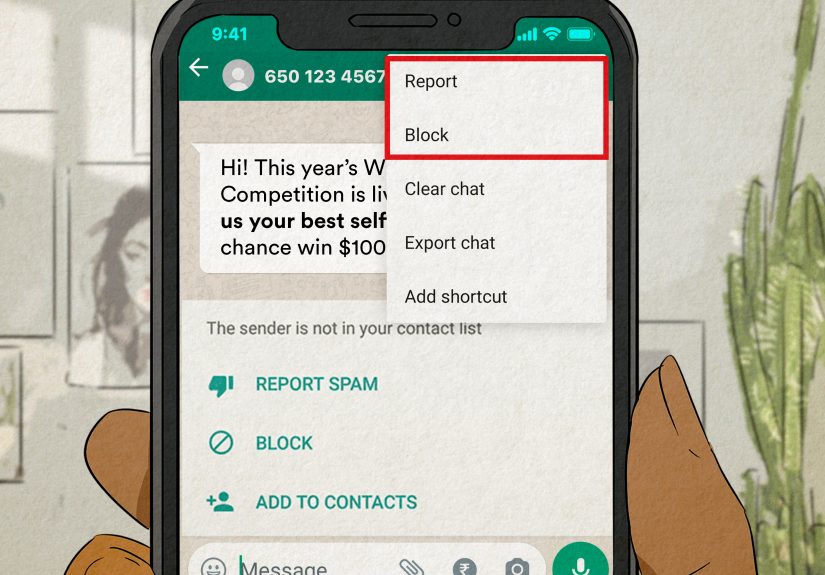
Blocking stops further contact. Reporting helps WhatsApp investigate spammy or abusive accounts. If a number is clearly scamming, don’t “debate” themreport and move on.
4) Be Cautious with Group Invites
Random group additions are a common scam vector. If you’re invited to a group you don’t recognize, leave. If you’re asked to click links, pay fees, or join “investment”
chats, treat it like a digital back alley: no sightseeing.
If You Already Replied: What to Do Next
First: don’t panic. A reply alone doesn’t doom you. What matters is whether you shared sensitive information, clicked a link, or sent money.
If you shared a verification code (or suspect account takeover)
- Immediately enable two-step verification if you still have access.
- Review linked devices (like WhatsApp Web) and log out of anything you don’t recognize.
- Tell close contacts you may have been targeted so they ignore unusual requests “from you.”
If you clicked a suspicious link
- Close the page and don’t enter credentials.
- If you did enter credentials, change the password on that account immediately and enable MFA.
- Watch for follow-up phishing: scammers often try again with “urgent security alerts.”
If you sent money
- Contact your bank or payment provider right awayspeed matters.
- Save evidence: screenshots, usernames, numbers, and any payment receipts.
- Report the scam through official reporting channels appropriate to your location and payment method.
Common Fake WhatsApp Number Scenarios (With Specific Examples)
Here are realistic scenarios people run into, with what to look for and how to respond.
Scenario A: “I’m your bossurgent invoice”
A message arrives: “Need you to pay this invoice right now. Don’t tell anyone. Use this link.” The number is unknown, the tone is urgent,
and the secrecy is weirdly dramatic. The fix: verify via your company email directory, call the boss’s known phone number, or check with a coworker.
Real finance processes don’t start with surprise WhatsApps and end with gift cards.
Scenario B: “You won a prizejust pay a small fee”
You’re told you won something, but to claim it you must “verify identity” or pay a fee. That’s not winning; that’s shopping under duress.
Block and report. If it’s real, you can verify through official channelswithout paying strangers first.
Scenario C: “Task job” or “easy money” pitch
A recruiter messages: “Work from home! Earn $200/day clicking tasks.” Then comes the twist: you must deposit money to “unlock” higher earnings.
Legit jobs don’t require you to pay to get paid. Treat it as a scam and walk away.
Wrap-Up: Trust Is Earned, Not Texted
Identifying a fake WhatsApp number isn’t about being paranoidit’s about being appropriately skeptical in a world where scammers industrialize trust.
Remember the four warning signs:
- Code requests (verification or “oops I sent it to you”) are a giant red flag.
- Wrong-number chats that turn into friendship and then money talk are often scams.
- Profile/number mismatchesespecially country codes and thin profilessignal impersonation or burner accounts.
- Urgent money/info requests plus secrecy are classic scam tactics.
Slow down, verify through a trusted channel, and use WhatsApp’s block/report tools without guilt. Your attention is valuabledon’t donate it to scammers.
Experiences From the Real World: What Fake WhatsApp Numbers Look Like “In the Wild” (Extra )
People often imagine scams as obviouslike a cartoon villain typing, “Hello I am totally your bank, please send money.” In reality, the most effective fake WhatsApp
numbers succeed because the messages feel ordinary. They blend into your daily life the way junk mail blends into a stack of coupons: quietly, until it’s not.
One common experience starts with polite confusion. Someone receives a simple “Hi” or “Are you available?” and responds out of habit. The scammer
keeps the tone warm, calm, and conversational, like a stranger in line at a coffee shop. The moment the target shows they’re willing to engage, the scammer begins
testing boundaries: asking where you’re from, what you do, whether you’re “open-minded,” or if you’ve ever “invested before.” The content isn’t the trickthe
momentum is. The scam only works if you keep replying.
Another pattern people describe is the impersonation jolt: you get a message from a number you don’t recognize that claims to be a friend or family member
with a “new phone.” At first, it sounds plausiblepeople change numbers all the time. Then the message becomes oddly scripted: short sentences, repeated urgency, and
a request that doesn’t match the person’s normal behavior. The easiest way out is also the most reliable: contact the real person using a number you already have.
Many people say the instant they tried to verify with a call, the scammer got irritated or made excuses. That reactionannoyance at verificationis the tell.
Some experiences are less dramatic but more dangerous: the verification-code trap. A target receives a code and, seconds later, a message: “I’m locked out,
can you send it?” Victims often say the request felt “small,” like helping someone reset a password. The regret hits fast because the code isn’t a favorit’s access.
Afterward, scammers may message the victim’s contacts pretending to be them. People who’ve been through this often describe the same lesson: if a request involves codes,
passwords, or “just confirming,” treat it like handing a stranger your house keys because they promised they only wanted to borrow your hallway.
Then there’s the group chat ambush. Someone gets added to a group named something official-sounding“Community Grants,” “VIP Trading Tips,” “Benefit Support.”
Members appear to be chatting enthusiastically, sharing “wins” and screenshots of payouts. Victims later realize the group was staged to create social proof. The experience
is usually the same: the group pushes a link, a sign-up, or a deposit. People who avoid losing money often do one simple thing: they leave the moment a group asks for
payment, personal info, or off-platform registration. No arguing. No explaining. Just exit.
Across these experiences, the most consistent theme is speed vs. safety. Scammers want speed: quick replies, quick trust, quick payments. Safety takes
a beatchecking the number, verifying through a known channel, refusing to be rushed. If you build the habit of pausing before you respond, you’ll spot fake WhatsApp
numbers faster than scammers can type their next line.