Table of Contents >> Show >> Hide
- Why Safe Formula Preparation Matters
- Start With the Basics Before You Mix Anything
- How to Prepare Baby Formula Safely
- Special Precautions for Powdered Formula
- How to Store Baby Formula Correctly
- How to Make Formula Feeding Easier Day to Day
- Common Formula Mistakes to Avoid
- A Simple Example of a Safe Formula Routine
- Real-Life Experiences Around Preparing and Storing Baby Formula
- Final Thoughts
Preparing baby formula sounds simple until you are doing it one-handed at 2:13 a.m. while your baby is auditioning for a role in a tiny, very loud opera. The good news is that safe formula prep is not complicated. It just needs to be consistent. When you know how to mix, warm, store, and toss formula the right way, you protect your baby from germs, prevent nutrition mistakes, and make daily feeding a whole lot less stressful.
This guide breaks down exactly how to prepare and store baby formula in a practical, real-world way. You will learn what to do before you open the container, how to mix different types of formula correctly, how long formula can stay out, what belongs in the refrigerator, what needs to be thrown away, and which common shortcuts are absolutely not worth the risk.
Why Safe Formula Preparation Matters
Baby formula is designed to provide complete nutrition, but it has to be prepared and stored properly to stay safe. The biggest problems usually come from four issues: using the wrong water or wrong formula-to-water ratio, poor bottle hygiene, storing prepared bottles too long, and saving leftovers after a feeding. Tiny mistakes can add up fast, especially in the newborn stage when babies are more vulnerable.
One detail many caregivers do not realize is that powdered infant formula is not sterile. That does not mean it is unsafe when used correctly. It means you have to handle it carefully, follow the label exactly, and use extra caution for babies who are younger than 2 months, premature, or have weakened immune systems. In those cases, your pediatrician may recommend extra steps or even a sterile liquid formula option.
Think of formula prep like baking, except the customer is extremely picky, cannot explain the complaint, and deserves zero kitchen shortcuts. Precision matters.
Start With the Basics Before You Mix Anything
Wash your hands first
Before you touch the formula container, bottles, nipples, or water, wash your hands well with soap and water. It is the easiest safety step and the one people skip most often when they are tired. Unfortunately, germs do not care that you have only had four hours of sleep.
Use clean feeding supplies
Make sure bottles, nipples, caps, rings, and any mixing tools are clean and completely dry before use. If you are using a bottle brush or wash basin, keep those clean too. Damp gear sitting around the sink is not a charming rustic nursery detail. It is just a way to invite germs to the party.
Check the formula container
Always look at the container before opening it. Do not use formula that is expired, dented, swollen, leaking, rusty, or damaged. The label matters too. Read the mixing instructions every time, even if you think you know them. Different brands and types are not always mixed the same way.
Know your water source
For most families in the United States, safe tap water can be used to prepare powdered or concentrated liquid formula unless there is a known issue with the local water supply. If your water source is questionable, you use private well water, or you are traveling somewhere with uncertain water quality, ask your pediatrician or local health department what is safest. When in doubt while traveling, use purified or properly boiled water.
How to Prepare Baby Formula Safely
Step 1: Identify the type of formula
There are three main forms of infant formula, and each has its own rules:
- Powdered formula: Mixed with water. Most affordable, but not sterile.
- Concentrated liquid formula: Also mixed with water, but only in the amount listed on the label.
- Ready-to-feed formula: No water needed. Just pour and serve.
This is where many mistakes happen. Never add water to ready-to-feed formula unless the label tells you to, and never “eyeball” the dilution for powder or concentrate. Formula is not soup. You cannot freestyle it.
Step 2: Measure water first when required
If you are preparing powdered or concentrated formula, pour the exact amount of water into a clean bottle or clean mixing container first, then add the formula as directed. This helps you get the ratio right. Adding extra powder to make a bottle “more filling” or extra water to make the can last longer can be dangerous. Too much water can dilute nutrients and upset electrolyte balance. Too much powder can make the feed too concentrated and hard on your baby’s body.
Step 3: Add the exact amount of formula
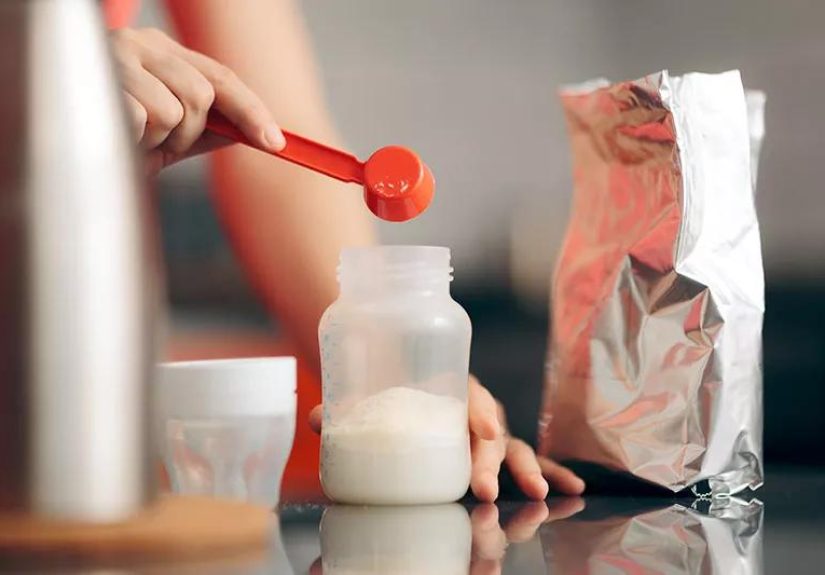
Use the scoop that came with the formula unless the label says otherwise. Level the scoop as directed. Do not pack it down like brown sugar for cookies. Formula directions are written for accuracy, not creativity.
Step 4: Mix well
Cap the bottle and shake gently until the formula is fully dissolved. If you are preparing several bottles at once, a clean pitcher can work well, especially for busy families or daycare prep. Once mixed, pour the amount you need into each clean bottle.
Step 5: Cool if needed
Formula does not have to be warmed. Many babies are perfectly happy drinking it at room temperature or cool. If you do warm it, place the bottle in warm water or use a bottle warmer according to the manufacturer’s instructions. Never microwave formula. Microwaves can create hot spots that may burn your baby’s mouth even when the bottle itself does not feel very warm.
Step 6: Test the temperature
Before feeding, put a few drops on your wrist or the back of your hand. It should feel lukewarm, not hot. Baby feeding is not the place for surprise lava.
Special Precautions for Powdered Formula
Because powdered formula is not sterile, some babies need extra caution. Babies younger than 2 months, babies born prematurely, and babies with weakened immune systems are at higher risk for serious illness from certain germs, including Cronobacter. For these infants, ask your pediatrician whether you should use sterile liquid formula or prepare powdered formula with extra precautions.
One commonly recommended extra step for high-risk babies is preparing powdered formula with very hot water, around 158°F or 70°C, to help reduce germs. That sounds intimidating, but it usually means boiling water, letting it cool for about 5 minutes, mixing the formula, and then cooling the bottle to feeding temperature before use. This should only be done carefully and exactly as advised for your child.
How to Store Baby Formula Correctly
Room temperature rules
Prepared formula should be used within 2 hours of preparation if left at room temperature. Once your baby starts feeding, the clock moves faster. Any formula left in the bottle should be thrown away within 1 hour after feeding begins. That is because saliva gets into the bottle and can encourage bacterial growth.
Translation: if your baby drinks half the bottle, then falls asleep looking adorable and expensive, you still cannot save the rest for later.
Refrigerator rules
If you prepare formula ahead of time and your baby has not started drinking it yet, store it in the refrigerator right away and use it within 24 hours. Labeling bottles with the date and time can save a lot of guesswork, especially if more than one adult is helping with feeds.
If the formula was already fed from the bottle, do not refrigerate the leftovers for the next feeding. Leftover formula belongs in the trash, not in a “maybe later” section of the fridge.
Opened container rules
Opened powdered formula is typically stored with the lid tightly closed in a cool, dry place and usually should be used within about 1 month, though the package directions always win if they differ. Do not store powdered formula in the refrigerator, where moisture can cause clumping and contamination problems.
Opened ready-to-feed formula and concentrated liquid formula usually need to be covered, refrigerated, and used within 48 hours, depending on label directions. Again, the package instructions are your best friend here.
Freezer rules
Do not freeze prepared baby formula unless the manufacturer specifically says it is okay. Freezing can affect quality and texture, and it is generally not recommended for routine home use.
How to Make Formula Feeding Easier Day to Day
Batch prep can help
If your pediatrician is comfortable with it and you follow storage rules, preparing a day’s worth of formula in a clean pitcher can make life easier. Pour individual bottles as needed, keep the pitcher refrigerated, and use everything within 24 hours. This can be especially helpful for twins, daycare routines, or anyone who feels personally attacked by the phrase “make every bottle from scratch.”
Label bottles clearly
A simple label with the date and time can prevent midnight confusion. It also helps grandparents, babysitters, and childcare providers know exactly what is still safe to use.
Pack smart for outings
For short trips, many parents carry pre-measured powder in a dry dispenser and separate clean water in bottles until feeding time. For longer outings, use an insulated cooler with ice packs if you are carrying prepared formula. If you cannot keep it cold safely, it is usually better to prepare fresh bottles as needed.
Know when fresh is best
If the refrigerator loses power for several hours or the temperature becomes unsafe, it is smarter to toss questionable prepared formula and make a fresh bottle. Waste is frustrating. A sick baby is worse.
Common Formula Mistakes to Avoid
- Do not water down formula. Stretching formula to save money is dangerous because it changes the nutrient balance.
- Do not add extra powder. More powder does not mean a “better” bottle. It means the ratio is wrong.
- Do not microwave bottles. Hot spots can burn your baby.
- Do not save leftovers after a feeding. Once baby’s saliva enters the bottle, the countdown is on.
- Do not make homemade infant formula. It may be contaminated or nutritionally incomplete.
- Do not assume all formulas mix the same way. Read the label every time you switch brands or formula types.
- Do not ignore the use-by date. Formula is not a “close enough” product.
A Simple Example of a Safe Formula Routine
Let’s say your baby usually eats at 7 a.m., 10 a.m., 1 p.m., and 4 p.m. You could wash your hands, prepare enough formula for the next 24 hours in a clean pitcher at 6:30 a.m., label it, refrigerate it immediately, and pour each bottle when needed. If the 10 a.m. bottle is poured but not used right away, it should be offered within 2 hours or discarded. If the baby starts drinking from it, any leftovers should be tossed within 1 hour.
Or maybe you prefer to make bottles one at a time. That works too. The safest system is often the one you can repeat accurately when you are tired, busy, or handing instructions to someone else.
Real-Life Experiences Around Preparing and Storing Baby Formula
Many parents say the biggest surprise about formula feeding is not the mixing itself. It is how often the little decisions pop up all day long. One family may feel confident about the basics but still pause in front of the refrigerator asking, “Wait, when did we make this bottle?” Another may discover that the hardest part is not measuring powder but remembering whether that bottle was warmed already, offered already, or just living a mysterious second life on the kitchen counter.
A common early experience is the midnight bottle scramble. You finally get the baby settled, only to realize you forgot to prep the next feed. That is why many caregivers become loyal fans of a simple system: clean bottles lined up, fresh water ready, formula scoop dry, and a note on the fridge that says when the last batch was made. It sounds basic, but those tiny systems can turn chaos into something close to competence.
Another very real experience is learning that babies do not always cooperate with your perfect plan. You might warm a bottle beautifully, test it like a pro, and then your baby drinks exactly one ounce before deciding the meal is over. It feels wasteful to toss the rest, especially when formula is expensive, but this is one of the most important safety habits to keep. Parents often say that once they stop negotiating with leftover formula, bottle time becomes less confusing. The rule is simple, so nobody has to debate it while half-awake.
Daycare and caregiver handoffs bring their own lessons. Parents who label bottles with both the date and time usually have a much smoother day than those who rely on memory. Grandparents, babysitters, and partners are wonderful helpers, but they are not mind readers. A clearly labeled bottle saves repeated texting and removes the classic question, “I found one in the fridge. Is this from today or from the age of dinosaurs?”
Travel is another area where experience becomes the best teacher. Many families learn to keep powder and water separate until feeding time, especially for errands, flights, or long drives. It is lighter, simpler, and less stressful than carrying several already-mixed bottles and watching the clock like it is a game show. Parents also learn quickly that insulated coolers and ice packs are not optional accessories. They are part of the plan.
Then there is the emotional side. Feeding a baby can feel deeply personal, and parents sometimes worry they will be judged no matter what they do. In reality, what matters most is that your baby is fed safely and consistently. Families who formula feed often become experts in organization, observation, and routine. They know the smell of fresh formula, the sound of an actually hungry cry versus a “I would like to speak to management” cry, and the relief that comes from having one reliable system that works.
With time, the process becomes second nature. The scoop gets leveled automatically. The label gets checked without thinking. The leftover bottle gets tossed without guilt. And one day you realize you are making formula with the calm confidence of a person who once Googled, in total panic, whether one warm bottle on the counter for too long had ruined civilization. That is parenthood in a nutshell: you learn, you adapt, and you get very good at the basics that keep your baby safe.
Final Thoughts
Knowing how to prepare and store baby formula safely is one of those parenting skills that looks small on paper but matters every single day. The essentials are straightforward: wash your hands, use clean bottles, follow the label exactly, use safe water, refrigerate unused prepared formula promptly, and throw away leftovers after a feeding. Skip the shortcuts, trust the clock, and when something seems questionable, toss it and start fresh.
You do not need a fancy setup to do this well. You just need a routine that is accurate, repeatable, and easy enough to follow even when your brain is running on coffee fumes and nursery rhymes. Safe formula prep is not about perfection. It is about dependable habits that protect your baby and make feeding time less stressful for everyone involved.