Table of Contents >> Show >> Hide
- Why Learn the Riffle and Bridge Shuffle?
- Before You Start: Choose the Right Deck
- Technique 1: The Table Riffle Shuffle
- Technique 2: The In-the-Hands Riffle Shuffle
- Technique 3: The Bridge Shuffle Finish
- Common Mistakes Beginners Make
- How to Practice Without Wrecking Your Deck
- How Many Times Should You Shuffle?
- When to Use Each Technique
- Can Small Hands Learn to Riffle and Bridge Shuffle?
- Real-Life Experiences Learning the Riffle and Bridge Shuffle
- Final Thoughts
- SEO Tags
If you have ever watched someone shuffle cards with that crisp rrrip followed by a satisfying waterfall finish, you already know the riffle and bridge shuffle has serious main-character energy. It makes game night look classier, magic tricks look cleaner, and casual card handling look a whole lot less like you are angrily folding laundry.
The good news is that learning how to riffle and bridge shuffle cards is not reserved for poker dealers, magicians, or that one uncle who somehow makes every family gathering feel like a casino in 1968. With the right grip, a little patience, and a willingness to hear a few clumsy card noises at first, most beginners can learn it.
In this guide, you will learn three easy techniques: the table riffle shuffle, the in-the-hands riffle shuffle, and the bridge finish that makes the whole move look smooth and impressive. Along the way, we will cover common mistakes, how to practice without mangling your deck, and when this shuffle is actually useful instead of just flashy.
Why Learn the Riffle and Bridge Shuffle?
There are plenty of ways to mix a deck, but the riffle shuffle sits in the sweet spot between useful and cool. It is practical enough for card games, polished enough for poker night, and stylish enough for cardistry or simple sleight-of-hand routines.
It also teaches you a lot about card handling. Once you can control pressure with your thumbs, support packets with your fingers, and square the deck neatly, other moves start feeling less intimidating. In other words, the riffle shuffle is not just a shuffle. It is a gateway skill. Today you are learning a bridge finish. Tomorrow you are pretending you casually know what a faro shuffle is.
Before You Start: Choose the Right Deck
If you are practicing with an old, sticky deck that has been living in a kitchen drawer since the Obama administration, be kind to yourself and upgrade. A fresh, decent-quality poker-size deck is usually the easiest place to start. The cards flex better, feel more consistent, and give you more surface area to control.
That does not mean bridge-size cards are useless. They are narrower and can feel easier for smaller hands in some situations. But for learning a riffle and bridge shuffle, many card handlers prefer poker-size decks because they are a bit wider, more pliable, and easier to press and release in a controlled way.
Also, start on a soft surface if possible. A card mat, mouse pad, or clean tablecloth can help reduce sliding and make the learning process less chaotic. Hardwood table plus nervous beginner hands equals one very dramatic scatter shot.
Technique 1: The Table Riffle Shuffle
The table riffle shuffle is the classic version. It is neat, stable, and beginner-friendly because the table does some of the support work for you. If you want the easiest path into learning how to riffle shuffle cards, start here.
Step 1: Split the Deck
Cut the deck into two halves that are roughly even. They do not have to be mathematically perfect. You are learning a shuffle, not performing surgery.
Step 2: Place the Halves on the Table
Set the two packets in front of you with their inner corners angled toward each other. Keep a small gap between them. Your thumbs rest on the inner edges, while your index fingers curl lightly on top and your other fingers support the outer edges.
Step 3: Bend and Release
Apply gentle downward pressure so the inner corners flex upward slightly. Then begin releasing the cards with your thumbs in a controlled way so the two halves interlace. Think “zipper,” not “dump truck.” The goal is a steady ripple of cards, not one giant clump followed by panic.
Step 4: Push the Halves Together
Once the cards are interwoven, push the packets together carefully until they form one deck. At this stage, do not worry about the bridge yet. Just learn to make the cards mesh evenly and square up without spraying half the deck across the room.
Beginner Tip
If the cards keep dropping in chunks, your thumbs are probably releasing too many cards at once. Slow down. You want tiny, even releases from both halves. A shallow flex and lighter thumb pressure usually work better than trying to muscle the deck into obedience.
Technique 2: The In-the-Hands Riffle Shuffle
Once the table version feels comfortable, try the in-the-hands riffle shuffle. This is the version that looks more casual, more stylish, and a little more magical. It is also the one that makes beginners suddenly realize how much work their fingers normally let their thumbs do.
Step 1: Hold a Packet in Each Hand
Split the deck into two halves. Hold one packet in each hand. Your thumbs rest along the inner edges, your index fingers can curl gently over the top, and your middle and ring fingers support the outer sides. A slightly deeper grip usually gives you more control than balancing the cards only on your fingertips.
Step 2: Bring the Inner Corners Together
Angle the two packets inward so their inner corners meet. The packets should look symmetrical and feel balanced. If one half is tilted awkwardly, the weave will be awkward too.
Step 3: Riffle the Edges
Use your thumbs to release the cards in small bursts so the two halves interlace. Do not worry if the first few attempts sound more like a coughing accordion than a polished riffle. That is normal. The important part is learning how much pressure creates a smooth release.
Step 4: Let the Packets Meet
After the cards weave together, bring the packets closer until they form one joined deck. Keep your fingers supporting the outer edges so the shape stays controlled.
Why This Version Matters
The in-the-hands riffle shuffle is useful when you are standing, walking around a table, performing a card trick, or just trying to look like a person who has shuffled cards before. It also naturally flows into the bridge finish, which is where the move gets its charm.
Technique 3: The Bridge Shuffle Finish
Now for the part everyone actually remembers. The bridge shuffle, sometimes called the cascade or waterfall finish, happens after the two halves have already interlaced. It is not the mixing part. It is the flourish that releases tension and lets the deck settle back into one squared pack.
Step 1: Start From an Interlaced Deck
After completing a table or in-the-hands riffle, keep the interwoven deck lightly compressed.
Step 2: Bend the Joined Deck Upward
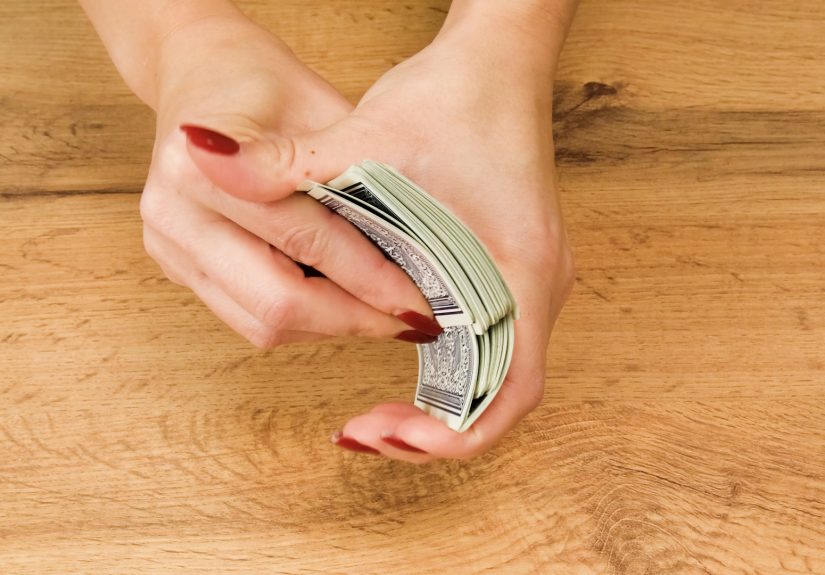
Use both hands to bend the center of the deck upward into a gentle arch. Your thumbs and fingers should support the sides while your palms stay relaxed. This is a controlled bend, not an attempt to fold the deck into modern art.
Step 3: Release Pressure Gradually
As you reduce pressure, the cards will spring downward in sequence and settle together with that classic cascading sound. Done well, it looks elegant and feels ridiculously satisfying.
Step 4: Square the Deck
Once the cascade is finished, tap the deck lightly on the table or against your palm to square the edges. A beautiful bridge followed by a crooked deck is like ironing one sleeve and calling it fashion.
Important Reminder
The bridge should be gentle. Too much force can stress the cards, warp the deck, or create a release so violent that your shuffle turns into modern dance. You want control, not drama.
Common Mistakes Beginners Make
Using Too Much Force
This is the big one. Many beginners assume the riffle and bridge shuffle requires strength. It does not. It requires controlled pressure. Too much force leads to bent cards, loud clumps, and the kind of shuffle that makes everyone politely look away.
Releasing Too Many Cards at Once
If the halves are not interlacing evenly, slow the thumb release. Aim for a more consistent trickle of cards from both packets.
Practicing With Bad Cards
Sticky, soft, or badly warped cards fight back. Use a decent deck when learning, especially in the beginning.
Skipping the Squaring Step
Even a good shuffle can look sloppy if the deck is left uneven. Get in the habit of squaring the cards after every attempt.
Trying to Master Everything in One Sitting
Learn the mechanics in layers. First, split and grip. Then riffle. Then interlace cleanly. Then bridge. If you try to speed-run the whole thing, your deck will file a complaint.
How to Practice Without Wrecking Your Deck
Start with five-minute practice sessions instead of marathon shuffling. Short, focused practice helps you build finger control without turning your hands into irritated claws. Try this simple routine:
- Practice splitting the deck evenly 10 times.
- Practice just the thumb release with one packet in each hand.
- Do 10 slow riffles without worrying about the bridge.
- Finish with 10 gentle bridge attempts.
It also helps to practice with relaxed hands. Tension is the enemy of smooth shuffling. If your shoulders are creeping upward and your jaw is clenched, congratulations, you are not shuffling cards anymore. You are preparing for battle.
How Many Times Should You Shuffle?
Here is the part that surprises people: one impressive riffle and bridge does not automatically mean the deck is thoroughly mixed. It looks great, sounds convincing, and absolutely improves the order of the deck, but repeated shuffles are what really randomize the cards.
That is why many formal dealing procedures use multiple shuffling actions rather than one showy flourish. For casual games at home, a few solid riffles mixed with a cut are usually more sensible than one superhero bridge followed by a smug nod.
So yes, learn the bridge because it is fun and elegant. Just do not confuse style with statistical destiny.
When to Use Each Technique
Use the Table Riffle Shuffle When:
- You are learning the basics.
- You want stability and control.
- You are dealing for a card game at a table.
Use the In-the-Hands Riffle Shuffle When:
- You are standing or moving around.
- You want a more natural, magician-style shuffle.
- You are practicing card handling skills beyond basic game play.
Use the Bridge Finish When:
- You want the shuffle to feel polished and complete.
- You enjoy cardistry flair.
- You want your cards to settle neatly after interlacing.
Can Small Hands Learn to Riffle and Bridge Shuffle?
Absolutely. Hand size can change what feels comfortable, but it does not disqualify you. Smaller hands may benefit from a slightly looser packet size at first, a softer grip, or starting with bridge-size cards before moving to poker-size decks. The key is finding a grip that lets your fingers support the packets without strain.
If the full deck feels awkward, practice with half decks. Seriously. There is no rule that says your training montage has to begin with all 52 cards. Build coordination first, then add difficulty.
Real-Life Experiences Learning the Riffle and Bridge Shuffle
Learning how to riffle and bridge shuffle cards feels a lot like learning to whistle, use chopsticks, or reverse a car with confidence: when you watch someone else do it, it seems suspiciously easy. Then you try it yourself and discover your hands apparently missed several staff meetings.
Most beginners go through the same stages. The first stage is optimism. You split the deck, line up the packets, and think, “How hard could this be?” The answer arrives immediately in the form of twelve cards dropping at once, seven cards refusing to move, and one card shooting sideways like it has personal goals outside the group project.
The second stage is overcorrection. You squeeze too hard, bend the deck too much, and attempt to force the shuffle into existence through determination alone. This rarely works. The deck becomes stiff, your thumbs get jumpy, and the whole thing starts sounding less like a crisp riffle and more like someone stepping on a plastic salad container.
Then comes the strange but encouraging stage: partial success. You get one half of the deck to release beautifully, while the other half behaves like a stubborn filing cabinet. Or you nail the riffle but fail the bridge. Or the bridge works, but only with enough tension to make you wonder whether your cards will ever emotionally recover.
That in-between stage is where real progress happens. You start noticing the little details. A slightly deeper grip makes the packets steadier. A lighter thumb release creates a cleaner sound. A smaller bend gives you more control. Instead of trying to dominate the deck, you start cooperating with it. That is usually the exact moment the shuffle begins to click.
And when it finally clicks, it feels great. The cards interlace in a smooth ripple. The bridge releases in a soft cascade. The deck lands squared in your hands like it always belonged there. It is one of those tiny, oddly satisfying victories that makes you want to do it again immediately for no practical reason other than, “Did you hear that? That sounded amazing.”
There is also a social side to it. Once you can riffle and bridge shuffle comfortably, people notice. You do not need to announce anything. You just pick up the deck, shuffle cleanly, and suddenly everyone assumes you know at least three card tricks and maybe own a vest. It is an unfair amount of credit for a basic skill, but honestly, take the win.
What surprises many people is that the experience becomes calming. The rhythm of splitting, riffling, bridging, and squaring can be almost meditative. It gives your hands something deliberate to do. That is why card handling often becomes a hobby in itself. You start out wanting to shuffle better for game night, and next thing you know you are comparing finishes on card stock and casually using the phrase “packet control” like this is perfectly normal behavior.
So if your early attempts are messy, that does not mean you are bad at it. It means you are on schedule. Nearly everyone starts with clumps, crooked bridges, and random escapee cards. Smooth shuffling is not a talent people are born with. It is a coordination skill built one slightly less embarrassing attempt at a time.
Final Thoughts
If you want to learn how to riffle and bridge shuffle cards, the fastest route is simple: start with the table riffle, move to the in-the-hands riffle, and then add the bridge finish once the weave feels controlled. Keep the pressure light, the practice short, and the expectations realistic.
You do not need perfect hands, expensive cards, or a smoky backroom poker soundtrack. You just need repetition and a little patience. Before long, that clunky beginner shuffle turns into a clean ripple and a smooth cascade. And once that happens, good luck not shuffling every deck you see for the next six months.