Table of Contents >> Show >> Hide
- Quick primer: what the catalytic converter does (and why it fails)
- Symptom #1: Check Engine Light (especially P0420 / P0430)
- Symptom #2: Sluggish acceleration and loss of power (especially under load)
- Symptom #3: Poor fuel economy (your MPG quietly runs away)
- Symptom #4: Rotten egg or sulfur smell from the exhaust
- Symptom #5: Rattling or metallic noises under the car
- Symptom #6: Hard starting, stalling, or even a no-start in severe cases
- Symptom #7: Rough idle, hesitation, or misfires
- Symptom #8: Failed emissions test (or obvious exhaust changes)
- Symptom #9: Excessive heat under the car (sometimes a glowing converter)
- Okay… how do you confirm it’s the catalytic converter?
- Can you drive with a bad catalytic converter?
- How to help your catalytic converter live a longer, less dramatic life
- Conclusion
- Real-world experiences: what these symptoms look like in everyday life (about )
Your car has a tiny chemical factory tucked into the exhaust system. It’s called a catalytic converter, and it’s the reason your tailpipe
doesn’t smell like a villain’s lair (most days). When it goes bad, your vehicle may still run… but it’ll often run weird, waste fuel, trigger warning
lights, and occasionally perfume your driveway with “eau de rotten egg.”
In this guide, you’ll learn 9 bad catalytic converter symptoms (aka the most common signs of a failing catalytic converter),
why they happen, and what to do nextwithout keyword-stuffing you into boredom. Let’s diagnose the drama.
Quick primer: what the catalytic converter does (and why it fails)
The catalytic converter lives in the exhaust stream and uses precious-metal catalysts to help convert harmful exhaust gases into less harmful compounds.
In plain English: it’s an emissions “clean-up crew.” When it fails, it’s usually because:
- It gets clogged/restricted (exhaust can’t flow; engine can’t “breathe out”).
- It overheats and melts internally (often from misfires or running too richraw fuel hits the hot catalyst and turns it into a toaster).
- It gets contaminated (oil or coolant burning can coat the catalyst and reduce efficiency).
- It physically breaks (internal honeycomb cracks and rattles around like a maraca).
Important note: a “bad cat” is sometimes a symptom, not the root cause. If you replace the converter but ignore the misfire, oil consumption, or coolant leak that
killed it, the new converter may not live a long and fulfilling life.
Symptom #1: Check Engine Light (especially P0420 / P0430)
This is the classic opening act. Your check engine light comes on, you plug in a scanner, and you see codes like P0420 (“catalyst system efficiency
below threshold,” usually bank 1) or P0430 (bank 2). Many drivers feel personally attacked by these codes. Understandable.
Why it happens
Your car compares signals from oxygen sensors before and after the converter. If the converter isn’t doing its job, the downstream sensor readings look too similar
to the upstream readingsso the computer complains.
What else it could be
P0420/P0430 can be triggered by more than the converter itself: exhaust leaks, lazy oxygen sensors, engine issues that skew air-fuel ratio, or wiring problems.
Translation: don’t buy a converter just because your dashboard has feelings.
Symptom #2: Sluggish acceleration and loss of power (especially under load)
If your car used to merge onto the highway confidently and now merges like it’s writing a memoir about its childhoodpay attention. A clogged catalytic converter
can restrict exhaust flow and create backpressure, which steals power.
How it shows up in real driving
- Weak acceleration from a stop
- Struggling to climb hills
- Power fades at higher RPM (feels like your engine hit an invisible wall)
- Occasional “surging” or inconsistent throttle response
Why it happens
Engines need to inhale and exhale efficiently. If exhaling is restricted, performance sufferssimple biology, but for machines.
Symptom #3: Poor fuel economy (your MPG quietly runs away)
A failing converter can contribute to reduced fuel economysometimes subtly, sometimes “why am I at the gas station again?” levels.
If your driving habits haven’t changed but your fuel receipts look like a subscription service, the exhaust system may be part of the story.
Why it happens
When exhaust flow is restricted or sensor feedback is off, the engine may run less efficiently. In some cases, the system compensates by adjusting fuel delivery,
and you burn more gas to do the same work.
Symptom #4: Rotten egg or sulfur smell from the exhaust
This one is hard to miss and impossible to romanticize. A rotten egg smell (often described as sulfur) can happen when the converter isn’t converting
sulfur-related compounds effectively. It may appear at idle, in traffic, or after hard acceleration.
Why it happens
Fuel contains small amounts of sulfur. Normally, the converter helps reduce funky sulfur byproducts. When it’s not working wellor when it’s overheatingmore of that
odor escapes out the tailpipe.
Reality check
A rotten egg smell can also point to fuel mixture issues (running rich), so treat this as a strong cluenot a final verdict.
Symptom #5: Rattling or metallic noises under the car
Hear a rattling noise that seems to come from under the middle of the vehicleespecially on startup or when you rev the engine? The converter’s internal honeycomb
can crack and break apart. Once that happens, it can rattle around inside the metal shell.
What it sounds like
- A light metallic rattle at idle
- A harsher rattle when blipping the throttle
- A “tin can full of pebbles” vibe when accelerating
Not every rattle is the converter (heat shields can rattle too), but a converter rattle paired with other symptoms is a big neon arrow.
Symptom #6: Hard starting, stalling, or even a no-start in severe cases
A converter that’s badly clogged can create so much restriction that the engine struggles to runespecially at higher demand or sometimes even at idle.
You might notice longer crank times, stumbling starts, or stalling at stoplights.
Typical pattern
It can feel like the car runs “okay” cold, then gets worse as it warms up and exhaust flow demand increases. In extreme situations, the car may start and then die,
or refuse to start because it can’t push exhaust out.
Symptom #7: Rough idle, hesitation, or misfires
A failing catalytic converter can be connected to engine misfires in two ways:
- Cause: A restricted converter can contribute to poor breathing and rough running.
- Effect: Misfires (from bad plugs, coils, injectors, etc.) can dump raw fuel into the exhaust and overheat/melt the converter.
Either way, if you have rough idle + a converter efficiency code, don’t ignore the misfire. Fixing the root problem can save your converteror save the next one.
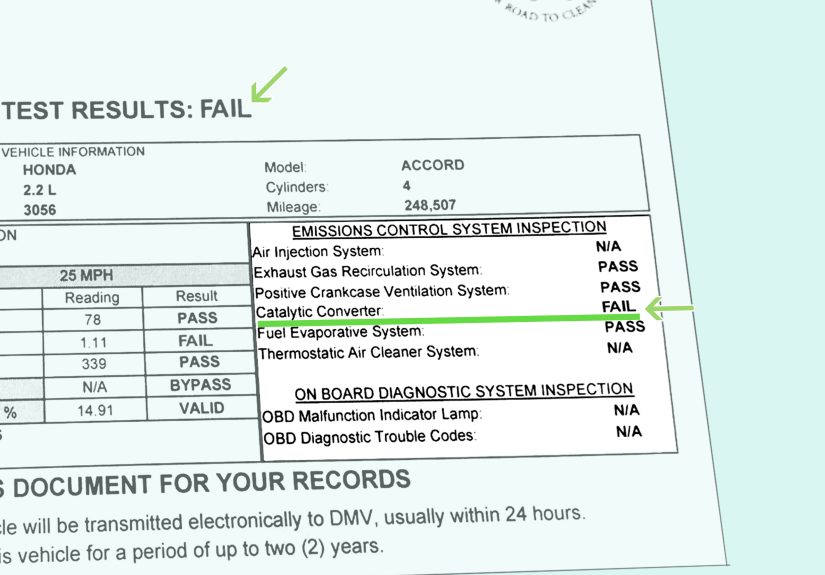
Symptom #8: Failed emissions test (or obvious exhaust changes)
If your vehicle fails an emissions inspection, a weak or damaged converter is a common suspect. Since the converter’s job is emissions cleanup, a failing unit can
lead to elevated pollutants and “not today” results at the testing station.
Other exhaust clues that can tag along
- Darker exhaust smoke than normal (can also indicate oil or fuel issues)
- Stronger exhaust odor than you’re used to
- Changes in exhaust tone (especially if the substrate breaks apart or restriction changes)
Remember: emissions failures can also come from upstream problems (fueling, misfires, oxygen sensors, leaks). A proper diagnosis matters.
Symptom #9: Excessive heat under the car (sometimes a glowing converter)
A converter that’s clogged or overheating can generate serious heat. Drivers sometimes notice a hot, burning smell or intense heat under the floorespecially after
driving. In severe cases, a converter can glow red-hot.
Why it’s a big deal
Excessive heat can damage nearby components (wiring, heat shields, underbody materials). It’s also a safety concern. If you suspect overheating, get it checked ASAP.
Okay… how do you confirm it’s the catalytic converter?
You don’t need to become a full-time exhaust detective, but a few smart checks can narrow things down:
1) Scan codes and look at the full picture
If you have P0420/P0430, check for other codes too (misfires, fuel trim issues, oxygen sensor codes). Fixing those first is often the correct order of operations.
2) Listen and sniff (yes, really)
Rattles, sulfur smells, and performance loss together are stronger evidence than any single symptom alone.
3) Consider professional tests
- Backpressure testing to measure restriction
- Temperature comparisons before and after the converter
- Smoke testing to find exhaust leaks that can mimic converter failure
- O2 sensor waveform analysis to verify catalyst efficiency behavior
If you’re not sure, a reputable shop can diagnose it quicklyand that’s often cheaper than guessing and replacing expensive parts.
Can you drive with a bad catalytic converter?
Sometimes yes… temporarily. But “can” and “should” are not the same. A failing converter can:
- Reduce power and create unsafe merging/passing situations
- Overheat and potentially damage nearby components
- Worsen fuel economy and drivability
- Mask (or be caused by) engine problems that get more expensive the longer you wait
If your car is stalling, losing power dramatically, or running extremely hot, treat it as urgent.
How to help your catalytic converter live a longer, less dramatic life
- Fix misfires quickly: a flashing check engine light often means “stop feeding raw fuel into the exhaust.”
- Keep up with maintenance: spark plugs, coils, air filters, and oil changes matter more than they get credit for.
- Address oil or coolant burning: these can contaminate the catalyst and shorten converter life.
- Don’t ignore small drivability issues: “it only hesitates sometimes” is how expensive stories begin.
Conclusion
A bad catalytic converter rarely shows up quietly. The most common warning signs include the check engine light (P0420/P0430), loss of power,
poor fuel economy, sulfur smells, rattling noises, rough running, and overheating. The trick is recognizing the patternand fixing upstream engine issues so you
don’t replace the converter twice (your wallet deserves better).
Real-world experiences: what these symptoms look like in everyday life (about )
If you’re wondering whether these symptoms actually feel “real” behind the wheel, you’re not alone. Drivers often describe catalytic converter problems as
confusing because the car can act mostly normal… until it suddenly doesn’t. Here are a few common scenarios people run into, and what they usually learn
from them.
Experience 1: “It’s just a check engine light… right?”
A super common story: the car runs fine, but the check engine light appears. A quick scan shows P0420. The driver ignores it for weeks because, honestly,
the car still starts and goes. Then one day the MPG drops, the exhaust smell gets harsher, and the vehicle feels sluggish on hills. The takeaway? Converter-related
codes can be an early warning, and performance symptoms may lag behind the light. Catching it early gives you time to diagnose root causes (like minor misfires or
a small exhaust leak) before the converter overheats or clogs severely.
Experience 2: “My car suddenly got lazy on the highway.”
Another classic: the car accelerates okay around town, but on the highway it feels like it’s dragging a parachute. Passing becomes a negotiation. Some drivers say
it’s worst after 15–20 minutes of drivingonce everything is hot. In many cases, that points toward restriction getting worse as the converter heats up, or an internal
substrate that has begun to melt and collapse. The lesson here is that a restricted converter can behave like a “progressive” problem: it may be mild at first and
then intensify under sustained load.
Experience 3: “What is that smell? Did something die in my trunk?”
The rotten egg smell is memorable. People tend to notice it at stoplights, in drive-thrus, or when parking in a garage where odors don’t dissipate quickly. Some
drivers report it after hard accelerationlike merging aggressivelybecause high exhaust temperatures make converter inefficiency more obvious. What surprises many
people is that the smell doesn’t always mean “replace the converter immediately.” Sometimes it’s the converter reacting to an engine running rich, which can be caused
by a bad sensor, leaking injector, or misfire. Fixing the fueling issue can reduce the odor and protect the converter from overheating.
Experience 4: “It rattles… but only sometimes.”
Rattling is often intermittent at first. Drivers may hear it on cold starts, then it disappears, then it returns when they hit a bump. This can happen because a
cracked catalyst substrate shifts around inside the converter shell, or a heat shield loosens and vibrates. The difference is that a broken substrate rattle often
pairs with performance or efficiency symptoms (power loss, codes, smell). The big “aha” moment for many people is realizing that a rattle isn’t just annoying
it can be the sound of your emissions system literally disintegrating.
In short: catalytic converter problems rarely come with a single, perfect clue. Most people connect the dots only after they notice a combinationlight + smell + power loss,
or rattle + rough running + poor MPG. If that sounds familiar, you’re not imagining it. Your car is sending you a strongly worded email via physics.