Table of Contents >> Show >> Hide
- Why Palm Trees Are Not Just “Regular Trees”
- When You Should Trim a Palm Tree
- How to Trim a Palm Tree Step by Step
- When Not to Prune a Palm Tree
- Common Palm Trimming Mistakes to Avoid
- DIY vs. Hiring a Professional Arborist
- Between Prunings: Everyday Palm Tree Care
- Real-Life Experiences: Lessons from Palm Tree Pruning
- Conclusion: Trim Less, Enjoy More
Palm trees look carefree and low-maintenance, like the friend who always shows up in sunglasses and never seems stressed. But when those fronds start turning brown or drooping dangerously over your driveway, you realize: somebody has to do the grooming. That somebody might be you.
Trimming a palm tree is not like pruning a maple or oak. Palms are structurally different and can be badly damaged by the wrong kind of pruning. A little smart trimming can keep your palm tidy and healthy; the wrong cuts can weaken it, shorten its life, or even kill it.
In this guide, you’ll learn exactly how to trim a palm tree step by step, when it’s a good idea to prune, andequally importantwhen to put the saw down and walk away. We’ll also look at common palm pruning mistakes and some real-world lessons from palm owners who learned things the hard way so you don’t have to.
Why Palm Trees Are Not Just “Regular Trees”
Before you start cutting, it helps to understand what makes palms special. Unlike many trees that grow thicker over time, most palms have a single growing point at the top called the bud or heart. All new fronds emerge from that central point. If it’s damaged, the palm usually can’t recover.
Palms also hold their nutrients in their fronds much longer than broadleaf trees. Those big green leaves are busy photosynthesizing and feeding the tree. When you remove too many living fronds, you’re essentially taking away its food factory. That’s why overpruning palms can lead to smaller new fronds, nutrient deficiencies, and a weaker overall tree.
Another surprise: palms don’t need much pruning at all. In nature, they simply shed their old fronds as they die. Humans prune them mostly for safety, cleanliness, and looksnot because the tree inherently requires it.
When You Should Trim a Palm Tree
Good Reasons to Prune a Palm
You generally only want to trim a palm tree when there’s a clear, practical reason. Good times to grab your pruning tools include:
- Dead or brown fronds are hanging down. Fronds that are completely brown and dry are no longer helping the palm and can safely be removed.
- Yellowing, badly damaged fronds. A few yellow fronds might indicate nutrition problems, so don’t rush to cut them all off. But severely broken or torn fronds that are mostly done can be removed.
- Flower or fruit stalks (inflorescences) are messy or hazardous. Some palms drop heavy seed clusters that attract pests, stain pavement, or make sidewalks slippery. Removing flower and fruit stalks is often recommended to keep things clean and safer.
- Safety concerns. Fronds or fruit hanging over driveways, sidewalks, or roofs may pose a risk to people, vehicles, or structures.
If you’re trimming for one of those reasons, you’re in the “reasonable maintenance” zonenot the “I saw someone do a hurricane cut on social media” zone.
The Best Time of Year to Trim a Palm Tree
Unlike many shade trees that are pruned in winter dormancy, palms often respond best to trimming during their growing season. In many warm climates, that’s late spring through early summer. During this time:
- The palm is actively growing and can recover from small wounds more quickly.
- Fresh cuts are less likely to be exposed to cold snaps that can damage tissue.
- You can often remove seed pods and fruit clusters in a single pruning session.
That said, timing can vary by species and region. In very hot, dry climates, you might avoid severe pruning during extreme heat, because the palm is already stressed. In subtropical coastal areas, you may also time pruning to avoid the peak of pest activity or to clean up before a storm seasonwithout stripping the palm bare.
Light, sensible maintenanceremoving a few obviously dead fronds or a low-hanging stalkcan usually be done any time of year. Just avoid major pruning when the palm is already under stress from drought, cold, transplant shock, or disease.
How to Trim a Palm Tree Step by Step
Safety First (Seriously)
Palm trees can be tall, heavy, and armed with sharp, rigid fronds. Even modest-sized palms can cause serious injury if a frond or seed pod hits you on the way down. Before you start, make sure you have:
- Eye protection – Palm fibers and debris are notorious for falling straight into your face.
- Gloves – Some fronds have spines that will happily introduce themselves to your hands.
- Sturdy footwear – No flip-flops on this job.
- Stable footing – If you can’t reach all your cuts from the ground using a pole saw, it may be time to call a professional arborist.
Never climb a palm with spikes unless you’re removing the tree entirely. Climbing spikes puncture the trunk and create entry points for disease and decay.
Recommended Tools for Palm Tree Pruning
- Hand pruners or loppers for small fronds and flower stalks.
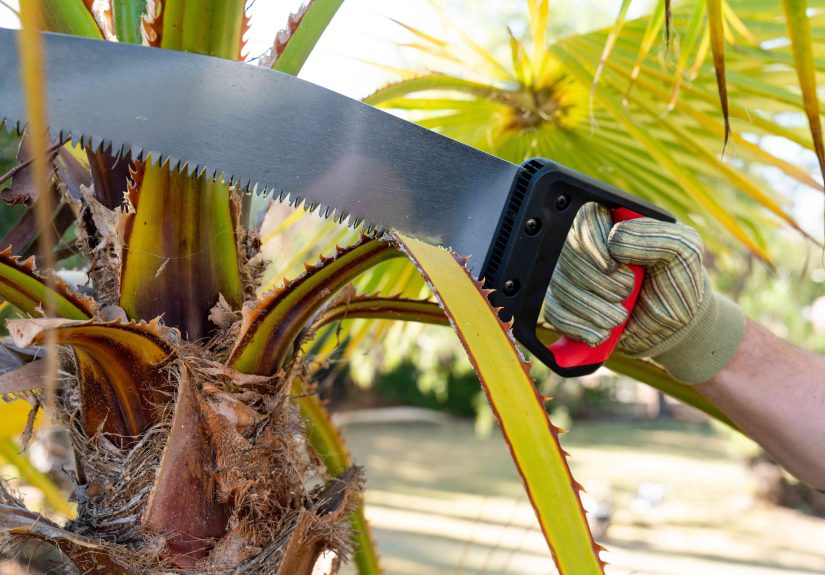
- Pruning saw or pole saw for larger fronds higher up.
- Rope and pruning hook (optional) to help lower heavy fronds safely.
- Disinfectant (like 70% alcohol or a bleach solution) to clean blades between trees and reduce disease spread.
Step-by-Step: Trimming a Palm Tree the Right Way
- Assess the crown.
Stand back and look at the palm’s canopy as a whole. A healthy palm usually has a full, 360-degree crown of fronds radiating around the top. Imagine a clock face: you generally don’t want to cut any fronds that are above the “9 o’clock to 3 o’clock” line, even if they’re drooping slightly. - Start with the lowest, dead fronds.
Focus first on fronds that are completely brown and clearly dead. These are often hanging downward, sometimes forming a “skirt” of old leaves. These aren’t feeding the tree anymore and can safely be removed. - Cut close, but not into the trunk.
Make clean cuts near the base of each dead frond, leaving a small, smooth stub rather than gouging into the trunk. Avoid tearing or ripping the frond offthis can damage the tissue where future fronds attach. - Avoid cutting green, upright fronds.
Green fronds, especially those that point up or are near horizontal, are still providing energy. Removing too many of them weakens the palm. Unless a green frond is badly broken and dangerous, leave it alone. - Remove unwanted flower and fruit stalks.
If your palm drops messy fruit or heavy clusters, you can cut those flower or fruit stalks early, before they fully mature. This keeps sidewalks cleaner and reduces pest problems. - Do not touch the spear leaf or growing point.
The tight, central “spear” leaf at the top of the crown is the palm’s future. Cutting it can seriously stunt the tree or kill it outright. - Clean up and disinfect tools.
When you’re done, pick up all the debris and dispose of it properly. If you’re moving on to another palm, clean your tools first to avoid spreading diseases from one tree to another.
If at any point you feel like you’re guessing, especially on a tall palm, it’s okay to call in a certified arborist. A one-time expert visit is cheaper than replacing a mature palm.
When Not to Prune a Palm Tree
Don’t “Hurricane Prune” or “Pineapple” Your Palm
One of the most damaging trends in palm care is the so-called “hurricane cut”removing almost all fronds and leaving just a few upright ones at the top like a toothbrush or a pineapple. It may look neat to some people, but the palm pays the price.
Over time, repeated heavy pruning can:
- Reduce the palm’s food supply and force it to burn through stored energy.
- Cause new fronds to emerge smaller and weaker.
- Thin the trunk (“pencil topping”), making it more likely to snap in high winds.
- Increase susceptibility to nutrient deficiencies and pests.
Ironically, the “hurricane cut” doesn’t make palms more resistant to stormsresearch and field observations suggest it can actually make them more likely to fail in strong winds.
Don’t Prune Just for a Bare, Clean Look
If your main reason for pruning is “I don’t like seeing any lower fronds at all,” that’s a red flag. Palms naturally carry a skirt of fronds at various angles. Removing every frond that’s not pointing straight up is a cosmetic choice that costs the tree energy.
A healthier rule of thumb: if the frond is green and above or near horizontal, leave it. Focus your pruning energy on what’s dead, brown, broken, hanging dangerously, or making a big, messy, pest-attracting problem.
Don’t Prune Palms Under Stress
Avoid or minimize pruning if:
- The palm was recently transplanted and is still establishing roots.
- The tree is recovering from cold damage, drought, or storm injury.
- You suspect disease or severe nutrient deficiency.
- Temperatures are extremely hot or freezing in your area.
In these situations, the palm needs every healthy frond it has to recover. Removing green fronds when the tree is already struggling is like taking away someone’s snacks while they’re running a marathon.
Never Cut into the Trunk or Crownshaft
Palm trunks are not like the thick, layered wood of many trees. Cutting into the trunk or crownshaft (in palms that have one) can open the door to decay and disease, and the palm has little ability to compartmentalize that damage. Avoid chiseling, shaving, or carving patterns into the trunkit may look artistic in the short term but can shorten the palm’s life significantly.
Common Palm Trimming Mistakes to Avoid
- Using climbing spikes on palms you’re not removing.
Every puncture wound from a spike is a potential infection site. Save spikes for removals only. - Leaving long, ragged stubs.
Cutting fronds halfway or leaving torn stubs looks bad and can create pockets where water and decay accumulate. Aim for clean, close cuts just outside the base. - Cutting the spear leaf.
That central spear might look tempting to “tidy up,” but it’s the palm’s future foliage. Damaging it can slow growth or kill the tree. - Removing too many fronds at once.
As a loose guideline, if you’re taking off more than about a quarter to a third of the canopy, you’re probably doing too much. - Pruning without cleaning tools.
Some palm diseases are spread by contaminated pruning tools. A quick disinfecting dip between trees is worth the extra minute.
DIY vs. Hiring a Professional Arborist
Not every palm requires an expert and a bucket truck. For small to medium palms that you can safely reach from the ground with a pole saw, a careful DIY trim is often fine.
However, you should seriously consider hiring a pro if:
- The palm is very tall or located on a slope.
- Fronds or fruit clusters hang over streets, driveways, or roofs.
- The job requires chainsaw use high above the ground.
- The tree is near power lines (never tackle this yourself).
- You’re unsure which fronds are safe to remove.
Certified arborists understand palm biology, follow safety standards, and can spot early signs of disease or structural issues you might misssaving you money and heartache in the long run.
Between Prunings: Everyday Palm Tree Care
Great pruning can’t fix poor basic care. To keep your palm healthy between trims:
- Water properly. Avoid constantly soggy soil, but don’t let newly planted palms dry out completely.
- Fertilize appropriately. In many regions, palms benefit from slow-release fertilizers formulated specifically for palms, with balanced nutrients and micronutrients.
- Mulch wisely. A light layer of mulch helps retain moisture and moderate soil temperature, but keep it off the trunk.
- Watch for pests and diseases. If you see sudden browning, drooping of the spear leaf, or odd spotting, consult a professional or local extension service before you start cutting.
Real-Life Experiences: Lessons from Palm Tree Pruning
Palm trees come with stories. Ask anyone who’s lived with them for a while, and you’ll hear about everything from falling coconuts to surprising wildlife hiding in the fronds. These real-world experiences can teach you a lot about howand whennot to prune.
Imagine a homeowner in a coastal neighborhood who decided to “tidy up” before hurricane season. Their neighbor’s palms were lush and full, while theirs looked like giant pineapples after an aggressive hurricane cut. The logic seemed sound: less foliage must mean less wind resistance, right? After a big storm, though, the full-canopy palms came through with minimal damage, while the heavily pruned ones showed broken tops and snapped trunks. With fewer fronds to buffer the wind and protect the crown, the stripped palms were actually more vulnerable.
Another common experience involves nutrient problems that are made worse by pruning. A homeowner might notice yellowing fronds low on the tree and assume they look “ugly,” so they remove them quickly. What they don’t realize is that the palm is moving nutrients from older fronds to newer ones during a deficiency. By cutting off those “almost spent” fronds too soon, the tree loses a valuable reserve. Over time, new fronds emerge smaller, more yellow, and weaker. The homeowner keeps pruning, the tree keeps struggling, and the cycle continuesuntil someone finally tests the soil, corrects the nutrient imbalance, and stops overpruning.
There are also safety stories that turn into cautionary tales. One DIY enthusiast climbs a ladder with a chainsaw to trim tall fronds without a helper on the ground. As they cut a heavy, half-dead frond, it twists unexpectedly, knocks the ladder, and nearly sends them tumbling. Even when the outcome isn’t a trip to the ER, those close calls are enough to convince many people that hiring a pro for tall palms is well worth the cost. Heavy seed pods and rigid fronds can behave unpredictably as they fall, especially in tight spaces with cars, fences, or power lines nearby.
Wildlife is another factor people forget about until they’re face-to-face with it. Old frond “skirts” sometimes shelter birds, bats, lizards, or beneficial insects. One homeowner planning a big cleanup discovered a nesting family of birds tucked inside the brown skirt. Rather than ripping everything down at once, they chose a gradual approach: removing only the dead, lowest fronds and leaving an area around the nest until the chicks fledged. That kind of flexible, aware pruning respects both the tree and the small ecosystem it supports.
Finally, many palm owners discover the value of doing less over time. Maybe at first they trimmed every yellowing frond and tried to force a minimalist, sculpted look. But as they learned more about palm biology and watched how their trees responded, they shifted to a “light-touch” strategy: prune once or twice a year, stick to dead or badly damaged fronds, remove messy seed clusters, and then walk away. The result is often a healthier, fuller canopy, fewer nutrient issues, and less money spent on emergency care or replacements.
The big lesson from these experiences? Respect how palms naturally grow. They don’t want to be turned into pineapples or telephone poles. If you focus on safety, health, and minimal, thoughtful trimming, your palm tree will reward you with a strong, graceful canopy that weathers stormsand avoids becoming the neighborhood cautionary tale.
Conclusion: Trim Less, Enjoy More
Learning how to trim a palm tree is as much about knowing what not to cut as it is about making the right cuts. Remove dead, brown, or dangerously placed fronds. Take off messy flower and fruit stalks if needed. But leave healthy green fronds in place, avoid hurricane cuts, and never carve into the trunk or crown.
When in doubt, step back, look at the overall canopy, and remember that palms are naturally designed to handle wind and weather better than they handle overzealous pruning. A lighter hand, good timing, and a focus on tree health will keep your palm looking beautifuland standing strongfor years to come.