Table of Contents >> Show >> Hide
- Quick Snapshot: Who Was J. Robert Oppenheimer?
- Early Life: From Manhattan Art Collection to Modern Physics
- Building the Bomb: The Manhattan Project Years
- Fact Check: The Bhagavad Gita Quote
- Politics, Security Hearings, and a Very Public Fall
- Oppenheimer’s Moral Struggle With the Bomb
- Human Details: The Man Behind the Myth
- Oppenheimer’s Legacy in Science and Pop Culture
- Experiences and Reflections Around “J. Robert Oppenheimer Facts”
- Final Thoughts: A Brilliant Mind in a Dangerous Century
If you’ve ever walked out of a screening of Oppenheimer wondering, “Okay, but what was this guy actually like in real life?”, you’re in the right place. J. Robert Oppenheimer wasn’t just the “father of the atomic bomb.” He was a chain-smoking, poetry-quoting, multilingual physicist with a complicated moral compass and a front-row seat to the birth of the nuclear age.
Below, we’ll unpack the most fascinating J. Robert Oppenheimer factshis privileged New York childhood, his whirlwind academic career, the Manhattan Project, the infamous security hearing, and the legacy that still shapes science, politics, and pop culture today.
Quick Snapshot: Who Was J. Robert Oppenheimer?
Let’s start with the basics before we dive into the wild details:
- Full name: Julius Robert Oppenheimer
- Born: April 22, 1904, New York City, New York
- Died: February 18, 1967, Princeton, New Jersey
- Claim to fame: Scientific director of the Manhattan Project’s Los Alamos Laboratory, where the first atomic bombs were designed and built.
- Job titles: Theoretical physicist, professor at the University of California, Berkeley and Caltech, later director at the Institute for Advanced Study in Princeton.
- Most famous line: His recollection of a verse from the Bhagavad Gita: “Now I am become Death, the destroyer of worlds.”
Early Life: From Manhattan Art Collection to Modern Physics
A privileged, artsy childhood
Oppenheimer was born into a wealthy, highly cultured German-Jewish family on Manhattan’s Upper West Side. His father was a successful textile importer, and the family apartment reportedly featured original works by van Gogh, Cézanne, and Picasso on the wallscasual, like you might hang a framed movie poster. He grew up surrounded by art, music, and books, and he quickly developed a reputation as that kid who is “too smart for his own good.”
He was also physically frail as a child, which meant more time reading than playing sports. He loved mineral collecting and science; by his teens he was already corresponding with professional geologists about rock samples. Social butterfly? Not exactly. Intellectual overachiever? Absolutely.
Racing through school and falling for quantum theory
Oppenheimer entered Harvard University in 1922 and basically speed-ran the place. He finished his degree in just three years, excelling in chemistry, philosophy, and literature in addition to physics. After Harvard, he studied briefly at Cambridge in England, where he struggled in the lab (he was famously clumsy with experimental equipment) but shined in theoretical work.
He went on to the University of Göttingen in Germany, one of the world’s leading centers for quantum mechanics. There he completed a PhD in physics under Max Born in 1927, publishing important papers on quantum theory before he was thirty. When he returned to the United States, he split his time between Caltech and the University of California, Berkeley, helping turn the West Coast into a serious hub for cutting-edge theoretical physics.
Building the Bomb: The Manhattan Project Years
Why Oppenheimer was picked to lead Los Alamos
In 1942, during World War II, the U.S. launched the Manhattan Projecta crash program to build an atomic bomb before Nazi Germany could. Despite having zero experience running large laboratories, Oppenheimer was chosen to direct a new secret lab at Los Alamos, New Mexico. The choice surprised many colleagues; he was known more as a brilliant theorist than a manager.
But he had what the project needed: a broad grasp of nuclear physics, the ability to connect ideas across many subfields, and a strange charisma that inspired loyalty among other scientists. Under his leadership, Los Alamos pulled together top physicists, chemists, mathematicians, and engineers to turn abstract nuclear physics into real weapons.
The Trinity test: “We knew the world would not be the same”
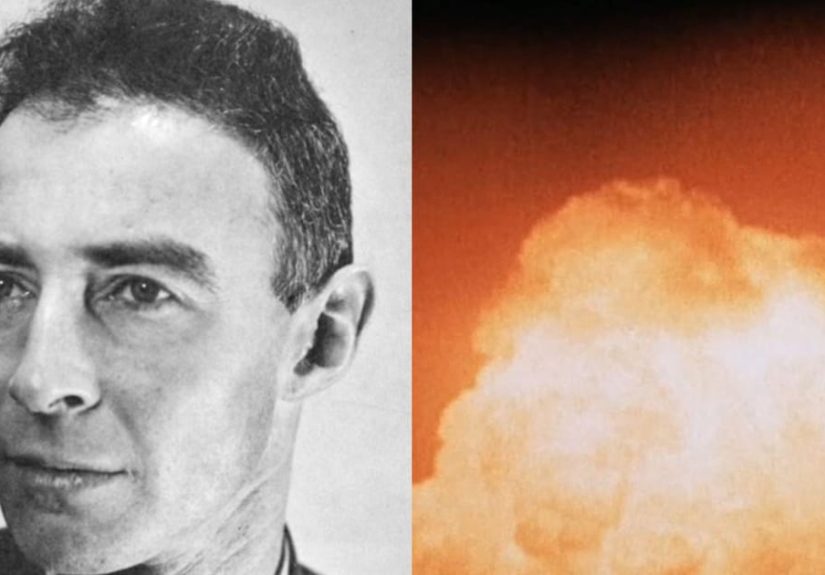
On July 16, 1945, at a site in the New Mexico desert code-named “Trinity,” Oppenheimer’s team detonated the first nuclear device in history. The explosion lit up the predawn sky and produced a fireball and mushroom cloud that signaled the arrival of the atomic age.
Witnesses recalled Oppenheimer watching tensely as the countdown neared zero, then visibly relaxing in relief when the device worked. His brother Frank later remembered that Oppenheimer’s first, very human reaction was simply, “I guess it worked.” Only later did Oppenheimer describe the moment with more haunting language, saying it brought to mind a verse from the Bhagavad Gita about a dazzling, world-shattering vision.
Within weeks of Trinity, atomic bombs were dropped on Hiroshima and Nagasaki, Japan. The weapons contributed to Japan’s surrender but also killed well over 100,000 people outright and exposed many more to long-term radiation effects. Oppenheimer’s scientific triumph instantly turned into a lifelong moral burden.
Fact Check: The Bhagavad Gita Quote
One of the most quoted “facts” about Oppenheimer is that he dramatically said, at the moment of the Trinity explosion, “Now I am become Death, the destroyer of worlds.” The reality is more nuanced (and less movie-ready).
Oppenheimer studied Sanskrit in the 1930s and read the Hindu scripture the Bhagavad Gita in the original language. After the war, he said that when he watched the bomb explode, a verse from the Gita came to mind: “If the radiance of a thousand suns were to burst at once into the sky, that would be like the splendor of the mighty one,” and also the famous line about “become Death.”
But historians note that he mentioned this years after the event, in a 1965 television documentary. There’s no evidence he spoke the line out loud in the bunker while the fireball rose. It was more of an inner commentary he later used to explain how overwhelming and morally unsettling the moment felt. Skeptical analyses point out that the quote has been turned into a kind of mythic punchline for a much more complex emotional reaction.
Politics, Security Hearings, and a Very Public Fall
Left-leaning sympathies in a Cold War world
Before and during World War II, Oppenheimer moved in circles that included communists and left-wing activists, especially in 1930s California. His wife Kitty and his brother Frank had been members of the Communist Party, and Oppenheimer donated to causes like anti-fascist relief. That combination of associations looked a lot more alarming once the Cold War with the Soviet Union heated up.
The FBI kept him under heavy surveillance for years, tapping his phone and opening his mail. Still, during the war he was trusted with some of the United States’ most sensitive secrets and played a central role in the Manhattan Project’s success.
The 1954 security clearance hearing
In 1954, Oppenheimer was hauled before a security board convened by the Atomic Energy Commission (AEC). The hearing examined his past political associations, his honesty with security officials, and his opposition to developing the even more powerful hydrogen bomb.
The panel unanimously agreed that he was loyal and had protected atomic secrets. However, a majority still voted to revoke his security clearance, citing “faulty judgment” and worries about his influence over nuclear policy. It was a huge public humiliation that effectively ended his role in government advising and branded him as politically suspect during the height of McCarthy-era fears.
Decades later, historians and officials widely viewed the hearing as unfair and politically driven. In 2022, the U.S. Secretary of Energy formally nullified the 1954 decision, calling the process flawed and acknowledging Oppenheimer’s contributions and loyalty.
Oppenheimer’s Moral Struggle With the Bomb
Oppenheimer is famous not only for helping build the bomb, but also for wrestling with what that meant.
As chair of the AEC’s General Advisory Committee after the war, he argued against a rapid push to develop a hydrogen bomb, worrying about a spiraling arms race. He favored international control of nuclear weapons and limits on their spread, though he still believed some nuclear deterrent was necessary in the Cold War context.
He also spoke openly about the moral weight of what physicists had done. In one famous reflection, he said that, in a sense, physicists had “known sin” and could not unknow ita remarkably raw statement from a scientist in a public forum.
Human Details: The Man Behind the Myth
A polymath with a flair for drama
Oppenheimer was very much not your stereotypical one-track science nerd. He read poetry constantly, loved the English metaphysical poets (especially John Donne), quoted French and Sanskrit, and could switch between several languages. Friends described him as intense, theatrical, and sometimes cutting, but also generous and captivating in conversation.
His choice of “Trinity” as the code name for the first test site came from Donne’s religious poetrya detail that pretty much sums up his habit of mixing high literature with hard science.
Chain-smoking to the end
Physically, Oppenheimer was slight, sharp-featured, and almost always seen with a cigarette. He smoked heavily for most of his adult life, a habit that caught up with him in the 1960s when he developed throat cancer. After unsuccessful surgery, radiation, and chemotherapy, he died in 1967 at age 62 at his home in Princeton.
His ashes were scattered at sea near a beach house he and his wife loveda quiet, almost understated end for a man whose work had changed the destiny of nations.
Oppenheimer’s Legacy in Science and Pop Culture
Oppenheimer’s scientific work extended beyond the bomb. In earlier research, he and his students explored topics like quantum field theory and the behavior of collapsing starswork that helped lay the groundwork for later ideas about black holes. But it’s his role in nuclear weapons that permanently stamped his name on history.
The debates he raised about scientific responsibility, government secrecy, and the ethics of new technology still echo today in discussions about artificial intelligence, genetic engineering, and more. Scientists now routinely talk about “the Oppenheimer moment”the point where you realize your research could be used in ways you never intended.
His life story has been retold in biographies, documentaries, and most recently Christopher Nolan’s 2023 film Oppenheimer, which brought his story to a global audience and reignited public interest in both the man and the Manhattan Project.
Experiences and Reflections Around “J. Robert Oppenheimer Facts”
Facts about Oppenheimer are one thing on paper; they land very differently when you encounter them in real-world settings and stories.
Imagine visiting Los Alamos today. The mesas and pines look peaceful, but the museum exhibits pull you straight back into the 1940s. You might stand in front of models of the “Gadget” (the Trinity device) and the bombs dropped on Japan, reading labels that bluntly list kilotons of explosive yield and casualty estimates. Seeing those numbers next to Oppenheimer’s photothin tie, cigarette in handmakes the familiar trivia feel heavier: he was only in his early 40s when he helped unleash that power.
Or picture listening to audio clips of the 1954 security hearings. The transcripts read like a tense courtroom drama: lawyers pressing him on old friendships, party meetings, offhand comments from the 1930s. You hear the pauses, the careful wording, the sense that a man who helped win the war is now being asked to defend his right to be trusted at all. Context turns the “he lost his clearance in 1954” fact into a gut-level story about fear, politics, and shifting definitions of loyalty.
Watching the archival footage where Oppenheimer recalls the Bhagavad Gita verse is another powerful experience. His voice is quiet, almost fragile, as he describes the Trinity test and says, “We knew the world would not be the same.” The line has been meme-ified and quoted endlessly, but in the original clip he doesn’t sound triumphant; he sounds like someone trying to put words around something that may genuinely be beyond language. The famous quote becomes less of a cool sound bite and more of a coping mechanism.
Modern pop-culture portrayals add another layer. A big-budget film condenses decades of decisions, regrets, and political battles into three hours of storytelling. You see Oppenheimer as hero, victim, collaborator, rebel, and tragic figureall at once. After the credits roll, reading straight historical facts feels different. “Born in 1904. Died in 1967. Directed Los Alamos. Lost his security clearance.” These bullet points suddenly carry the weight of crowded bunkers, desert fireballs, congressional rooms, and sleepless nights staring at the ceiling, wondering if the world will survive the thing you helped create.
Ultimately, learning about Oppenheimer is less like memorizing a neat list of trivia and more like walking through a series of moral and emotional rooms. One room is filled with chalkboards and equations; another with military briefings; another with grieving families in distant cities; yet another with scientists arguing late into the night about what they’ve done. The “facts” are doorways into all of those spaces.
That’s why Oppenheimer’s story keeps coming back into public conversation. It’s not just about how clever humans can be; it’s about what we do once we realize our cleverness can destroy everything we care about.
Final Thoughts: A Brilliant Mind in a Dangerous Century
J. Robert Oppenheimer’s life doesn’t fit neatly into a single box. He was a brilliant theoretical physicist, a gifted teacher, a sometimes ruthless leader, a self-critical moral thinker, a political target, and ultimately a symbol of the promises and perils of modern science.
The key factshis New York upbringing, his rapid academic rise, his central role in the Manhattan Project, the Trinity test, the security hearing, and his early death from cancerall matter. But what makes his story unforgettable is the tension between intellect and responsibility. Oppenheimer reminds us that scientific breakthroughs don’t arrive in a vacuum; they land in a messy world of governments, fears, ambitions, and human lives.
Whether you meet him first in a textbook, a museum, or a movie theater, one thing is clear: understanding Oppenheimer isn’t just about learning history. It’s about understanding the world we still live inthe one shaped by the flicker of light in the New Mexico desert on a July morning in 1945.