Table of Contents >> Show >> Hide
- What Is Surrealism, Really?
- Defining Traits of Surrealist Art
- Classic Surrealist Artists You Should Know
- Women Surrealists Who Rewrote the Script
- Beyond Canvas: Surrealist Sculptors and Image-Makers
- Contemporary and Neo-Surrealist Artists
- Master List: 60+ Great Surrealist Artists, Painters and Sculptors
- How to Actually Look at Surrealist Art (Without Getting Overwhelmed)
- Experiences and Reflections: Living with Surrealism in Everyday Life
Surrealism is what happens when dreams steal your car keys and drive off with your sense of reality.
Melting clocks, faceless figures in bowler hats, tigers jumping out of pomegranates – for a century,
surrealist artists have been turning the subconscious into unforgettable images. If you’ve ever looked
at a painting and thought, “I have absolutely no idea what’s going on, but I can’t stop staring,”
there’s a good chance it was surrealist or at least surrealist-adjacent.
This guide rounds up more than 60 of the greatest surrealist artists, painters, and sculptors –
from the big icons like Salvador Dalí and René Magritte to brilliant women surrealists and
contemporary artists who are still bending reality today. Consider this your cheat sheet for
sounding very smart (and slightly mysterious) at your next museum visit.
What Is Surrealism, Really?
Surrealism emerged in the early 1920s, inspired by Freudian psychoanalysis, Dada, and the general
chaos that followed World War I. Writer André Breton published the Surrealist Manifesto,
calling for art that tapped directly into dreams, automatic writing, free association, and the
unconscious mind. Instead of painting polite landscapes, these artists wanted to show what the
mind was doing when nobody was watching.
Surrealist art tends to mix very realistic details with completely impossible situations:
a train coming out of a fireplace, a fur-covered teacup, a man in a suit whose face is hidden by
a floating green apple. The result is a feeling of uncanniness – familiar and strange at the same time.
Defining Traits of Surrealist Art
- Dream logic: Images feel like scenes from a vivid dream where time, space, and scale don’t play by normal rules.
- Unexpected juxtapositions: Everyday objects appear in bizarre combinations – think lobsters on telephones or elephants on stilt-like legs.
- Symbolism and psychology: Motifs like eyes, keys, birds, and doubles hint at deeper emotional or subconscious meanings.
- Automatic and experimental techniques: Artists use chance, doodling, and “automatic drawing” to bypass rational control.
- Cross-disciplinary energy: Surrealism isn’t just painting. It shows up in sculpture, film, photography, poetry, and performance.
Classic Surrealist Artists You Should Know
Let’s start with the central players – the names you’ll see in every major surrealism show
and every art history exam you forgot to study for.
Salvador Dalí (1904–1989)
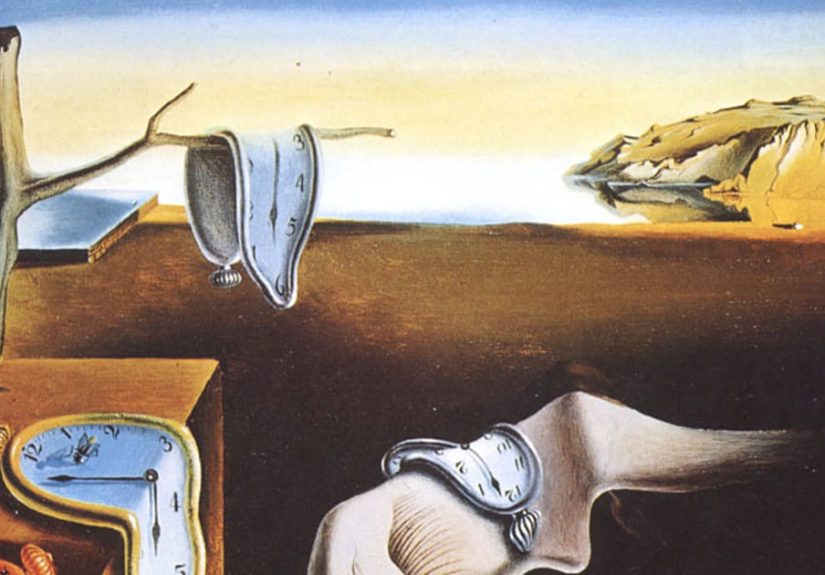
The mustache alone deserves its own museum. Dalí’s paintings combine hyper-realistic detail with
impossible scenes: melting clocks, crutches, burning giraffes, and desert landscapes that feel like
the inside of someone’s anxieties. Works like The Persistence of Memory and his famous
lobster telephone sculpture helped turn surrealism into a global pop-culture phenomenon.
René Magritte (1898–1967)
Magritte is the poet of “normal but not.” His bowler-hat men, floating rocks, and pipes labeled
“This is not a pipe” quietly mess with language and perception. Instead of painting wild hallucinations,
he makes the everyday world feel slightly hacked, like someone changed reality’s settings without
telling you.
Max Ernst (1891–1976)
A pioneer of surrealist collage and experimental techniques, Ernst used rubbing (froissage),
scraping (grattage), and chance textures to discover new forms. His bird-like alter ego “Loplop”
appears in paintings and collages that look like scientific diagrams from a universe that never existed.
Joan Miró (1893–1983)
Miró’s bright, biomorphic shapes and playful lines feel childlike, but they’re rooted in serious
experimentation. His floating forms and stars connect surrealism to abstraction, showing how far
the subconscious can stretch once you let go of traditional perspective and shading.
Yves Tanguy (1900–1955)
Tanguy paints endless landscapes filled with strange, smooth objects that resemble bones, rocks,
and sea creatures all at once. His dreamscapes feel like the setting for a sci-fi film filmed
inside someone’s subconscious.
André Breton, Jean (Hans) Arp, and André Masson
Breton is the movement’s chief theorist; without his manifestos and organizing, there might not
be “Surrealism” as we know it. Arp moved between Dada and Surrealism, creating abstract reliefs
and sculptures that look like organic, half-remembered forms. Masson experimented with automatic
drawing and violent, fragmented images that mirrored anxiety between the wars.
Paul Delvaux, Roberto Matta, and Wifredo Lam
Delvaux paints quiet, eerie scenes of classical architecture and sleepwalking figures.
Matta turns cosmic space and psychological interiors into swirling, energetic abstractions.
Lam weaves Afro-Caribbean spirituality and Cubist structure into surreal, mask-like figures,
expanding the movement far beyond Paris.
Man Ray, Giorgio de Chirico, and Alberto Giacometti
Man Ray’s photographs and “rayographs” (camera-less images) helped define surrealist photography.
De Chirico’s metaphysical plazas, painted before Surrealism officially formed, deeply influenced
the group’ s love of uncanny architecture. Giacometti’s early sculptures – cages, elongated figures,
and strange objects – capture the feeling of being slightly out of place in your own body.
Women Surrealists Who Rewrote the Script
For decades, museums and textbooks focused on a mostly male lineup, but women surrealists were
absolutely central to the movement. Many reworked surrealist ideas to tackle identity, gender,
power, and mythology in fresh ways.
Leonora Carrington and Remedios Varo
Carrington’s paintings look like illustrated spell books: white horses, alchemical kitchens, and
figures mid-transformation. Varo creates intricate scenes where women operate strange machines,
stir cosmic soups, or weave light – like science fiction powered by witchcraft and physics homework.
Dorothea Tanning and Leonor Fini
Tanning moves from sharply realistic, uncanny interiors to near-abstract swirls of figures,
exploring desire, childhood, and metamorphosis. Fini paints powerful, androgynous figures and
felines in theatrical settings; her work flips the traditional “muse” role on its head.
Meret Oppenheim and the Power of the Object
Oppenheim’s best-known work, a fur-covered teacup, saucer, and spoon, turns a polite afternoon tea
into something unsettlingly sensual. She also created jewelry, paintings, and sculptures that show how
everyday objects can become uncanny with just one surreal twist.
Other Essential Women Surrealists
- Eileen Agar: British artist blending collage, painting, and found objects with a playful but sharp wit.
- Kay Sage: Stark architectural landscapes that feel like abandoned futuristic cities.
- Toyen (Marie Čermínová): Czech painter moving from dreamlike symbolism to politically charged images during wartime.
- Claude Cahun: Artist and writer whose self-portraits prefigure contemporary conversations about gender and identity.
- Dora Maar and Lee Miller: Brilliant photographers whose work goes far beyond their relationships with more famous male artists.
- Gertrude Abercrombie, Fanny Brennan, Rachel Baes, Bridget Tichenor, Ithell Colquhoun: Artists who brought surrealism into mid-century Chicago, Belgium, Mexico, and beyond.
While Frida Kahlo never officially joined the surrealist group, her dreamlike, symbol-packed
self-portraits are often discussed alongside Surrealism, especially in exhibitions focused on
the movement’s global reach.
Beyond Canvas: Surrealist Sculptors and Image-Makers
Surrealism was never a paint-only operation. Many artists worked in three dimensions or mixed media
to push strangeness into the physical world.
- Jean (Hans) Arp: Organic wood and plaster sculptures that feel like living, simplified forms.
- Alberto Giacometti: Spindly figures and “cage” pieces that stage psychological spaces.
- Meret Oppenheim: Objects transformed through unexpected materials – fur, metal, and found items.
- Maria Martins: Brazilian sculptor whose tangled, sensual bronze forms earned her the nickname “sculptor of the tropics.”
- Hans Bellmer: Disturbing jointed dolls and photographs exploring desire and fragmentation.
- Mimi Parent: Surrealist boxes and assemblages that feel like personal shrines to the unconscious.
- Isamu Noguchi and Henry Moore: Not card-carrying surrealists, but their biomorphic sculptures show clear surrealist influence.
Contemporary and Neo-Surrealist Artists
Surrealism never really ended; it just changed outfits. Contemporary painters and sculptors still
mine dream logic, pop culture, and psychological symbolism.
- Michaël Borremans: Carefully rendered figures in eerie, ambiguous situations that feel like paused nightmares.
- Julie Curtiss: Hair, food, and fashion become uncanny symbols in her sharply graphic paintings.
- Kati Heck, Drew Dodge, Matthew Hansel, Rae Klein: Younger artists whose strange narratives and distorted figures update surrealism for a meme-saturated world.
- Mark Ryden and pop-surrealism: Candy-colored figures, big-eyed characters, and bizarre symbol mashups.
- Yayoi Kusama: Infinity rooms and polka-dot universes that overwhelm the senses and flirt with the surreal.
- Takashi Murakami, Jim Shaw, Peter Doig, Ernst Fuchs, HR Giger: Very different stylistically, but all blend fantasy, the subconscious, and dream logic in ways that echo surrealist ideas.
- David Lynch and Alejandro Jodorowsky: Filmmakers whose movies are basically moving surrealist paintings.
Master List: 60+ Great Surrealist Artists, Painters and Sculptors
Here’s a consolidated list you can bookmark, print, or dramatically recite in a gallery for maximum effect.
Some are core Surrealists; others are surrealism-adjacent or contemporary heirs to the tradition.
- Salvador Dalí
- René Magritte
- Max Ernst
- Joan Miró
- André Breton
- Yves Tanguy
- André Masson
- Jean (Hans) Arp
- Paul Delvaux
- Roberto Matta
- Wifredo Lam
- Man Ray
- Giorgio de Chirico
- Alberto Giacometti
- Francis Picabia
- Victor Brauner
- Oscar Domínguez
- Pierre Roy
- Wolfgang Paalen
- Paul Nash
- Maria Martins
- Mimi Parent
- Hans Bellmer
- Isamu Noguchi
- Henry Moore
- Leonora Carrington
- Remedios Varo
- Dorothea Tanning
- Leonor Fini
- Meret Oppenheim
- Eileen Agar
- Kay Sage
- Toyen (Marie Čermínová)
- Claude Cahun
- Dora Maar
- Lee Miller
- Gertrude Abercrombie
- Fanny Brennan
- Rachel Baes
- Bridget Tichenor
- Ithell Colquhoun
- Frida Kahlo (surrealism-adjacent)
- Pablo Picasso (surreal period)
- Luis Buñuel
- Alejandro Jodorowsky
- Michaël Borremans
- Julie Curtiss
- Kati Heck
- Drew Dodge
- Matthew Hansel
- Rae Klein
- Mark Ryden
- Yayoi Kusama
- Takashi Murakami
- Jim Shaw
- Peter Doig
- Ernst Fuchs
- HR Giger
- Valentine Hugo
- Maria “Remedios” Escobar (representing Latin American neo-surrealist trends)
- Anna Weyant (contemporary surreal-inflected painter)
You could easily keep going – surrealism is less a closed club and more a viral idea that keeps infecting
new generations of artists. But this lineup gives you a strong starting point to explore museums, collections,
and auction catalogs with confidence.
How to Actually Look at Surrealist Art (Without Getting Overwhelmed)
Surrealist works can be dense with symbols and references, but you don’t need a PhD or a decoder ring.
A simple approach:
- Describe before you interpret: Say (even just in your head) what you literally see. A clock. A beach. An egg. A faceless figure. This slows you down.
- Notice what feels “off”: Is it the scale? The setting? The materials? That weird feeling is exactly what the artist is playing with.
- Connect to emotions, not just symbols: Does the image feel funny, anxious, sensual, lonely, absurd? There’s no wrong answer.
- Let ambiguity be the point: Surrealism thrives on multiple interpretations. If the painting could mean three things at once – good, it’s working.
Experiences and Reflections: Living with Surrealism in Everyday Life
Imagine walking into a surrealist exhibition. The lights are slightly dimmed, the walls are filled with
strange colors and impossible scenes, and everyone around you looks like they’re trying very hard to
understand something that refuses to be fully explained. You move closer to a painting by Dalí or Carrington
and realize the real experience of surrealism isn’t about “getting it right” – it’s about letting your own
subconscious wake up a little.
Many viewers report a similar pattern. At first, there’s confusion: “Why are there ants crawling across a
pocket watch?” or “What is that half-animal, half-machine figure doing?” Then curiosity kicks in. Instead of
asking what the painting is supposed to mean, people begin asking what it reminds them of: an anxious dream,
a childhood memory, a story they half-remember from a book. Surrealist art quietly invites personal
free association – the same method the original artists loved.
Spend enough time in front of these works and everyday objects start to look different. A coffee mug might
suddenly feel like a potential sculpture. A street of identical houses could resemble a Magritte backdrop.
Even social media feeds, with their rapid-fire mix of jokes, disasters, and memes, can feel unintentionally
surreal. The movement’s lesson is that the strange and the ordinary are never very far apart.
People who collect or live with surrealist-inspired art often describe the pleasure of discovering new
details over time. A painting that looked purely whimsical on day one might reveal something darker
after a long week. A piece that once felt unsettling can become oddly comforting, like a visual reminder
that it’s normal for thoughts and emotions to be complicated and contradictory.
For creative people, surrealism is a permission slip. Writers borrow its dream logic for fiction; filmmakers
borrow its visual vocabulary for everything from horror to comedy; designers sneak in surreal touches to
branding, fashion, and interiors. When you study these artists, you start to notice how often contemporary
culture leans on surrealist tricks – double images, unexpected juxtapositions, playful symbolism – to catch
your attention in a crowded world.
Even if you never paint a melting clock, you can use surrealist thinking as a mental exercise. Try automatic
drawing or free writing for a few minutes without editing yourself. Combine two unrelated ideas – say, a
kitchen and outer space – and sketch or describe what that might look like. This kind of experiment doesn’t
just generate wild images; it can shake loose new solutions in work, relationships, and everyday problems,
simply by bypassing your usual “that’s impossible” filter.
Ultimately, the greatest experience surrealist art offers is a shift in perspective. It reminds you that
reality is partly constructed – by habits, language, culture, and memory. By exploring the worlds invented
by Dalí, Magritte, Carrington, Oppenheim, and their many heirs, you practice questioning what seems fixed.
That’s why surrealism still feels fresh a century later: beneath all the melting clocks and floating apples,
it’s really about learning to see your own life differently.