Table of Contents >> Show >> Hide
- Who Is Mister Finch?
- Why Mister Finch’s Work Feels “Edgy” (Without Trying Too Hard)
- The Materials: Upcycled Textiles, Found Objects, and Serious Stitch Work
- Signature Creatures and “Specimens” You’ll Recognize Instantly
- New York’s “Handmade Museum”: When a Gallery Became a Storybook Exhibit
- What Artists and Makers Can Learn From Mister Finch
- How to Display Textile Sculpture at Home (So It Looks Curated, Not Cluttered)
- Field Notes: Experiencing Mister Finch’s World (Extended)
- Conclusion: The Charm of the Strange, Sewn to Perfection
Somewhere between a fairy tale and a natural history museum lives the work of Mister Fincha textile artist
best known for hand-sewn creatures and curiosities made from vintage fabrics, rescued textiles, and found materials.
His sculptures can look sweet from across the room, then quietly unsettling up close (in the best possible way).
Think: couture toadstools, velvet-winged moths, crowned swans, and “specimens” that feel like they escaped a cabinet of curiosities
and started a very stylish second life.
If that sounds dramatic, goodMister Finch’s art is dramatic, but not in the loud, neon sense. It’s dramatic in the
“storybook got annotated by a Victorian botanist with a wink” sense. And that’s exactly why his work stands out in the world of
fiber art, soft sculpture, and upcycled textiles.
Who Is Mister Finch?
Mister Finch (who goes by “Finch”) is a UK-based textile artist who built a devoted following through meticulously crafted,
hand-stitched sculptures inspired by nature, folklore, and museum displays. He’s also known for working largely solo and doing
things the old-fashioned way: stitching, shaping, dyeing, and assembling pieces by handoften using materials that already had a
life before they became art.
A practice built on craft, patience, and a slightly mischievous imagination
What makes his work instantly recognizable is the mix of extremes. The forms are soft, tactile, and often charming at first glance,
but the themes lean into the shadowy edges of fairy tales: warning stories, strange woods, and beauty with a bite. It’s not gore
(and no animals are usedthese are fabric creations), but it does play with “pretty and poisonous” vibes the way folklore often does.
Why Mister Finch’s Work Feels “Edgy” (Without Trying Too Hard)
“Edgy” can mean a lot of things online. In Mister Finch’s case, it’s not shock valueit’s tension. His pieces hold opposing ideas
in the same stitched body: whimsical but eerie, delicate but intense, cute but slightly haunted. You’re not sure whether to smile,
shiver, or do bothand that uncertainty is part of the magic.
1) The soft sculpture twist: plush, but not “plushie”
Soft sculpture is often associated with comfort. Finch flips that expectation. He uses the softness of fabric to make subjects we
don’t normally think of as comfortingbugs, fungi, “specimens,” and creatures that feel like they belong under glass.
The result is oddly irresistible: you want to get close, even when your brain says, “This might be enchanted.”
2) The cabinet-of-curiosities mood
Many of his displays and groupings feel like a modern take on the old “wonder room”: a collection of rare things, strange things,
beautiful things, and things you can’t easily categorize. That aesthetic makes the work feel curated, story-driven, and slightly
secretlike you’re seeing something you weren’t supposed to find.
3) Fairy tales are darker than we pretend
Finch draws from the idea that folklore isn’t just cozy bedtime readingit’s also a set of warnings. Don’t stray from the path.
Don’t touch what you can’t name. Don’t assume something pretty is harmless. When those ideas get stitched into fabric creatures,
the work becomes “edgy” in a smart way: it’s playful, but it remembers the original stories had teeth.
The Materials: Upcycled Textiles, Found Objects, and Serious Stitch Work
One reason Mister Finch is so widely admired is the craftsmanship. The pieces aren’t quick “craft projects.” They’re engineered:
built over frames, layered, shaped, detailed, and finished with the kind of care you’d expect from coutureexcept the runway is a
forest floor, and the models are moths.
What goes into a Mister Finch sculpture?
While each work varies, the material palette often includes combinations of vintage fabric scraps, cotton and velvet, bits of silk,
wire structures, paper and plastic details, floral tape, beads, and other found componentschosen for texture as much as color.
The vintage element matters because it gives the surfaces a “lived-in” honesty. The fabric doesn’t just cover the form;
it suggests history.
- Rescued fabrics: old curtains, worn linens, embroidered cloth, tapestry-like textures
- Structural supports: wire frames and internal shaping for stance, lift, and scale
- Surface storytelling: stains, dye, and patina used intentionally for mood and realism
- Found details: tiny elements that add “specimen” credibilitylike a museum label, but stitched
This blend of upcycled materials and high-level technique is a big part of why his work feels modern and ethical
without waving a preachy banner. The sustainability is baked into the processand also into the aesthetic. The materials look like
they’ve been places. That’s the point.
Signature Creatures and “Specimens” You’ll Recognize Instantly
Mister Finch’s world has recurring starsforms he revisits because they’re rich with symbolism and visual drama.
If you’re new to his work, these are the greatest hits that tend to pull people in.
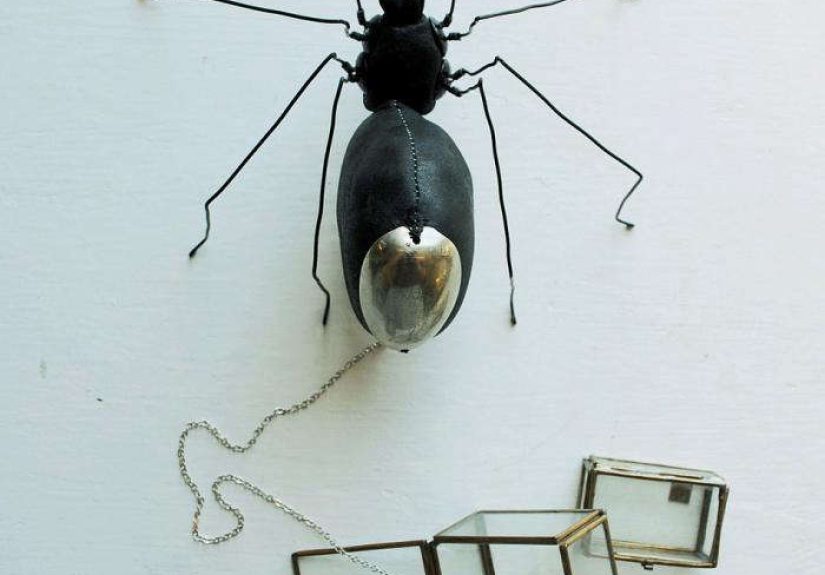
Toadstools and fungi: the couture forest floor
Finch’s toadstools are famous for their scale play: small enough to feel like collectibles, dramatic enough to feel like stage props.
They often sit on wooden bases like botanical specimens, with textures selected to mimic caps, gills, and that velvety “forest after rain”
feeling. They’re whimsicaluntil you remember fungi are both life-giving and quietly ominous. Perfect Finch territory.
Insects and moths: delicate, obsessive detail
Moths and butterflies show up often, and it’s easy to see why: they let him show off wing patterning, embroidery-like surfaces,
and the poetry of transformation. Their life cycles also fit his larger themesbeauty, decay, and timewithout needing a single word.
Birds as “study skins,” reimagined in fabric
Some of Finch’s bird pieces reference the way natural history collections preserve specimens. In museums, birds are often kept in a
compact, carefully posed format for study. Finch translates that idea into textile formkeeping it respectful and clearly artificial,
more about memory and the life cycle than anything graphic. It’s one of the clearest examples of how his work can be tender and
unsettling at the same time.
Masked rabbits, crowned swans, and dressed-up animals
Finch sometimes adds clothing, accessories, masks, or crownshuman touches that make the creatures feel like characters.
The styling isn’t random: it’s storytelling. When an animal looks “ready for an occasion,” your brain starts inventing the occasion.
That’s how a sculpture becomes a narrative.
New York’s “Handmade Museum”: When a Gallery Became a Storybook Exhibit
A major spotlight moment for Mister Finch came with his debut solo gallery exhibition in New York City,
Mister Finch’s Handmade Museum, presented by Steven Kasher Gallery in 2015. The show was described as a “cabinet of curiosities”
filled with hand-sewn specimensworks that turned a white-walled gallery into something closer to an enchanted archive.
The exhibition emphasized two things that define his practice:
(1) scale (tiny details rendered with absurd seriousness, and large creatures made to feel intimate),
and (2) atmosphere (the sense that you’ve stepped into a world with rules you don’t know yet).
It’s the kind of show people remember because it doesn’t just display objectsit stages a mood.
What Artists and Makers Can Learn From Mister Finch
Even if you’re not sewing moth wings at 1 a.m., Finch’s approach offers a masterclass in how to build an artistic voice that feels
both personal and consistent.
Make a world, not just a product
The strongest thing about Mister Finch’s brand (in the best sense of the word) is that everything belongs to the same universe.
That universe has materials, rules, characters, and recurring symbols. Viewers don’t just “like a sculpture.” They feel like
they’ve visited a place.
Let materials carry meaning
Upcycled textiles aren’t only a sustainability choicethey’re narrative tools. A vintage tablecloth doesn’t read like a blank fabric.
It reads like a past life. Finch uses that emotional shorthand, so the object feels storied before you even identify it.
Use contrast as your engine
Cute + uncanny. Soft + strange. Old + new. Finch thrives in those pairings. If you’re building your own practicewhether it’s
embroidery art, fabric sculpture, mixed media, or any kind of craftcontrast is a powerful way to keep work visually alive.
How to Display Textile Sculpture at Home (So It Looks Curated, Not Cluttered)
Mister Finch’s pieces often look like they belong in a museum display case, which is a helpful clue if you want to style similar work
in your own space. Whether you’re collecting fiber art or making it, presentation matters.
- Think “specimen,” not “shelf filler”: give pieces breathing room and a simple base or stand.
- Use a backdrop with calm energy: neutral walls, natural wood, or glass-front cabinets keep textures readable.
- Group by story: fungi with botanical books, moths with framed sketches, birds with vintage jars (no chaos, please).
- Light it like an exhibit: soft directional light makes stitching and surface detail pop.
The goal is to highlight the handwork. Finch’s art rewards close lookingso your display should invite it, not overwhelm it.
Field Notes: Experiencing Mister Finch’s World (Extended)
The first “experience” of Mister Finch’s work usually happens before you know anything about him. You see a photomaybe a toadstool
perched on a wooden base, maybe a moth with wings that look impossibly detailedand your brain does that quick double-take:
Is that fabric? It’s the same feeling you get when you realize a movie prop is practical, not CGI. Your respect kicks in
immediately because the illusion is earned.
Then comes the second experience: the slow scan. Your eyes start tracking decisions. The choice of a faded velvet for shadow.
The way a seam line becomes anatomy. The tiny bits of pattern that read like “forest texture” even if they started life as a
floral curtain panel. This is where the work starts to feel less like “a sculpture” and more like “a specimen with a biography.”
Upcycled textiles are doing heavy lifting herebecause when fabric looks older, it automatically suggests a past. Finch uses that
like an author uses backstory.
If you’ve ever stood in front of a display case in a museumrocks, insects, pinned butterflies, labeled drawersyou know that museum
feeling: curiosity mixed with hush. Finch’s art triggers a similar response. Not because it copies museums, but because it borrows
their language: careful arrangement, attentive craft, and the implication that everything on display has a reason to exist.
In a world where so much visual content is designed to be scrolled past in 1.5 seconds, that “please slow down” energy feels almost rebellious.
The “edginess” shows up as you look longer. A toadstool is gorgeous, but it’s also the classic symbol of “don’t eat the pretty thing.”
A bird looks elegant, but it’s presented like a study objectmore about time and memory than about cuteness.
Even when an animal is dressed up (a crown here, a mask there), it doesn’t become silly. It becomes theatricallike a character from
a folktale who might help you, trick you, or both. That uncertainty is oddly satisfying. It’s not horror; it’s suspense.
There’s also a maker’s experience embedded in Finch’s practice that many artists recognize instantly: the hunt. Fabric is not just
“material,” it’s “the right material.” Anyone who has ever thrifted, salvaged, or repurposed knows the exact thrill of finding a
textile with the perfect weight, pattern, or worn-in softness. Finch’s work feels like it comes from that thrilland you can sense
it in the final object. The textures don’t feel random; they feel discovered.
And finally, there’s the collector’s experience: living with a piece that keeps changing on you. Not physicallyemotionally.
In bright morning light, a moth might read as elegant and decorative. At night, under a lamp, it might feel mysterious and slightly uncanny.
That shifting mood is a big reason people fall hard for Finch’s world. The work isn’t a single-note “cute craft” moment or a single-note
“dark art” moment. It’s both, stitched together. You get a little wonder, a little unease, and a lot of admiration for the hands that made it.
Conclusion: The Charm of the Strange, Sewn to Perfection
Mister Finch proves that textile art can be as cinematic as painting and as emotionally charged as literaturewithout losing the
satisfaction of handmade craft. His work sits in that rare zone where technique and storytelling feed each other: the materials are
meaningful, the forms are unforgettable, and the mood is unmistakably his. If you’re looking for an edgy textile artist whose work
feels like a fairytale artifact you’re not entirely sure you were meant to find, Mister Finch is exactly that kind of magic.