Table of Contents >> Show >> Hide
- The Point of a Monthly Self-Check (and What It Isn’t)
- Grab Your “Self-Check Kit” (No Subscription Required)
- Breast Self-Check (Breast Awareness) in About 5 Minutes
- Testicular Self-Check: A Quick Monthly “Roll Call”
- Skin Cancer Self-Check: The Head-to-Toe “Spot the Difference” Game
- How to Make This a Habit You’ll Actually Keep
- Common Questions (Because Bodies Love Plot Twists)
- Conclusion: Small Habit, Big Awareness
- Experiences: What People Notice During Monthly Self-Checks (and How to Not Freak Out)
You check your bank balance. You check your fridge for that mystery container. You even check your phone battery like it’s a vital sign.
So let’s talk about a monthly self-check that’s actually worth the two minutes it takes: a simple, head-to-toe “what’s new with me?” scan
for common warning signs of breast cancer, testicular cancer, and skin cancer.
This guide is practical, judgment-free, and mildly funny (because if we can laugh while we do taxes, we can laugh while we do self-checks).
You’ll get step-by-step instructions, what “normal” can look like, what changes are worth a call to your clinician, and what to search for if you
prefer learning by video.
Important note: Self-checks don’t diagnose cancer. They help you notice changes early and bring them to a professional’s attention. If anything here makes you think, “Hmm… that’s weird,” that’s your cue to get it checkedpreferably sooner than later.
The Point of a Monthly Self-Check (and What It Isn’t)
A monthly self-check is about body awarenessgetting familiar with your baseline so you can spot changes. It is not a replacement for medical screening.
For example, mammograms (for people at average risk) are recommended on a schedule based on age and risk factors, and skin checks by a clinician may be advised if you’re higher risk.
Think of self-checks as your “between-appointments” radar.
Why monthly?
- Consistency: Same interval makes changes easier to notice.
- Low effort, high payoff: It’s quick and free.
- Momentum: Doing it monthly builds a habitlike flossing, but with fewer lectures.
Quick reality check on recommendations
Many major medical groups no longer recommend formal “self-exams” as a stand-alone cancer screening tool for everyone because they haven’t clearly reduced deaths and can lead to anxiety and false alarms.
However, most experts still encourage knowing what’s normal for your body and reporting new or persistent changes. That’s the spirit of this article: self-awareness, not self-diagnosis.
Grab Your “Self-Check Kit” (No Subscription Required)
Here’s what helps:
- Good lighting (bathroom light that doesn’t make you look like a haunted Victorian portrait).
- A full-length mirror and a hand mirror (especially for skin checks).
- Your phone for notes or photos (tracking change is the whole game).
- A ruler or measuring tape (for moles/spots).
- Lotion or soap (helps fingers glide for breast checks).
Best habit hack: Pick one easy datelike the first weekend of the monthor set a recurring reminder. Call it “Monthly Maintenance.” You’re basically a human apartment.
Breast Self-Check (Breast Awareness) in About 5 Minutes
This applies to anyone with breast tissueincluding women, men, and many transgender and nonbinary people.
The goal is to learn what your breasts normally look and feel like and notice changes.
When to do it
- If you menstruate: A few days after your period ends is often easiest (less tenderness/lumpiness).
- If you don’t menstruate: Pick a consistent day each month (e.g., the 1st, or “rent day”).
- If you’re pregnant, breastfeeding, or on hormones: Your baseline may shiftstill check monthly, but expect more normal variation.
What you’re looking for
Most breast changes are not cancer. Still, watch for:
- A new lump or thickening that feels different from the rest of the breast
- Swelling, warmth, redness, or darkening
- Dimpling or puckering of skin (sometimes described like “orange peel” texture)
- Nipple changes: turning inward, new scaling, or persistent rash
- New discharge (especially bloody) not related to breastfeeding
- A persistent, localized pain in one spot (not the usual “both sides are sore” situation)
- New swelling or lump in the armpit or near the collarbone
How to do it (3-part method: Look, Feel Standing, Feel Lying Down)
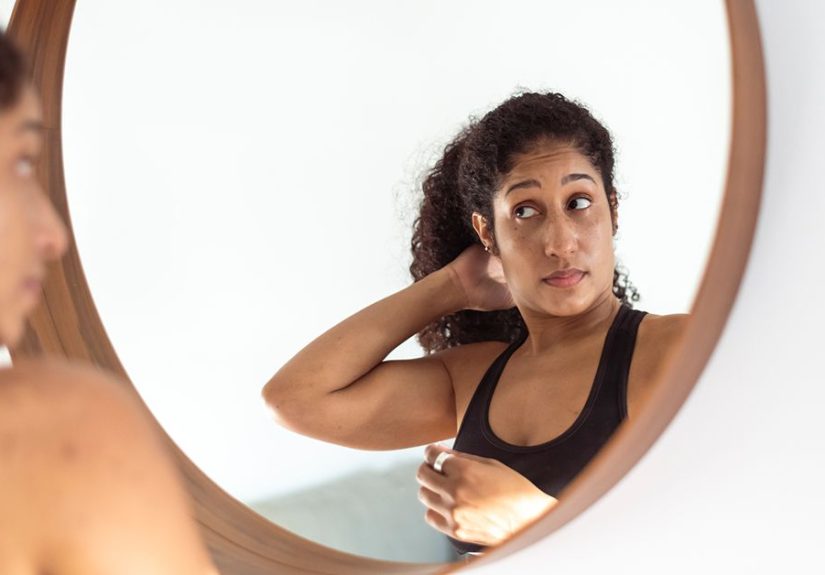
1) Look in the mirror (30–60 seconds)
- Stand with shoulders relaxed, arms at your sides. Look for changes in shape, size, or skin texture.
- Put hands on hips and press firmlythis tightens chest muscles and can reveal dimpling.
- Raise arms overhead and look again.
- If helpful, gently lift breasts to view the underside where rashes and skin changes can hide.
2) Feel while standing or in the shower (1–2 minutes per side)
- Use the pads of your three middle fingers (not the tips).
- Use light, medium, then firm pressurelike testing a peach for ripeness, not kneading bread dough.
- Follow a pattern so you don’t miss spots:
- Vertical strip pattern: Move up and down in lines, covering collarbone to bra line and sternum to armpit.
- Or circle pattern: Spiral from nipple outward (or the reverse).
- Don’t forget the armpit area (lymph nodes live there).
3) Feel lying down (2–3 minutes total)
- Lie down with a pillow or folded towel under the shoulder of the side you’re checking.
- Place that arm behind your head. This spreads breast tissue more evenly.
- Repeat the same pattern as above, covering all areas and the armpit.
What to search for in videos (reputable, easy-to-follow)
- “Mayo Clinic breast self-exam for breast awareness”
- “Breastcancer.org breast self-exam 5 steps”
- “National Breast Cancer Foundation breast self-exam”
- “Breast self-awareness ACOG explanation”
When to call a clinician
- A new lump that persists after your next menstrual cycle (or lasts more than a couple weeks if you don’t cycle)
- Bloody nipple discharge
- Skin dimpling or new nipple inversion
- Rapid swelling, warmth, or redness that doesn’t improve (urgent evaluation is smart)
Testicular Self-Check: A Quick Monthly “Roll Call”
Testicular cancer is relatively uncommon overall, but it’s one of the more common cancers in younger men.
Many clinicians encourage men to be familiar with their usual anatomy so changes get checked promptly.
That said, routine screening by self-exam is not universally recommended for everyoneso think of this as knowing your baseline and acting on changes.
When to do it
- Best time: After a warm shower or bath, when the scrotal skin is relaxed.
- Frequency: Monthly, same day each month.
Know what “normal” can be
- It’s common for one testicle to hang lower or be slightly larger.
- You’ll feel a soft, rope-like structure on the back/top of each testicle called the epididymis. That’s normal.
How to do a testicular self-check (2 minutes)
- Stand comfortably. Use both hands.
- Examine one testicle at a time. Place your index and middle fingers underneath and your thumb on top.
- Gently roll the testicle between your fingers and thumb, feeling the surface.
- Check for:
- Any hard lump (often painless)
- New swelling or enlargement
- A change in firmness
- A heavy or dragging feeling
- Repeat on the other side.
Red flags (and one “don’t wait” emergency)
- A painless lump or swelling
- A feeling of heaviness in the scrotum
- A dull ache in the lower abdomen or groin
- Sudden collection of fluid in the scrotum
- Emergency: Sudden, severe testicular pain can signal testicular torsion. That’s an ER-now situation, not a “let’s see tomorrow” situation.
What to search for in videos
- “Urology Care Foundation testicular self-examination”
- “KidsHealth testicular self-exam slideshow”
- “Testicular Cancer Society how to self exam”
If you’re at higher risk (for example, a history of undescended testicle or strong family history), ask a clinician what monitoring makes sense for you.
The best plan is the one you’ll actually followand that’s tailored to your risk.
Skin Cancer Self-Check: The Head-to-Toe “Spot the Difference” Game
Skin checks are the most visual of the bunch, which is great because your eyes are excellent at noticing changeespecially if you give them a monthly mission.
Many experts suggest a monthly self-skin exam, particularly if you have risk factors like lots of moles, a personal/family history of skin cancer, frequent sunburns, tanning bed use, or very fair skin.
What you need
- Full-length mirror + hand mirror
- Bright light
- Comb or hair dryer (to part hair for scalp checks)
- Phone camera (progress pics are powerful)
- A “buddy” if possible (backs are notoriously uncooperative)
What to look for: ABCDE + “Ugly Duckling”
The ABCDE rule helps spot suspicious moles or pigmented lesions:
- A Asymmetry: One half doesn’t match the other.
- B Border: Irregular, scalloped, or poorly defined edges.
- C Color: Multiple colors or uneven shades (tan, brown, black, red, white, blue).
- D Diameter: Often larger than 6 mm (about a pencil eraser), though smaller can still be concerning.
- E Evolving: Changing in size, shape, color, or symptoms.
Add the “Ugly Duckling” idea: a spot that looks noticeably different from your other moles deserves attention.
Also watch for any sore that doesn’t heal, a spot that bleeds easily, or a lesion that itches, crusts, or becomes painful.
How to do a skin self-check (10 minutes, monthly)
- Face + scalp: Check nose, lips, mouth, ears (front and back). Part hair and scan the scalp section by section.
- Hands + arms: Palms, backs of hands, between fingers, under nails, wrists, forearms, elbows, upper arms.
- Torso: Neck, chest, stomach. Don’t skip under breasts or skin folds.
- Back: Use a hand mirror (or a helper) for shoulders, upper back, lower back, buttocks.
- Legs + feet: Front and back of legs, ankles, tops and soles of feet, between toes, under toenails.
- “Hidden zones”: Genital area and anywhere the sun “never” hitsbecause skin cancer didn’t get that memo.
Track changes like a pro (without turning into a detective show wall)
- Take photos of moles/spots you’re watchingsame lighting and angle if possible.
- Measure suspicious spots (a small ruler works).
- Use a body map worksheet if you like structure.
- If you’re unsure, book a professional skin examdermatology exists for a reason.
What to search for in videos
- “American Academy of Dermatology skin self-exam”
- “Cleveland Clinic skin self exam ABCDE melanoma”
- “Skin Cancer Foundation self-exams what to look for”
- “NCI ABCDE melanoma tool”
How to Make This a Habit You’ll Actually Keep
Use the “stacking” trick
Pair your self-check with something you already do monthly:
refilling a prescription, changing your toothbrush head, paying rent, or that one calendar reminder you never ignore because it yells at you.
Keep notes simple
- Breast: “No change” or “Left outer area feels lumpierrecheck next month.”
- Testicles: “No change” or “Small pea-sized bumpcall urology.”
- Skin: “Mole on right shoulder unchanged. New pink spot on shinphoto taken.”
Don’t let anxiety drive the car
Self-checks can bring up worry, especially at first. That’s normal. The goal isn’t to become your own radiologistit’s to notice patterns and act on persistent changes.
A reasonable mindset: “Observe, document, follow up if it’s new, changing, or unusual.”
Common Questions (Because Bodies Love Plot Twists)
“I found a lump. Is it definitely cancer?”
No. Many lumps are benign (cysts, hormonal changes, inflammation). But any new lump that persists deserves a clinician’s evaluation.
You don’t have to decide what it isyou just have to decide to get it checked.
“My skin has a new spot, but it’s tiny.”
Size alone doesn’t rule anything out. “Evolving” matters a lot. If it’s changing, bleeding, not healing, or looks like an “ugly duckling,” get it looked at.
“I’m not in a ‘high-risk’ group. Do I still need this?”
Cancer doesn’t require an invitation. Risk factors matter, but awareness helps everyoneespecially because life is busy and symptoms can get ignored.
Monthly self-checks are a low-stakes way to stay in touch with your baseline.
“What if I’m doing it wrong?”
If you’re checking consistently and covering the areas, you’re doing the most important part right.
If you want more confidence, watch a video from a major medical organization and mirror the steps.
Conclusion: Small Habit, Big Awareness
Monthly self-checks are not about perfection. They’re about noticing what’s normal for you and spotting changes early.
If you remember nothing else: new, changing, or unusual is your signal to talk to a clinician.
Your future self will thank youpossibly with fewer appointments that start with, “So… how long has that been there?”
Experiences: What People Notice During Monthly Self-Checks (and How to Not Freak Out)
When people start monthly self-checks, the first experience is usually: awkward. Mirrors feel judgmental. Lighting is either too flattering or too “crime documentary.”
And suddenly you’re hyper-aware of every freckle, bump, and harmless asymmetry you’ve had since middle school. That’s normal.
The first month isn’t about finding something scaryit’s about meeting your baseline like you’re being introduced at a party: “Hi, this is my skin. It has opinions.”
A common early surprise is how much bodies naturally change. Breasts can feel different depending on the time of month, stress, caffeine, new workouts, or hormone shifts.
People often describe finding a “new lump” that turns out to be a cyst, swollen gland, or normal tissue that just feels more noticeable in that moment.
The key habit is to recheck intelligently: if you menstruate, reassess after your next cycle; if you don’t, give it a short window (like two weeks) and see if it persists.
If it sticks aroundor if it comes with skin changes, nipple changes, or dischargeget it evaluated.
With testicular checks, people often worry they’ll “find something” and not know what it is. The epididymis (that soft, rope-like structure) causes a lot of unnecessary panic.
Many men also notice that one side feels slightly different or hangs lower, which is extremely common. The mindset that helps most is:
you’re not searching for perfectionyou’re searching for change. A new, hard lump is the classic concern, but so is swelling, heaviness, or a persistent ache.
And if there’s sudden severe pain, the experience to remember is simple: don’t tough it outget urgent care.
Skin checks can feel like playing “Where’s Waldo?” on your own bodyespecially if you have lots of moles. People who do well with monthly skin checks usually do two things:
they pick a consistent routine (same mirror, same light, same order), and they use photos.
A quick picture of a mole you’re watching beats trying to rely on memory, which is famously unreliable (see also: why you walked into the kitchen).
Over time, you start recognizing your “usual suspects,” and anything new stands out more clearly.
One of the most helpful real-world patterns people report is that self-checks reduce anxiety after a few months.
The first couple checks can feel intense because everything is “new” to your attention, not necessarily new to your body.
By month three or four, you typically know what’s stable. The self-check turns into a calm scan:
“Nope, still the same freckle. Still the same mole. Still the same tissue texture. Great.”
And if something is different, you have the confidence to say, “This is new,” which helps clinicians take the next steps faster.
If you want a practical, experience-based rule that keeps things balanced, use the 3-word filter:
New. Changing. Unusual. If a spot, lump, or symptom fits one (or more) of those wordsespecially if it persistsput it on your “call the clinician” list.
If it doesn’t, note it and move on with your life. Your self-check should feel like self-care, not a monthly audition for a medical drama.