Table of Contents >> Show >> Hide
- The listing in plain English (before we swoon)
- Meet Spring House: Wright’s “ship in the woods”
- Why this Florida Wright home is truly rare
- A quick (fun) guide to Wright’s hemicycle style
- The design details worth obsessing over (because they’re the point)
- The plot twist: this is a historic landmark and a serious fixer-upper
- Preservation context: why people care so much about saving it
- So… who buys a Frank Lloyd Wright home in Florida?
- What a smart buyer should consider (beyond the purchase price)
- Why this sale matters beyond real estate
- The takeaway
- A reader’s-eye experience: what it feels like to encounter Spring House (and why it sticks with you)
- SEO Tags
Some homes “hit the market.” This one enters like a celebrity cameo: sunglasses on, curves out, and absolutely no interest in being compared to your neighbor’s gray farmhouse flip.
The Spring House (also called the Lewis Spring House) is widely noted as the only built private residence Frank Lloyd Wright designed in Floridaand it’s now listed for sale in Tallahassee.
The asking price sits at $2,128,000, and yes, it comes with bragging rights, architectural history, and a restoration-sized to-do list. In other words: rare, iconic, and not for the faint of heart (or the faint of budget).
The listing in plain English (before we swoon)
Here’s the quick snapshot: the home is on roughly 10 acres of wooded land at 3117 Okeeheepkee Road in Tallahassee, Florida, with a listing price of $2,128,000 and a recorded date on market in mid-August 2025.
It’s described as a three-bedroom, two-bath home with about 2,040 square feet of heated and cooled living area, and it’s associated with the legendary “Spring House” name that nods to a natural spring on the property. If your real estate app is used to showing “open-concept kitchen” as the headline feature, this one is going to feel like it dropped in from another universe.
Meet Spring House: Wright’s “ship in the woods”
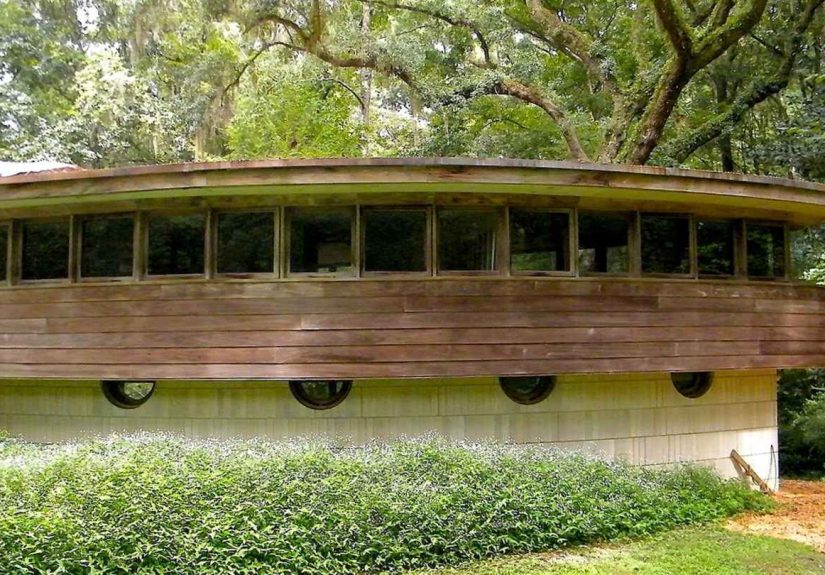
Wright designed hundreds of private homes across the U.S., but Florida barely got a single residential “hello” from him. Spring House is that helloa two-story, late-career work in Tallahassee that many describe as ship-like, as if a sleek vessel decided to dock permanently among trees instead of waves.
The house was commissioned by George Lewis II and Clifton Lewis while Wright was working in Florida on Florida Southern College projects, and it was completed in 1954. The result is a home that looks less like a conventional box and more like a set of intersecting arcs, with the landscape treated as a co-star instead of mere scenery.
Why this Florida Wright home is truly rare
There are “rare” homes that are rare because the wallpaper pattern was discontinued. Then there’s rare because the architect is Frank Lloyd Wright and the state is Florida.
Multiple outlets and preservation organizations describe Spring House as the only private residence designed by Wright that was built in Florida, which makes the listing feel like a once-in-a-generation moment for architecture fans.
It’s also tied to Wright’s late “hemicycle” periodan approach that leans into semicircular planning and curved glass walls rather than his more famous long horizontals and sharp geometry.
A quick (fun) guide to Wright’s hemicycle style
If Prairie Style is Wright in his “long lines, low roofs, and horizon-hugging confidence” era, hemicycle is Wright in his “what if the whole house was a sunrise diagram?” era.
The hemicycle concept uses arcs and semicircles to shape rooms and circulation, often pairing curved plans with expansive glass so daylight can slide across interiors over the course of the day.
Several write-ups connect this curving logic to the same creative period that produced the Solomon R. Guggenheim Museum’s iconic spiral in New Yorkdifferent building, same love of geometry that refuses to sit still.
The design details worth obsessing over (because they’re the point)
1) The glass wall that treats daylight like interior décor
A big part of Spring House’s personality is its relationship to light. The home is described as having dramatic glazing and a double-height sense of openness in key living areas, helping the wooded site feel present from inside.
Wright wasn’t just adding windows; he was staging an all-day performance where the sun does the moving and the house does the framing.
For anyone who thinks “natural light” is a listing cliché, this place is the rebuttal: light isn’t a feature hereit’s the floor plan’s best friend.
2) Built-ins, including the bench that literally curves with the room
Wright loved built-ins because they made spaces feel intentionallike the house had opinions about how you should live (politely, but firmly).
Accounts of Spring House highlight a signature built-in bench that follows the curve of the wall, encouraging people to gather in the communal living area.
It’s the opposite of the “everyone disappear to separate corners of the house with separate screens” lifestyle. The architecture gently insists you share the spacewithout sending a group text about it.
3) Materials that feel grounded, not glossy
Spring House is frequently described as using concrete block and cypress, with warm wood tones that read as both midcentury and timeless.
You’ll also find references to features like a skylight and fireplaces that reinforce the home’s cozy, sheltering vibean important counterbalance to all that glass and curvature.
The materials aren’t trying to sparkle; they’re trying to belong to the site, which is peak Wright.
The plot twist: this is a historic landmark and a serious fixer-upper
Here’s the part that separates casual dreamers from committed stewards: the house has long been associated with preservation concerns.
The National Trust for Historic Preservation has described the property as deteriorating and in urgent need of repairs, noting issues tied to exposure and water intrusion as well as deterioration in wood elements.
In other words, you’re not just buying a rare Wright homeyou’re potentially inheriting a rescue mission with architectural stakes.
That’s not meant to scare people off; it’s meant to be honest about what “rare” often costs. Wright’s designs can be magical, but they can also be demanding.
Curves, custom details, and specialized materials don’t always play nicely with quick repairs or bargain contractors.
If your renovation plan is “we’ll see what my cousin can do on weekends,” this house will respectfully decline that invitation.
Preservation context: why people care so much about saving it
Spring House isn’t just notable because it’s Wright. Preservation groups have spotlighted it because hemicycle homes represent a lesser-known chapter of his career, and because the property’s significance was recognized relatively early.
The home was placed on the National Register of Historic Places in 1979an unusually quick timeline for a building of its age, reflecting the belief that it mattered on a national architectural level.
It has also been associated with preservation advocacy and public interest over the years, including attention from groups dedicated to protecting Wright sites.
So… who buys a Frank Lloyd Wright home in Florida?
Let’s be realistic: most buyers are not looking for “historic hemicycle stewardship” when they’re scrolling listings at midnight.
But this kind of property tends to attract a specific mix of people and institutions:
collectors of important architecture, preservation-minded philanthropists, cultural organizations, and buyers who want a home that functions as both residence and legacy.
If that sounds dramatic, goodbecause a Wright home is inherently dramatic. It’s architecture with a plot.
What a smart buyer should consider (beyond the purchase price)
1) Restoration is not HGTV-speed
A thoughtful restoration of a significant modernist house typically involves research, documentation, and specialists who understand how Wright buildings behave over time.
Expect assessments from structural experts, enclosure/roof professionals, and preservation architectsespecially where water intrusion and wood deterioration are concerns.
This isn’t about making it “trendier.” It’s about making it sound, safe, and faithful to the design while respecting modern realities.
2) Historic status can shape what you can change
Being listed on the National Register doesn’t automatically freeze a house in amber, but it can influence how restorations are approachedespecially if grants, easements, or preservation partnerships enter the picture.
If a buyer wants to add, subtract, or reconfigure major elements, it’s wise to understand the ripple effects early.
The goal isn’t to make ownership miserable; it’s to keep the integrity of something that can’t be replaced once it’s altered beyond recognition.
3) Florida weather is not a passive roommate
Even in Tallahasseeaway from some coastal conditionsstorms, humidity, and wind-driven rain can be relentless over decades.
Preservation sources have specifically pointed to exposure and storm-related impacts as part of the house’s deterioration story.
A responsible plan should include resilient detailing that protects the building while preserving its characterbecause the climate does not care that your house is famous.
Why this sale matters beyond real estate
Most listings are about lifestyle. This one is about cultural memory.
When a rare Wright home comes up for saleespecially one that’s broadly described as Florida’s only built private residence by himit triggers a familiar question:
should an architectural landmark remain a private home, become a public site, or find a hybrid future that funds its preservation?
However it ends, the listing shines a bright spotlight on a truth preservationists repeat constantly: historic architecture survives when someone chooses stewardship over convenience.
The takeaway
Spring House isn’t just “a cool midcentury property.” It’s a rare piece of American design history with a price tag that buys you entrance into a very specific club: the people responsible for keeping an architectural idea alive in the real world.
If the right buyer shows upwith patience, resources, and a deep respect for what makes the home specialFlorida’s most singular Wright residence could move from “endangered icon” to “restored masterpiece.”
And if you’re just here to admire it from afar, that’s valid too. Some houses are meant to be lived in. Some are meant to be learned from. This one insists on being both.
A reader’s-eye experience: what it feels like to encounter Spring House (and why it sticks with you)
Imagine you’re driving through Tallahassee’s greenery and the world slowly quiets downless strip-mall noise, more wind in the trees. The road name alone feels like a spelling bee challenge,
and then the forest opens just enough to reveal it: a home that doesn’t “sit” on land so much as it “rests” there, like it found the one spot where it finally made sense to stop moving.
From the outside, the curves read as confidence. No fussy ornament. No “look at me” mansion theatrics. Just geometry and wood and the kind of calm that says,
“I was designed by someone who believed buildings should have a relationship with the Earthso please don’t ask me to be symmetrical for your convenience.”
As you picture stepping inside, you can almost feel the shift: the straight-line habits you bring from everyday life don’t quite apply. Corners don’t command the room.
Instead, the space guides you along an arc, and suddenly you’re moving the way the building movessoftly, gradually, like you’re following a path instead of walking across a box.
Daylight becomes a real presence. Not a harsh spotlight, not a dim lamp glow, but something that changes minute by minute, sliding across surfaces and making the room feel alive.
In a house like this, “time of day” isn’t just a clock thingit’s a mood thing.
Then there are the built-ins: the subtle reminders that this wasn’t meant to be a blank container for furniture trends. A curved bench doesn’t just provide seating;
it creates a gathering point, a natural “come sit here” message that feels friendlier than a sign and more persuasive than a group chat.
You can imagine family conversations collecting in that spacestories told, debates held, long silences shared without anyone feeling like they needed to fill them.
The house doesn’t beg for attention; it invites participation.
And because it’s Florida, the outdoors never fully leaves the picture. Even in your imagination, you notice how the landscape presses closetrees, shadows, and the suggestion of water nearby.
The name “Spring House” isn’t a branding trick; it’s a clue to what the place is about: living with the site, not just on it.
You can almost hear the sounds that come with a wooded propertybirds, insects, the occasional “what was that?” rustle that makes you pause and listen.
It’s the kind of setting that makes you put your phone downnot because someone told you to, but because the environment is simply more interesting than your notifications.
Of course, the experience also carries a weight: the awareness that beauty like this can be fragile. When a famous house needs care, you feel the tension between awe and responsibility.
It’s easy to fall in love with the idea of living in a Wright home. It’s harderand more meaningfulto fall in love with the work of keeping it standing for the next chapter.
That’s why this listing lands differently than most. Even if you never plan to buy it, it prompts a question worth sitting with:
what do we owe the places that shaped our cultural imagination? Spring House doesn’t answer that for you. It just makes it impossible to ignore.