Table of Contents >> Show >> Hide
- What “Blended Workforce” Really Means (And Why It’s Not Just a Buzzword)
- The Three AI Paradigms That Get Leaders in Trouble
- The New Talent Archetype: “Taste Makers,” Not Task Executors
- The Blended Workforce Playbook: 9 Moves to Blend Humans + AI Safely
- Move 1: Start With a Work Map (Not a Tool List)
- Move 2: Set Your Human–Agent Ratio (Yes, Like Staffing)
- Move 3: Define Three Non-Negotiable Roles
- Move 4: Build an “AI Deployment Factory” (So It’s Not Random Acts of Automation)
- Move 5: Design for Drift, Errors, and Weirdness (Because It Will Happen)
- Move 6: Put Governance Where Work Happens (Not in a Binder)
- Move 7: Redesign Roles Around “Fusion Skills”
- Move 8: Measure Outcomes, Not “AI Usage”
- Move 9: Address the Human Impact Head-On
- Examples: What a Blended Workforce Looks Like in Real Work
- Common Failure Modes (And How to Avoid Becoming a Cautionary LinkedIn Post)
- A Practical 30–60–90 Day Rollout Plan
- FAQ: Quick Answers Leaders Actually Need
- Conclusion: Don’t “Add AI.” Redesign Work.
- Field Notes: 10 Experience-Based Lessons Teams Learn the Hard Way
- 1) Your best people adopt firstthen quietly get annoyed
- 2) The real bottleneck isn’t promptsit’s operationalization
- 3) Human review doesn’t scale unless you redesign the review itself
- 4) “More output” can accidentally destroy your brand
- 5) Drift shows up as tone before it shows up as errors
- 6) The moment AI touches customer data, procurement becomes product
- 7) The safest path is “constrained autonomy”
- 8) Performance management must evolve (gently, but clearly)
- 9) “AI anxiety” drops when people can see the ladder
- 10) The best blended orgs celebrate judgment as much as speed
Picture your org chart in six months. Now picture it with an invisible layer of always-on “employees” who never sleep, never take PTO, and occasionally hallucinate with the confidence of a man explaining Bitcoin at brunch. Congratsyou’ve just met the blended workforce: humans + AI agents working together to ship outcomes.
And if you’ve been treating AI like “a faster intern” (or worse, “a replacement human”), you’re not alone. But you are walking straight into the two things that break organizations fastest: confused accountability and unmanaged change.
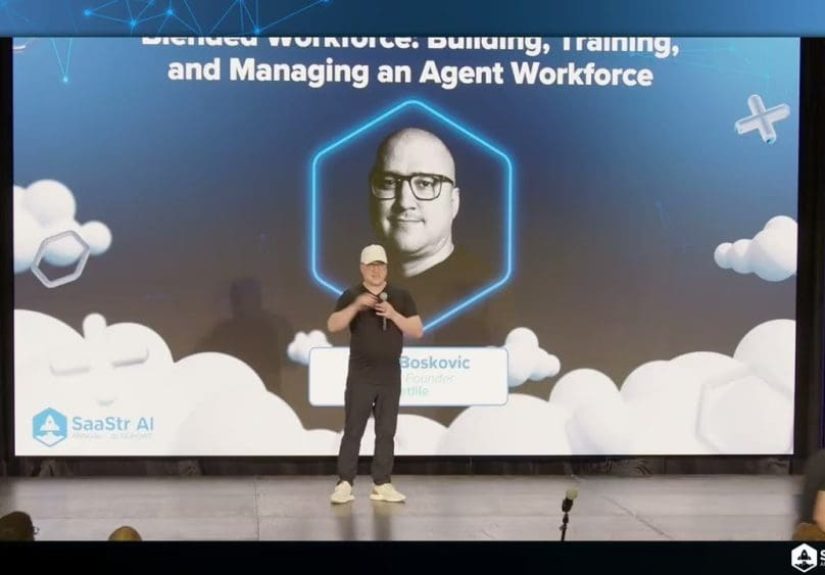
This playbook synthesizes proven guidance on human–AI collaboration and operating models, anchored by practical lessons shared by David Boskovic, Founder & CEO of Flatfilea company building AI agents for enterprise data preparation and cleanup in high-sensitivity environments. The result: a leadership guide for blending humans and AI without snapping culture, quality, compliance, or your best people.
What “Blended Workforce” Really Means (And Why It’s Not Just a Buzzword)
Historically, “blended workforce” referred to mixing full-time employees with contractors, freelancers, and on-demand talent. The new version adds a more disruptive category: AI agents that can perform worksometimes at scale, sometimes autonomously, and often with weird edge cases that only show up after deployment.
So the question isn’t “Should we use AI?” The question is:
- Which work should be automated end-to-end?
- Which work should become human–AI collaboration?
- And where do you need humans to stay firmly in charge because the downside risk is real?
If you don’t answer those intentionally, you’ll get a “shadow blended workforce” anywayemployees using tools in the dark, inconsistent outputs in the wild, and executives acting surprised when legal asks, “Wait… we put what data into which model?”
The Three AI Paradigms That Get Leaders in Trouble
1) The “Augmentation Trap”
This is the comforting story: “AI makes everyone 20% more productive, so job descriptions stay the samejust faster.” It sounds nice in an all-hands. It’s also incomplete.
In real deployments, AI doesn’t simply speed up the same tasks; it changes the shape of the job. If you keep the old role design, you often get more outputbut not necessarily better outcomes. (Hello, 400 blog posts no one reads.)
2) The “Replacement Fantasy”
“Meet our AI SDR!” “Meet our AI analyst!” This is where companies put a human mask on a machine and shove it into a human-shaped role. The machine may deliver bursts of valueuntil it hits nuance, context, judgment, or brand risk and faceplants in front of your customers.
3) The “Amplification Flip” (The One That Actually Works)
Here’s the shift Boskovic highlights: stop focusing on how AI amplifies a human. Focus on how a human amplifies AIdirecting it, evaluating it, applying judgment, and owning the outcome. That’s how you get step-change gains without losing control.
The New Talent Archetype: “Taste Makers,” Not Task Executors
AI makes execution cheaper. That shifts value toward:
- Taste (what good looks like)
- Judgment (what’s correct, safe, on-brand, compliant)
- Context (what matters for this customer, this quarter, this market)
- Accountability (who owns the decision when the model is wrong)
Some people thrive here. Others don’t. Your job as a leader is not to pretend everyone will love it. Your job is to design a system that lets people succeedand gives them a path to build the skills they’ll need.
The Blended Workforce Playbook: 9 Moves to Blend Humans + AI Safely
Move 1: Start With a Work Map (Not a Tool List)
Before you buy anything, map your work into three buckets:
- Low-risk, repeatable (good for automation): internal summaries, data normalization drafts, first-pass classification, routine reporting.
- Medium-risk, judgment-heavy (good for collaboration): customer comms drafts, sales research, policy comparisons, onboarding workflows with review.
- High-risk, high-impact (human-owned with AI support): hiring decisions, pricing exceptions, regulated outputs, financial reporting sign-offs, sensitive HR actions.
Pro tip: The trap is “automate the easy stuff” without connecting it to an outcome. Instead, pick workflows where cycle time, error rate, or cost-to-serve materially improves.
Move 2: Set Your Human–Agent Ratio (Yes, Like Staffing)
Leading research on workplace AI points to a practical truth: you need an explicit plan for which processes are ripe for full automation and which require human–AI collaboration. Treat it like staffingbecause it is.
A useful starting heuristic:
- 1 human : many agents for high-volume content, triage, and researchwith a strong evaluation harness.
- 1 human : 1 agent for roles where the agent is a daily copilot and context matters.
- Many humans : 1 agent for shared services like knowledge retrieval, meeting intelligence, and internal support bots.
Make the ratio explicit in leadership conversations. Otherwise, it becomes accidentaland accidental ratios create accidental failures.
Move 3: Define Three Non-Negotiable Roles
Boskovic’s operating reality breaks down into three roles that show up in successful deployments:
- The Taste Maker: sets quality standards, directs AI, and approves outputs. This person “underwrites” results with judgment.
- The Operational AI Deployer: converts “We could use AI for this” into an operational workflowdashboards, integrations, prompts, automation logic, evaluation criteria.
- The Accountability Layer: trusted reviewers who handle exceptions, approve high-impact outputs, and own the “final mile” risk.
If you skip these roles, you’ll get chaos disguised as innovation. If you staff them, you get scalable leverage.
Move 4: Build an “AI Deployment Factory” (So It’s Not Random Acts of Automation)
The best companies treat AI like a product capability, not a hackathon trophy. Your deployment factory needs:
- Use-case intake: a simple form tied to business KPIs and risk level.
- Evaluation harness: test sets, rubrics, and acceptance thresholds.
- Prompt + workflow standards: versioning, documentation, owners.
- Monitoring: drift detection, output audits, exception queues.
- Change management: training, communication, role redesign.
Translation: don’t just “turn on AI.” Operationalize it.
Move 5: Design for Drift, Errors, and Weirdness (Because It Will Happen)
Model behavior changes over timesometimes in ways you didn’t ask for. Drift can show up as tone shifts, unexpected confidence, or subtle errors that slip past casual review.
Build safety into the system:
- Golden sets (known-good examples) you retest regularly
- Human escalation paths for uncertain outputs
- Rate limits and “blast radius” controls
- Logging for prompts, outputs, and downstream actions
If you treat AI as “set-and-forget,” your org will eventually learn the hard way that AI is “set-and-regret.”
Move 6: Put Governance Where Work Happens (Not in a Binder)
Good AI governance isn’t a committee that meets quarterly to admire a slide deck. It’s guardrails embedded into workflows.
Borrow from established risk frameworks and adapt them to your context:
- Acceptable use policies (what data can be used where)
- Vendor and model procurement checks (privacy, security, retention)
- Human-in-the-loop requirements for high-impact decisions
- Auditability (can you explain what happened after the fact?)
If you operate in regulated spaces or handle sensitive personal data, this is not optional. It’s operational hygiene.
Move 7: Redesign Roles Around “Fusion Skills”
Human–AI success depends on the skills people use to direct, evaluate, and integrate AI outputs into real work. You’re looking to develop:
- Problem framing (what are we actually trying to accomplish?)
- Prompting as specification (clear constraints, context, examples)
- Critical evaluation (spotting omissions, bias, hallucinations)
- Workflow thinking (where does this output go next?)
- Responsible data behavior (what not to paste into tools)
Teach these like you’d teach Excel, sales methodology, or secure coding. Training isn’t a perk; it’s a control mechanism.
Move 8: Measure Outcomes, Not “AI Usage”
AI adoption metrics are tempting because they’re easy. They’re also misleading. Instead, measure:
- Cycle time (lead response time, onboarding time, time-to-close)
- Quality (error rates, rework, customer satisfaction)
- Cost-to-serve (support cost per ticket, onboarding cost per customer)
- Risk (policy violations, escalations, audit findings)
- Employee experience (burnout, role clarity, engagement)
If AI raises “usage” but increases rework, you didn’t winyou moved the work to a different spreadsheet.
Move 9: Address the Human Impact Head-On
AI creates winners, skeptics, and people who feel threatenedoften at the same time, in the same meeting. Ignoring that reality is how you lose trust.
Leadership moves that work:
- Be explicit about which work will change and why.
- Protect dignity: offer training paths and internal mobility.
- Celebrate judgment: reward people who prevent mistakes, not just those who ship fast.
- Redefine performance: include responsible AI behavior and high-quality outcomes.
Examples: What a Blended Workforce Looks Like in Real Work
Example 1: Content Marketing Without Content Spam
In Boskovic’s case study, Flatfile didn’t hire a traditional “writer.” They hired someone who could define quality, create a rubric, and direct AI to produce content that’s actually worth sharing. AI did much of the drafting, fact-checking, and SEO structuringwhile the human provided narrative taste and judgment.
Takeaway: AI didn’t replace the marketer. It replaced the low-leverage parts of the workflow and elevated the human role to editor-in-chief + strategist.
Example 2: RevOps as an AI Deployment Team
Flatfile described spending on research tooling, but the real unlock came from someone turning that into an operational dashboard and process. In many orgs, this becomes a new capability inside RevOps or Business Ops: building internal AI workflows that scale outbound, forecasting, and account insights.
Takeaway: Your ops team becomes the bridge between “cool demo” and “repeatable revenue motion.”
Example 3: Data Onboarding and Cleanup at Enterprise Scale
Data onboarding is famously messy: inconsistent formats, missing fields, mismatched schemas, and edge cases that ruin timelines. Flatfile’s positioning focuses on AI-assisted (and increasingly agentic) data preparation and cleanupespecially where mistakes are expensive and environments are sensitive.
Takeaway: AI agents shine when the work is high-volume, repetitive, and structured enough to evaluateyet still painful for humans to do manually.
Example 4: Hiring and HRWhere You Must Slow Down
AI can help with job description drafts, interview question banks, and candidate communications. But selection decisions are high-stakes. Employers still carry responsibility if automated tools create discriminatory impact or fail to provide required accommodations. Treat HR AI as “assistive with controls,” not “autonomous decision-maker.”
Takeaway: In high-impact people decisions, human accountability is the product.
Common Failure Modes (And How to Avoid Becoming a Cautionary LinkedIn Post)
Failure Mode: “Shadow AI” Everywhere
Symptom: Teams use random tools with no policy, no logging, and no shared standards.
Fix: Provide approved tools, clear acceptable-use rules, and an easy path to propose new use cases.
Failure Mode: Automation Debt
Symptom: You ship a workflow once, then it breaks quietly as models, data, and processes change.
Fix: Treat workflows like software: owners, monitoring, and maintenance cadence.
Failure Mode: “We Scaled Output, Not Outcomes”
Symptom: More content, more emails, more summaries… but no KPI movement.
Fix: Tie AI work to outcome metrics and customer value.
A Practical 30–60–90 Day Rollout Plan
Days 1–30: Foundation
- Pick 2–3 workflows with clear ROI and manageable risk.
- Write acceptable-use rules (especially around sensitive data).
- Assign the three roles: Taste Maker, AI Deployer, Accountability Layer.
- Build a basic evaluation rubric and a small golden test set.
Days 31–60: Operationalize
- Ship workflows into the tools people already use (CRM, helpdesk, docs, data pipelines).
- Instrument logging, sampling audits, and escalation paths.
- Train teams on fusion skills and workflow thinking.
- Publish “what good looks like” examples per function.
Days 61–90: Scale With Controls
- Expand to 5–10 workflows, prioritizing measurable outcomes.
- Create an intake process and a lightweight governance cadence.
- Standardize templates, prompts, rubrics, and monitoring.
- Update performance expectations to include responsible use and quality outcomes.
FAQ: Quick Answers Leaders Actually Need
Should we create an AI Center of Excellence?
Yesif it builds reusable standards, evaluation, governance, and enablement. Noif it becomes a gatekeeping committee that slows delivery without managing risk.
How do we keep quality high?
Rubrics, golden test sets, sampling audits, and clear accountability. “Hope” is not a quality strategy.
What’s the #1 org design change?
Stop designing work around tasks. Design around outcomes, risk, and accountabilitywith humans directing AI rather than impersonating it.
Conclusion: Don’t “Add AI.” Redesign Work.
The blended workforce isn’t a tool rolloutit’s a new operating model. The leaders who win will be the ones who design human–AI systems intentionally: clear roles, measurable outcomes, embedded governance, and training that turns employees into confident “agent managers,” not anxious bystanders.
Or, as the blunt version goes: you can either architect the blended workforceor you can be surprised by it. And surprise is a terrible strategy.
Field Notes: 10 Experience-Based Lessons Teams Learn the Hard Way
Below are patterns repeatedly reported by leaders and operators rolling out human–AI workflows across sales, marketing, support, data, and internal ops. Think of them as “what happens in the first 90 days,” distilled into lessons you can apply before your org learns them the expensive way.
1) Your best people adopt firstthen quietly get annoyed
High performers will try AI immediately, because they’re outcome-obsessed. But if they run into policy ambiguity (“Can I paste this customer data?”), broken access, or inconsistent tools, they’ll stop evangelizing and start improvising. The fix is simple: approved tools, clear rules, and fast supportso early adopters become multipliers instead of lone wolves.
2) The real bottleneck isn’t promptsit’s operationalization
Many teams can write a decent prompt. Few can connect it to a workflow, instrument evaluation, set thresholds, and route exceptions. This is why the “Operational AI Deployer” becomes a power role. When you staff it, AI projects stop being experiments and start being systems.
3) Human review doesn’t scale unless you redesign the review itself
Organizations often say “We’ll keep a human in the loop,” then assign a manager to read 1,000 AI outputs a week. That manager becomes an exhausted bottleneck. The better pattern is tiered review: AI handles first pass, humans review samples and edge cases, and only high-risk items require full sign-off. In other words: humans shouldn’t review everythinghumans should review what matters most.
4) “More output” can accidentally destroy your brand
AI can increase volume fastemails, landing pages, help articles, outreach sequences. If you don’t set taste standards, you get generic content that sounds like every other company. Teams that protect brand quality usually create a style guide, a rubric, and a small library of “golden examples” that the AI must emulate.
5) Drift shows up as tone before it shows up as errors
One of the earliest warning signs teams notice isn’t factual inaccuracyit’s weird tone shifts: overly enthusiastic, oddly formal, or strangely inconsistent phrasing across channels. That’s why monitoring must include qualitative checks (tone, style, policy compliance), not just numeric metrics.
6) The moment AI touches customer data, procurement becomes product
As soon as AI workflows ingest customer data, questions multiply: retention, training, access controls, audit trails, and where the data goes. Teams that scale safely treat vendor review and data governance as part of the product launch checklistnot an afterthought once something breaks.
7) The safest path is “constrained autonomy”
Teams get strong results when AI agents can actwithin boundaries. Examples: drafting responses but not sending; updating internal fields but not issuing refunds; preparing data transformations but requiring approval before import. This delivers speed without handing over the keys to the kingdom.
8) Performance management must evolve (gently, but clearly)
If you want durable adoption, define what responsible use looks like and incorporate it into expectations: documenting workflows, following data rules, using evaluation rubrics, and owning outcomes. The goal isn’t “AI usage theater.” The goal is reliable performance with new tools.
9) “AI anxiety” drops when people can see the ladder
When employees see a concrete progressionbasic copilot use → workflow design → evaluation and governancethey engage. When they don’t, they assume the future is arbitrary. Training plus visible career paths turns fear into momentum.
10) The best blended orgs celebrate judgment as much as speed
Fast output is easy to reward. Good judgment is harderbut it’s what prevents costly failures. Mature teams celebrate people who catch issues, refine rubrics, improve guardrails, and make the system more trustworthy over time.
Bottom line: a blended workforce is less about replacing humans and more about elevating theminto designers, reviewers, system architects, and accountable decision-makers. That’s how you get the leverage without breaking the organization.