Table of Contents >> Show >> Hide
- The Non-Linear Truth: Sales Results Don’t Scale Like Effort
- The Compounding Math: Where Great Reps Multiply Outcomes
- 1) Speed-to-Lead: Great Reps Show Up While the Buyer Still Cares
- 2) Qualification: Great Reps Don’t “Hope” DealsThey Prove Them
- 3) Discovery Depth: Great Reps Diagnose, They Don’t Pitch
- 4) Conversation Skill: Great Reps Listen Like It’s Their Job (Because It Is)
- 5) Follow-Up Discipline: Great Reps Outlast Silence Without Becoming Annoying
- 6) Multi-Threading and Stakeholders: Great Reps Don’t Get “Single-Point-of-Failure’d”
- 7) Deal Control: Great Reps Run the Process Without Being Pushy
- Why Great Reps Also Beat “Good Reps” by 2.5x
- The Data Pattern Behind the Headline: Top Reps Carry Disproportionate Revenue
- How to Turn More “Good” Reps Into “Great” Reps (Without Waiting for Unicorns)
- A Practical “Great Rep” Checklist You Can Use This Week
- Field Notes: of Real-World Experiences That Explain the Gap
Two reps walk into the same pipeline. Same product. Same pricing. Same inbound leads. Same CRM that nags them like a digital parent.
One rep struggles to hit quota. One hits quota. One makes you wonder if they secretly have a second calendar labeled “Borrowed Time.”
The punchline (and the plot twist) is that sales performance isn’t linear. It’s compounding. Small differences in speed, targeting,
discovery, follow-up, and deal control stack on top of each other like a Jenga towerexcept the great rep’s tower goes higher,
while the poor rep’s tower falls over after “Just checking in…” email #2.
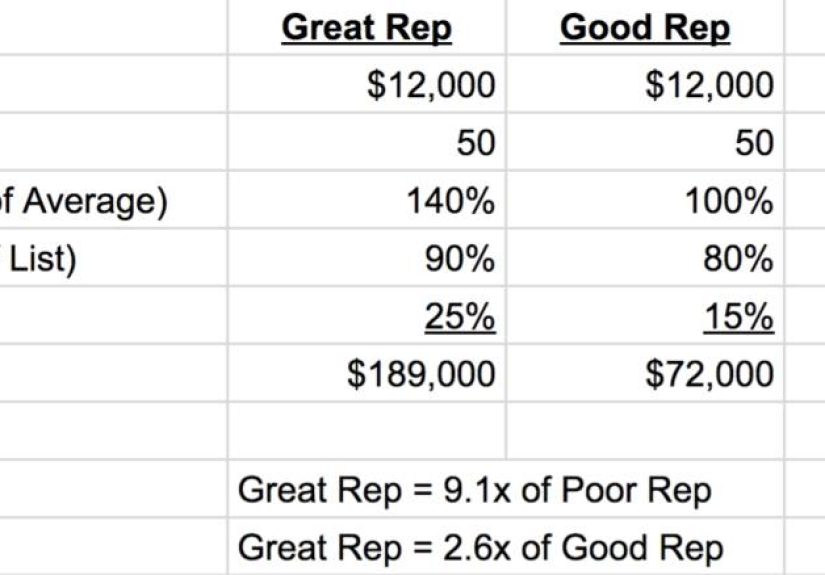
If you’ve heard the claim that a great rep can close 9x more than a poor repand 2.5x more than a “good” repyou’re not hearing a fairy tale.
You’re hearing a real-world pattern that shows up across revenue data, call analysis, and pipeline research. The best sellers don’t just “try harder.”
They run a better system, execute it more consistently, and create less friction for buyers.
The Non-Linear Truth: Sales Results Don’t Scale Like Effort
Most teams talk about sales performance like it’s a straight line: “If we train reps 10% more, we’ll get 10% more revenue.”
But sales behaves more like a chain reactionespecially in B2B, where deals are multi-step, multi-stakeholder, and multi-opportunity for mistakes.
A “poor rep” doesn’t lose because they’re missing one big magical skill. They lose because they’re leaking conversions at multiple stages:
slow response time, weak qualification, shallow discovery, generic value messaging, inconsistent follow-up, and late-stage panic.
A “good rep” patches some leaks. A “great rep” seals most leaks, then builds pressure in the system.
A Quick “Same Leads” Example (Why 9x Happens)
Imagine three reps each receive 100 leads over a quarter.
- Poor rep: books 10 meetings → qualifies 4 → advances 3 → closes 2
- Good rep: books 20 meetings → qualifies 10 → advances 8 → closes 7
- Great rep: books 30 meetings → qualifies 18 → advances 15 → closes 18
That’s not “a little better.” That’s 18 vs 2 (9x), and 18 vs 7 (2.57x). Same top-of-funnel count. Completely different execution.
And those gaps are achievable because each stage is a multiplier.
The Compounding Math: Where Great Reps Multiply Outcomes
Let’s zoom in on the usual sales funnel steps and the specific behaviors that turn “good” into “great.”
The best reps don’t rely on charisma. They rely on precision.
1) Speed-to-Lead: Great Reps Show Up While the Buyer Still Cares
Fast response isn’t a “nice-to-have.” It’s a competitive weapon. When a buyer raises their hand (inbound form, demo request, event scan),
they’re at peak curiosity. Wait too long and you’re no longer the first conversationyou’re the fifth follow-up in a crowded inbox,
sitting between a coupon email and a calendar reminder.
Great reps (and great teams) treat speed like a policy, not a personality trait:
respond quickly, confirm the ask, and schedule the next step before interest cools.
2) Qualification: Great Reps Don’t “Hope” DealsThey Prove Them
Poor reps treat every opportunity like it’s equally real. Good reps qualify early. Great reps qualify continuously.
They verify pain, urgency, authority, process, and the “why now” at multiple momentsbecause B2B deals mutate.
Qualification isn’t about being picky. It’s about using time like it costs money (because it does). Great reps avoid the
“free consulting trap” and the “maybe next quarter” mirage. They ask direct questions with a friendly tone:
“What happens if you don’t solve this by Q2?” and “Who else will weigh in before signature?”
3) Discovery Depth: Great Reps Diagnose, They Don’t Pitch
Poor reps pitch features. Good reps pitch benefits. Great reps uncover the buyer’s decision math:
the business problem, the internal politics, the cost of doing nothing, and the definition of success.
They also structure discovery so it feels helpful, not interrogative. That means:
- Clear agenda (“I’ll ask a few questions, then we’ll map fit and next steps.”)
- Layered questions (surface → impact → decision process)
- Summaries that earn trust (“Here’s what I’m hearing…”)
4) Conversation Skill: Great Reps Listen Like It’s Their Job (Because It Is)
Great reps talk less, listen more, and ask better questions. Not in a robotic “tell me about your pain” waybut in a
calm, curious, confident way that makes buyers feel understood.
The practical difference is huge: buyers volunteer more truth (real objections, real timelines, real stakeholders),
which makes forecasting better and closing easier.
5) Follow-Up Discipline: Great Reps Outlast Silence Without Becoming Annoying
Poor reps give up early. Good reps follow up. Great reps follow up strategicallywith relevance, value, and a clear ask.
Instead of sending “Just checking in,” great reps send:
- “You mentioned reducing onboarding timehere’s a 1-page example of how a similar team approached it.”
- “Want to loop in Security this week? I can share our standard docs and set a 20-minute Q&A.”
- “If Q1 is too tight, should we plan for a Q2 pilot? I can draft a simple timeline.”
They’re persistent and professional. They make it easy to say yes, no, or not nowwhich is weirdly comforting for buyers.
6) Multi-Threading and Stakeholders: Great Reps Don’t Get “Single-Point-of-Failure’d”
Poor reps build a deal around one champion. When that champion goes on vacation (or changes jobs, or gets busy, or loses political capital),
the deal stalls. Good reps know stakeholders matter. Great reps actively map the decision team early and build relationships across it.
That means they can handle:
- Procurement questions without flinching
- Security reviews without “Let me get back to you in 10–14 business days”
- Executive “So why you?” moments without rambling
7) Deal Control: Great Reps Run the Process Without Being Pushy
Great reps don’t “pressure” buyers. They create clarity. They propose next steps, confirm dates, and keep momentum.
They use lightweight tools like a mutual action plan (MAP): who does what, by when, and what success looks like.
Poor reps wait for buyers to drive. Good reps suggest. Great reps leadwith respect and structure.
Why Great Reps Also Beat “Good Reps” by 2.5x
Here’s the sneaky part: “good reps” often have the basicspolite communication, some product knowledge, decent hustle.
But they still lose deals they “should” win. Why?
- They accept vague timelines. (“Circle back next month” is not a timeline.)
- They don’t confirm decision criteria. They sell what they think matters, not what the buyer is measuring.
- They under-prepare for objections. Great reps anticipate and neutralize risk early.
- They run demos too soon. Great reps earn the demo by shaping the problem first.
- They don’t build a strong business case. Great reps tie outcomes to dollars, time, risk, or strategic priority.
The gap between good and great is rarely “work ethic.” It’s deal leverage: the ability to shape the buyer’s thinking,
align stakeholders, and create a path to yes that feels obvious.
The Data Pattern Behind the Headline: Top Reps Carry Disproportionate Revenue
If the 9x and 2.5x concept sounds dramatic, consider this: revenue often concentrates among top performers.
In large datasets of enterprise opportunities, the top slice of reps can drive the majority of revenuewhile the bottom half contributes surprisingly little.
That’s not motivational-poster content. That’s a structural reality of sales teams.
This concentration happens because great reps:
- Win more often (higher win rate)
- Win faster (shorter cycles)
- Win bigger (better deal shaping, stronger business cases, better packaging)
- Lose less time (strong qualification and prioritization)
How to Turn More “Good” Reps Into “Great” Reps (Without Waiting for Unicorns)
Hiring elite reps helps, but most organizations can’t (and shouldn’t) bet everything on recruiting alone.
The smarter play is building an environment where great behaviors are taught, reinforced, and measured.
1) Standardize the Fundamentals (So “Great” Isn’t a Mystery)
Create team-wide definitions for:
- Lead response time expectations
- Qualification requirements (what must be known before a deal advances)
- Discovery structure (required questions, outcomes, and recap)
- Deal stage exit criteria (what “Stage 2” actually means)
2) Coach the Moments That Matter (Calls, Emails, Deal Reviews)
Coaching is where performance multipliesespecially when it’s consistent and specific. Great coaching focuses on:
- First-call discovery quality
- Next-step clarity (calendar discipline)
- Objection handling (pricing, security, competition, timing)
- Deal strategy (multi-threading, business case, mutual plan)
3) Fix the System That Steals Selling Time
Many reps don’t fail because they’re lazy. They fail because their time is shredded by admin tasks, tool chaos, and unclear internal processes.
Great reps still winbut they’re winning uphill. Remove friction and you create more room for excellence.
If reps are spending the majority of the week on non-selling tasks, your “performance problem” might actually be an “operational drag” problem.
4) Measure What Great Reps Do Differently (Not Just What They Produce)
Outcomes matter, but behaviors predict outcomes. Track:
- Speed-to-lead and first-touch quality
- Discovery completion and depth
- Next-step conversion rate (meeting → next meeting)
- Multi-threading (number of stakeholders engaged)
- Follow-up cadence and relevance
A Practical “Great Rep” Checklist You Can Use This Week
Whether you’re a founder, VP Sales, sales manager, or a rep who wants to level up, here’s a simple self-audit.
Score each item 0–2 (0 = rarely, 1 = sometimes, 2 = consistently):
- I respond to inbound leads fast and always propose a next step.
- I qualify continuously (pain, urgency, authority, process), not once.
- I run discovery with structure and recap what I learned.
- I listen more than I talk and ask layered questions.
- I multi-thread early so deals don’t depend on one person.
- I follow up with relevance, not “checking in.”
- I control the process kindly (mutual plan, dates, owners).
- I build a clear business case tied to measurable outcomes.
If you’re below 10, you’re leaking conversion. If you’re 10–13, you’re probably “good.” If you’re 14+, you’re building “great” habits.
And the beautiful thing about habits? They compound.
Field Notes: of Real-World Experiences That Explain the Gap
Sales leaders often describe a specific moment when they realize performance isn’t evenly distributed: pipeline reviews.
You pull up a dashboard and see two reps with similar opportunity counts. One has deals moving cleanly from stage to stage.
The other has a graveyard of “stuck” opportunities that have been “closing this month” since the invention of the month.
One common experience: the great rep makes the buyer do less work. They don’t just send a deck and hope it magically persuades an entire org.
They say, “Here’s a short recap email you can forward internally,” then they write it in a way that sounds like the buyer wrote it:
problem, impact, proposed approach, and next step. Buyers love that because internal selling is exhausting. Great reps become
helpful co-authors of the internal narrative, not just vendors waiting outside the meeting room.
Another pattern leaders share: great reps are allergic to ambiguitybut in a calm way. They don’t accept “We’re interested.”
They ask, “Interested in what outcome?” They don’t accept “We need to think about it.” They ask, “What specifically do you need to validate?”
They don’t accept “Send pricing.” They ask, “So I send the right packagehow are you planning to buy: seats, usage, departments, or a pilot first?”
The difference isn’t aggression; it’s clarity. Good reps avoid uncomfortable questions because they want to stay liked. Great reps ask
the questions buyers actually need someone to ask.
You’ll also hear this one a lot: great reps don’t get emotionally hijacked by a deal. When a prospect goes quiet, poor reps panic and spam.
Good reps wait and hope. Great reps run a play: they multi-thread, they send a value-based follow-up, they confirm the decision process,
and they propose two clean options“Let’s proceed with X by Friday” or “Let’s pause and revisit in February.” Ironically, giving a respectful “off-ramp”
often restarts momentum because it reduces pressure and forces a real decision.
Sales managers often describe the coaching difference too. With a poor rep, coaching turns into constant firefighting:
rewriting emails, fixing basic qualification gaps, and cleaning up CRM notes that read like a mystery novel missing chapters 2–9.
With a good rep, coaching is mostly about consistency and sharper messaging. With a great rep, coaching becomes strategic:
competitive positioning, deal shaping, negotiation planning, and account expansion. The great rep isn’t “done learning.”
They’re just learning at a higher altitude.
And finally, there’s a very practical experience that explains the 9x effect: great reps protect their calendar.
They ruthlessly prioritize high-probability opportunities, and they cut bait early when qualification is weak.
Poor reps, meanwhile, get trapped in low-quality activity: chasing unqualified leads, giving endless demos, and sending proposals
to “pricing gatherers.” Great reps still work hard, but their hard work is aimed like a laser, not sprayed like a garden hose.
Over a quarter, those choices don’t add upthey multiply. That’s how you get 2.5x…and sometimes 9x.