Table of Contents >> Show >> Hide
- Why Alliums Deserve a Spot in Almost Every Sunny Garden
- 20 Best Allium Varieties to Grow for Their Beautiful Flowers
- Allium ‘Globemaster’
- Allium ‘Gladiator’
- Allium ‘Purple Sensation’
- Allium ‘Mount Everest’
- Allium giganteum
- Allium christophii (Star of Persia)
- Allium schubertii
- Allium sphaerocephalon (Drumstick Allium)
- Allium caeruleum (Azureum)
- Allium moly
- Allium karataviense
- Allium ‘Millenium’
- Allium ‘Serendipity’
- Allium ‘Summer Beauty’
- Allium ‘Windy City’
- Allium ‘Chivette’
- Allium senescens ‘Blue Eddy’
- Allium thunbergii ‘Ozawa’
- Allium cernuum (Nodding Onion)
- Allium tuberosum (Garlic Chives)
- How to Grow Alliums for the Best Flower Display
- Final Thoughts
- What Growing Alliums Is Really Like in a Real Garden
If you have ever looked at an allium flower and thought, “That seems a little ridiculous,” congratulations: you understand the appeal perfectly. Alliums are the fireworks of the flower border, the lollipops of late spring, the garden’s way of showing off without technically bragging. Their blooms float on tall stems, sway in the breeze, and somehow manage to look both elegant and slightly mischievous at the same time.
Better yet, ornamental alliums are not just pretty faces. Many gardeners love them because they are easy to tuck into sunny beds, attractive to pollinators, and less tempting to deer and rabbits than many other flowering plants. Some alliums bloom in late spring with giant globe-shaped flower heads, while others act more like summer perennials and keep the show going long after tulips and daffodils have packed their bags.
If you want flowers with strong structure, real personality, and seed heads that still look good after the color fades, this is your plant group. Below are 20 of the best allium varieties and species to grow for beautiful flowers, followed by practical growing tips and a real-world look at what gardeners often experience once these plants settle into the landscape.
Why Alliums Deserve a Spot in Almost Every Sunny Garden
There is a reason alliums keep turning up in perennial borders, cottage gardens, cutting gardens, pollinator beds, and modern landscapes. Most types prefer full sun and well-drained soil, which makes them surprisingly low-fuss once they are planted in the right place. The bulbous spring-blooming kinds deliver bold color and unforgettable form in late spring to early summer, while herbaceous summer-blooming alliums create neat clumps of foliage and weeks of midsummer flowers.
They also solve several common garden headaches at once. Their flower heads add vertical punctuation without feeling heavy. Their spherical form contrasts beautifully with spiky salvias, soft catmint, airy grasses, and broad peony leaves. Many types are excellent cut flowers, and the dried seed heads can keep the show going for weeks. Pollinators absolutely adore them. Deer usually walk right past them. And once you grow a few good ones, it becomes very hard to stop. Your garden starts with one purple globe and ends with a full-blown allium habit.
20 Best Allium Varieties to Grow for Their Beautiful Flowers
-
Allium ‘Globemaster’
If alliums had a red carpet event, ‘Globemaster’ would arrive first and assume everyone came to see it. This famous giant ornamental onion produces huge violet-purple flower heads that look almost too perfect to be real. It blooms in late spring, makes an incredible focal point, and keeps earning compliments even after the petals fade because the seed heads stay handsome for a long time.
-
Allium ‘Gladiator’
Think of ‘Gladiator’ as the tall, athletic cousin of ‘Globemaster.’ It has big purple blooms, sturdy stems, and a little more height, which makes it excellent for the middle or back of a border. It pairs beautifully with peonies, catmint, salvia, and ornamental grasses. If you want a dramatic purple allium that looks powerful without being fussy, this is a smart pick.
-
Allium ‘Purple Sensation’
This is one of the best starter alliums because it is affordable, reliable, and seriously pretty. ‘Purple Sensation’ produces rich raspberry-purple spheres on slim stems and usually blooms earlier than many of the giant varieties. Plant it in groups, and it creates a floating sea of color that looks far more expensive than it is. It is also one of the easiest alliums to weave through perennial beds.
-
Allium ‘Mount Everest’
If purple is not your thing, or if you want a white garden moment worthy of a dramatic gasp, grow ‘Mount Everest.’ Its clean white globe flowers bring brightness and contrast to mixed borders, especially when planted near dark foliage or deep-colored blooms. This is one of the best alliums for creating a sophisticated look without sacrificing the bold, architectural form that makes ornamental onions so memorable.
-
Allium giganteum
As the name politely suggests, this one is not shy. Giant onion is among the tallest ornamental alliums, with lilac-purple flower heads perched high above the foliage. It is excellent for adding height and a strong vertical accent in late spring. Use it where you want a stately, almost sculptural effect. Just remember that it likes company around its feet because the foliage can look tired after bloom.
-
Allium christophii (Star of Persia)
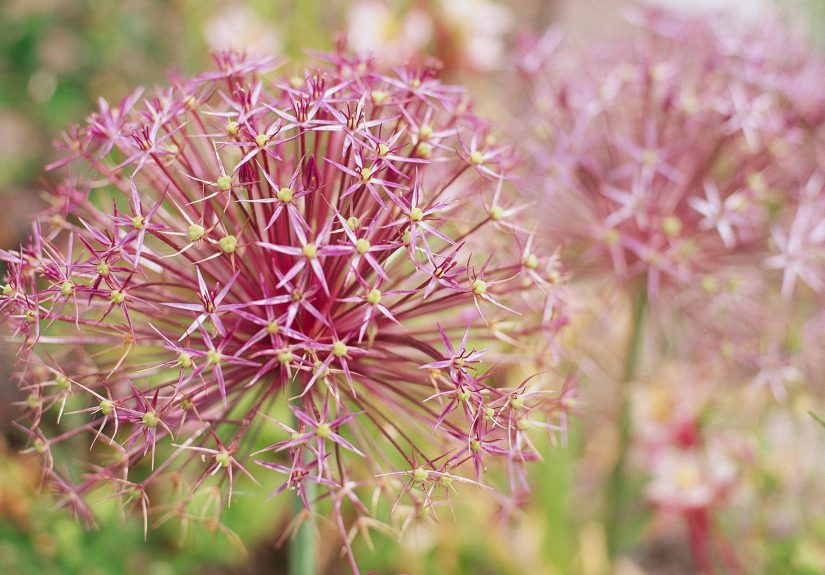
This variety has some of the most mesmerizing flower heads in the allium world. Instead of a dense globe, it forms an airy, sparkling sphere made up of star-shaped florets with a silvery-violet glow. The effect is magical, especially in evening light. It is fabulous in borders, gravel gardens, and cut arrangements, and its dried seed heads are so decorative they practically become garden jewelry.
-
Allium schubertii
If you enjoy plants that make visitors stop mid-sentence and ask, “What on earth is that?” grow Allium schubertii. Its flower heads look like tiny floral explosions, with individual florets radiating outward in a dramatic starburst. It is shorter than many giant alliums, so it works well closer to the front of a sunny bed. This one is weird in the best possible way.
-
Allium sphaerocephalon (Drumstick Allium)
Drumstick allium brings a completely different shape to the party. Instead of round globes, it makes small, egg-shaped flower heads in rosy purple tones that bob above wiry stems in early summer. It looks wonderful threaded through prairie-style plantings, meadow gardens, and looser perennial borders. Because the flowers are smaller, the effect is more naturalistic and playful than formal.
-
Allium caeruleum (Azureum)
Blue flowers are garden gold, and Allium caeruleum delivers that rare color in cheerful sky-blue spheres. It is smaller and lighter in feel than the famous purple giants, which makes it useful for softening the overall look of a planting. Tuck it among grasses, low perennials, or silver foliage, and it adds a fresh, almost cool-toned sparkle that stands out without screaming for attention.
-
Allium moly
Not all alliums need to be giant purple planets. Allium moly, also called golden garlic, offers bright yellow, star-shaped flowers that bring a warm, sunny look to the front of borders and rock gardens. It is especially charming mixed with blue or purple companions. If your garden needs a cheerful allium that breaks the purple stereotype, this one is a winner.
-
Allium karataviense
This compact allium is grown as much for its foliage as for its flowers. It forms broad, blue-green leaves, sometimes with a slight purple tint, and then sends up a short stem topped with a pale pink to lilac bloom. Because it stays low, it is ideal for rock gardens, edging, and small-space gardens. It proves that alliums do not have to be tall to be unforgettable.
-
Allium ‘Millenium’
‘Millenium’ is a modern garden favorite for good reason. Unlike the spring bulb types that bloom and then fade, this herbaceous allium forms neat clumps of dark green foliage and produces rosy-purple flower heads in midsummer. It looks tidy for a long season, attracts pollinators like a magnet, and slides beautifully into perennial borders. If you want an allium that behaves like a hardworking perennial, start here.
-
Allium ‘Serendipity’
‘Serendipity’ feels like ‘Millenium’ with a stylish update. It offers similar round purple blooms in summer, but the foliage has a blue-green cast and a slightly twisty look that adds more texture. It stays compact, handles a range of soils, and gives borders a polished but not stiff appearance. It is an especially good fit for modern perennial designs and smaller gardens.
-
Allium ‘Summer Beauty’
This is one of the best alliums for gardeners who want long-season value. ‘Summer Beauty’ forms glossy green mounds and then covers itself with lilac-pink flower clusters in midsummer. The flowers are not massive, but they are plentiful and charming, and pollinators treat the plant like a five-star buffet. It is easy to blend with coneflowers, nepeta, salvias, and ornamental grasses.
-
Allium ‘Windy City’
‘Windy City’ has dark stems, deep green foliage, and rose-purple flowers with bright white anthers that give the blooms extra sparkle. It is a strong summer performer with a tidy habit and a long ornamental window. This is a great choice for gardeners who love the flower power of summer-blooming alliums but want something with a little extra contrast and refinement.
-
Allium ‘Chivette’
Technically a chive selection, ‘Chivette’ proves that edible plants can still dress up for the flower border. It produces lavender-purple blooms and fine-textured foliage that fits beautifully into informal gardens, herb beds, and foodscape designs. Because it bridges ornamental and edible gardening, it is perfect for gardeners who want pretty flowers and practical plants living side by side without drama.
-
Allium senescens ‘Blue Eddy’
‘Blue Eddy’ is grown for both its wavy blue-green foliage and its pinkish-lavender summer flowers. The curly leaves make it stand out even before it blooms, giving beds a fun, slightly whimsical texture. It stays compact, so it is perfect near paths, in containers, or at the front of a border. This is the sort of allium that earns its keep even on non-blooming days.
-
Allium thunbergii ‘Ozawa’
Need flowers later in the season? ‘Ozawa’ steps in when many spring and summer alliums are already done showing off. It flowers in fall with rosy pink blooms, giving the garden a welcome late-season lift. That makes it especially valuable for extending the allium season and pairing with fall asters, sedums, and ornamental grasses. In a garden calendar, this one shows up fashionably late and still steals attention.
-
Allium cernuum (Nodding Onion)
This North American native has graceful, nodding clusters of pink flowers that feel softer and more natural than the bold globes of many ornamental alliums. It is a lovely choice for pollinator gardens, native plantings, and looser borders where a wildflower feel is welcome. It may not shout, but it has quiet charm and ecological value, which is often an even better kind of beauty.
-
Allium tuberosum (Garlic Chives)
Garlic chives pull double duty as an edible and ornamental plant. In late summer to fall, they produce clusters of starry white flowers above grassy foliage, adding brightness when many spring bulbs are long gone. They are terrific in herb gardens, cottage gardens, and mixed borders, though they can spread if allowed to self-seed freely. Deadhead if you want the flowers without the future surprise army.
How to Grow Alliums for the Best Flower Display
Give them sun and drainage
Most alliums bloom best in full sun and dislike soggy soil. If your ground stays wet in winter, bulb rot can become the villain of the story. Raised beds, gravelly soil, and spots with good drainage are your friends.
Know which kind you are planting
Spring-blooming bulb alliums are usually planted in fall. These include classics like ‘Globemaster,’ ‘Purple Sensation,’ and ‘Mount Everest.’ Summer-blooming herbaceous alliums such as ‘Millenium,’ ‘Serendipity,’ and ‘Summer Beauty’ behave more like perennials and are usually planted like other garden perennials.
Hide the fading foliage
This is the allium trick experienced gardeners learn quickly. Many of the big spring-blooming types begin to lose their leaves while still flowering. The solution is not panic. It is plant design. Place them among perennials such as catmint, salvia, lady’s mantle, peonies, or ornamental grasses so the neighboring foliage can cover the decline.
Let the seed heads linger
Do not rush out with the pruners the second petals drop. Many alliums form beautiful seed heads that stay decorative for weeks, sometimes even longer in dry weather. These seed heads add shape, structure, and a slightly sculptural look that keeps the plant useful beyond bloom time.
Mix bloom times for a longer season
If you combine early bloomers like ‘Purple Sensation,’ bold late-spring giants like ‘Globemaster,’ and summer or fall performers like ‘Millenium’ and ‘Ozawa,’ you can enjoy alliums for a much longer stretch of the gardening season. That is the difference between a nice planting and a very clever one.
Final Thoughts
The best allium varieties do more than produce beautiful flowers. They add structure, timing, movement, texture, and personality to a garden. Some are grand and theatrical. Others are delicate, naturalistic, or quietly useful. Together, they offer one of the most versatile flower groups a gardener can grow.
If you are just getting started, plant a few dependable favorites like ‘Purple Sensation,’ ‘Globemaster,’ and ‘Millenium.’ If you already love alliums, branch out into stars like Allium christophii, late bloomers like ‘Ozawa,’ and compact gems like ‘Blue Eddy.’ One thing is almost guaranteed: once those floating flower globes start blooming, you will begin looking for room to plant more.
What Growing Alliums Is Really Like in a Real Garden
Reading plant descriptions is helpful, but growing alliums teaches a few memorable lessons that plant tags never quite capture. The first is that alliums have a strange talent for looking both dramatic and relaxed at the same time. When the blooms open, they hover above the border like little satellites, and suddenly the garden feels more designed, even if the rest of it is still figuring itself out. A patch that looked ordinary the week before can look magazine-worthy the moment the alliums kick in.
The second real-life experience is surprise. Even gardeners who know what they planted are often caught off guard by how much attention these flowers get. Visitors notice them immediately. Pollinators notice them even faster. Bees seem to treat blooming alliums like a grand opening with free snacks and no closing time. If your goal is to make the garden feel alive, alliums do that with very little effort on your part.
There is also the famous foliage lesson. New allium growers sometimes fall in love with the flowers and then feel personally betrayed when the leaves begin to yellow or flop. This is normal. It is not a failure. It is just part of the allium deal. Experienced gardeners solve it by surrounding the bulbs with neighboring perennials that rise at the same time and gently hide the mess. Once you learn that trick, alliums become much easier to love long-term.
Another common experience is discovering that different alliums play very different roles. The giant spring types feel like punctuation marks. They create instant structure and pull the eye upward. Summer-blooming forms such as ‘Millenium’ and ‘Summer Beauty’ feel more like reliable cast members who never miss a scene. They bloom longer, keep tidy foliage, and settle into mixed borders without demanding center stage every second. Fall bloomers like ‘Ozawa’ add an extra twist by showing up late when the garden could really use fresh energy.
Gardeners also learn quickly that alliums reward repetition. One bloom is interesting. Three are charming. Ten or twenty suddenly look intentional and unforgettable. Planting them in drifts or clusters gives them more visual impact and makes their unusual shapes feel like part of a pattern instead of a one-off curiosity. This is especially true with varieties such as ‘Purple Sensation,’ drumstick allium, and ‘Millenium,’ which become much more impressive when planted generously.
Perhaps the most satisfying part of growing alliums is that they bring beauty in layers. First come the fresh shoots, then the swelling buds, then the full flower show, then the seed heads. Even after bloom, many alliums still contribute something useful to the garden. In other words, they do not just have a moment. They have a whole season of moments. And in gardening, that kind of flower power is hard to resist.