Table of Contents >> Show >> Hide
- What You’ll Learn
- Before You Squat: A Fast Safety + Setup Checklist
- The 5 Common Types of Squat Machines
- 1) Smith Machine Squat
- 2) Hack Squat Machine
- 3) Belt Squat Machine
- 4) Pendulum Squat Machine
- 5) Leverage Squat / V-Squat (Plate-Loaded Squat Machine)
- How to Choose the Right Squat Machine for Your Goal
- Programming Ideas: How to Use Squat Machines in a Real Plan
- FAQ: The Stuff People Wonder While Staring at the Machine
- Conclusion
Squats are the lower-body equivalent of brushing your teeth: boring to skip, painful to neglect, and weirdly satisfying when you finally get consistent. The catch? Not everyone wants to wrestle a barbell, especially on a crowded gym floor where the squat rack is treated like beachfront property. That’s where squat machines come inbuilt to help you train hard, stay stable, and focus on your legs without needing a physics degree in balance.
In this guide, we’ll break down five common types of squat machines, what they’re best at, how to use them correctly, and the small technique tweaks that can turn “meh leg day” into “why are stairs attacking me?” leg day (in a good way).
Before You Squat: A Fast Safety + Setup Checklist
Machines can make squats feel more controlled, but they can’t magically fix form. The basics still matter: a stable foot, a braced torso, and knees that track where your toes point.
Quick form cues that work on almost every squat machine
- Neutral spine: Keep your ribcage stacked over your pelvisavoid rounding or over-arching your lower back.
- Knee tracking: Knees generally follow the direction of your toesno “knees collapsing inward” plot twist.
- Full-foot pressure: Think “tripod foot”: big toe, little toe, and heel all stay connected.
- Depth you own: Squat as deep as you can without pain and without losing posture.
- Start lighter than your ego wants: Learn the machine’s path first, then add load.
If you have pain (sharp, pinchy, or “my knee just said nope”), treat that as useful information, not motivation. Adjust stance, reduce depth, lower weight, or choose a different machineand when in doubt, ask a qualified coach or clinician.
The 5 Common Types of Squat Machines
1) Smith Machine Squat
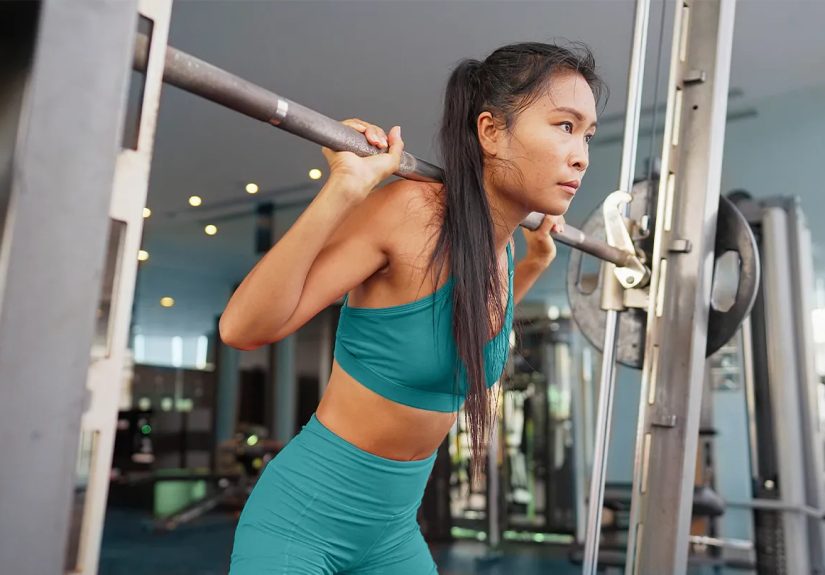
The Smith machine is the classic “barbell on rails.” The bar moves along a fixed path (often vertical or slightly angled), which reduces balance demands and can make squatting feel more secureespecially for beginners or when training without a spotter.
Key benefits
- Stability and confidence: Great for learning squat rhythm and bracing without worrying about the bar drifting.
- Easier to push close to fatigue: Safety stops help you train hard with less fear of getting pinned.
- Useful for hypertrophy: Because balance is less demanding, you can often focus on muscle tension and controlled reps.
Tradeoffs to know
- A fixed bar path may not match your natural squat mechanics. That can feel fineor feel awkwarddepending on your build and stance.
- It can encourage “lazy bracing” because the machine helps stabilize. Your core still matters, even if the bar is on rails.
How to use it (step-by-step)
- Set safety stops slightly below your bottom squat depth.
- Choose foot position: Start shoulder-width with toes slightly out. Stand so the bar stays over mid-foot as you descend.
- Unrack by standing tall and rotating the bar to release it (varies by machine).
- Descend with control: Hips and knees bend together; keep chest proud and spine neutral.
- Drive up through your mid-foot, keeping knees tracking over toes.
- Re-rack by rotating the bar back into the hooks.
Common mistakes (and quick fixes)
- Feet too far forward (turns it into a weird hinge-squat hybrid): bring feet slightly back so the bar stays over mid-foot.
- Knees collapsing in: reduce load, slow down, and think “knees follow toes.”
- Over-arching the back: ribs down, brace like you’re about to laugh-cough.
Best for
Beginners building confidence, lifters adding quad volume after barbell work, or anyone who wants a stable setup with adjustable safety stops.
2) Hack Squat Machine
The hack squat machine is a sled-style squat where your shoulders sit under pads and your back is supported. You squat by bending your knees and hips while pushing the sled along rails. It’s famous for lighting up the quads (and your facial expressions).
Key benefits
- Quad emphasis: The setup often keeps your torso more upright, shifting work toward the front of the thighs.
- Back support: Many people find it easier to train legs hard without loading a bar on the spine.
- Easy progression: Add plates, track reps, and improve without needing perfect bar control.
How to use it
- Set foot stance: Start shoulder-width, toes slightly out, feet flat on the platform.
- Get under the pads with your back against the pad, shoulders snug under the shoulder supports.
- Unlock the safeties (handles vary by machine).
- Lower slowly until thighs are around parallel (or as deep as you can maintain control without pain).
- Drive up through the mid-foot; keep heels down and knees tracking over toes.
- Re-engage safeties at the top.
Foot placement tweaks that change the feel
- Feet lower on platform: more knee bend, more quad focus (and more “wow my quads exist” feedback).
- Feet higher: slightly more hip involvement (glutes/hamstrings) and often a friendlier knee angle.
- Narrow stance: quads; wider stance: more adductors and glutes for many lifters.
Common mistakes
- Heels lifting: reduce depth or load; keep full-foot pressure.
- Bottom “bounce”: control the last few inchesyour knees will thank you later.
- Short range of motion by habit: earn depth gradually with lighter weight and better control.
Best for
Lifters who want strong quad stimulus with back support, hypertrophy training, and clear, repeatable progress.
3) Belt Squat Machine
The belt squat loads weight through a belt around your hips instead of on your shoulders. Translation: you can train the squat pattern hard while often reducing spinal and upper-body stress. If back or shoulder loading is limiting your leg work, belt squats can be a game changer.
Key benefits
- Lower spinal loading: Weight is anchored at the hips, which many people find friendlier for the back and shoulders.
- Great for volume: Belt squats can be excellent for higher-rep leg work without your upper body becoming the bottleneck.
- Strong “legs-only” focus: Less grip and less bar-on-back fatigue means your legs can be the limiting factor.
How to use it
- Set the belt so it sits comfortably around the hips (not digging into your stomach like a betrayed waistband).
- Stand on the platform with feet about shoulder-width and toes slightly out.
- Attach the belt to the machine’s loading point and take the slack out by standing tall.
- Squat down with a neutral torso and steady knee tracking.
- Stand up by driving through the mid-foot, finishing tall without over-arching your lower back.
Common mistakes
- Belt too high: can feel uncomfortable and reduce controlposition it around the hips.
- Letting the belt yank you: move smoothly; keep tension and control throughout.
- Leaning excessively: aim for a balanced squatdon’t turn it into a forward fold with resistance.
Best for
People who want a squat pattern with less shoulder/back loading, athletes accumulating leg volume, and lifters building legs when barbell squats aren’t ideal.
4) Pendulum Squat Machine
The pendulum squat is a guided squat where your torso travels along a curved, arcing path. Compared with a straight up-and-down sled, the arc can feel smoother and can allow deep squat positions with strong quad emphasis for many lifters. These machines vary, but the “swinging arc” is the signature feature.
Key benefits
- Big quad stimulus: Many lifters report intense quad loading through a long range of motion.
- Support + consistency: The machine’s guided path helps repeat the same rep pattern.
- Adjustability: Some pendulum machines allow platform or stop adjustments to match mobility and comfort.
How to use it
- Adjust the foot platform (if available) and set safety stops to a safe depth.
- Position shoulders/upper back against pads; keep ribcage down and torso braced.
- Set feet shoulder-width; toes slightly out; keep heels heavy.
- Descend slowly along the arc, keeping knees tracking over toes.
- Drive up with controldon’t slam into the top stop like it owes you money.
Common mistakes
- Going too heavy too soon: the arc can feel “easy” until it suddenly isn’tearn the load.
- Cutting depth because it’s spicy: reduce weight and keep the range you can control.
- Relaxing at the bottom: stay braced; don’t dump tension into joints.
Best for
Quad-focused training, lifters who like a guided path but want a deep squat feel, and anyone looking for a “barbell-style” leg challenge with support.
5) Leverage Squat / V-Squat (Plate-Loaded Squat Machine)
A leverage squat (often called a V-squat or “plate-loaded squat machine”) uses shoulder pads and a foot platform, with a guided lever path that feels closer to a squat than a leg presswithout balancing a free barbell. Different brands feel different, but the goal is the same: stable heavy leg training with a squat-like pattern.
Key benefits
- Guided path, squat feel: Less balance demand than free weights, often more “natural” than a straight-rail sled for some lifters.
- Load it up: Plate-loaded designs make progressive overload simple and satisfying.
- Upper-body friendly: No bar on wrists, elbows, or shoulderspads carry the load.
How to use it
- Adjust pad height so you can get under comfortably without tiptoeing into position.
- Set feet shoulder-width, toes slightly out, full foot on the platform.
- Unrack/unlock the machine (usually a lever or handles).
- Squat down under control; keep torso braced and knees tracking with toes.
- Drive up through mid-foot, finishing tall and stable.
- Re-rack using the safety lever/handles before stepping out.
Common mistakes
- Half reps because the weight “looks cool”: reduce load, increase control and depth.
- Knees drifting inward: slow down; lighten weight; focus on alignment.
- Feet too narrow for your hips: widen slightly if you feel pinchy hips or unstable tracking.
Best for
Lifters who want squat-like training without barbell setup, people prioritizing heavy leg work with stability, and anyone building strength with controlled mechanics.
How to Choose the Right Squat Machine for Your Goal
There’s no “best squat machine” for everyonejust the best fit for your body, goals, and gym options. Use this as a quick decision guide.
If you want bigger quads
- Hack squat and pendulum squat often deliver strong quad tension and deep knee flexion.
- Smith machine can be great with a controlled tempo and consistent depth.
If your back/shoulders get cranky with barbell loading
- Belt squat is a top pick when spinal/shoulder loading is the main limiter.
- Pendulum and hack machines also provide support and can reduce upper-body demands.
If you want a squat pattern that feels “most like squatting” but stable
- V-squat/leverage squat often hits the sweet spot: squat-like pattern, less balance drama.
If you’re newer to lifting
- Smith machine (with smart setup) or V-squat can help you learn bracing, depth, and consistent reps.
- Start light, aim for smooth reps, and progress gradually.
Programming Ideas: How to Use Squat Machines in a Real Plan
Machines shine when you want repeatable reps and reliable overload. Here are simple ways to program them without turning leg day into a chaotic science fair.
For strength (without maxing out)
- Pick one primary machine (V-squat, hack squat, or Smith squat).
- Do 3–5 sets of 4–8 reps, leaving 1–2 reps “in the tank.”
- Rest 2–3 minutes, keep form consistent, add small weight jumps over time.
For muscle (hypertrophy)
- Choose 1–2 machines (example: hack squat + belt squat).
- Do 3–4 sets of 8–15 reps, controlled tempo, deep range you can own.
- Finish with a “pump” set (12–20 reps) on a belt squat or lighter hack squat if it feels good on joints.
For joint-friendly leg volume
- Use belt squat as your volume anchor: 3–4 sets of 10–20 reps.
- Keep intensity moderate and prioritize smooth reps and posture.
- Pair with hamstring work (like leg curls) and calves for a balanced session.
A simple 2-day lower-body example
- Day A (Quad focus): Pendulum or Hack Squat (4×8–12) + Leg Extension (3×12–15) + Calves (3×10–15)
- Day B (Balanced legs): V-Squat or Smith Squat (4×6–10) + Belt Squat (3×10–15) + Hamstring Curl (3×10–15)
FAQ: The Stuff People Wonder While Staring at the Machine
Are squat machines safer than barbell squats?
They can bemainly because they reduce balance demands and often provide built-in safeties. But “safer” still depends on setup, load choice, and technique. Machines don’t stop knees from collapsing inward if you ignore it.
How deep should I go?
As deep as you can go with control, a neutral spine, and no pain. If your hips tuck, heels lift, or your back rounds hard, reduce depth or load and build range gradually.
Should my knees go past my toes?
Sometimes, yesdepending on your anatomy, mobility, and squat style. What matters more is that your knees track smoothly and you stay balanced over your mid-foot.
Can teens use squat machines?
Generally, yeswhen supervised and programmed appropriately. Focus on learning good movement patterns, using moderate loads, and avoiding max-effort attempts. If you’re unsure, work with a qualified coach.
Conclusion
Squat machines aren’t “cheating.” They’re tools. Used well, they let you train legs hard with stable mechanics, repeatable form, and smart progressionespecially when you want more quad work, less balance stress, or less bar-on-back fatigue.
- Smith machine: stable and beginner-friendly, but set up foot position thoughtfully.
- Hack squat: quad-dominant with back supportgreat for hypertrophy.
- Belt squat: hips-loaded leg training that can reduce spinal and shoulder stress.
- Pendulum squat: arcing path with deep ROM and strong quad focus for many lifters.
- V-squat/leverage squat: squat-like pattern with a guided path and easy loading.
Real-World Experiences: What People Notice After a Few Weeks (Extra Notes)
Here’s the funny thing about squat machines: the first session is usually a confidence boost, and the second session is usually a reality check. A lot of lifters hop on a Smith machine and think, “Wow, I’m so stablemy legs are unstoppable.” Then they realize the stability didn’t make them stronger; it just removed the balancing act. That’s not badit’s useful. But it means you can hit your muscles harder, which also means your muscles will send you a polite but firm email the next day. Subject line: Stairs are now your enemy.
In busy gyms, machines also change your whole mindset. Instead of negotiating for rack space, you can set up quickly, lock in your position, and focus on consistent reps. People often find they improve faster on machines because every rep is easier to repeat: same foot placement, same depth, same tempo. That consistency makes progress obvious. On a hack squat, for example, a common “aha” moment is realizing that dropping the weight slightly and going deeperslowlycreates a quad burn you can’t fake with half reps. The machine doesn’t care about your ego, and it definitely won’t reward it.
Belt squats tend to earn fans among people who have strong legs but get limited by upper-body discomfort. Many lifters describe the first good belt squat session as, “Wait… my legs can work this hard without my low back feeling like it’s doing taxes?” Because the load sits at the hips, you can often rack up solid volumesets of 12–20without feeling like you need a nap between reps. And yes, it’s normal to look slightly confused while figuring out belt setup the first time. (Pro tip: take 30 seconds to adjust it. The belt shouldn’t feel like it’s trying to win a wrestling match.)
The pendulum squat is where people get humbled in a different way. The arcing path can make the movement feel smooth and “friendly” at lighter loads, but it also keeps tension where you feel it mostoften the quads. Lifters commonly report they need less weight than they expected, especially if they’re used to pushing big plates on a leg press. That’s not a failure; that’s the machine doing its job. When people start respecting the movement, controlling the descent, and keeping knees tracking cleanly, the pendulum becomes a go-to for building legs without turning every session into a max-out.
And then there’s the V-squat/leverage squat: the machine that makes many lifters feel strong immediately (because the setup is stable and the load is simple), but also teaches discipline if you use it right. A common experience is finding your “sweet spot” foot placement over a few sessions. Feet slightly higher might feel more glute-friendly; slightly lower might be more quad-heavy. Once you find your stance, the V-squat becomes an easy place to track progressadd a small plate, add a rep, or slow the tempo. The best part? You don’t have to make every set a life event. Some of the most impressive long-term results come from boring consistency: steady reps, good depth, clean tracking, and leaving the gym feeling like you could do a little more. That’s how you come back next week and actually improve.