Table of Contents >> Show >> Hide
- The Supersonic Bomber at the Center of the Mystery: The Tu-22M3 “Backfire”
- What Happened: The Night a Mission Ended in Flames
- The Case for “Error”: How Big Bombers Fail in Very Un-dramatic Ways
- The Case for “Incredible Shot”: Why Ukraine’s Claim Turned Heads
- How Do You Tell the Difference: Accident vs. Air Defense Shootdown?
- Strategic Context: Why This One Loss Fits a Bigger Pattern
- So… Error or Incredible Shot? A Reasonable, Unsatisfying Answer
- Experiences and Lessons: What This Kind of Incident Feels Like Up Close (Without Being There)
- Conclusion
A warplane can be fast, expensive, and intimidatingright up until it suddenly becomes a flaming question mark.
When a Russian Tu-22M3 “Backfire” (a Cold War-era, supersonic bomber) came down in southern Russia in April 2024,
the internet did what the internet does: it split into camps, argued loudly, and invented at least six “definitive” explanations before lunch.
The official Russian line pointed to a technical malfunction. Ukrainian officials claimed something far more dramatic:
the bomber was shot downpossibly by a modified, Soviet-era S-200 (SA-5) surface-to-air missile at extraordinary range.
If you’re wondering which story is true, welcome to the fog of modern war, where even a fireball comes with competing press releases.
In this deep dive, we’ll unpack what’s known, what’s claimed, and what clues matter when a strategic bomber crash
might actually be a rare, long-range air defense shootdown. We’ll also talk about why this debate matters beyond one aircraft:
it’s a window into how airpower is changing in the Russia–Ukraine air war.
The Supersonic Bomber at the Center of the Mystery: The Tu-22M3 “Backfire”
The Tu-22M familynicknamed “Backfire” by NATOisn’t a museum piece. It’s an aging but still potent long-range strike platform,
built for the kind of missions that make air-defense operators drink extra coffee. With its variable-sweep wings and the ability to sprint
into the supersonic neighborhood, the Tu-22M3 is often described as a strategic bomber with a strong “maritime strike” résumé.
During the Cold War, the Backfire’s job description included: fly far, hit hard, andmost importantlymake U.S. Navy carrier groups
lose sleep. In today’s conflicts, the Tu-22M3 has been linked to standoff strike roles, launching large cruise missiles designed for
high-speed, long-range attacks.
And here’s the key point: when an aircraft like this goes down, it’s never “just” an aircraft loss. It’s a capability hit, a political message,
and a propaganda contest all at once. That’s why the questionerror or incredible shot?is more than clickbait.
Why a Backfire Loss Is a Big Deal
- Scarcity: Many Soviet-era bombers aren’t easily replaced quickly, even by large militaries.
- Standoff firepower: A bomber that can launch long-range missiles helps keep pilots farther from air defenses.
- Symbol value: Strategic aviation carries prestigelosing it publicly is a headache with wings.
What Happened: The Night a Mission Ended in Flames
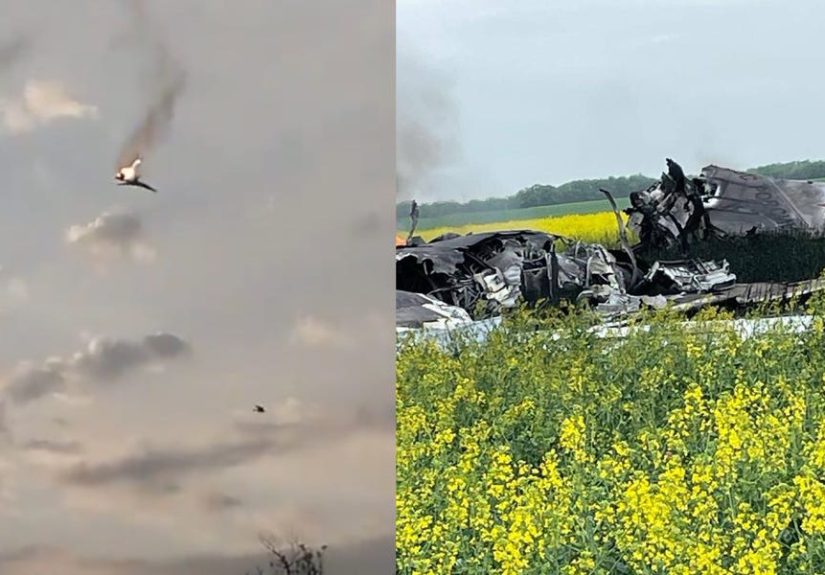
The basic outline is widely reported: a Tu-22M3 went down in Russia’s Stavropol region after a combat mission. Footage circulated online
showing an aircraft in distress, with visible fire, spiraling toward the ground. Russian statements pointed toward malfunction; Ukrainian statements
pointed toward interception.
Notice how carefully that’s worded. That’s not evasivenessit’s realism. In wartime, early reporting is often a messy collage of:
official statements, partial videos, local witness accounts, and analysts trying to geolocate smoke plumes like they’re playing
the world’s bleakest version of “Where’s Waldo?”
Two Narratives, One Fireball
When the dust (and smoke) settled, the public story forked into two main explanations:
- Mechanical failure or accident: The bomber experienced a technical issuepossibly an in-flight fireand crashed.
- Air defense shootdown: Ukrainian forces hit the bomber with a long-range surface-to-air missile, and it limped on before crashing.
Both explanations can produce a burning aircraft and a catastrophic end. The difference is in the detailsdetails that aren’t always available,
and aren’t always shared honestly by the parties involved.
The Case for “Error”: How Big Bombers Fail in Very Un-dramatic Ways
“Technical malfunction” may sound like a generic excuse, but aviation is a complicated businesseven when nobody is shooting at you.
Large military aircraft are maintenance-intensive, and older fleets can be especially vulnerable to reliability problems:
fatigue, parts shortages, deferred maintenance, rushed turnaround cycles, and the simple reality that metal and engines don’t care about
your geopolitical messaging.
In-Flight Fire: A Nightmare Scenario
Many reports referenced fire as part of the incident. In-flight fireespecially around engines or fuel systemsis a pilot’s worst enemy,
because it’s fast, unforgiving, and not impressed by heroism. A fire can escalate from “we should land soon” to “we should not be inside this aircraft”
in the time it takes to regret your last life decision.
An engine problem can also create secondary failures: loss of hydraulics, degraded control authority, electrical faults, or structural damage if fire
spreads. If video shows fire in a particular section of the aircraft (for example, rear fuselage), that can be consistent with an engine-related emergency.
It’s not proofbut it’s a plausible fit.
The Human Factor (Because Humans Are Always In the Loop)
Even if the initiating event was mechanical, decisions still matter: how the crew responds, what checklist actions are taken, whether the aircraft is
able to reach a safe ejection envelope, and whether they can steer away from populated areas. In many accidents, the “cause” is a chain:
a mechanical fault triggers a fast-moving situation, and the outcome depends on seconds-long choices.
That’s not a moral judgment. It’s the uncomfortable truth of aviation: sometimes the difference between “made it home” and “headline” is one bad sensor,
one delayed call, or one component that finally decided it was done being heroic for the motherland.
The Case for “Incredible Shot”: Why Ukraine’s Claim Turned Heads
Ukraine’s version of the story wasn’t subtle. Ukrainian officials claimed the bomber was downedreportedly at very long rangeusing an old but
powerful Soviet-era air defense system, the S-200 (SA-5).
If true, that would be notable for two reasons: first, because it would mark a rare interception of a long-range bomber; second, because the S-200 is
an older system not commonly associated with modern, flexible battlefield air defense.
Why the S-200 Angle Is So Surprising
The S-200 was designed for big jobs: high-altitude targets, long distances, and defending large areas. It’s the kind of system that says,
“I heard you like airspace, so I brought a missile the size of a small car.”
But old systems come with limitations: they’re typically less survivable against modern suppression tactics, can be logistically heavy,
and may require significant modernization to function effectively under today’s conditions. That’s why the claim sparked so much attention.
The underlying idea wasn’t “Ukraine used a missile.” It was “Ukraine used that missile, like that.”
The “Limp Home” Pattern
One detail often discussed in shootdown claims is whether an aircraft could be hit, remain airborne for a time, and then crash later.
That’s possible. Not every shootdown looks like a Hollywood snap-cut from “flying” to “exploding.” Some aircraft take damage,
lose systems, catch fire, and still flybrieflybefore control is lost or the structure fails.
That scenario is consistent with the idea that a bomber could be struck at range, attempt to return, and then go down when damage becomes unrecoverable.
It’s also consistent with some accident chains. Again: plausible is not the same as proven.
How Do You Tell the Difference: Accident vs. Air Defense Shootdown?
Outside of war, aviation investigations rely on a robust toolbox: flight data recorders, maintenance logs, radar data, wreckage mapping, metallurgy,
and interviews. In war, that toolbox gets smaller, noisier, and politically weaponized.
Clues Analysts Look For
- Wreckage signatures: Missiles with fragmentation warheads can leave distinctive shrapnel patterns.
Fires and mechanical failures may leave different burn and break signatures. - Video timing and geometry: Footage can show whether the aircraft was already burning before a break-up,
how it lost control, and whether an external flash suggests proximity detonation (though video compression lies constantly). - Radar and tracking data: If credible radar track data exists, it can show altitude, speed changes,
and abrupt maneuvers consistent with damage. - Communications and rescue details: Reports of where crew ejected, how many survived, and how quickly rescue arrived
can sometimes reveal how long the aircraft remained controllable.
Unfortunately for anyone who loves neat conclusions, the best evidence is often classified, controlled, or never released.
That doesn’t mean you can’t reason about probabilitiesit just means you should hold your conclusions with a loose grip.
Why Both Sides Benefit from Their Story
Russia has incentives to frame the loss as an accident: it suggests the aircraft wasn’t defeated by enemy defenses and avoids admitting a vulnerability.
Ukraine has incentives to frame it as a shootdown: it demonstrates capability, boosts morale, and warns Russian aviation that “distance is not immunity.”
Neither incentive automatically makes a claim false. But incentives are the lens through which every statement should be read.
Strategic Context: Why This One Loss Fits a Bigger Pattern
Whether this event was a mechanical failure or an air defense success, it still sits inside a broader trend:
strategic bomber vulnerability is rising in contested environmentsnot only from classic SAMs, but also from drones, sabotage,
and long-range strikes against airbases.
Bombers, But Make It 2020s
The classic bomber logic is standoff: launch from far away, use missiles for reach, keep aircrews out of the “danger zone.”
But that logic depends on the “danger zone” being geographically predictable.
Modern conflict has been redefining that boundary with:
- Long-range air defense surprises (including novel uses of older systems).
- Open-source intelligence that makes secrecy harder to maintain.
- Drone attacks on bases that threaten aircraft on the ground as much as in the sky.
- Operational tempo that strains maintenance and increases mishap risk.
In other words, bombers aren’t obsoletebut they are increasingly forced to play a game where the board keeps changing shape.
So… Error or Incredible Shot? A Reasonable, Unsatisfying Answer
If you came here for a courtroom-style verdict“case closed!”I have bad news.
Public information doesn’t give a clean, definitive answer that everyone can agree on.
What we have instead is a situation where both explanations remain plausible:
- An older, heavily used bomber fleet can absolutely suffer catastrophic failuresespecially under wartime stress.
- A long-range SAM engagement is also possible, and Ukraine has strong reasons to highlight such a capability if it occurred.
The most honest conclusion is this: the event underscores how thin the margin can be for large aircraft in wartime.
Whether the initiating spark came from a failing component or a missile fragment, the outcome is the same:
a supersonic bomber ended its mission in flamesand both sides rushed to claim the meaning of the fire.
And that meaning matters. Because every time a bomber is lostby accident or by interceptionsomeone on the other side updates their playbook.
Not because they enjoy paperwork, but because the next mission might depend on it.
Experiences and Lessons: What This Kind of Incident Feels Like Up Close (Without Being There)
Let’s talk about “experience,” because it’s easy to reduce events like this to a scoreboard: one aircraft down, one claim up, one meme posted.
But the lived reality around a supersonic bomber crashwhether caused by mechanical failure or air defense shootdownis
a messy blend of adrenaline, uncertainty, and second-guessing that follows people long after the smoke clears.
For aviation maintainers, the experience often starts hoursor daysbefore anyone outside the base knows a mission is coming.
Wartime flying tends to compress timelines: inspections happen faster, parts are harder to source, and aircraft that “would normally be grounded”
sometimes get pushed back into service because operational demand is relentless. Mechanics and technicians describe the emotional whiplash of signing off
a system knowing you did everything you couldthen watching news break later and wondering which line item on the checklist will haunt you.
It’s not guilt in a dramatic-movie sense; it’s a very practical, very human urge to rewind time and stare harder at every bolt.
For aircrews, the experience is different, but the uncertainty is similar. In-flight emergencies don’t announce themselves politely.
A warning light is a suggestion; smoke is a demand. Crews train to run checklists, coordinate, and make rapid decisions while the aircraft is still flying,
still heavy, still hot, still full of fuel, and possibly still inside contested airspace. Ejectionoften discussed online like it’s a simple “escape button”
is physically violent and psychologically complicated. Surviving an ejection doesn’t automatically feel like a win; it can feel like an abrupt transition from
“professional mission” to “pure survival” in under a second.
For air defense operators, the experience sits at the intersection of discipline and doubt. If a long-range engagement happened, it would likely involve
hours of preparation, careful target identification, and tense waitingfollowed by a short burst of action that either ends in success or in silence.
The emotional texture there isn’t constant excitement; it’s more like long stretches of focus punctuated by moments where everything matters at once.
And even after a successful intercept, confirmation can be complicated. “Did we hit it?” can become “Did it crash because of us?” which becomes
“What will the enemy do differently tomorrow?”
Then there’s the experience of the wider publicespecially in the age of instant footage. Watching a burning aircraft fall is shocking, even through a screen.
But it also invites a kind of armchair certainty that real professionals tend to avoid. One grainy clip can look like “proof” of a missile hit to one viewer and
“obvious engine fire” to another. Video compression, missing context, and the human tendency to see patterns in chaos are a dangerous combination.
This is why serious analysts often speak in probabilities, not absolutes: not because they’re timid, but because they know how often the first story is wrong.
Finally, there’s a strategic “experience” that militaries absorb: the quiet, bureaucratic aftershock. Lossescombat or accidentaltrigger reviews, changes in
routing, changes in timing, changes in basing, changes in electronic procedures, changes in maintenance priorities. A single incident can reshape behavior for months.
If the loss was mechanical, the experience becomes a reliability crisis: inspections tighten, missions slow, commanders get nervous. If it was a shootdown, the experience
becomes a survivability crisis: standoff distances get reevaluated, air defense threats get re-mapped, and crews are asked to fly a little differentlyoften with fewer margins.
The big lesson in all these experiences is humility. Aviation is unforgiving. War is chaotic. And when they overlap, certainty is expensive.
Whether this bomber fell to an error or an incredible shot, the human experience around it is the same: a sharp reminder that modern air war is not just about speed and
firepowerit’s also about friction, fatigue, improvisation, and the thin line between “made it back” and “didn’t.”