Table of Contents >> Show >> Hide
- What Makes These “Double-Almond”?
- Ingredients
- Equipment You’ll Want
- Before You Start: Quick Macaron Strategy
- Step-by-Step: Double-Almond Macarons
- Make the Almond Buttercream Filling
- Assemble, Mature, and Serve
- Troubleshooting (Because Macarons Love Drama)
- Storage and Make-Ahead Tips
- Flavor Variations (Still Double-Almond at Heart)
- FAQ
- Kitchen Experiences: What Learning Double-Almond Macarons Feels Like ()
- SEO Tags
If you’ve ever stared at a bakery macaron and thought, “Sure, I could make that,” welcome to the sweet little confidence trap known as French macarons. The good news: you absolutely can make them at home. The better news: this Double-Almond Macarons Recipe leans into the one flavor macarons already lovealmonds and doubles down with an almond-forward filling that tastes like it belongs in a fancy pastry case (but lives in your kitchen).
This guide is equal parts recipe, technique, and “what to do when the batter looks like it’s judging you.” You’ll get smooth shells, ruffled feet, a chewy interior, and a filling that makes the whole thing taste like a soft almond cloud. (A delicious cloud. Not a weather event.)
What Makes These “Double-Almond”?
Classic macarons already use almond flour for the shells. In this version, we add a gentle almond boost to the shell batter and pair it with a almond buttercream that’s flavored with almond extract and (optional, but highly encouraged) a spoonful of almond butter for deeper nuttiness. So you get almond in the structure and almond in the fillinghence, double-almond. No math test required.
Ingredients
Macarons reward precision. If you own a kitchen scale, this is its time to shine. If you don’t, this recipe may be the moment you finally understand why bakers get emotional about grams.
For the Double-Almond Macaron Shells (about 22–28 sandwich cookies)
- 120 g superfine blanched almond flour (not almond meal)
- 120 g powdered sugar (confectioners’ sugar)
- 100 g egg whites (about 3 large egg whites), room temperature
- 90 g granulated sugar
- 1/8 tsp cream of tartar (optional, but helpful for stability)
- 1/4 tsp almond extract (go easyalmond extract is powerful)
- Pinch of fine salt
- Optional: a few drops gel food coloring (avoid liquid coloring, which can thin batter)
For the Almond Buttercream Filling
- 85 g unsalted butter, softened (about 6 Tbsp)
- 240 g powdered sugar (about 2 cups), sifted
- 1–2 Tbsp milk or cream
- 1/2 tsp almond extract
- Pinch of salt
- Optional (for extra “double”): 1–2 Tbsp creamy almond butter
Optional Finish (for extra flair)
- Finely chopped toasted almonds (press around the filling edge after sandwiching)
- Or a whisper of powdered sugar for a “snowy bakery window” look
Equipment You’ll Want
- Kitchen scale
- Fine-mesh sieve
- Stand mixer or hand mixer
- Rubber spatula (macaronage happens here)
- Piping bag + round tip (about 1/2 inch / 12 mm)
- Parchment paper or silicone macaron mat
- 2 rimmed baking sheets
- Oven thermometer (strongly recommended)
Before You Start: Quick Macaron Strategy
Macarons are less “hard” and more “specific.” They’re like a cat: perfectly pleasant if you respect boundaries. Three boundaries matter most:
- Dry ingredients must be fine. Sift, and if needed, pulse briefly in a food processor.
- Meringue must be glossy and stiff. Not foamy. Not dry and clumpy. Stiff and shiny.
- Macaronage must be “lava.” Batter should ribbon and settle back in smoothly.
Step-by-Step: Double-Almond Macarons
1) Prep your pans and dry mix
Line two baking sheets with parchment or silicone mats. If using parchment, you can draw 1.5-inch circles on the underside as a template (then flip the paper so the ink/pencil isn’t touching your batter).
Sift almond flour and powdered sugar together into a bowl. If you see lots of coarse bits, pulse the mixture in a food processor for a few seconds and sift again. The goal is a dry mix that looks like pale sand, not gravel.
2) Make the meringue (the part that makes or breaks the vibe)
In a clean, grease-free mixing bowl, whip egg whites on medium speed until foamy. Add cream of tartar (if using) and the pinch of salt. Then slowly rain in the granulated sugar while continuing to whip.
Increase to medium-high and whip until the meringue is glossy and holds stiff peaks. When you lift the whisk, the peak should stand tall with only the tiniest bend at the tip. Add almond extract and gel coloring near the end and mix briefly to combine.
3) Macaronage: fold like you’re deflating a balloon… politely
Add the sifted almond flour/powdered sugar mixture to the meringue in two additions. Fold gently with a spatula, scraping around the bowl and then through the center, rotating as you go.
At first the batter will look thick and stubborn. Keep folding, and watch for the moment it transforms: it should flow off the spatula in a smooth ribbon. A practical test: draw a figure “8” with the ribbon of batterif you can do it without the ribbon breaking, and the lines melt back into the batter in about 10–20 seconds, you’re in the sweet spot.
Stop folding as soon as you hit that consistency. Overmixing leads to runny batter and flat shells; undermixing leads to lumpy tops and volcano peaks.
4) Pipe the shells
Transfer batter to a piping bag fitted with a round tip. Pipe straight down, holding the bag perpendicular to the tray, until each round is about 1.25–1.5 inches wide. Stop pressure, then flick the tip slightly to finish.
Tap the baking sheet firmly on the counter 3–5 times to release air bubbles. Use a toothpick to pop any obvious bubbles on the surface. (This is oddly satisfying. Like bubble wrap, but edible later.)
5) Rest until a skin forms
Let the shells rest at room temperature until the tops feel dry to a light touchno sticking. In many kitchens this takes 20–40 minutes, but humidity can stretch the timeline. Don’t rush this step; the skin helps the macarons rise upward and form “feet” instead of cracking.
6) Bake
Preheat oven to 300–325°F. Oven behavior varies a lot, so an oven thermometer can save a batch. Bake one tray at a time on the center rack for 12–15 minutes, rotating once halfway through if your oven has hot spots.
Macarons are done when the tops feel set and the shell doesn’t wiggle like a loose tooth when gently nudged. Cool completely on the tray before peeling off parchment/mat.
Make the Almond Buttercream Filling
Beat softened butter until smooth. Add powdered sugar in stages, mixing slowly at first (unless you enjoy a kitchen blizzard). Add almond extract, a pinch of salt, and 1 tablespoon milk/cream. Beat until fluffy. If it’s too thick, add a little more milk; if it’s too loose, add a bit more powdered sugar.
Want a deeper almond flavor and a slightly richer texture? Beat in 1–2 tablespoons almond butter. It turns the filling into something that tastes like almond croissant filling’s cooler cousin.
Assemble, Mature, and Serve
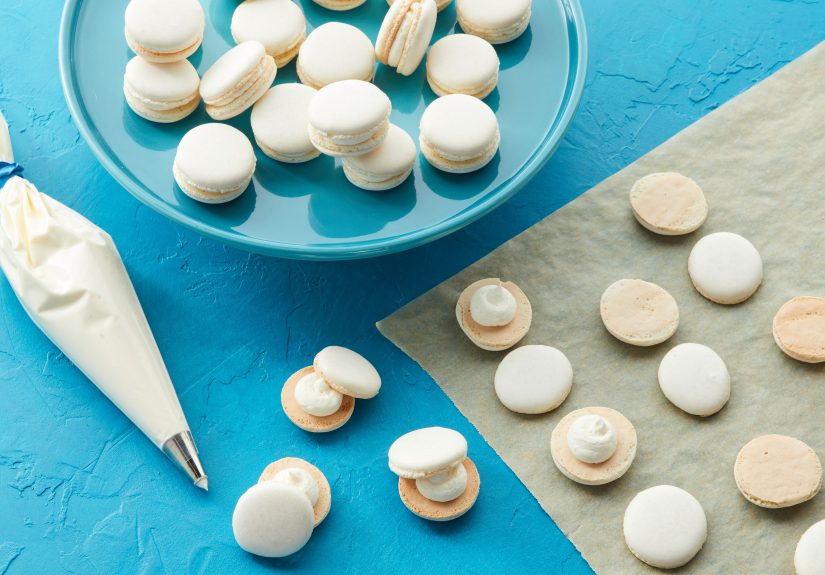
Match shells into pairs of similar size. Pipe a small mound of almond buttercream onto one shell, then gently press the second shell on top until the filling spreads to the edges.
You can eat them right away. But many bakers swear macarons taste best after a rest: refrigerate the filled macarons in an airtight container for 12–24 hours, then bring to room temp before serving. This “maturing” step softens the interior slightly and blends flavors for that bakery-style bite.
Troubleshooting (Because Macarons Love Drama)
Problem: cracked tops
- Likely cause: shells weren’t rested long enough, or oven heat was too high/uneven.
- Fix: rest until dry-to-touch; use an oven thermometer; bake one tray at a time.
Problem: no feet (flat bottoms, smooth tops, sadness)
- Likely cause: batter overmixed, meringue under-whipped, or oven too cool.
- Fix: whip meringue to glossy stiff peaks; stop macaronage at lava stage; verify oven temp.
Problem: hollow shells
- Likely cause: meringue under- or over-whipped, oven too hot, or bake time issues.
- Fix: aim for stiff-but-not-dry peaks; don’t overbake; check for hot spots and adjust temp.
Problem: lopsided or feet spreading sideways
- Likely cause: uneven heat or batter slightly overmixed.
- Fix: rotate tray once; consider reducing temp slightly; double-check your macaronage stop point.
Problem: grainy or bumpy tops
- Likely cause: almond flour too coarse or dry mix not sifted well.
- Fix: use superfine blanched almond flour; sift well; pulse + sift again if needed.
Storage and Make-Ahead Tips
- Filled macarons: store airtight in the fridge up to 4–5 days; bring to room temp before serving.
- Shells only: store airtight at room temp 1 day, or freeze up to 1 month.
- Freeze assembled: freeze in a single layer, then transfer to a container; thaw overnight in the fridge.
Flavor Variations (Still Double-Almond at Heart)
Coffee-Almond
Add a small amount of espresso powder to the dry mix for a subtle mocha-almond vibe, then fill with almond buttercream (coffee + almond is an underrated friendship).
Chocolate-Almond
Replace a small portion of powdered sugar with unsweetened cocoa in the dry mix, and keep the almond extract low so it doesn’t compete. Fill with chocolate ganache spiked with a drop of almond extract.
Cherry-Almond
Add a tiny amount of cherry flavoring (or a spoon of cherry jam in the center of the filling) for a classic bakery combination. Almond + cherry tastes like nostalgia wearing a beret.
FAQ
Do I really need to “age” egg whites?
Not strictlybut many bakers find that separating egg whites ahead of time and letting them rest (refrigerated, then brought to room temperature) can improve consistency. If you’re new, focus more on clean tools, accurate weighing, and hitting the right meringue and batter texture.
Almond flour vs. almond mealwhat’s the difference?
Almond flour is typically made from blanched, skinless almonds and is much finer, which helps create smoother, shinier shells. Almond meal is coarser and often includes skins, which can create bumpy tops and heavier shells.
My macarons stick to the parchment. Why?
Usually they’re underbaked or removed too soon. Let them cool completely, and consider adding 1–2 minutes to bake time next round (while keeping an eye on browning).
Kitchen Experiences: What Learning Double-Almond Macarons Feels Like ()
Making macarons is a very specific kind of baking experience: part science experiment, part confidence-building exercise, and part “why is the weather involved in my dessert?” If you’ve never made them before, your first batch might feel like an emotional roller coaster with powdered sugar on top. That’s normaland honestly, it’s part of the fun once you decide to treat each round as feedback, not failure.
One of the most common “aha” moments happens when you stop trying to force macarons to behave like regular cookies. The batter isn’t supposed to be fluffy like cake batter or thick like brownie batter. When you nail macaronage, it moves like slow lavaglossy, heavy, and smooth. Many home bakers describe the first time they get this right as instantly recognizable: the ribbon falls, spreads, and disappears back into itself without leaving harsh ridges. It’s the culinary version of hitting the right note on a guitar after a week of weird buzzing sounds.
Then there’s resting. Resting is the step that teaches patience in a way few desserts can. In a dry kitchen, you might get a skin in 20 minutes and feel unstoppable. In a humid kitchen, you’ll touch the top at minute 35 and realize it’s still tackylike the macaron is saying, “Not yet, bestie.” People often try to shortcut this with fans or dehumidifiers; sometimes it helps, but the real win is simply learning what “dry-to-touch” feels like in your space. Once you know your kitchen’s personality, macarons become less mysterious.
Double-almond macarons, specifically, have a comforting advantage: almond is naturally at home here. The shells taste familiarnutty, lightly sweet, and almost marzipan-adjacentwhile the almond buttercream brings a cozy bakery aroma. Many bakers notice that almond extract can swing from “wonderful” to “too much” quickly, so it’s a great exercise in restraint. You’re not trying to make the macaron taste like a bottle of extract; you’re trying to make it taste like almonds that got dressed up for a party.
Another shared experience is the “oven reality check.” You might set your oven to 315°F and still discover the back corner runs hotter, or the top heat is more aggressive than you thought. This is why macarons have a reputation: they reveal everything your oven has been hiding. But once you learn your hot spots (and rotate once), your results jump dramatically. The first tray that comes out with even feet feels like winning a tiny edible trophy.
Finally, there’s the moment you taste a matured macaron the next day. The shell and filling settle into each other, the interior turns perfectly chewy, and the almond flavor rounds out into something deeper and more “bakery.” That’s when many people go from “I made macarons” to “Okay… I might be a macaron person now.” And yes, that can lead to buying a dedicated piping tip set. This is how it starts.