Table of Contents >> Show >> Hide
- What Epoxy and Polyurethane Actually Are (No Lab Coat Required)
- The Quick Answer (Because You Have Things to Do)
- Epoxy vs Polyurethane: Side-by-Side Comparison
- Where Epoxy Wins (and Why People Love It on Concrete)
- Where Polyurethane Wins (and Why It’s Often the Topcoat Hero)
- The “Power Couple” Approach: Epoxy Base + Polyurethane Topcoat
- Specific Use Cases: What’s Better for Your Project?
- Installation Reality Check (Because the Coating Doesn’t Care About Your Weekend Plans)
- Durability, Lifespan, and Maintenance (A.K.A. “How Long Until I Regret This?”)
- Safety Notes (Short, Serious, and Worth Reading)
- Decision Guide: Which Should You Pick?
- FAQ
- Real-World Experiences (The Part You Only Learn After You Open the Kit)
- Conclusion: The Better Coating Is the One That Matches the Job
If coatings had personalities, epoxy would be the tough bouncer at the door (“Not on my floor, oil stain.”),
while polyurethane would be the flexible gymnast who can take a beating and still look camera-ready.
Both are legit heavy-hittersbut the “better” one depends on what you’re coating, where it lives, and how much abuse it’s going to see.
This guide breaks down epoxy vs polyurethane in plain American English, with real-world examples (garage floors, wood floors,
countertops, workshops), plus a few gotchas that people usually learn the expensive way.
What Epoxy and Polyurethane Actually Are (No Lab Coat Required)
Epoxy (the hard-shell option)
Epoxy coatings are typically made by mixing two parts (a resin and a hardener) that chemically react and cure into a
hard, dense, thermoset plastic. Once cured, epoxy is known for strong adhesion, good chemical resistance,
and excellent compressive strengthmeaning it handles weight and impacts well when the surface prep is done right.
Polyurethane (the flexible bodyguard)
Polyurethane (often shortened to “urethane”) is a family of coatings that cure into a tough but more flexible film.
Depending on the product, polyurethane can be water-based or solvent-based, and single-component or two-component.
In general, polyurethane is prized for abrasion/scratch resistance, UV stability,
and gloss retention.
The Quick Answer (Because You Have Things to Do)
- Choose epoxy when you want a thicker, harder build with strong adhesion and chemical resistanceespecially on concrete.
- Choose polyurethane when you want better scratch/abrasion resistance, flexibility, and UV stabilityespecially as a topcoat or in sunlit areas.
- Best of both worlds? A common “pro” system is epoxy base + polyurethane topcoat.
Epoxy vs Polyurethane: Side-by-Side Comparison
| Category | Epoxy | Polyurethane |
|---|---|---|
| Hardness & load handling | Very hard; great compressive strength and strong adhesion | Tough, but typically less “rock-hard” than epoxy |
| Scratch & abrasion resistance | Good, but can show scratches/scuffs depending on formula and use | Often excellentcommonly chosen to resist wear and keep gloss longer |
| Flexibility & movement | More rigid; can crack if the substrate moves or vibrates a lot | More flexible; better at handling movement and minor impacts |
| UV resistance | Many epoxies can yellow/chalk in sunlight | Typically better UV stability and color/gloss retention |
| Chemical resistance | Excellent for many automotive fluids, salts, and household chemicals | Also strong; often selected for broad chemical exposure plus UV needs |
| Moisture & temperature sensitivity | Surface must be properly prepped; moisture issues can cause failures | Some systems can be more humidity/temperature sensitive during install |
| Thickness & “build” | Often thicker; can help mask minor imperfections | Often thinner; may not hide flaws as well, but can be a great protective top layer |
| Typical use pattern | Primer/base coat, build coat, decorative flake systems, industrial floors | Topcoat over epoxy, wood finishes, high-traffic protective coatings |
Where Epoxy Wins (and Why People Love It on Concrete)
1) Garage floors, workshops, and warehouses
Epoxy is the classic choice for concrete floors that need to handle:
hot tires, oil drips, road salt, dropped tools, rolling tool chests, and the occasional “oops” with brake fluid.
If your floor is basically a WWE arena for your car, epoxy is in its element.
2) Strong adhesion when the prep is right
Epoxy bonds aggressively to properly prepared concrete. That’s why surface prep is non-negotiable:
cleaning, repairing, profiling (often via grinding), and ensuring the slab isn’t quietly sweating moisture like it ran a marathon.
3) Chemical resistance for the real world
Many epoxy floor coatings are formulated to resist common chemicals (gasoline splashes, oils, salts).
That’s a big reason epoxy shows up in auto shops, industrial spaces, and busy residential garages.
Epoxy’s biggest “ugh” moments
- UV exposure: Many epoxies yellow or chalk in sunlight. If your “indoor” floor gets strong sun through big windows, this matters.
- Rigidity: Concrete moves (micro-cracks, thermal cycles). Epoxy can crack if movement is significant.
- Prep sensitivity: The floor can look perfect… and still fail if moisture vapor or contaminants aren’t handled.
Where Polyurethane Wins (and Why It’s Often the Topcoat Hero)
1) High-traffic areas that get scratched, scuffed, and judged
Polyurethane is often selected when you care about wear and appearance over time.
Think retail floors, corridors, showrooms, or anywhere that sees constant foot traffic and cleaning.
It tends to keep its finish looking nicer longerespecially in systems designed for abrasion resistance.
2) Sunlight and UV exposure
If sunlight hits your coated surface regularly, polyurethane usually has the advantage.
That’s why polyurethane is commonly used as a protective topcoat over epoxy in sunlit spaces or where color/gloss retention matters.
3) Flexibility for movement and temperature swings
Polyurethane’s flexibility can help it handle vibration, minor substrate movement, and temperature fluctuations better than a very rigid coating.
This is one reason urethane systems are often discussed for environments with thermal cycling or more dynamic wear patterns.
Polyurethane’s biggest “ugh” moments
- Application sensitivity: Some polyurethane systems are picky about humidity, recoat windows, and mixing accuracy (especially 2K products).
- Less forgiving build: Many urethanes don’t hide concrete flaws as well as thicker epoxy systems.
- Safety considerations: Certain two-component urethane coatings involve isocyanatesPPE and ventilation matter a lot (more on that below).
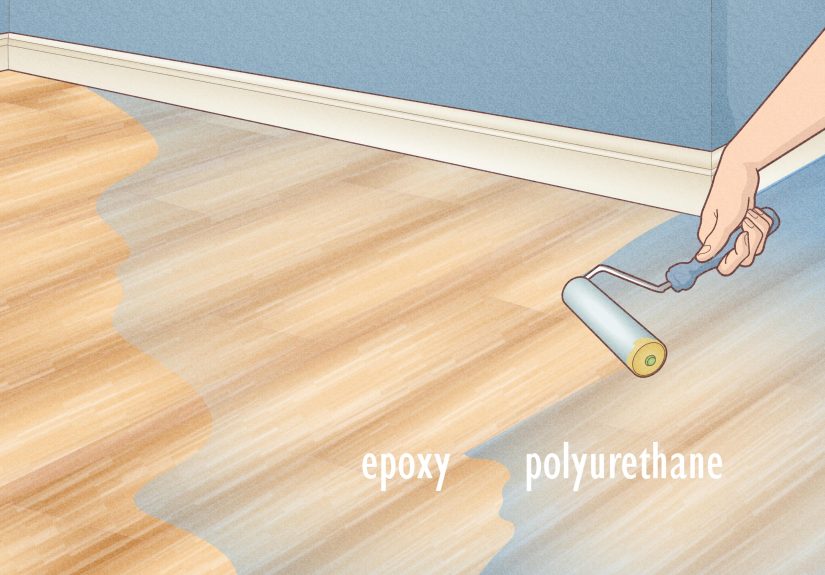
The “Power Couple” Approach: Epoxy Base + Polyurethane Topcoat
In many high-performance flooring systems, epoxy does the heavy lifting below (bonding, build, chemical resistance),
and polyurethane comes in on top like a clear, protective shieldadding scratch resistance, easier cleanability,
and better UV stability.
If you’ve ever heard someone say, “Epoxy is great… but topcoat it,” this is what they mean. It’s not epoxy slander.
It’s just acknowledging that real life includes sunlight, grit, tires, mopping, and people who drag furniture like they’re auditioning for a strongman competition.
Specific Use Cases: What’s Better for Your Project?
Garage floor coating
- Best single-system bet: Epoxy (especially if you need chemical resistance and a thicker build).
- Best long-term “looks good” setup: Epoxy base + polyurethane topcoat (great if sunlight hits the slab).
Basements and utility rooms
Epoxy is common here because it bonds well to concrete and holds up to typical household wear.
But basements can have moisture issuesso testing moisture vapor and using the right system matters more than choosing “epoxy vs polyurethane” in the abstract.
Wood floors and furniture
For wood, polyurethane is the household name. It’s widely used as a protective clear finish because it’s durable and relatively forgiving,
especially in water-based versions that dry faster and have less odor than traditional oil-based finishes.
Epoxy can be used on wood (think bar tops or river tables), but it’s often more about the “look” and build than everyday practicality.
Countertops and tabletops
If you want that thick, glossy “glass” finish, epoxy is the usual suspect. But epoxy alone can scratch and may amber over time with UV exposure.
A polyurethane topcoat (when compatible and applied correctly) can add additional scratch resistance and help protect the appearance.
Outdoor surfaces
Outdoors is where epoxy can get cranky. If the surface sees direct sunlight, a UV-stable polyurethane (or an alternative technology designed for UV)
is often the smarter callor epoxy must be protected with a UV-resistant topcoat.
Installation Reality Check (Because the Coating Doesn’t Care About Your Weekend Plans)
Surface preparation: the unskippable part
The number-one reason coatings fail isn’t “epoxy vs polyurethane.” It’s prep.
Coatings need a clean, sound, properly profiled surfacefree of oil, curing compounds, weak concrete, and mystery gunk.
If the slab has moisture vapor problems, you’ll need a system rated for it (or mitigation steps) before any coating becomes “forever.”
Mixing and recoat windows
Two-component products are chemistry projects with a time limit.
Measure accurately, mix thoroughly, and follow the product’s recoat window.
Recoat too late and you may need sanding to ensure adhesion; recoat too early and you can trap solvents or create soft layers.
Thickness and traction
High-gloss floors look amazing… until they become a slip-and-slide.
If this is a walking surface, consider traction additives or a finish designed to balance cleanability with slip resistance.
(Yes, you can have bothno, it won’t look like sandpaper unless you choose chaos.)
Durability, Lifespan, and Maintenance (A.K.A. “How Long Until I Regret This?”)
Lifespan depends on product quality, prep, thickness, traffic, and maintenance.
Many consumer-facing resources cite epoxy floors lasting up to around a decade or two in good conditions,
but the real lesson is: maintenance extends life.
Use gentle cleaners, avoid harsh abrasives, and address chips or scratches before they become peeling edges.
Polyurethane topcoats can help floors stay looking newer longer by resisting surface scratches and preserving gloss.
In high-traffic spaces, that “cosmetic durability” is not vanityit’s how you avoid a floor that looks tired long before it actually fails.
Safety Notes (Short, Serious, and Worth Reading)
Both epoxy and polyurethane products can be hazardous during mixing and application. Read the label and Safety Data Sheet (SDS),
ventilate the space, and use appropriate gloves and eye protection.
Epoxy safety
Epoxy resins and hardeners can irritate skin and may cause allergic sensitization (meaning future exposures can trigger worse reactions).
Avoid skin contact, wear chemical-resistant gloves, and don’t treat “a little itch” like a badge of honor.
Polyurethane safety
Some polyurethane systemsespecially certain two-component coatingsmay involve isocyanates, which are associated with respiratory sensitization
and occupational asthma risk when exposure isn’t controlled. Proper ventilation and PPE are essential, and spraying has additional hazards compared to rolling.
Decision Guide: Which Should You Pick?
Pick epoxy if you:
- Need a hard, high-build coating on concrete (garages, workshops, warehouses).
- Want strong adhesion and chemical resistance for spills and stains.
- Need to hide minor surface imperfections (with proper patching and prep).
Pick polyurethane if you:
- Need better UV stability (sunlit rooms, areas near windows, outdoor exposure).
- Want excellent abrasion resistance and scratch resistance over time.
- Need a tougher-looking finish that holds gloss and color longer.
Pick an epoxy + polyurethane system if you:
- Want epoxy’s bonding/build strengths plus polyurethane’s wear and UV advantages.
- Care about long-term appearance in high-traffic or sunlit environments.
- Want a more “professional-grade” performance profile without jumping into other chemistries.
Quick note: You’ll also hear about polyaspartic and polyurea coatingsfast-curing, high-performance options often marketed for “one-day” installs.
They can be fantastic, but they’re not automatically better for every slab or every installer. For this article, we’re keeping the spotlight on epoxy vs polyurethane.
FAQ
Can I put polyurethane over epoxy?
Often, yesthis is a common approach to improve UV resistance and scratch resistance. But compatibility and timing matter.
Follow the manufacturer’s instructions for recoat windows and surface prep (some require sanding if fully cured).
Will epoxy always yellow?
Not always, and not equally. But many epoxies are UV-sensitive and can yellow or chalk with sunlight exposure.
If UV exposure is expected, a UV-stable topcoat is usually recommended.
Is polyurethane more durable than epoxy?
“Durable” depends on what kind of abuse. Epoxy often wins on compressive strength and build.
Polyurethane often wins on abrasion resistance, flexibility, and long-term appearance under wear and UV.
Which is more DIY-friendly?
DIY-friendly depends on the product format. Many epoxy kits are designed for homeowners, but prep is still the hard part.
Polyurethane ranges from easy water-based wipe-on finishes to more technical two-component coatings.
The more industrial the product, the more it expects you to act like a careful adult.
Real-World Experiences (The Part You Only Learn After You Open the Kit)
Let’s talk about what actually happens when epoxy and polyurethane leave the marketing brochure and enter your garage, basement, or workshop.
First: epoxy feels like progress almost immediatelyespecially on ugly concrete. You go from “stained parking pad” to “Wow, this looks like a real space”
in a single weekend. The transformation is dramatic: color, gloss, and that satisfying “sealed” look that makes sweeping feel like you upgraded your life.
Then reality taps you on the shoulder and says, “Cool. Did you degrease properly?” Because epoxy is incredibly honest.
If there’s oil you didn’t remove, epoxy may fisheye or fail in that spot. If the slab has moisture vapor issues, you can do everything “right”
and still get bubbling or peeling later. People often describe the prep as 80% of the job, and after doing it once, they stop arguing.
Grinding is messy, etching can be inconsistent depending on the concrete, and cleaning feels endless. But when the prep is solid,
epoxy rewards you with a coating that shrugs off typical garage abuse.
Another common experience: epoxy is tough, but it can still show wear cosmetically. Drag a metal stool, twist a jack stand,
or grind grit under your shoes, and you can end up with fine scratches that catch the light. The floor is still protected, but the finish looks “lived in”
faster than some people expectespecially if they went with a high-gloss look that highlights every scuff like it’s on stage under a spotlight.
That’s where polyurethane gets its fan club. In real-world use, polyurethane topcoats are often described as the layer that keeps the system looking “new”
longer. People notice that it’s easier to clean without the surface looking hazy, and it tends to resist the micro-scratches that make glossy floors go dull.
If a space gets sunlight through windows, polyurethane’s UV stability can be the difference between “still looks great” and “why is my floor changing color?”
On wood projects, polyurethane has a very different vibe: it’s the dependable daily driver. You apply it, it levels out, it protects, and you move on with life.
Water-based polyurethane is frequently chosen when people want faster dry times and less odor, while oil-based tends to give a warmer tone and a more traditional look.
Epoxy on wood, on the other hand, is more like hosting a fancy dinner: the result can be stunning, but you’ll pay for it in careful mixing,
bubble management, dust control, and a mild obsession with making sure nothing lands in the finish while it cures.
The most consistent “hands-on” lesson across both materials is this: follow the instructions like they’re the rules of gravity.
People who eyeball ratios, rush recoat windows, skip testing, or assume “dry to the touch” means “fully cured” are the ones writing angry reviews online at 2 a.m.
The folks who treat the process like a controlled recipemeasure, mix, prep, and protectend up with floors and finishes that look great for years.
Conclusion: The Better Coating Is the One That Matches the Job
Epoxy vs polyurethane isn’t a cage match where one wins forever. Epoxy is a powerhouse for concrete: thick build, strong adhesion, and excellent chemical resistance.
Polyurethane shines where wear, flexibility, and UV stability matteroften as a topcoat that helps a surface stay good-looking under real traffic and real sunlight.
If you want a simple rule: epoxy for bonding/build, polyurethane for protection/appearance.
And if you want the most reliable “best of both” setup for many floors, an epoxy base with a polyurethane topcoat is hard to beat.