Table of Contents >> Show >> Hide
- What Is a Moon?
- Quick Moon Count by Planet
- Mercury and Venus: The Moonless Inner Worlds
- Earth’s Moon: The One That Started It All
- Mars: Phobos and Deimos, the Tiny Trouble Twins
- Jupiter’s Moons: A Solar System Within a Solar System
- Saturn’s Moons: The Current Moon Champion
- Uranus: The Literary Moon System
- Neptune: Triton and the Captured Moon Mystery
- Pluto’s Moons: A Tiny System With Big Personality
- Moons of Other Dwarf Planets and Small Bodies
- Why Some Moons Could Host Life
- Why Moon Counts Keep Changing
- Experiences That Make Every Moon in Our Solar System Feel Real
- Conclusion
- SEO Tags
Our solar system is not just a tidy lineup of eight planets politely circling the Sun. It is a crowded, noisy, wildly creative neighborhood filled with rings, dwarf planets, asteroids, comets, and hundreds of moons. Some moons are larger than planets. Some are volcano factories. Some may hide oceans beneath ice. Some are tiny captured rocks with names that sound like forgotten cousins from Greek mythology. In other words, the moons of our solar system are not background decoration. They are some of the most interesting worlds we know.
When people ask about “every moon in our solar system,” the answer depends on how strict we are being. If we mean the moons orbiting the eight major planets and Pluto, the number is already in the hundreds. If we include moons around dwarf planets, asteroids, and distant trans-Neptunian objects, the count climbs even higher. New discoveries also keep arriving as telescopes improve, so the moon list is more like a living guestbook than a carved stone tablet.
This guide gives you a complete, reader-friendly tour of the solar system’s moons: who has them, who does not, which ones matter most, and why these natural satellites have become some of the hottest targets in planetary science. Buckle up. The planets brought snacks, but the moons brought the drama.
What Is a Moon?
A moon, also called a natural satellite, is a natural object that orbits a planet, dwarf planet, asteroid, or another small solar system body. Earth’s Moon is the classic example, but it is far from the only one. Moons can be round or potato-shaped, icy or rocky, calm or explosively volcanic. Some formed beside their planets. Others were likely captured later. A few may be fragments of larger bodies smashed apart in ancient collisions.
Moons matter because they preserve clues about the early solar system. Their surfaces record impacts, tidal forces, geological activity, and chemical histories. They also help scientists understand habitability beyond Earth. If life exists elsewhere in our solar system, it may not be on a planet at all. It may be under the ice of a moon such as Europa or Enceladus.
Quick Moon Count by Planet
| World | Known Moons | Best-Known Examples |
|---|---|---|
| Mercury | 0 | None |
| Venus | 0 | None |
| Earth | 1 | The Moon |
| Mars | 2 | Phobos, Deimos |
| Jupiter | 101 officially recognized by NASA/IAU sources as of 2026 | Io, Europa, Ganymede, Callisto |
| Saturn | 285 known moons after recent IAU confirmations | Titan, Enceladus, Mimas, Rhea, Iapetus |
| Uranus | 29 known moons, including a newly reported small moon | Titania, Oberon, Ariel, Umbriel, Miranda |
| Neptune | 16 known moons | Triton, Nereid, Proteus |
| Pluto | 5 known moons | Charon, Nix, Hydra, Kerberos, Styx |
Mercury and Venus: The Moonless Inner Worlds
Mercury and Venus have no known moons. Mercury is very close to the Sun, and the Sun’s gravity makes it difficult for the tiny planet to hold a moon in a stable orbit for long. Venus is larger, but it also has no natural satellite. Scientists have suggested several possibilities: perhaps Venus never formed with a moon, perhaps a moon was lost after ancient collisions, or perhaps solar tides disrupted any companion it once had.
These two planets prove that moons are not automatic accessories. Apparently, the universe does not hand out satellites like party favors.
Earth’s Moon: The One That Started It All
Earth has one natural satellite, simply called the Moon. It orbits about 239,000 miles, or 385,000 kilometers, from Earth on average. It is tidally locked, meaning the same side always faces us. The far side was not seen by humans until spacecraft made it visible in the 20th century.
The Moon shapes life on Earth in major ways. Its gravity drives ocean tides, stabilizes Earth’s axial tilt, and helped humans create calendars long before smartphones started yelling about meetings. Its surface is covered in craters, plains called maria, mountains, and ancient lava flows. Samples returned by Apollo astronauts revealed that the Moon likely formed after a Mars-sized object struck the young Earth, blasting material into orbit that eventually gathered into our lunar companion.
Mars: Phobos and Deimos, the Tiny Trouble Twins
Mars has two small moons: Phobos and Deimos. Their names mean fear and panic, which feels slightly dramatic until you remember Mars is named after the Roman god of war. Both moons are irregularly shaped, dark, and much smaller than Earth’s Moon.
Phobos is the larger and closer of the two. It orbits only about 3,700 miles above the Martian surface, closer to its planet than any other known moon in the solar system. It circles Mars about three times per Earth day. Deimos is smaller, farther out, and more relaxed, taking about 30 hours to complete one orbit.
Phobos is slowly spiraling inward. In tens of millions of years, it may either crash into Mars or be pulled apart into a ring. Deimos, meanwhile, is taking the long-term survival route. Scientists still debate whether these moons are captured asteroids, fragments from a giant impact, or products of a more complex origin story.
Jupiter’s Moons: A Solar System Within a Solar System
Jupiter is enormous, so it is not surprising that it has a giant family of moons. NASA and IAU-linked sources list 101 officially recognized Jovian moons as of 2026, though that number can change as astronomers confirm more faint objects. Jupiter’s moon system includes four famous giants, several inner moons, and many distant irregular moons that may be captured asteroids or collision fragments.
The Galilean Moons
The four largest moons of Jupiter are Io, Europa, Ganymede, and Callisto. Galileo Galilei observed them in 1610, and their discovery helped change humanity’s understanding of the cosmos. They proved that not everything orbits Earth, which was awkward for old models of the universe but excellent for science.
Io is the most volcanically active world in the solar system. Its surface is constantly reshaped by eruptions powered by tidal heating from Jupiter’s gravity and orbital interactions with nearby moons. Io looks like a pizza that got into a fight with a chemistry lab, and scientists adore it.
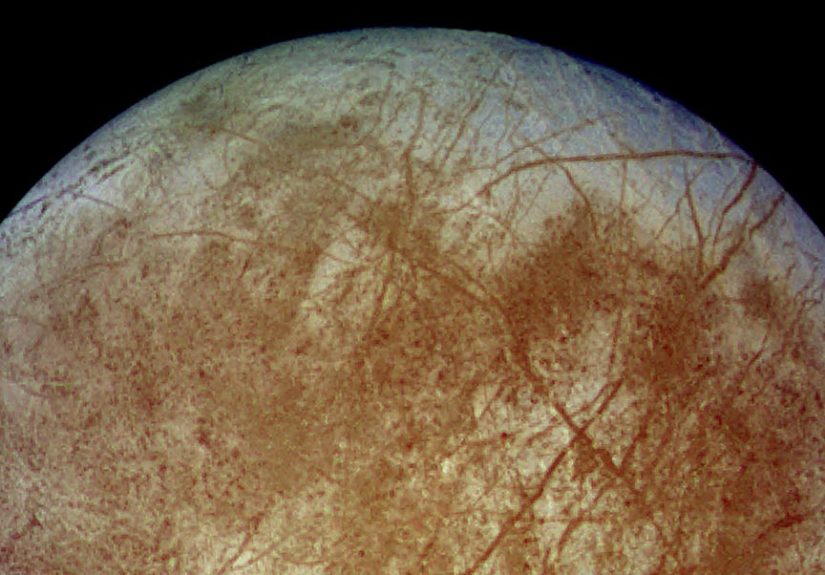
Europa is one of the most exciting places in astrobiology. Beneath its cracked icy crust, scientists believe there is a global salty ocean. Because liquid water, chemistry, and energy are key ingredients for habitability, Europa is a major target for future exploration.
Ganymede is the largest moon in the solar system and is bigger than the planet Mercury. It is also the only known moon with its own magnetic field. Beneath its icy shell, Ganymede may also contain a subsurface ocean.
Callisto is heavily cratered and ancient. Its battered surface preserves a long record of impacts, making it a kind of cosmic history book with very poor page protection.
Jupiter’s Smaller Moons
Beyond the Galilean moons, Jupiter has inner moons such as Metis, Adrastea, Amalthea, and Thebe. Farther out are swarms of irregular moons, many only a few kilometers wide. These distant moons often travel in tilted, eccentric, or retrograde orbits, suggesting they were captured or created from collisions long ago.
Saturn’s Moons: The Current Moon Champion
Saturn is famous for its rings, but its moons deserve equal billing. After recent confirmations of additional small moons, Saturn now has 285 known moons, making it the solar system’s moon-count champion. Many of these moons are tiny irregular satellites, but Saturn also has some of the most remarkable worlds ever visited by spacecraft.
Titan: A Moon With Weather
Titan is Saturn’s largest moon and the second-largest moon in the solar system. It is the only moon known to have a thick atmosphere, and it has rivers, lakes, seas, clouds, and rain. The twist is that Titan’s surface liquids are not water; they are methane and ethane. Imagine Earth, but colder, orange, and somehow more committed to hydrocarbons.
Titan is a major target for NASA’s Dragonfly mission, which will send a rotorcraft to fly through its dense atmosphere and study its organic-rich surface. Scientists are interested in Titan because its chemistry may resemble processes that occurred on early Earth before life emerged.
Enceladus: The Ocean Moon With Geysers
Enceladus is small, icy, and astonishing. NASA’s Cassini mission discovered that it has a global salty ocean beneath its crust. Jets of water vapor, ice particles, and organic molecules spray from fractures near its south pole. These plumes allow spacecraft to sample material from the hidden ocean without drilling through ice, which is convenient because space drills are not exactly sold at the hardware store.
Because Enceladus has liquid water, organic chemistry, and potential energy sources, it is one of the top places scientists consider in the search for life beyond Earth.
Other Notable Saturn Moons
Saturn’s moon lineup includes Mimas, famous for its giant crater that makes it look suspiciously like the Death Star; Iapetus, with its strange two-tone surface; Rhea, Saturn’s second-largest moon; Dione and Tethys, icy worlds with complex surfaces; and Hyperion, which looks like a cosmic sponge. Saturn’s moons interact with its rings, sculpting gaps and waves through gravity.
Uranus: The Literary Moon System
Uranus has 29 known moons, including a small moon reported in observations from the James Webb Space Telescope. Uranus is already unusual because it rotates on its side, and its moons orbit in the planet’s tilted plane. If the solar system had a “most committed to being weird” award, Uranus would at least be nominated.
The five major Uranian moons are Miranda, Ariel, Umbriel, Titania, and Oberon. They are named after characters from Shakespeare and Alexander Pope, giving Uranus the most literary moon system in the solar system. Titania is the largest moon of Uranus, while Miranda is famous for its bizarre surface, with cliffs, grooves, and patchwork terrain that suggest dramatic geological activity.
Uranus has only been visited once, by Voyager 2 in 1986. That means many mysteries remain. A future Uranus mission could transform our understanding of ice giant planets and their moons.
Neptune: Triton and the Captured Moon Mystery
Neptune has 16 known moons. Its largest moon, Triton, dominates the system. Triton is unusual because it orbits Neptune in the opposite direction of the planet’s rotation, a retrograde orbit. This strongly suggests Triton was captured, likely from the Kuiper Belt.
Triton has geyser-like plumes, a thin atmosphere, and a surface coated with nitrogen ice. It resembles Pluto in several ways, which supports the idea that it began life as a Kuiper Belt object before Neptune’s gravity grabbed it. This capture may have disrupted Neptune’s original moon system, leaving behind a complicated family of smaller moons.
Nereid, another Neptunian moon, has a highly elliptical orbit and has recently attracted scientific interest because it may preserve clues about Neptune’s earlier satellite system. Other moons, including Proteus Neptune’s original moon system, leaving behind a complicated family of smaller moons.
Nereid, another Neptunian moon, has a highly, Larissa, Galatea, Despina, Thalassa, and Naiad, orbit closer to Neptune and are linked to its faint ring system.
Pluto’s Moons: A Tiny System With Big Personality
Pluto may be classified as a dwarf planet, but its moon system is wonderfully complex. Pluto has five known moons: Charon, Styx, Nix, Kerberos, and Hydra.
Charon is the largest and most important. It is about half Pluto’s size, making it enormous relative to its parent body. Pluto and Charon orbit a shared center of mass outside Pluto itself, so many scientists describe them as a binary dwarf planet system. They are also mutually tidally locked, meaning each always shows the same face to the other.
The smaller moonsStyx, Nix, Kerberos, and Hydraorbit farther out. They are irregularly shaped and affected by the gravitational dance of Pluto and Charon. NASA’s New Horizons spacecraft revealed this system in detail during its 2015 flyby, showing that even small icy worlds can be geologically and dynamically fascinating.
Moons of Other Dwarf Planets and Small Bodies
Pluto is not the only dwarf planet with moons. Eris has one known moon, Dysnomia. Haumea has two, Hiʻiaka and Namaka. Makemake has one known moon, often referred to by its provisional designation before official naming. Ceres, the largest object in the asteroid belt and the closest dwarf planet to Earth, has no known moon.
Many asteroids and trans-Neptunian objects also have moons. Some are binary systems where two bodies orbit a shared center of gravity. Others are tiny satellites created by impacts, captures, or rotational breakup. These small moon systems are important because they help scientists measure masses, densities, and formation histories of distant objects.
Why Some Moons Could Host Life
For decades, the search for life focused mostly on planets. Now, moons are front and center. Europa and Enceladus are especially promising because they appear to have subsurface oceans. Titan is interesting for its organic chemistry. Ganymede and Callisto may also contain deep oceans beneath ice.
These worlds are far from the Sun, but tidal heating can warm their interiors. Gravity from giant planets squeezes and flexes moons, creating internal heat. That heat can maintain liquid water beneath frozen crusts. On Earth, life thrives around hydrothermal vents deep in the ocean, where sunlight never reaches. That makes ocean moons compelling places to investigate.
Why Moon Counts Keep Changing
Moon counts are not fixed forever. Astronomers keep finding new small moons around giant planets because telescope technology improves, surveys become deeper, and orbit calculations become more precise. A faint moving dot is not confirmed as a moon immediately. Scientists must track it long enough to prove it is truly orbiting a planet rather than passing through the background sky.
This is why older articles may list different counts for Jupiter, Saturn, Uranus, or Neptune. The most accurate answer depends on the date and the confirming authority. Saturn’s recent jump in confirmed moons is a perfect example. It did not suddenly manufacture hundreds of new satellites like a cosmic vending machine; astronomers simply got better at finding and confirming small ones.
Experiences That Make Every Moon in Our Solar System Feel Real
Reading about every moon in our solar system can feel abstract at first. Hundreds of objects orbiting distant worlds sounds impressive, but also a little spreadsheet-like. The magic begins when you connect those moons to experiences you can actually imagine.
Start with our own Moon. Step outside on a clear night and watch it rise. It looks calm, familiar, and almost close enough to touch, even though it is about 239,000 miles away. That simple sight links you to every skywatcher in human history: farmers, sailors, poets, scientists, astronauts, and kids who should have been asleep but were busy asking excellent questions. Earth’s Moon is the gateway moon. Once you notice it properly, the rest of the solar system feels less like a textbook and more like a place.
Now imagine standing on Mars and watching Phobos race across the sky. It would move fast, rising and setting in only a few hours. Deimos would be smaller and slower, a faint companion in the rusty Martian night. The experience would be alien, but understandable: a sky with moons, shadows, and cycles.
Picture Jupiter from Europa. The giant planet would dominate the sky, banded, stormy, and enormous. Beneath your boots would be ice; beneath the ice, perhaps an ocean. Every crack in the surface would feel like a clue. On Io, the experience would be much less peaceful. Volcanoes would erupt across the landscape, sulfur compounds would paint the ground in wild colors, and Jupiter’s gravity would be the invisible engine behind the chaos.
Saturn’s moons offer a different kind of wonder. From Titan, sunlight would be dim and filtered through orange haze. Rivers and lakes would exist, but they would be made of methane and ethane instead of water. The landscape might look strangely familiar and completely wrong at the same time. On Enceladus, you might stand near icy fractures and watch plumes spray material from a hidden ocean into space. That is the kind of view that makes science fiction look underdressed.
Then there are the colder, lonelier moons: Uranus’s Shakespearean worlds, Neptune’s captured Triton, and Pluto’s Charon. These places remind us that the solar system is not just warm sunlight and rocky planets. It is also deep cold, ancient ice, strange chemistry, and quiet gravitational dances happening billions of miles away.
The best experience related to the moons of our solar system is not only visual. It is intellectual. Each moon asks a question. How did it form? Why is it active? Could it hold an ocean? Did it come from somewhere else? Could life survive there? When you follow those questions, “every moon” becomes more than a list. It becomes a map of curiosity.
Conclusion
The moons of our solar system are far more than sidekicks. They are volcanic laboratories, ocean worlds, captured wanderers, shattered fragments, icy archives, and possible homes for chemistry that could point toward life. Mercury and Venus have none. Earth has one magnificent companion. Mars has two tiny mystery moons. Jupiter and Saturn host vast satellite systems. Uranus and Neptune carry strange, underexplored families. Pluto and other dwarf planets prove that even small worlds can have complex moon systems.
As telescopes sharpen and spacecraft travel farther, the list of known moons will keep changing. That is part of the fun. The solar system is not finished surprising us. It is still handing astronomers new dots of light and saying, “Here, count this too.”
SEO Tags
Note: Moon counts can change as astronomers confirm new discveries. This article uses current NASA, IAU, and planetary science information available for publication in 2026.