Table of Contents >> Show >> Hide
- What Does “Fool Me Once, Shame on You” Mean?
- Why the Saying Feels So Powerful
- The Meaning in Everyday Life
- The History of “Fool Me Once, Shame on You”
- Is It a Proverb, an Idiom, or a Quote?
- How to Use the Phrase Naturally
- Examples of the Saying in Context
- “Fool Me Once” vs. Similar Sayings
- What the Saying Gets Right
- Where the Saying Can Be Too Harsh
- Why This Proverb Still Matters Today
- Real-Life Experiences Related to “Fool Me Once, Shame on You”
- Conclusion
- SEO Tags
Some sayings are so sharp they barely need an introduction. “Fool me once, shame on you; fool me twice, shame on me” is one of them. It is short, punchy, and just judgmental enough to live rent-free in people’s heads for centuries. You hear it in conversations about dating, politics, bad bosses, online scams, flaky friends, and that one store that keeps emailing you “final sale” deals that somehow never feel like a deal.
At its core, this proverb is about trust, deception, and personal responsibility. The first time someone tricks you, the blame belongs to the trickster. The second time, the saying argues, at least some blame shifts to you because you already had the warning label. In other words: getting fooled once may be unfortunate, but getting fooled the exact same way twice starts to look like a lesson you ignored.
That basic idea is probably why the phrase has stayed so popular. It speaks to something deeply human. Most of us can forgive one mistake. Most of us can even explain away one betrayal. But repeat the same nonsense twice, and suddenly the proverb strolls in like a disappointed aunt with excellent instincts.
What Does “Fool Me Once, Shame on You” Mean?
The phrase means that if someone deceives, cheats, or misleads you one time, the wrongdoing is on them. But if they do it again in the same way, you should have learned from the first experience. That second failure is where the proverb places responsibility on the person who allowed it to happen again.
Put simply, the saying is less about revenge and more about learning. It tells you to pay attention, remember what happened, and stop handing repeat offenders a second chance wrapped in decorative tissue paper.
People usually quote the full version:
“Fool me once, shame on you; fool me twice, shame on me.”
Sometimes they shorten it to just “fool me once,” especially when the rest is obvious from context. The meaning stays the same: trust should come with memory.
Why the Saying Feels So Powerful
It splits blame cleanly
A lot of expressions wander around making vague points. This one does not. It divides responsibility into two clear rounds. Round one: the deceiver is at fault. Round two: the deceived person has a duty to recognize the pattern. That simple structure makes the proverb memorable and satisfying.
It sounds balanced
The saying works because it is not purely self-righteous. It does not just say, “That person is terrible.” It also asks, “Okay, but what did you learn?” That small twist gives the line moral weight. It is not only a complaint; it is a warning.
It has rhythm
The phrase sticks in the mind because it is built with neat parallel structure. “Fool me once” mirrors “fool me twice.” “Shame on you” mirrors “shame on me.” It sounds almost like a verbal seesaw, and that tidy balance is a big reason people remember it so easily.
The Meaning in Everyday Life
This proverb shows up anywhere repeated disappointment is involved. It is especially common when someone ignores a red flag that was already flapping dramatically in the wind the first time.
In relationships
If a partner lies once, you may decide to talk it through. If they tell the same lie again, the proverb starts making uncomfortable eye contact. The saying reminds people that trust is not just about giving chances; it is also about protecting yourself from patterns.
In friendships
Maybe a friend “borrows” money and forgets to pay it back. Fine. Annoying, but maybe life happened. If they do the same thing again with the same speech and the same sheepish smile, the proverb suddenly becomes the unofficial treasurer of your social circle.
At work
Suppose a manager promises that overtime this week will definitely be compensated next pay period. If that promise evaporated last month too, “fool me once” becomes less of an idiom and more of an HR survival strategy.
Online
Internet scams are practically built for this saying. Fake giveaways, suspicious payment requests, “urgent” messages, miracle investment tips, and mystery links from “friends” who are definitely not your friends anymore all fit the pattern. The proverb encourages skepticism after the first warning shot.
The History of “Fool Me Once, Shame on You”
Like many old sayings, the modern version did not appear fully polished in one magical moment. Instead, it developed over time through older forms that used slightly different wording.
Earlier roots: deceive me once
Long before the now-famous “fool me once” wording took over, English sources recorded related ideas using the verb deceive. One early version appears in Tarlton’s Jests, associated with 1611, where the thought is more forgiving but still cautionary: if someone deceives you once, blame them; if it keeps happening, blame yourself for not being careful.
That older form matters because it shows the core lesson was already in circulation centuries ago: repeated deception should teach the victim something.
Anthony Weldon and the proverb tradition
A major step in the phrase’s history comes from Anthony Weldon’s The Court and Character of King James, published in 1650/1651. Weldon gives a version often quoted in discussions of the proverb’s origin: “He that deceives me once, it’s his fault; but if twice, it’s my fault.”
Weldon presents it as an Italian proverb, which is intriguing, but scholars do not have a neat, universally accepted original Italian line that can be proven as the single source. So the safest claim is this: the idea was definitely in English by the seventeenth century, and Weldon helped preserve one influential early form.
From “deceive” to “fool”
Over time, the verb fool became the version most people recognize today. That shift makes sense. “Deceive” sounds formal and slightly literary. “Fool” sounds direct, personal, and a little sharper. It lands harder in conversation.
Nineteenth-century examples show several transitional forms, including versions about being fooled once, twice, or even three times. By the early twentieth century, the modern wording had clearly arrived in print: “Fool me once, shame on you. Fool me twice, shame on me.”
The Bush moment that gave it a second life
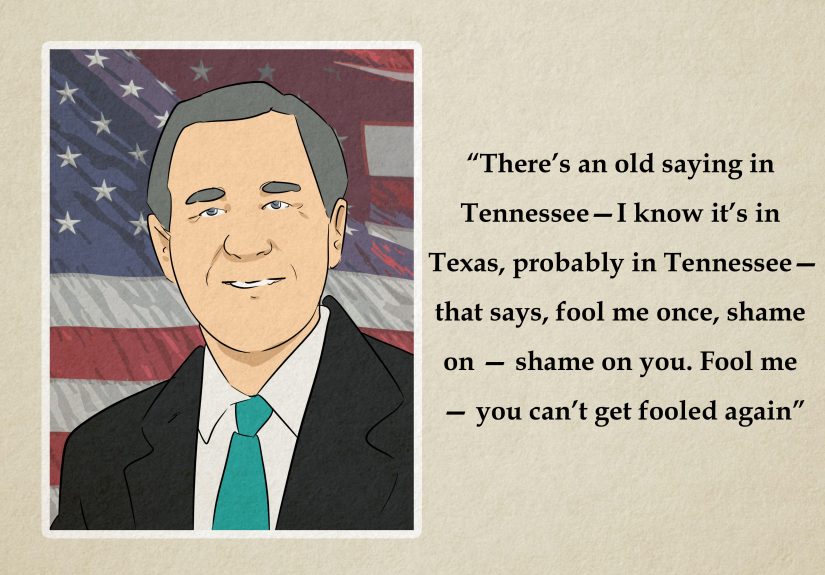
No discussion of this phrase is complete without its famous modern detour. In 2002, President George W. Bush began quoting the proverb during remarks in Nashville, Tennessee, then famously stumbled and turned it into: “Fool me you can’t get fooled again.”
That verbal swerve became one of the best-known “Bushisms” and gave the proverb renewed pop-culture life. So while the saying is much older than modern politics, that moment helped introduce it to a new generation that may not have known the original but definitely knew something very weird had happened to it.
Is It a Proverb, an Idiom, or a Quote?
The best label is proverb. A proverb is a short, memorable saying based on common experience and practical wisdom. That description fits this expression perfectly. It gives a lesson about life, behavior, and judgment in a compact form.
People also treat it like an idiomatic expression because it is widely used in fixed wording and understood figuratively. And yes, it is quoted often enough to feel like a quote. But at heart, this is a proverb: old, portable wisdom with a little side of sass.
How to Use the Phrase Naturally
You can use the saying in serious or playful ways depending on tone.
Serious use
“I trusted that contractor after the first missed deadline, but after the second one, it was fool me once, shame on you; fool me twice, shame on me.”
Casual use
“I ordered from that restaurant again after they forgot my food the first time. They forgot my drink too. Fool me once, I guess.”
Humorous use
“The clearance rack said 70% off, but somehow my total was still terrifying. Fool me once, department store. Fool me twice, I’m bringing a calculator.”
The phrase usually works best when there is a clear repeated pattern. If something bad happened twice for completely different reasons, the proverb may feel forced. It is strongest when the lesson is obvious and the mistake repeats.
Examples of the Saying in Context
- Dating: “He canceled our first date at the last minute, then tried the same excuse again. Fool me once, shame on you.”
- Money: “I already invested in one ‘guaranteed’ opportunity that wasn’t guaranteed at all. Fool me twice, shame on me.”
- Work: “If a company promises flexibility in the interview and then demands midnight emails, that is a fool-me-once situation.”
- Shopping: “That ‘limited-time offer’ appears every weekend. Fool me once, marketing team.”
- Family life: “If your cousin says he is ‘five minutes away’ and still arrives an hour later, you stop setting dinner by his clock.”
“Fool Me Once” vs. Similar Sayings
“Once bitten, twice shy”
This expression is closely related. It means that after being hurt once, a person becomes cautious the next time. The difference is subtle but useful. “Once bitten, twice shy” focuses on the emotional result: caution. “Fool me once, shame on you” focuses on responsibility: who should be blamed, and when.
“Burn me once…” style sayings
English has lots of folk wisdom built around repeated mistakes. The reason is simple: humans are incredibly talented at repeating the same bad idea while insisting this time it is “different.” Proverbs exist partly to ruin that fantasy.
What the Saying Gets Right
The proverb has lasted because it contains durable advice. It encourages discernment. It says memory matters. It reminds people that kindness and gullibility are not the same thing. You can be generous without volunteering to be the unpaid intern of someone else’s bad behavior.
It also reinforces boundaries. You do not need to keep proving how forgiving you are to people who keep running the exact same scam, emotional or otherwise. At some point, wisdom means stepping back, not leaning in harder.
Where the Saying Can Be Too Harsh
That said, the proverb is not perfect in every situation. Life is messier than a neat two-line warning. People can be manipulated, pressured, misinformed, gaslit, or trapped in systems that make “just leave” or “just learn” sound easier than it is. Repeated harm is not always the result of foolishness.
So while the saying is useful, it should be used with some compassion. It works best as a reminder to learn from patterns, not as a weapon to shame people for being human. There is a difference between wisdom and smugness, and the internet would be a much calmer place if everyone remembered that.
Why This Proverb Still Matters Today
The digital age has only made the saying more relevant. People are constantly asked to trust: apps, headlines, influencers, brands, strangers, subscription boxes, “exclusive” offers, and emails that begin with “Dear Valued Customer” right before doing something suspicious.
In that environment, “fool me once, shame on you” feels less like an old proverb and more like a survival setting. It encourages media literacy, emotional awareness, and practical caution. That is not cynicism. That is pattern recognition wearing sensible shoes.
And maybe that is the real reason the phrase survives. It gives people a compact way to say, “I have learned something, and I do not plan to donate my peace of mind to the same nonsense twice.”
Real-Life Experiences Related to “Fool Me Once, Shame on You”
Most people do not learn this proverb in a classroom. They learn it the old-fashioned way: by getting burned, sighing dramatically, and then pretending they “totally saw it coming.” A classic example is the friend who is always in a crisis. The first time, you help because that is what decent people do. The second time, you notice the emergency sounds suspiciously familiar. The third time, you realize the real pattern is not bad luck. It is poor planning wearing a sad face.
Then there is the workplace version. Almost everyone has worked for someone who promised a reward “next quarter,” “after this launch,” or “once things calm down,” which of course is corporate language for “please continue giving 120% while receiving motivational phrases instead of actual support.” The first promise feels encouraging. The second feels questionable. By the third round, the proverb starts flashing in neon over your desk.
Online shopping offers another deeply modern lesson. Maybe you buy from a flashy website with suspiciously perfect reviews and a countdown timer that screams urgency. Your package arrives three weeks late and looks like it lost a fight with reality on the way over. Fine. Lesson learned. But if you return to the same site because the photos are pretty and the discount code is named something ridiculous like BESTDEALEVER, then yes, the proverb applies with loving but brutal honesty.
Romantic experience may be the area where the saying hits hardest. Plenty of people have ignored the first red flag because they wanted to believe the best. Maybe the person was charming, attentive, funny, and just unreliable enough to turn every plan into a suspense thriller. The first disappointment feels like an exception. The second makes you wonder. The fifth has you explaining your choices to friends who have mastered the art of silent concern. That is when “fool me once, shame on you” stops sounding like a proverb and starts sounding like a pep talk.
Even families know this story. There is often one relative who says they are “on the way” while still standing in the shower, or one uncle who claims he will absolutely not bring up politics at dinner and then arrives practically wearing a debate podium. At some point, experience becomes a form of preparation. You stop expecting a different outcome from the same setup.
But there is also a gentler side to these experiences. Sometimes the saying is not about becoming cold. It is about becoming clearer. You can still care about people. You can still be hopeful. You can still believe in second chances. You just stop confusing repeated evidence with bad timing. That is the mature version of the proverb: not bitterness, but better judgment.
Conclusion
“Fool me once, shame on you; fool me twice, shame on me” has lasted for centuries because it says a great deal in very few words. It captures the balance between trust and caution, generosity and judgment, grace and self-protection. Its older roots go back to early “deceive me once” forms, while its modern wording became the version most English speakers know and use today.
The saying remains popular because it does not just describe deception. It describes learning. It reminds us that one mistake may be an accident, one betrayal may be a surprise, but repeated patterns deserve attention. You do not have to become cynical to become wiser. Sometimes all you need is memory, boundaries, and the courage to stop auditioning for the role of “person who believes that excuse again.”