Table of Contents >> Show >> Hide
- Why 282 MPH With the Roof Down Is So Difficult
- The W16 Engine: The 1,600-PS Heart of the Mistral
- Aerodynamics: Making an Open Car Behave Like a Closed One
- The Tires: The Unsung Heroes Spinning Over 4,000 RPM
- Why Papenburg Was the Right Place
- Andy Wallace: The Human Stability Control System
- Structure: What Happens When You Remove the Roof?
- Cooling: Feeding and Chilling the Monster
- How the Mistral Beat the Previous Open-Top Record
- The World Record Edition: A 14-Million-Euro Exclamation Point
- Why the Mistral Matters Beyond the Record
- Car Tech Lessons From the Bugatti Mistral
- Experience Section: What the Bugatti Mistral Teaches Anyone Who Loves Cars
- Conclusion
The Bugatti W16 Mistral did something that sounds like a billionaire’s daydream after too much espresso: it hit 282.04 mph with no roof. Not “with the roof slightly open.” Not “with a removable panel somewhere in a velvet bag.” Roof down. Air everywhere. Hair? Probably irrelevant at that speed.
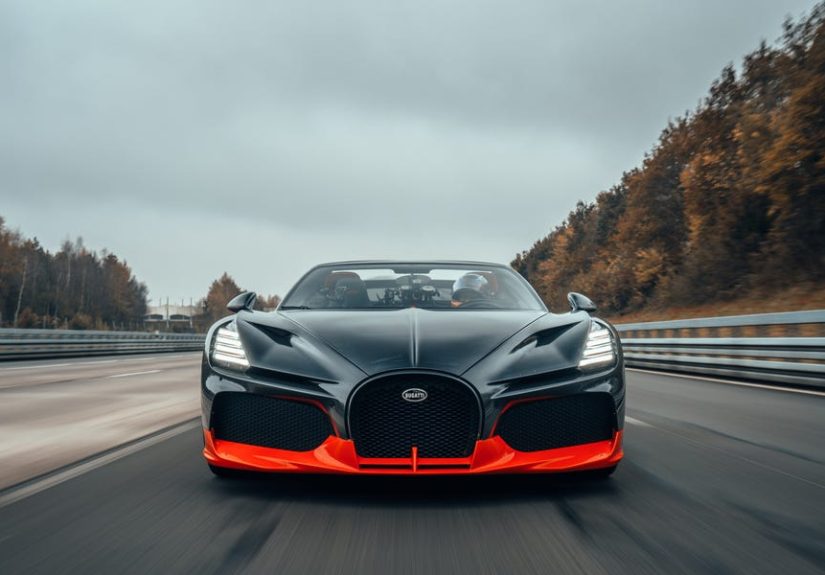
On November 9, 2024, at ATP Automotive Testing Papenburg in Germany, Bugatti test driver Andy Wallace pushed the one-off W16 Mistral World Record Car to 453.91 km/h, officially making it the fastest open-top car in the world. That number is not just a flex for collectors. It is a rolling engineering thesis on aerodynamics, cooling, tires, structure, combustion, stability, and bravery.
The fascinating part is not simply that the Mistral is fast. A Bugatti being fast is like a microwave being warm. The real story is how Bugatti managed to make an open-top roadster behave at speeds where ordinary cars would start filing complaints with the laws of physics.
Why 282 MPH With the Roof Down Is So Difficult
At ordinary highway speeds, removing a roof is mostly about sunshine, sound, and pretending every tunnel is a concert hall. At 282 mph, the missing roof becomes a major engineering problem. Air no longer politely flows around the car. It attacks, tumbles, lifts, shakes, and tries to turn the cabin into a very expensive wind blender.
A closed hypercar can use its roofline as part of a smooth aerodynamic shell. The air travels over the windshield, roof, engine cover, and rear bodywork in a controlled path. In a roadster, that elegant flow is interrupted. The cockpit becomes an open cavity, and open cavities create turbulence. Turbulence creates drag. Drag demands power. Power creates heat. Heat demands cooling. Cooling openings create more drag. Welcome to the world’s fastest vicious circle.
Bugatti’s challenge was to build a car that could move through the air like a missile while letting the driver sit in an open cockpit like a person who forgot missiles usually have lids.
The W16 Engine: The 1,600-PS Heart of the Mistral
The Mistral uses Bugatti’s legendary 8.0-liter quad-turbocharged W16 engine, tuned to 1,600 PS. It is related to the power unit that helped the Chiron Super Sport 300+ break the 300-mph barrier in 2019. In plain English, this engine is less “car motor” and more “small private weather system.”
A W16 layout is unusual because it packs 16 cylinders into a relatively compact form. Add four turbochargers, advanced cooling, all-wheel drive, and a dual-clutch transmission, and the result is a powertrain designed for absurd speed without turning every launch into a tire-smoking circus act.
Power alone, however, does not explain the Mistral’s record. Plenty of cars make huge horsepower. The trick is turning that horsepower into usable motion at extreme speed. At 282 mph, aerodynamic drag increases dramatically, and the car needs enormous output just to gain a few more miles per hour. The final stretch from 260 to 282 mph is not a casual sprint. It is a knife fight against the atmosphere.
Aerodynamics: Making an Open Car Behave Like a Closed One
The Mistral is not just a Chiron with a haircut. Its bodywork was reshaped for open-top performance. The front end, windshield surround, side intakes, rear deck, diffuser, and underbody all matter. At these speeds, styling lines are not just decoration. They are negotiations with air molecules.
Bugatti had to balance three main aerodynamic goals: reduce drag, maintain stability, and feed enough air to the engine and cooling systems. That is a difficult triangle. Reduce openings too much and the engine cooks. Add too many openings and drag increases. Add too much downforce and the car becomes stable but slower. Remove too much downforce and the car becomes fast but terrifying.
The solution is controlled airflow. The Mistral’s large intake structures behind the occupants are not merely dramatic design jewelry. They help feed the W16 while contributing to the car’s visual identity. The body channels air around and through the car so the roadster can stay planted even while the cabin remains open to the sky.
The Roofless Cabin Problem
Inside an open hypercar, air wants to swirl. That swirl can create buffeting, noise, instability, and pressure changes. Bugatti’s engineers had to manage the cockpit as part of the aerodynamic system, not as a hole where a roof used to be.
The windshield shape, side surfaces, rear humps, and air channels all help reduce chaos. The goal is not to make 282 mph feel like sitting in a library. That would be impossible unless the library is inside a jet engine. The goal is to keep the airflow predictable enough that the driver can focus, the car can remain stable, and the record run can be completed safely on a closed test track.
The Tires: The Unsung Heroes Spinning Over 4,000 RPM
At 282 mph, tires become one of the most important parts of the entire machine. They are not just black circles doing black-circle things. They are highly stressed rotating structures dealing with heat, centrifugal force, load, and surface imperfections.
Popular mechanics of the run point out that the wheels were spinning at more than 4,000 rpm. That is a wild number for road-car tires. Ordinary tires would not survive that punishment. High-speed Bugatti tires must be engineered, tested, inspected, and prepared with obsessive attention.
Before the record attempt, Wallace warmed the tires carefully. This matters because tire temperature affects grip, pressure, structure, and stability. At top speed, there is no room for “close enough.” A tiny issue can become a very large issue very quickly when a car is covering more than 400 feet per second.
Why Papenburg Was the Right Place
Bugatti used ATP Automotive Testing Papenburg, a high-speed oval in Germany. The track has long straights and banked curves, giving cars enough room to build speed and slow down safely. That last part deserves attention. Getting to 282 mph is impressive; returning from 282 mph without drama is the part your insurance agent would appreciate.
Wallace entered the banking at a controlled speed, then accelerated hard as the straight opened. This approach allowed the Mistral to use the track layout efficiently. A record like this is not simply “floor it and hope.” It is a choreography of throttle, steering, tire temperature, wind, surface condition, braking zones, and driver concentration.
Andy Wallace: The Human Stability Control System
The driver matters. Andy Wallace is not a random person who won a raffle called “Press the Scary Pedal.” He is a Le Mans winner and Bugatti’s official test driver, with deep experience in extreme-speed machinery. At 282 mph, the driver must process information calmly while the world arrives at the windshield with deeply unreasonable enthusiasm.
Wallace reportedly described the Mistral as remarkably stable during testing, even suggesting the car felt as if it wanted to go faster. That sentence is both technically impressive and emotionally unhelpful to anyone who gets nervous merging onto the freeway.
His job was not just to keep the steering wheel straight. At that speed, tiny inputs matter. The driver must understand how the car loads up through banking, how crosswinds might affect it, how it responds under full power, and how to manage braking after the peak-speed phase.
Structure: What Happens When You Remove the Roof?
A roof is not only a weather shield. In many cars, it is part of the structure. Remove it, and the chassis can lose stiffness. A flexible body is bad for handling, bad for refinement, and extremely bad for confidence at nearly 300 mph.
Bugatti had to reinforce the Mistral so it retained the precision expected from a top-speed record car. The structure must handle aerodynamic loads, drivetrain forces, suspension loads, and the additional challenge of an open cockpit. A hypercar at this level is not assembled like a normal convertible. It is engineered as a complete system from the beginning.
This is why the Mistral feels like a true roadster rather than a Chiron that misplaced its hat. It had to preserve Bugatti’s high-speed DNA while creating a different emotional experience: the sound of the W16, the rush of air, and the exposed sensation of speed.
Cooling: Feeding and Chilling the Monster
The W16 engine needs huge airflow. Bugatti has said the Mistral’s rear air intakes help move massive volumes of air toward the engine under full load. That matters because producing 1,600 PS generates enormous heat.
Cooling is one of the least glamorous parts of hypercar design, but it is absolutely central. A car can have beautiful carbon fiber, heroic horsepower, and a price tag that makes accountants speak softly, but if it cannot manage heat, it cannot run flat-out for long.
The Mistral’s cooling and aerodynamic systems had to work together. Cooling air has to enter, do useful work, and exit cleanly without ruining stability. At 282 mph, even the path of hot air leaving the car matters.
How the Mistral Beat the Previous Open-Top Record
Before the Mistral, the Hennessey Venom GT Spyder held a major open-top benchmark at 265.6 mph. That was already outrageous. Bugatti did not beat it by a polite amount. The Mistral pushed the open-top number to 282.04 mph, adding more than 16 mph to the conversation.
Those extra miles per hour are harder than they look. At very high speed, each additional mph requires more power, better aero, more stability, and more tire capability. The Mistral’s achievement is not just a larger number; it is proof that Bugatti managed the complete system better than anyone else in the open-top category.
The World Record Edition: A 14-Million-Euro Exclamation Point
The record-setting car was a one-off W16 Mistral World Record Car, visually tied to Bugatti’s previous record machines through black carbon and vivid Jet Orange accents. Subtle? Not exactly. But when your car has just gone 282 mph without a roof, you are allowed to dress it like a victory parade.
The customer behind the car reportedly wanted to complete a collection of Bugatti world-record models, including the Veyron 16.4 Super Sport, Veyron Grand Sport Vitesse World Record Edition, and Chiron Super Sport 300+. That turns the Mistral into more than a speed machine. It becomes the final punctuation mark in Bugatti’s W16 record-breaking era.
Why the Mistral Matters Beyond the Record
The Bugatti Mistral is important because it closes a chapter. Only 99 examples were planned, all sold out, and the model represents the final roadgoing Bugatti powered by the W16 engine. That makes the 282-mph roof-down run feel like a farewell concert where the guitar solo lasts 453.91 km/h.
Future Bugattis will move into a new era of hybrid performance and different engineering priorities. The Tourbillon has already signaled that Bugatti’s next chapter will not be quiet or modest. Still, the Mistral’s record is special because it celebrates mechanical excess at its most polished: sixteen cylinders, four turbos, open air, and a driver brave enough to keep going when most people would be negotiating with their ancestors.
Car Tech Lessons From the Bugatti Mistral
1. Top Speed Is a System, Not a Single Spec
The Mistral proves that horsepower headlines are only part of the story. To hit 282 mph with the roof down, Bugatti needed aero balance, tire engineering, cooling, chassis stiffness, transmission calibration, track planning, and driver skill. A hypercar is a team sport disguised as a two-seat toy.
2. Aerodynamics Become More Important the Faster You Go
At normal speeds, a small aerodynamic improvement might save fuel or reduce wind noise. At 282 mph, aero decisions determine whether the car is stable, fast, and safe enough to complete a verified run. Every surface has a job.
3. Open-Top Speed Is a Different Beast
A roadster is not merely a coupe with a better view. Removing the roof changes airflow, structure, noise, cooling paths, and driver sensation. The Mistral’s record is impressive because Bugatti solved those problems without turning the car into an awkward science project on wheels.
Experience Section: What the Bugatti Mistral Teaches Anyone Who Loves Cars
Most people will never drive a Bugatti Mistral. Most people will never sit in one. Most people will never be within touching distance of one unless a security guard is feeling unusually poetic. But the Mistral’s 282-mph roof-down record still offers a surprisingly relatable lesson for anyone who loves cars, technology, or the strange human habit of asking, “What if we made it faster?”
The first experience this story brings to mind is the sensation of open-top driving itself. Even in an ordinary convertible at 45 mph, removing the roof changes everything. Sounds become sharper. The road feels closer. The engine note seems more alive. You notice temperature, smell, wind, and motion in a way that closed cars filter out. Now imagine multiplying that sensation until the air is no longer a breeze but a physical force. That is what makes the Mistral record so compelling. It is not sterile speed. It is speed with atmosphere included.
There is also an emotional lesson in restraint. Ironically, the world’s fastest open-top car is a reminder that public roads are not playgrounds for top-speed experiments. The Mistral achieved its record on a controlled test track with professional support, careful preparation, expert driving, and independent verification. That is the responsible way to explore the edge. For everyday drivers, the takeaway is not “try this.” The takeaway is respect: respect for engineering, respect for speed, and respect for the difference between a closed test facility and a commute.
For enthusiasts, the Mistral also shows why details matter. A casual observer might see a beautiful blue-blooded roadster and think the magic is simply the engine. But the deeper story is in the invisible work: tire warm-up, airflow control, structural reinforcement, cooling strategy, and driver feedback collected during testing. Great performance rarely comes from one giant breakthrough. It usually comes from hundreds of small problems solved with painful precision.
That lesson applies far beyond hypercars. A weekend mechanic chasing better lap times, a student building a robotics project, or a designer refining a product can learn from the Mistral’s philosophy. Do not only add more power. Improve the system. Make the parts work together. Remove unnecessary chaos. Test under real conditions. Then test again because reality enjoys embarrassing confidence.
The Mistral also captures something romantic about the end of the W16 era. Electric motors and hybrid systems are rewriting performance, and many of those machines will be quicker, cleaner, and technically astonishing. But the W16 has theater. It has vibration, heat, plumbing, turbos, oil, exhaust, and mechanical drama. The Mistral’s record feels like a final roar from an engine layout that will probably never return in the same form.
In that sense, the Mistral is not just a car tech story. It is a goodbye story. It shows what happens when a company takes its most famous engine, gives it one last open-air stage, and lets it sing at a speed where the horizon probably starts looking nervous. The result is part engineering milestone, part collector fantasy, and part reminder that humans are wonderfully unreasonable creatures. We looked at a 1,600-PS roadster and did not ask, “Is this necessary?” We asked, “Can it do 282 with the roof down?”
And somehow, Bugatti made the answer yes.
Conclusion
The Bugatti W16 Mistral hit 282.04 mph with its roof down because every major system was engineered for one purpose: controlled, stable, open-air speed. Its 1,600-PS quad-turbo W16 supplied the muscle, but the record depended just as much on aerodynamic discipline, tire capability, chassis stiffness, cooling efficiency, test-track preparation, and Andy Wallace’s experience behind the wheel.
That is what makes the Mistral more than a rich person’s convertible with a dramatic soundtrack. It is a rolling demonstration of how modern hypercar engineering works when cost, complexity, and common sense are politely asked to wait outside. The Mistral did not merely set a record. It gave the W16 engine a roofless, thunderous, 282-mph goodbye.
Note: This article is written for informational and editorial purposes. The Bugatti Mistral record was achieved by professionals on a controlled test track, not on public roads.