Table of Contents >> Show >> Hide
- What “Doomsday” Means in Government Terms
- The First 24 Hours: Alerts, Command, and Controlled Chaos
- How the Federal Government Scales Up
- What Agencies Would Handle in a Doomsday-Scale Crisis
- Public health and medical response (CDC, HHS/ASPR, FDA, and partners)
- Critical infrastructure protection and restoration (CISA, DOE, utilities, private sector)
- Weather, geologic, and hazard intelligence (NOAA, NWS, USGS)
- Radiological and nuclear preparedness (NRC, FEMA, CDC, state/local officials)
- Defense support and security (DoD/USNORTHCOM, National Guard, law enforcement)
- What the Public Would Actually Experience
- Where the System Is Strongand Where It Gets Stressed
- How the U.S. Government Would Really Deal With Doomsday
- Experience Section: What a Doomsday-Scale Government Response Might Feel Like on the Ground (Illustrative Scenario, ~)
- Conclusion
Let’s start with the obvious: there is no giant red “DOOMSDAY” button in Washington labeled Fix Everything. If a catastrophic event hit the United Stateswhether it was a mega-storm, cyberattack, pandemic-scale outbreak, radiological emergency, nationwide grid disruption, or some nightmare combo platterthe federal government would not use a single secret plan. It would use an all-hazards system: a layered framework built to handle different disasters with shared tools, shared command structures, and a lot of coordination.
In plain English, the U.S. response to a doomsday-scale crisis would be less like a movie montage and more like a massive operating system booting up: alerts go out, incident command structures activate, continuity plans protect government functions, public health and infrastructure teams mobilize, and federal support flows to states, local governments, tribes, and territories. It would be messy, stressful, and imperfectbut it would not be random.
This article breaks down how the U.S. government would realistically deal with “doomsday” using real emergency management systems already in place. We’ll look at who does what, how decisions get made, where the biggest strengths are, and where the pressure points show up when everything goes sideways at once.
What “Doomsday” Means in Government Terms
The federal government usually does not plan for “doomsday” as a single category. It plans for catastrophic incidents and all hazards. That matters because the first few hours of response look surprisingly similar across many disasters:
- Detect what happened (or what is about to happen)
- Warn the public
- Protect life and health
- Stabilize critical systems
- Coordinate responders across agencies and jurisdictions
- Restore essential services and begin recovery
The exact tactics change by scenario. A hurricane requires evacuation and debris clearance. A radiological emergency may require sheltering in place and contamination screening. A cyberattack on infrastructure can require restoration teams and public communication even when nothing is visibly “on fire.” But the management architecturehow agencies organizeuses common playbooks.
The First 24 Hours: Alerts, Command, and Controlled Chaos
1) Public alerts would go out fast (if systems are working)
In a major crisis, one of the first government jobs is simple but absolutely critical: tell people what to do next. Federal, state, and local authorities can push emergency warnings through systems such as Wireless Emergency Alerts (WEA), the Emergency Alert System (EAS), and NOAA Weather Radio. FEMA’s Integrated Public Alert and Warning System (IPAWS) helps connect those pathways so authenticated alerts can be distributed quickly.
In a true doomsday-scale event, messages would likely be short and action-focused: evacuate, shelter in place, boil water, avoid travel, conserve power, or stay tuned for updates. The goal is not to explain everything immediately. The goal is to reduce immediate harm before rumor mills achieve superhero speed.
2) Local response usually starts first
One of the most misunderstood parts of U.S. disaster response is that the federal government is not always the first on scene. In many emergencies, local governments and first responders act first, then states coordinate broader support, and then federal agencies scale in when the event overwhelms local and state capacity.
Think of it as concentric circles of help. Police, fire, EMS, hospitals, and local emergency managers do the first response. State emergency operations centers expand the response. Federal support then layers in through established systems and mission assignments.
3) Incident command structures would activate
The U.S. relies on the National Incident Management System (NIMS) and Incident Command System (ICS) to help agencies work together. That means responders use shared terminology, organized roles, and common coordination methods instead of 40 agencies freelancing with 40 different acronyms (which, to be fair, the government still has plenty of).
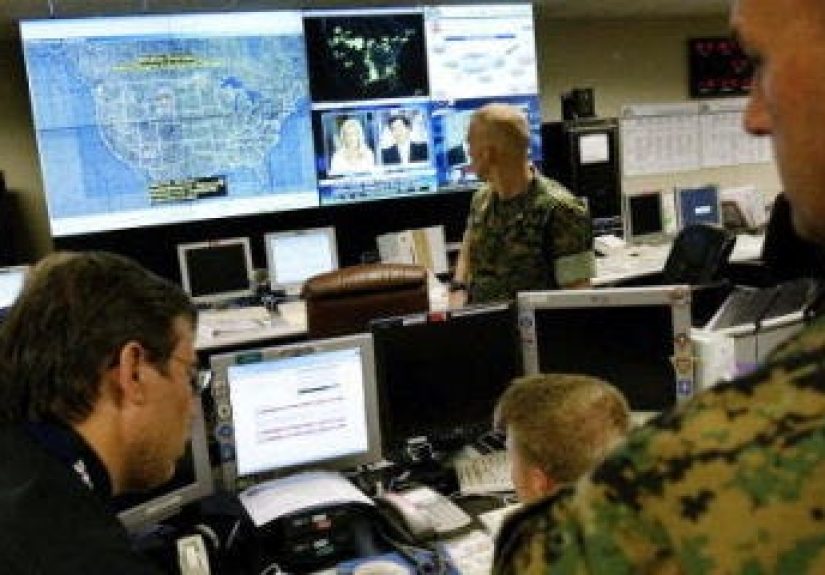
In a catastrophic incident, emergency operations centers (EOCs) would activate at local, state, and federal levels. These centers do not replace on-the-ground responders; they coordinate resources, logistics, intelligence updates, public messaging, and interagency support.
How the Federal Government Scales Up
FEMA’s role: coordinator, not magic wand
FEMA is often treated as the star of every disaster movie, but in real life FEMA is more of a national coordinator and support organizer than a solo rescue force. Under the National Response Framework (NRF), FEMA helps organize federal support across agencies and aligns response functions with what states and communities need.
In a doomsday-scale event, FEMA would likely help coordinate:
- Mass care and shelter support
- Search and rescue coordination
- Logistics and supply movement
- Temporary housing support
- Disaster survivor assistance operations
- Federal interagency coordination with states, tribes, and territories
If the incident is severe enough, the President may issue a major disaster or emergency declaration under federal authorities, which unlocks broader federal assistance and support mechanisms. That is a big turning point because it expands what the federal government can fund, coordinate, and deploy.
Continuity of government: keeping the state functional
In a true “doomsday” scenario, government response is not only about helping the public. It is also about making sure the government itself can keep functioning. That’s where continuity planning comes in.
Federal continuity plans are designed to preserve essential functionsthings like national security decision-making, communications, public warnings, financial operations, and key constitutional processes. In other words: the government has plans for how to keep governing even if offices, staff, or infrastructure are disrupted.
This does not mean “business as usual.” It means “essential mission first.” During a catastrophic emergency, agencies may shift to alternate facilities, remote operations, backup communications, and prioritized staffing so the most important functions stay online.
What Agencies Would Handle in a Doomsday-Scale Crisis
Public health and medical response (CDC, HHS/ASPR, FDA, and partners)
If the event involved widespread illness, contamination, or mass casualties, public health agencies would become central players. The CDC would support disease surveillance, health guidance, and risk communication. HHS and ASPR (Administration for Strategic Preparedness and Response) would help coordinate national health preparedness and medical countermeasure support, including access pathways tied to federal response systems.
The FDA’s emergency guidance also becomes highly relevant in disasters that disrupt food and water safety, refrigeration, supply chains, and contamination controls. In a long-duration event, “boring” public health advice (safe water, safe food, sanitation) becomes civilization-saving advice very quickly.
Critical infrastructure protection and restoration (CISA, DOE, utilities, private sector)
A genuine doomsday scenario is usually an infrastructure story: power, water, communications, transportation, fuel, and supply chains are what determine whether the crisis stays terrible or turns catastrophic. CISA’s critical infrastructure framework matters here because much of the infrastructure the public depends on is operated by a mix of public entities and private companies.
That means the federal response is not just “government sends trucks.” It is public-private coordination at scale. For energy disruptions, the Department of Energy (DOE), including CESER, works with FEMA, states, utilities, and industry partners to support restoration, identify unmet needs, and coordinate response efforts. In real events, this often includes pre-positioning personnel, coordination calls, and situation reporting before landfall or impact.
Weather, geologic, and hazard intelligence (NOAA, NWS, USGS)
The government’s response quality depends heavily on the quality of the information it has. Agencies like NOAA/NWS and USGS provide hazard monitoring, forecasting, and scientific updates that shape public decisions. Whether it’s severe weather, flooding, earthquake activity, or other hazards, responders use that information to prioritize evacuations, resource placement, and public messaging.
In short: scientists do not just make maps for TV. They help government decide where help goes first.
Radiological and nuclear preparedness (NRC, FEMA, CDC, state/local officials)
If “doomsday” involves a radiological or nuclear emergency, the response would become more specialized, but the public guidance still starts with familiar protective actions: get inside, stay inside, and stay tuned for official instructions. NRC oversight, FEMA coordination roles in preparedness exercises, CDC radiation guidance, and state/local emergency management plans all become part of the picture.
The public would likely receive instructions about sheltering, evacuation timing, contamination screening, decontamination, and where to get verified information. The message would be practical and step-basednot a graduate seminar in nuclear physics.
Defense support and security (DoD/USNORTHCOM, National Guard, law enforcement)
In especially large domestic emergencies, the Department of Defense may provide Defense Support of Civil Authorities (DSCA), typically in support of civilian-led response efforts. USNORTHCOM plays a key role in coordinating homeland defense missions and support to civil authorities when authorized.
This can include specialized capabilities such as logistics, transport, engineering support, medical support, or assistance in CBRN-related response scenarios. The important point is that military support in domestic emergencies is generally part of a coordinated system, not an improvised takeover.
What the Public Would Actually Experience
Expect phased guidance, not one perfect master plan
In a catastrophic crisis, people often expect the government to publish a complete roadmap in hour one. In reality, official guidance usually comes in phases:
- Immediate protective action: evacuate, shelter, avoid roads, conserve resources
- Stabilization guidance: where to get water, food, medical care, charging, shelter
- Recovery instructions: debris removal, claims, inspections, assistance programs
This phased approach can feel confusing, especially online, where everyone becomes an “expert” after watching one shaky livestream. But changing instructions are not always a sign of failure. Sometimes they mean officials have better data and are adjusting to reality.
Communications would be a battle inside the battle
In modern disasters, the government is not only fighting the hazardit is fighting misinformation, outdated screenshots, fake notices, AI-generated panic posts, and bad advice that spreads faster than actual emergency management updates. Expect official agencies to use multiple channels repeatedly: WEA, EAS, NOAA radio, press briefings, websites, and verified social accounts.
The most useful skill for the public in a doomsday-scale situation may be boring but powerful: checking trusted sources before acting.
Where the System Is Strongand Where It Gets Stressed
Strengths of the U.S. approach
- All-hazards framework: The system is designed to adapt across many disaster types.
- Layered response: Local, state, tribal, territorial, and federal roles can scale.
- Established alerting systems: IPAWS/WEA/EAS/NOAA create multiple warning pathways.
- Public-private coordination: Essential for restoring power, communications, and supply chains.
- Continuity planning: Helps protect essential government functions under extreme stress.
Stress points in a true “doomsday” event
- Simultaneous failures: If power, communications, fuel, and transport fail together, everything slows down.
- Scale: National or multi-region crises can strain staff, equipment, and supply inventories.
- Public trust: Conflicting messages or rumors can reduce compliance with life-saving guidance.
- Equity and access: Vulnerable populations may face higher barriers to alerts, transport, and care.
- Long-duration recovery: Restoring services is hard; rebuilding communities is harder.
That last point matters most. “Doomsday” response is not only about surviving impact day. It is about managing the weeks and months after, when fatigue, shortages, mental health strain, and economic damage start showing up in force.
How the U.S. Government Would Really Deal With Doomsday
So, how would the U.S. government deal with doomsday? Not with one bunker speech and a dramatic countdown clock. It would use a networked response: alert the public, activate incident command, preserve continuity, surge federal support, coordinate with states and the private sector, protect public health, restore infrastructure, and communicate constantly while conditions change.
Would it be flawless? No. No country has a flawless response to catastrophe, and anyone promising a perfectly smooth “doomsday plan” is probably also selling apocalypse vitamins. But the U.S. does have a real framework, real agencies, real warning systems, and real operational doctrine designed for extreme events.
The practical takeaway for readers is simple: if you want to understand how government manages disaster, think less “secret master plan” and more “layered coordination system under pressure.” That may sound less cinematicbut it is much closer to reality, and reality is what saves lives.
Experience Section: What a Doomsday-Scale Government Response Might Feel Like on the Ground (Illustrative Scenario, ~)
Picture a normal weekday evening that suddenly stops being normal. Your phone vibrates with a Wireless Emergency Alert. The message is short, blunt, and not interested in your feelings: Shelter indoors immediately. Avoid travel. Monitor official alerts. A minute later, local TV programming is interrupted. Radio stations repeat the same instruction. Social media is already melting down.
The first thing you notice is not the government. It is your neighborhood. Doors close. People start texting family. Someone drags patio furniture inside like the apocalypse can be blocked by lawn decor. But within 20 minutes, the government response starts to become visible in practical ways. School districts push notices. Transit agencies suspend service. City emergency management posts a map. The governor’s office announces an emergency declaration. Local officials hold a press briefing, even if all they can honestly say is, “Here’s what we know, here’s what we don’t know, and here’s what you should do right now.”
Overnight, the crisis gets bigger. Power is out in parts of the region. Cell service is spotty because everybody is trying to call everyone at once. The advice to use text messages suddenly makes sense. Official guidance starts coming in layers: conserve battery, boil water if instructed, avoid driving, check on neighbors if safe, and stay tuned for shelter locations and medical support points.
By morning, you can feel the system scaling up. Local responders are still the face of the response, but the language changes. Officials mention state emergency operations. They mention FEMA coordination. They mention utility restoration crews from other states. A hospital announces modified operations but remains open. A county updates school closures and opens a community center for cooling, charging, and basic supplies. None of it feels glamorous. All of it feels essential.
In the next 24 to 48 hours, the experience becomes a strange mix of uncertainty and structure. You still do not know when life returns to normal, but the response starts to create a rhythm: morning briefing, afternoon update, evening safety message. Rumors race around online (“they’re shutting down the whole state!”), and then official channels knock them down one by one. You learn quickly that the most valuable thing in a crisis is not hot takesit is accurate timing and clear instructions.
If the emergency involves contamination or a public health risk, the experience becomes even more procedural. You might be told where to go for screening, where not to go, how to handle food and water, and when to shelter versus evacuate. It feels repetitive, but repetition is the point. In a high-stress emergency, people need the same clear instructions multiple times in multiple places.
The biggest emotional shift comes later. The first day is adrenaline. The third day is logistics. That is when “government response” stops meaning sirens and starts meaning water deliveries, fuel priorities, debris removal, inspections, temporary housing, public health clinics, and forms you did not want to fill out in a crisis. It is not dramatic. It is how recovery begins.
In other words, a real doomsday-scale government response would probably feel less like a movie ending and more like a long, difficult collaboration between institutions, responders, utilities, hospitals, and ordinary people trying to keep each other functional. That may not be cinematicbut it is exactly how communities get through the worst days.
Conclusion
The U.S. government would deal with doomsday by relying on a layered, all-hazards emergency management systemnot a single silver-bullet plan. FEMA, CISA, CDC, DOE, HHS, NOAA, NRC, USNORTHCOM, and state and local partners each handle different parts of the problem, from alerts and health guidance to power restoration and continuity of government. The system is strongest when the public gets clear warnings, follows practical guidance, and uses trusted sources. In a catastrophic event, coordinationnot perfectionis the real superpower.