Table of Contents >> Show >> Hide
- What Is Body Mass Index?
- BMI Formulas at a Glance
- How to Calculate BMI Using Metric Units
- How to Calculate BMI Using U.S. Units
- Adult BMI Categories
- How to Measure Height and Weight More Accurately
- Common BMI Calculation Mistakes
- What BMI Can and Cannot Tell You
- BMI for Children and Teenagers
- What Should You Consider Alongside BMI?
- How to Estimate a Weight Range From BMI
- When to Discuss Your BMI With a Healthcare Professional
- Real-World Experiences and Lessons From Calculating BMI
- The First Calculation Often Reveals a Unit Problem
- Accurate Height Matters More Than Expected
- Daily Weight Changes Can Create Unnecessary Alarm
- A Muscular Person May Receive a Surprising Result
- A “Healthy” BMI Does Not Guarantee Perfect Health
- The Most Helpful Experience Is Viewing BMI Without Shame
- Trends Usually Matter More Than One Decimal
- Conclusion
Body mass index, better known as BMI, is one of those health numbers that looks more complicated than it really is. It requires only your height, your weight, and enough arithmetic to make you briefly wonder why you did not pay closer attention in middle-school math.
BMI compares your weight with your height and places the result into a general adult weight category. Healthcare professionals commonly use it as a quick screening tool, but it is not a medical diagnosis, a body-fat scan, or a final judgment about your health. Think of BMI as a dashboard warning light: useful enough to check, but not capable of explaining the entire engine.
This guide explains how to calculate BMI using metric units and U.S. customary units, how to interpret the result, which mistakes to avoid, and why the number should always be viewed in context.
What Is Body Mass Index?
Body mass index is a calculation based on height and weight. For adults, the result is typically classified as underweight, healthy weight, overweight, or obesity. The obesity category is further divided into three classes.
The same standard adult BMI ranges generally apply to men and women age 20 and older. Children and teenagers require a different interpretation because their results must be compared with age- and sex-specific growth charts.
Major U.S. health organizations describe BMI as a screening measure rather than a complete assessment of individual health. It may help identify people who could benefit from further evaluation, but it does not directly measure body fat, muscle, bone density, blood pressure, blood glucose, fitness, or fat distribution.
BMI Formulas at a Glance
Metric BMI Formula
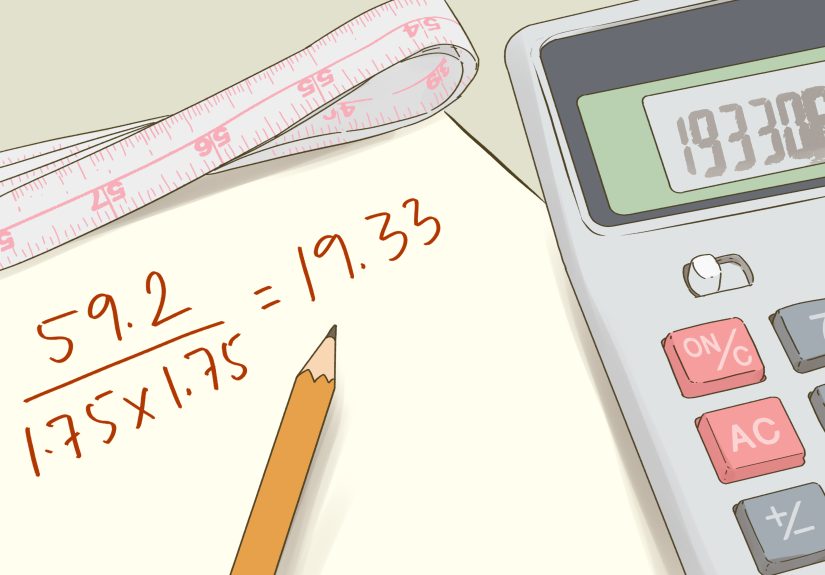
BMI = weight in kilograms ÷ height in meters squared
Written mathematically:
BMI = kg ÷ m²
U.S. BMI Formula
BMI = weight in pounds × 703 ÷ height in inches squared
Written mathematically:
BMI = (lb × 703) ÷ in²
The number 703 is a conversion factor. It adjusts pounds and inches so the answer matches the metric BMI scale. It is not a calorie target, an area code, or a secret password used by gym instructors.
How to Calculate BMI Using Metric Units
The metric calculation is the simpler of the two formulas because it does not require a conversion factor.
Step 1: Record Your Weight in Kilograms
Use your current weight in kilograms. For the most consistent reading, weigh yourself on a level surface with a reliable scale, wearing light clothing and no shoes.
Step 2: Convert Your Height to Meters
If your height is listed in centimeters, divide it by 100.
For example:
175 cm ÷ 100 = 1.75 m
Step 3: Square Your Height
Multiply your height in meters by itself.
1.75 × 1.75 = 3.0625
Step 4: Divide Your Weight by the Squared Height
Suppose a person weighs 70 kilograms and is 1.75 meters tall:
70 ÷ 3.0625 = 22.86
Rounded to one decimal place, the BMI is 22.9. Under the standard adult categories, that result falls within the healthy-weight range.
A Shortcut When Height Is in Centimeters
You can also calculate BMI without first writing the height in meters:
BMI = weight in kg ÷ height in cm² × 10,000
Using the same example:
70 ÷ 175² × 10,000 = 22.86
Both methods produce the same answer. The first.86
Both methods produce the same answer. The first formula is often easier to remember, while the centimeter version is handy when your measuring tape refuses to speak meters.
How to Calculate BMI Using U.S. Units
The U.S. formula uses pounds and inches. The most common mistake is entering feet directly into the equation, so convert your entire height to inches before doing anything else.
Step 1: Record Your Weight in Pounds
Use your current weight in pounds.
Step 2: Convert Height to Total Inches
Multiply the number of feet by 12, then add the remaining inches.
For someone who is 5 feet 10 inches tall:
(5 × 12) + 10 = 70 inches
Step 3: Square the Height in Inches
70 × 70 = 4,900
Step 4: Multiply Weight by 703
If the person weighs 180 pounds:
180 × 703 = 126,540
Step 5: Divide by the Squared Height
126,540 ÷ 4,900 = 25.82
Rounded to one decimal place, the BMI is 25.8. That falls within the standard adult overweight category.
The calculation does not mean that the person is automatically unhealthy or has a specific amount of excess body fat. It means the result may be worth interpreting alongside other health information.
Adult BMI Categories
The following categories are used for most adults age 20 and older:
| BMI | Adult Weight Category |
|---|---|
| Below 18.5 | Underweight |
| 18.5–24.9 | Healthy weight |
| 25.0–29.9 | Overweight |
| 30.0–34.9 | Obesity, class 1 |
| 35.0–39.9 | Obesity, class 2 |
| 40.0 or higher | Obesity, class 3, also called severe obesity |
These cutoffs are screening categories, not pass-or-fail grades. A BMI of 24.9 and a BMI of 25.0 are nearly identical measurements, even though they appear on opposite sides of a category line. Human health does not suddenly change at the decimal point.
Higher BMI values, especially when accompanied by abdominal fat or other risk factors, are associated with increased risks of conditions such as type 2 diabetes, high blood pressure, heart disease, stroke, sleep apnea, joint problems, fatty liver disease, and certain cancers. A low BMI may also require attention, particularly when it is related to unplmuscle. citeturn989059search2turn989059search8turn826580search11
How to Measure Height and Weight More Accurately
A BMI formula is only as accurate as the measurements placed into it. Small errors can noticeably change the result, especially for shorter individuals or people near a category boundary.
Tips for Measuring Weight
- Place the scale on a hard, level floor rather than carpet.
- Weigh yourself at a similar time of day when comparing results.
- Remove shoes, heavy clothing, keys, phones, and anything else that has quietly joined the weigh-in.
- Stand still with your weight distributed evenly.
- Use the same scale when tracking changes over time.
Tips for Measuring Height
- Remove shoes and bulky hair accessories.
- Stand with your back against a flat wall.
- Keep your feet flat and your legs straight.
- Look forward with your head level rather than tilted upward or downward.
- Use a flat object, such as a book, to mark the top of the head.
- Measure from the floor to the mark.
Do not rely entirely on the height printed on an old driver’s license. Many people round up, and adults can gradually lose height with age.
Common BMI Calculation Mistakes
1. Mixing Metric and U.S. Units
Do not use kilograms with inches or pounds with meters. Choose one system and use it throughout the calculation.
2. Forgetting to Square Height
BMI divides weight by height squared, not simply by height. Missing the square produces a number that belongs in a different mathematical universe.
3. Entering Feet Instead of Inches
In the U.S. formula, 5 feet 8 inches must be entered as 68 inches, not 5.8 feet and definitely not 58 inches.
4. Applying 703 to the Metric Formula
The conversion factor is used only with pounds and inches. Metric units do not need it.
5. Rounding Too Early
Keep several decimal places during the calculation and round only the final answer. Early rounding can move a borderline result slightly upward or downward.
6. Using Adult Categories for a Child
Adult BMI cutoffs are not appropriate for people ages 2 through 19. Pediatric BMI must be interpreted as a BMI-for-age percentile.
7. Treating One Reading as a Diagnosis
BMI is an initial screening number. It cannot diagnose obesity-related disease, malnutrition, an eating disorder, or overall fitness by itself.
What BMI Can and Cannot Tell You
BMI is popular because it is quick, inexpensive, standardized, and reasonably useful when studying large populations. For an individual, however, it has important limitations.
BMI Does Not Separate Fat From Muscle
Two people with the same height and weight will have the same BMI even if one has considerably more muscle and the other has more body fat. Athletes, bodybuilders, and people with muscular builds may therefore receive a high BMI result without having an unhealthy amount of fat.
BMI Does Not Show Where Fat Is Stored
Abdominal or visceral fat is more strongly associated with certain metabolic and cardiovascular risks than fat stored in some other areas. BMI cannot distinguish between them.
BMI May Miss Muscle Loss
An older adult can lose muscle and gain fat while remaining at almost the same weight. The BMI may appear unchanged even though body composition and physical function have shifted. Johns Hopkins Medicine notes that age-related muscle loss mal BMI less informative for adults over 65. citeturn544222search0
BMI Does Not Capture Demographic Differences Perfectly
The relationship among BMI, body-fat percentage, and health risk can vary with age, sex, ancestry, ethnicity, and other individual characteristics. The American Medical Association advises against relying on BMI alone and recommends considering otistory. citeturn826580search0turn826580search4turn989059search27
BMI Is Not Designed for Pregnancy
Standard BMI calculations do not account for the expected changes in body weight and composition during pregnancy. Clinicians may use prepregnancy BMI when discussing recommended pregnancy weight gain, but calculating an ordinary adult BMI during pregnancy will not provide a meaningful classification.
BMI for Children and Teenagers
For children and teens ages 2 through 19, the mathematical BMI formula is the same, but the result is interpreted differently. A child’s BMI is compared with children of the same age and sex and expressed as a percentile.
According to the CDC, pediatric categories generally include:
- Underweight: below the 5th percentile
- Healthy weight: 5th percentile to below the 85th percentile
- Overweight: 85th percentile to below the 95th percentile
- Obesity: at or above the 95th percentile
Because children develop at different rates, their results should be interpreted by a pediachart. citeturn989059search18turn989059search32turn535246search5
What Should You Consider Alongside BMI?
A more complete health assessment may include several pieces of information:
- Waist circumference or waist-to-height ratio
- Blood pressure
- Blood glucose or A1C
- Cholesterol and triglyceride levels
- Medical and family history
- Current medications
- Physical activity and cardiovascular fitness
- Strength, mobility, and muscle mass
- Sleep quality
- Eating patterns and nutritional status
- Recent or unexplained weight changes
Waist circumference can provide additional information because it offers a rough indication of abdominal fat. Common U.S. screening thresholds identify increased risk at waist measurements greater than 35 inches for women and greater than 40 inches for men, although these broad cutoffs do not fit every person or population equally well.
Research and clinical guidance increasingly emphasize combining BMI with waist measurements and metabolic ri059search20turn989059search46turn535246search14turn826580search17
How to Estimate a Weight Range From BMI
You can reverse the formula to estimate the weights that correspond to a particular BMI range. This does not create a personal “ideal weight,” but it can show how the standard categories relate to your height.
Metric Reverse Formula
Weight in kg = BMI × height in meters²
For a person who is 1.75 meters tall:
- Lower end of the healthy-weight category:
18.5 × 1.75² = 56.7 kg - Upper end of the healthy-weight category:
24.9 × 1.75² = 76.3 kg
The standard healthy-weight BMI range for that height corresponds to approximately 56.7 to 76.3 kilograms.
U.S. Reverse Formula
Weight in lb = BMI × height in inches² ÷ 703
For a person who is 70 inches tall:
- Lower end:
18.5 × 70² ÷ 703 = 128.9 lb - Upper end:
24.9 × 70² ÷ 703 = 173.6 lb
This is a wide range because healthy bodies come in different builds and body compositions. The calculation should not be used to select an aggressive weight-loss target without considering medical history, muscle mass, nutritional needs, and professional guidance.
When to Discuss Your BMI With a Healthcare Professional
Consider discussing your weight, BMI, or body composition with a qualified healthcare professional when:
- Your BMI is below 18.5 or at least 30.
- Your weight changes significantly without an obvious reason.
- You have high blood pressure, abnormal blood sugar, sleep apnea, joint pain, or other possible weight-related concerns.
- You are pregnant, planning a pregnancy, or recently gave birth.
- You are calculating BMI for a child or teenager.
- You are an athlete or have an unusually muscular build.
- You are an older adult concerned about muscle loss or frailty.
- Weight-focused discussions cause distress or may affect an eating disorder.
A clinician may decide that your BMI is useful, only mildly informative, or largely misleading. The correct interpretation depends on the person attached to the number.
Real-World Experiences and Lessons From Calculating BMI
The First Calculation Often Reveals a Unit Problem
One of the most common real-world experiences is calculating a spectacularly strange number on the first attempt. A person may divide pounds by meters squared, enter 5.9 as a height of 5 feet 9 inches, or forget the conversion factor in the U.S. formula. The result may suggest that the person has the proportions of either a paperclip or a small refrigerator.
The practical lesson is to write down every unit before calculating. Label the weight as kilograms or pounds and the height as meters or inches. When the units are consistent, the math becomes much less dramatic.
Accurate Height Matters More Than Expected
Many adults know their approximate height but have not measured it in years. Someone who believes they are 5 feet 8 inches may actually be 5 feet 7 inches. That one-inch difference changes the squared-height portion of the formula and may noticeably alter the final BMI.
Older adults may also discover that their current height differs from the number recorded decades ago. Measuring height instead of guessing produces a more dependable result and may reveal changes worth discussing with a clinician.
Daily Weight Changes Can Create Unnecessary Alarm
Another familiar experience is checking BMI after every small movement on the scale. Body weight naturally fluctuates because of hydration, sodium intake, meals, bowel contents, menstrual-cycle changes, and the time of day. A two-pound overnight change is usually not a two-pound change in body fat.
For tracking purposes, consistency is more useful than constant checking. Measuring under similar conditions and looking at trends over several weeks provides more meaningful information than reacting to a single salty-dinner plot twist.
A Muscular Person May Receive a Surprising Result
Strength-trained individuals sometimes calculate a BMI in the overweight category even when they have a relatively low body-fat percentage. The calculation is mathematically correct; the interpretation is simply incomplete. BMI sees total mass but cannot determine whether that mass comes primarily from fat, muscle, bone, or a combination.
In that situation, waist circumference, performance, blood pressure, laboratory results, and a professional body-composition assessment may be more informative. The experience demonstrates why BMI should open a health conversation rather than end one.
A “Healthy” BMI Does Not Guarantee Perfect Health
People are sometimes reassured by a BMI in the healthy-weight range and assume no other health screening is necessary. However, someone can have a BMI between 18.5 and 24.9 while also having high blood pressure, elevated blood glucose, low muscle mass, poor cardiovascular fitness, or excess abdominal fat.
The opposite situation also occurs: a person with a BMI above the healthy-weight category may have favorable metabolic measurements and strong fitness. Neither example makes BMI useless. They show that BMI is one clue among many.
The Most Helpful Experience Is Viewing BMI Without Shame
A BMI calculation can produce anxiety because weight categories often carry social judgment. That is not the purpose of the formula. BMI does not measure discipline, attractiveness, intelligence, effort, or personal value. It is a neutral calculation created from two measurements.
The healthiest approach is curiosity: Is the number changing? Does it match other health indicators? Is there unexplained weight loss or gain? Would additional screening help? Used this way, BMI becomes a practical question rather than a label.
Trends Usually Matter More Than One Decimal
A BMI of 24.9 is not meaningfully different from 25.0, and a BMI of 29.9 does not transform at midnight into a completely different health condition when it reaches 30.0. Category boundaries help researchers and clinicians organize information, but individual risk exists along a continuum.
Watching the direction and speed of change is often more informative. A stable BMI combined with good strength, balanced nutrition, normal laboratory results, and regular activity may tell a different story from a rapidly changing BMI accompanied by fatigue, shortness of breath, or metabolic abnormalities.
Conclusion
Calculating BMI is straightforward once the units are organized. In the metric system, divide weight in kilograms by height in meters squared. In the U.S. system, multiply weight in pounds by 703 and divide by height in inches squared.
The answer places most adults into a general weight category, but it does not provide a complete health report. BMI cannot distinguish muscle from fat, show where fat is stored, account for pregnancy, or fully reflect differences associated with age and body composition. Children and teens also require BMI-for-age percentiles rather than adult cutoffs.
Use BMI as a starting point. Combine it with waist measurements, physical fitness, blood pressure, laboratory results, medical history, nutrition, and professional advice. A calculator can produce the number; understanding what it means requires the bigger picture.