Table of Contents >> Show >> Hide
- Table of Contents
- 1) Decide what “prototype” means (for you)
- 2) Write a prototype brief (aka “requirements, but human”)
- 3) Protect your idea (without becoming a paranoid raccoon)
- 4) Choose your build path: DIY, freelancers, shops, or platforms
- 5) Turn your sketch into CAD + drawings
- 6) Pick the right prototype manufacturing process
- 7) Budget + timeline: what affects prototype cost
- 8) Test like you mean it (then iterate)
- 9) Add DFM early so production doesn’t punch you later
- 10) Common prototype mistakes (and how to dodge them)
- FAQ
- Wrap-up: From idea to prototype, without losing your mind
- Extra : Real-world experiences getting prototypes made
You’ve got an idea. It’s brilliant. It’s world-changing. It’s… currently living as a chaotic doodle on a napkin that smells faintly like tacos.
Good news: getting a prototype made is less “mystical invention wizardry” and more “a series of practical steps, plus a little humility.”
This guide walks you from concept to prototypewhether you’re building a physical product, an electronic gadget, or a “please don’t make me learn injection molding”
sort of contraption. We’ll cover the decisions, the tradeoffs, the costs (without giving you a heart attack), and the fastest ways to learn what actually works.
1) Decide what “prototype” means (for you)
The fastest way to waste money is to build the wrong kind of prototype. Before you price anything out, get brutally honest about what you’re trying to learn.
Prototypes exist to answer questions earlycheaply, quickly, and with minimal emotional attachment (yes, even if you named it “Proto McPrototyperson”).
Pick your prototype “job title”
- Proof-of-concept: “Can this even work?” Often ugly. Often glorious.
- Looks-like model: For shape, size, ergonomics, and marketing photos (your product’s “headshot”).
- Works-like model: For functional testing, durability, heat, stress, and real-world abuse.
- Engineering prototype: For fit, tolerances, assembly, and “why won’t these parts mate?” moments.
- Pilot / pre-production unit: A dress rehearsal for manufacturingmaterials, processes, and assembly methods get serious.
A practical mindset helps: prototypes are typically faster and easier to change than finished implementations, so you can evaluate earlier and iterate sooner.
That’s the pointlearning before you commit. (Your future self will send you a thank-you note.)
2) Write a prototype brief (aka “requirements, but human”)
You don’t need a 47-page spec document with seven appendices and a glossary of sadness. You do need a one-to-three page prototype brief that makes
decisions easier and quotes more accurate.
What to include in your brief
- The user + scenario: Who uses it, where, and how. (Kitchen? Construction site? Mars rover?)
- Success criteria: What must be true for this prototype to “win.” Example: “Must survive a 3-foot drop” or “Must open with one hand.”
- Key dimensions: What cannot change (envelope size, mounting holes, interface points).
- Constraints: Budget, timeline, weight targets, safety considerations, materials preferences.
- Risks to test: The top 3 unknowns you’re trying to de-risk (strength, user comfort, manufacturability, etc.).
- Reference inspiration: Photos of similar products, components you want to reuse, and any “please avoid this” examples.
Pro tip: if your prototype is part of a larger assembly, include mating parts (or at least accurate measurements). Fit failures are how prototypes teach humility.
3) Protect your idea (without becoming a paranoid raccoon)
You want to share enough to get helpwithout accidentally giving away the secret sauce. The right level of protection depends on your product, your market,
and how soon you plan to launch. Also: this section is practical info, not legal advice.
Common ways people protect early-stage inventions
- Keep it confidential: Share details only with people who need them, and use secure file sharing.
- NDA (non-disclosure agreement): Helpful with contractors and vendors, though not every manufacturer will sign one.
- Provisional patent application: In the U.S., a provisional application can be a lower-cost first filing that establishes an early filing date and lets you use “Patent Pending.” It’s not examined and generally lasts 12 months, during which you can file a nonprovisional application to claim that earlier date.
One important detail people miss
Provisional applications can apply to utility and plant inventions, but not design patents. So if your innovation is purely ornamental (the “look” of the product),
don’t assume a provisional filing covers that category.
The simplest strategy: document your invention well (drawings, descriptions, variations), decide your comfort level with sharing, and don’t post the full blueprint
on social media while asking strangers, “What do you think?” (Unless your strategy is “chaos marketing,” in which case… carry on.)
4) Choose your build path: DIY, freelancers, shops, or platforms
There are multiple valid ways to get a prototype made. Your best path depends on complexity, budget, timeline, and whether your product includes tricky stuff
like electronics, moving mechanisms, watertight seals, or “must survive toddlers.”
Option A: DIY prototype (fast, cheap, surprisingly effective)
For early learning, build something ugly on purpose. Cardboard, foam, tape, clay, off-the-shelf hardware, and a ruler can unlock design insights faster than
a fancy render ever will. The goal is to learn what you didn’t know you didn’t know.
Option B: Hire a freelancer (CAD, engineering, industrial design)
If your sketch needs to become manufacturing-ready CAD, a freelancer can bridge the gap. Look for someone with experience in your product category
(consumer goods, medical devices, robotics, etc.) and ask for examples that include prototypes, not just pretty renders.
Option C: Local machine shops / makerspaces
Great for hands-on collaboration. You can iterate quickly if you’re nearby and can bring parts back for adjustments. Bonus: you’ll learn a lot by watching
how something is actually made.
Option D: On-demand manufacturing platforms
Digital manufacturing services can produce prototypes in processes like 3D printing, CNC machining, sheet metal, and injection molding, often with quick quotes
and manufacturability feedback. Some providers even advertise extremely fast turnaround for prototype partsuseful when you’re iterating quickly.
5) Turn your sketch into CAD + drawings
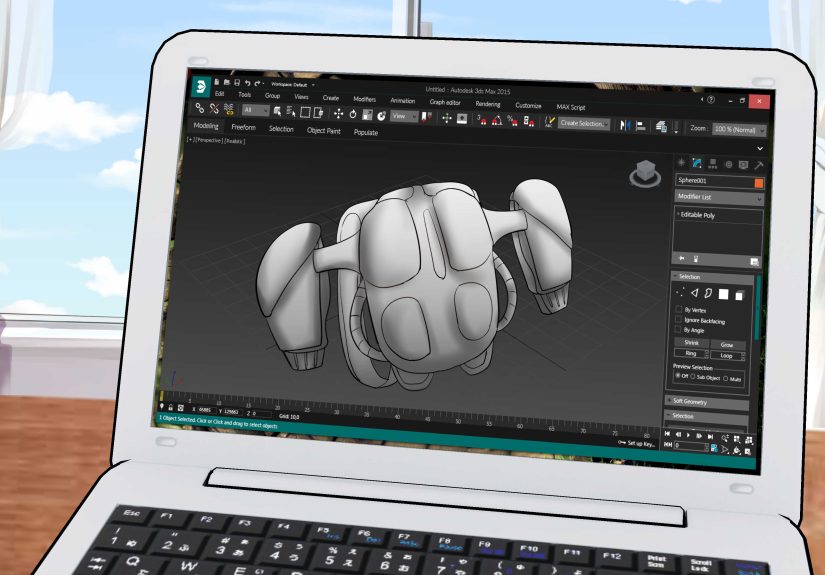
At some point, the napkin sketch must evolve into something that manufacturers can interpret consistently. That usually means a 3D CAD model and (often)
2D drawings that define critical dimensions, tolerances, and finishes.
CAD file formats that keep vendors happy
In general, solid model formats (like STEP) are widely usable across manufacturing methods, while mesh formats (like STL)
are typically limited to 3D printing workflows. If you’re requesting quotes across multiple processes, provide a solid model when possible.
What drawings should communicate
- Material: Example: aluminum, stainless steel, ABS-like resin, nylon, etc.
- Tolerances: Specify tight tolerances only where needed (tight = expensive).
- Surface finish: Cosmetic requirements, functional finishes, coating/anodizing notes.
- Threads + holes: Clear callouts for tapped holes, countersinks, inserts.
- Assembly notes: If parts need press fits, adhesives, or fasteners, say so.
If you’re working with a freelancer or engineer, share your prototype brief and tell them your intended manufacturing process. Designing with the end process in mind
reduces painful redesign later.
6) Pick the right prototype manufacturing process
Different prototype methods are good at different things. The best process depends on what you’re testing: fit, strength, surface finish, appearance, or production realism.
Rapid prototyping often favors quick-turn methods like 3D printing or CNC machining so you can iterate fast.
Quick comparison of popular prototype methods
| Method | Best For | Watch Outs |
|---|---|---|
| 3D printing (FDM/SLA/SLS) | Fast iteration, complex geometry, early form/fit, many functional tests | Material properties may differ from production plastics; surface finish varies by process |
| CNC machining | Strong functional parts, tight tolerances, realistic metals/plastics | Complex geometry and tight tolerances can raise cost; internal corners need fillets |
| Sheet metal fabrication | Enclosures, brackets, frames, quick functional hardware prototypes | Bend radii and hole placement near bends matter (DFM rules apply) |
| Urethane casting (soft tooling) | Small batches that mimic injection-molded plastics, good for early market tests | Tooling still required; lead times vary; not ideal for high heat loads |
| Prototype injection molding (often aluminum tooling) | Most production-realistic plastic parts for volume-like testing | Tooling cost is real; design must follow molding rules (draft, wall thickness) |
| Electronics prototyping (breadboard → PCB) | Validating circuits, sensors, power, and early integration | Breadboards are great early, but layout + manufacturability matter later |
A practical “fidelity ladder” that saves money
Start with low-fidelity models for learning, then climb toward higher fidelity only when you’ve answered the big questions. This keeps you from buying
“beautiful mistakes” in expensive materials.
Material realism matters (sometimes)
If you’re testing how something flexes, seals, or survives real abuse, you’ll need prototypes with material properties close to the intended production material.
Many teams use functional 3D printing and small-batch methods to validate designs before investing in expensive production tooling.
7) Budget + timeline: what affects prototype cost
Prototype cost ranges wildlyfrom “I built it with $18 of foam and pure determination” to “we machined it out of titanium because we hate money.”
The key is understanding what drives quotes, so you can control them.
The biggest cost drivers
- Complexity: More features, undercuts, and tight internal corners = more time and tooling.
- Material: Exotic materials cost more and may have longer lead times.
- Tolerances: Tight tolerances can require slower machining, inspection, and sometimes different processes.
- Finish: Cosmetics (polish, texture, coatings) often add steps.
- Quantity: One-off prototypes are different from small-batch runs; some processes shine at low volume, others at scale.
How to cut cost without cutting learning
- Prototype only the risky features first (a “test coupon” or partial build).
- Relax tolerances where they don’t matter (your wallet will applaud).
- Use standard hardware and off-the-shelf parts when possible.
- Tell vendors what you’re testing so they can recommend a cheaper method that still answers your question.
Also: plan for multiple iterations. Prototyping is not a one-and-done eventit’s a loop. If your budget assumes “one perfect prototype,” it’s basically a fairy tale,
and not the charming kind.
8) Test like you mean it (then iterate)
A prototype that isn’t tested is just an expensive desk ornament. Testing is where prototypes earn their keepby revealing what users do, not what you hope they’ll do.
Human-centered processes emphasize building and testing so you can learn and improve through iteration.
What to test (beyond “does it exist?”)
- Fit + assembly: Does it align with mating parts? Can it be assembled without a PhD in patience?
- Function: Does it do the thing, repeatedly, without drama?
- Usability: Can real humans use it without instructions written in ancient runes?
- Durability: Drop tests, heat tests, stress testswhatever is realistic for your product.
Test earlyeven with low-fidelity prototypes
If you’re prototyping a digital experience (or even a physical product with a user flow), low-cost prototypes can uncover major usability issues early.
Paper prototyping, for example, is a fast and inexpensive way to user test ideas before you invest in building the full thing.
Make iteration painless
- Track versions (V1, V2, V3… not “FINAL_final_reallyFINAL.stp”).
- Write down test results and decisions.
- Change one variable at a time when possible (so you know what actually helped).
9) Add DFM early so production doesn’t punch you later
DFM (Design for Manufacturability) is how you avoid the classic tragedy: “It works in CAD” followed by “Why does it cost THAT MUCH?”
DFM is about designing with real manufacturing constraints in mindreducing errors, reducing cost, and making production feasible.
DFM habits that pay off fast
- Use clear 2D drawings: Call out material, tolerance range, surface finish, and hole/thread details.
- Specify tolerances surgically: Tight tolerances only where function demands them.
- Design for your chosen process: CNC rules differ from injection molding rules, which differ from 3D printing rules.
- Simplify geometry: Fewer unique features often means faster, cheaper manufacturing.
- Think assembly: Parts that are easy to assemble reduce labor and defect risk.
Manufacturing-minded design choices early can eliminate headaches laterlike expensive redesigns, long cycle times, and “surprise” lead times when parts are overly complex.
In other words: DFM is boring in the same way flossing is boring. And it’s just as effective at preventing pain.
10) Common prototype mistakes (and how to dodge them)
Mistake: Building too fancy too soon
If your first prototype looks like a retail product, you’ve probably skipped the cheap learning stages. Start rough, learn fast, and “earn” the high-fidelity build.
Mistake: Not defining what you’re testing
If you don’t know what question the prototype answers, you won’t know if it succeeded. Write down the top 3 risks you’re testingthen build for those.
Mistake: Over-tolerancing everything
Tolerances are a power tool. Use them carefully. Tight tolerances can be essential in a few places and wildly expensive everywhere else.
Mistake: Ignoring supply chain and standard parts
If your prototype relies on custom everything, scaling will hurt. Use standard screws, bearings, motors, and connectors where possiblefuture manufacturing will be easier.
Mistake: Skipping documentation
Document versions, test results, and decisions. Otherwise, you’ll repeat work, forget why you changed something, and eventually start arguing with your past self.
(And past you is stubborn.)
FAQ
How long does it take to get a prototype made?
It depends on the method. A DIY mockup can happen today. 3D printing and quick-turn machining can take days. Tooling-based methods (like molding) can take longer.
The smartest approach is to prototype in stages so you’re not waiting weeks to learn something you could learn in an afternoon.
Do I need CAD to make a prototype?
Not always. For early proof-of-concept and ergonomic models, physical mockups can be enough. But for most manufacturing quotes (CNC, molding, production-like parts),
CAD becomes essential.
What if my product includes electronics?
Prototype electronics in layers: validate circuits quickly (often on a breadboard), then move to custom PCBs as the design stabilizes.
Early-stage electronics prototyping is about proving the core function before you optimize size and layout.
Should I use “prototype injection molding” right away?
Usually not as a first step. It’s best when your geometry is stable and you need production-realistic plastic parts.
Before that, 3D printing, machining, and soft tooling can teach you a lot for less commitment.
Extra : Real-world experiences getting prototypes made
Here’s what the “how to get a prototype made” journey feels like in real lifewhere the laws of physics are undefeated and your prototype has opinions.
Experience #1: the Foam-Core Hero Phase. You build a mockup with cardboard, tape, and enough optimism to power a small city. It looks like a middle-school art project,
but the moment you hold it, you realize the handle is in the wrong place and the “simple latch” requires three hands and a minor blessing from the universe.
That is a win. You just saved yourself from paying for a beautifully machined version of a bad idea.
Experience #2: the Tolerance Tax. The first time you send a CAD model out for CNC machining, you’re tempted to specify tight tolerances everywhere because it feels
“professional.” Then the quote arrives and you briefly consider selling a kidney. The lesson is simple: tolerances are not a vibe; they’re a requirement.
If two parts don’t interact, they probably don’t need aerospace-level precision. Put tight tolerances only where function demands it (like bearings, seals, or mating
surfaces), and let the rest breathe.
Experience #3: the Material Reality Check. A 3D printed part can look perfect and still behave differently than a production plastic.
Maybe it’s stiffer than expected. Maybe it warps. Maybe the surface finish makes sliding parts feel like sandpaper. You learn to separate “geometry testing” from
“material testing.” Early iterations can validate shape, fit, and user interaction. Later, you deliberately move to prototypes that mimic production materialsbecause
the only thing worse than a broken prototype is a broken product in a customer’s hands.
Experience #4: electronics are their own personality. Breadboards are fantastic for proving a circuit quicklyespecially when you’re still swapping sensors, testing power draw,
or changing components. But eventually, you’ll hit the moment where the breadboard becomes a spaghetti monument and intermittent connections start haunting your dreams.
That’s your cue to move to a PCB (even a simple one) so you can test stability, noise, and real-world integration. In electronics, “it worked once” is not a success metric.
Experience #5: your prototype is also a communication tool. When you hand a real object to a teammate, a manufacturer, or a potential customer, the conversation changes.
People stop debating hypotheticals and start giving useful feedback: “This edge digs into my hand,” “This button is hard to reach,” “This won’t fit the mounting bracket.”
Prototypes align teams because they turn opinions into observations. The most productive prototype meetings aren’t the ones where everyone agreesthey’re the ones where the
prototype makes disagreements obvious, testable, and solvable.
If you take nothing else from these experiences, take this: prototypes reward speed and honesty. Build the smallest thing that answers your biggest question.
Test it with people who will tell you the truth. Then iterate before you invest. That’s how prototypes turn napkin sketches into real productswithout turning your bank
account into a cautionary tale.