Table of Contents >> Show >> Hide
- First: Figure Out What Kind of Funk You’re Fighting
- The Fast Fixes (When You Need Relief Today)
- The Real Solution: Deep Clean the Odor Source
- Targeted Fixes for the Most Common Car Smells
- Don’t Forget the “Lungs” of Your Car: The Cabin Air Filter
- Odor Eliminators: What Works, What’s Hype, What’s a Trap
- A Simple “No-Stink” Checklist You Can Repeat
- Prevention: Keep Your Car From Smelling Like a Plot Twist
- of Real-World Experience: What Actually Happens When You Fight Car Odors
- Conclusion
A stinky car is a uniquely personal kind of betrayal. You pay for the gas, you change the oil, you keep it insured…
and it repays you by smelling like a forgotten gym bag that enrolled in a cheese-making course.
The good news: most car odors are fixable. The better news: you don’t need a sorcererjust a plan.
This guide walks you through how to get rid of odor in your car step-by-step, from quick wins to deep
fixes. We’ll cover everything from musty A/C smells and smoke odor to “something spilled and now it’s
alive.” Expect practical tips, a little humor, and results that last longer than a dangling air freshener.
First: Figure Out What Kind of Funk You’re Fighting
Before you start throwing products at the problem like it’s a game show, do a quick “odor diagnosis.”
Odors behave differently depending on their source. Here’s a cheat sheet:
Common car odors and what they usually mean
- Musty, mildew, “wet basement” smell: moisture trapped in carpet, padding, trunk, or the A/C evaporator area.
- Sour, rotten, “something crawled in here and gave up” smell: spilled food/drinks, bacteria growth, or forgotten trash.
- Smoke smell: upholstery and headliner holding onto tobacco (or campfire) residue.
- Sweet smell: could be coolantdon’t ignore it.
- Burning/electrical smell: stop guessing and get it checked ASAP.
If you suspect a fluid leak, burning smell, or anything that makes your eyes water in a scary way,
prioritize safety: ventilate the car and get a professional inspection. Some “odors” are actually warnings.
The Fast Fixes (When You Need Relief Today)
1) Air it out like you mean it
Open all doors (or at least windows) and let fresh air swap places with whatever’s currently haunting your cabin.
If you can, park in a safe spot with airflow. Odor molecules love stale, trapped air.
2) Remove the obvious offenders
Yes, this includes that “temporary” fast-food bag you’ve been “meaning to toss.” Pull out all trash, old cups,
gym clothes, damp umbrellas, and anything porous that can absorb odor. Check:
- Under seats (the Bermuda Triangle of fries)
- Door pockets and center console
- Trunk/spare tire well (moisture loves it there)
- Child seats and pet gear
3) Quick deodorize with an absorber (not a perfume)
A common mistake is trying to cover odors. Don’t. That’s how you end up with “Lavender Trash Fire” as your
signature scent. Use an absorber instead:
- Baking soda: sprinkle lightly on cloth seats and carpet, let sit (15 minutes minimum; overnight is even better), then vacuum thoroughly.
- Activated charcoal bags: place a couple under seats and in the trunk for passive odor control.
These help while you work on the real fix: removing what’s causing the smell in the first place.
The Real Solution: Deep Clean the Odor Source
Lasting odor removal comes down to one truth: odor lives in stufffabric, foam padding, carpet fibers,
and dust hiding in crevices. Deep cleaning is basically a rescue mission for your car’s soft surfaces.
Step 1: Vacuum like you’re getting paid
Vacuum everything: seats, seams, floor mats, carpets, trunk carpeting, and between seat rails.
Use a crevice tool and an upholstery attachment. The goal isn’t just crumbsit’s removing the dust and organic
bits that feed odor-causing bacteria.
Step 2: Wash the floor mats (yes, all of them)
Floor mats are odor sponges. Pull them out and clean based on type:
- Rubber mats: dish soap + warm water, scrub, rinse, dry completely.
- Carpet mats: carpet cleaner or mild detergent, scrub, rinse lightly, and dry fully (sun + airflow helps).
Step 3: Clean hard surfaces (where smell “films” form)
Odor doesn’t only soak into fabric; it also clings to plastic, vinyl, and leather as an invisible grime layer.
Wipe down:
- Dash and steering wheel
- Door panels and handles
- Cupholders (the sticky throne)
- Seat-belt straps (often overlooked and often gross)
Use a dedicated interior cleaner or a lightly damp microfiber cloth with gentle soap. Don’t soak electronics,
and avoid leaving surfaces wet.
Step 4: Shampoo/steam clean fabric and carpet (the odor basement)
For persistent smellsespecially smoke, pet odor, and “mystery spill”you’ll usually need to go beyond vacuuming.
Options:
- Upholstery/carpet shampoo: best for ground-in grime and spills.
- Steam cleaning: helps lift stains and refresh fibers without drowning them in water.
The golden rule: don’t over-wet. If water soaks into padding and can’t dry quickly, you’ll trade one smell
for a whole new mildew storyline.
Targeted Fixes for the Most Common Car Smells
Spills and food odors
If the smell started after a spill, treat it like a crime scene: the surface may look clean, but the padding underneath
is often the real culprit.
- Blot spills quickly (don’t rubrubbing pushes it deeper).
- Use an upholstery extractor or wet/dry vac to pull liquid out of foam padding.
- Apply an odor-neutralizing cleaner made for fabric, then extract again.
- Finish with baking soda once fully dry, then vacuum.
Smoke smell (tobacco or “campfire chic”)
Smoke is stubborn because it coats everything: headliner, seat foam, carpet, even the HVAC system.
For smoke odor removal, focus on:
- Replace the cabin air filter (more on that below).
- Clean glass and hard surfaces thoroughly (smoke film loves windows).
- Shampoo fabric and carpet; consider steam for the headliner (gentlyheadliners don’t like being soaked).
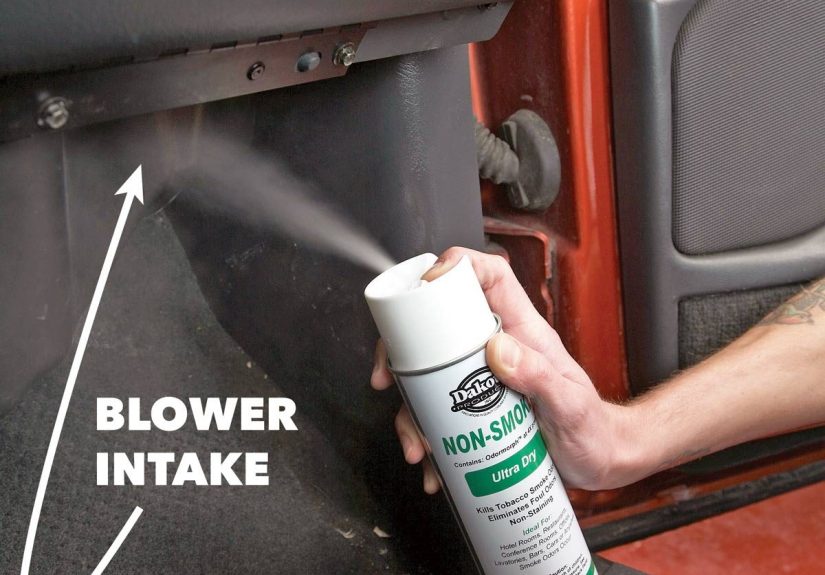
- Use an enzyme-based or smoke-specific odor eliminator on soft surfaces.
Expect smoke odor removal to take multiple passes. If the car was heavily smoked in, professional detailing may be the
fastest path to “not an ashtray.”
Musty A/C smell (“gym socks,” “old towel,” “why?”)
When the smell blasts you only when the A/C runs, the problem is often moisture and microbial growth around the HVAC system.
Common causes include a clogged/dirty cabin air filter and moisture lingering near the evaporator/drain area.
Helpful steps:
- Replace the cabin air filter (choose one with activated charcoal if odors are a recurring issue).
- Clean vents and surrounding trim (dust + humidity = odor buffet).
- Dry the system: before parking, run the fan for a few minutes with A/C off to reduce moisture left behind.
- If the musty smell persists, consider an HVAC evaporator cleaner or professional A/C inspection (a blocked drain can keep moisture trapped).
Mold and mildew (moisture is the villain)
If you’ve got a real mildew smell, don’t just deodorizedry everything. Mold problems get worse when moisture stays trapped.
The faster you dry, the better. Use airflow and, if available, a small dehumidifier in a closed garage.
If carpet or upholstery is soaked and can’t dry quickly, you may be looking at removing or replacing materials.
That’s not dramaticit’s just how mold works when moisture hangs around.
Don’t Forget the “Lungs” of Your Car: The Cabin Air Filter
If your car smells bad when the fan is on, or your vents smell stale, the cabin air filter is a prime suspect.
These filters trap dust, pollen, and debrisand once they’re clogged or damp, they can start contributing to odors.
How to know it’s time
- Musty or dusty smell from vents
- Reduced airflow through the HVAC
- Worsening allergies inside the car
Upgrading to a charcoal (carbon) cabin filter can help with odor control because it’s designed to capture more smell-causing compounds.
Some filters even use odor-neutralizing layers for extra help.
Odor Eliminators: What Works, What’s Hype, What’s a Trap
Enzyme cleaners (best for organic funk)
Enzyme-based cleaners are excellent for odors caused by organic material: food spills, pet accidents, sour milk, and anything that used to be alive.
They work by breaking down odor-causing residues rather than masking them.
Activated charcoal (quietly effective)
Charcoal bags are great “maintenance tools” after you’ve cleaned. They won’t fix a mold problem by themselves,
but they’re fantastic at absorbing lingering smells while your car stays fresh.
Vinegar (use it strategically)
White vinegar can help with certain odors. A classic trick is leaving a small bowl of vinegar in the car overnight,
then airing out the next day. It’s simple, cheap, and surprisingly effective for some lingering smells.
Just don’t spill it unless you want to unlock “salad bar” mode.
“Odor bombs” and heavy fragrances (proceed with caution)
Some products mostly add scent. If you haven’t removed the odor source, perfume just stacks on top of funk.
Use fragrance only after cleaning and neutralizing, and keep it light.
Ozone treatments (effective, but safety matters)
Ozone machines can remove stubborn odors, but ozone is also a respiratory irritant and isn’t something you want to breathe.
If you use ozone, do it carefully: never run it with people or pets in the vehicle, follow all device instructions,
and air the car out thoroughly afterward.
For many drivers, ozone is best handled by professionals who know how to use it safely and appropriately.
Think of it as a powerful toolmore “pressure washer” than “air freshener.”
A Simple “No-Stink” Checklist You Can Repeat
If you want an easy routine that works for most car odors, do this:
- Remove trash and anything damp or porous.
- Vacuum thoroughly (seats, crevices, trunk).
- Wash mats and wipe hard surfaces.
- Spot-treat spills with a proper upholstery cleaner or enzyme cleaner.
- Dry completely (fans, open windows, sunshine).
- Replace cabin air filter if vent smells persist.
- Add charcoal bags as a “maintenance” step.
Prevention: Keep Your Car From Smelling Like a Plot Twist
Once your car smells good again, protect your work:
- Dry wet items fast: towels, sports gear, rain-soaked matsdon’t let them live in the car.
- Don’t let spills linger: even “just water” can turn into mildew if it soaks into padding.
- Run the fan before parking: A/C off + fan on for a few minutes can reduce moisture in the HVAC area.
- Change the cabin air filter on schedule: especially if you drive in dusty areas or heavy traffic.
- Keep a small trash bag in the carfuture you will be grateful.
of Real-World Experience: What Actually Happens When You Fight Car Odors
Here’s what drivers and detailers learn the hard way: most “mystery smells” aren’t mysteries at allthey’re just
hiding in places people don’t clean. One common story starts with a harmless coffee spill. The driver blots the seat,
wipes the surface, and declares victory… until a week later when the cabin smells like a sour latte apocalypse.
Why? Because liquid doesn’t stop at the fabric. It seeps into foam padding, where it dries slowly and feeds bacteria.
The fix that finally works is boring but effective: extraction (wet/dry vac or upholstery extractor), a proper cleaner,
and patient drying. The takeaway: if it was wet, assume it went deeper than you think.
Another classic involves “musty A/C breath.” People often spray a scented product into the vents and call it done.
That can make the car smell better for a dayuntil humidity and heat reactivate the underlying funk. In many cases,
the real win comes from replacing the cabin air filter (especially if it’s old or damp), cleaning visible vent dust,
and changing habits: running the fan with A/C off for a few minutes before shutting the car down. It feels almost too
simple, which is why people ignore it… right up until the “gym socks” smell returns and ruins their commute playlist.
Smoke odors have their own personality: persistent, clingy, and absolutely not impressed by your peppermint air clip.
People who buy used cars sometimes discover the smell only after the seller’s fragrance fades. The successful approach
is multi-step: clean the glass (smoke film is real), wipe every hard surface, shampoo fabrics and carpets, and replace
the cabin air filter. Drivers who get the best results treat it like repainting a roomyou don’t paint over dirt; you
prep first. And if the smell is deep in the headliner and seat foam, they learn that professional detailing is often
cheaper than buying a dozen “miracle sprays” that don’t miracle.
Mold and mildew experiences usually start with water: a leaky door seal, a cracked window in the rain, or damp mats
after a snowy week. The people who win the fight move fast. They remove mats, lift carpet edges if possible, use fans,
and prioritize drying before deodorizing. Those who lose… try to mask it and end up with a smell that returns every
humid morning like it has a standing appointment. The lesson: drying is not optional. If something is soaked and can’t
dry quickly, replacement sometimes becomes the only practical option.
Finally, there’s the “nuclear option” experience: ozone. People love it because it can knock down stubborn odors.
The smarter users treat it with respect: nobody in the car during treatment, careful adherence to instructions, and
long airing-out afterward. They also learn that ozone isn’t a substitute for cleaningit’s a finishing move. Used
properly, it can be the difference between “mostly better” and “finally fresh.” Used carelessly, it becomes a health
risk and a regret story you tell at barbecues. The real-world theme across all these experiences is consistent:
remove the source, clean deeply, dry completely, then use absorbers or advanced treatments to polish the results.
Conclusion
Getting rid of odor in your car isn’t about finding one magical sprayit’s about removing what’s feeding the smell,
cleaning the surfaces that hold it, and drying everything so it doesn’t come back. Start with ventilation and trash
removal, move into vacuuming and deep cleaning, replace the cabin air filter if vents are funky, and use absorbers
like charcoal or baking soda to keep things fresh. Do it once the right way, and your car will stop smelling like a
cautionary tale.