Table of Contents >> Show >> Hide
- What You’re Making (And Why It Works)
- Supplies and Tools
- Helpful Measurements That Fit Real Life
- Step-by-Step: How to Make a Duct Tape Wallet
- Step 1: Make a “Duct Tape Fabric” Sheet
- Step 2: Fold the Wallet Body
- Step 3: Build the Bill Pocket (The “Money Tunnel”)
- Step 4: Make Card Pockets (Simple, Stackable, and Actually Useful)
- Step 5: Repeat on the Other Side (Or Customize)
- Step 6 (Optional): Add an ID Window
- Step 7: Reinforce Stress Points (So It Lasts)
- Step 8: Trim, Press, and “Test Drive”
- Common Mistakes (And How to Avoid Them)
- Design Upgrades That Make Your Wallet Feel “Store-Bought”
- Care and Maintenance
- Real-World Experiences: What You Learn After Making a Few (Yes, Even If You Swear You’ll Only Make One)
- Conclusion
Duct tape gets a bad reputation for being the thing you only use when something has gone tragically wronglike a vacuum hose
that decided it wanted to be “free.” But in the DIY world, duct tape is also a legitimate building material. It’s durable,
water-resistant, and comes in enough colors and patterns to make your wallet look like it has a personal brand.
In this guide, you’ll learn how to make a duct tape wallet (a classic bi-fold) with a bill pocket and card slots,
plus optional upgrades like an ID window and extra hidden pockets. We’ll keep it beginner-friendly, but still clean enough that
it won’t look like it was made during a power outage using only hope and sticky residue.
What You’re Making (And Why It Works)
A good DIY duct tape wallet is basically “duct tape fabric” folded into a bi-fold shape. The trick is making a
flat, double-sided sheet first (sticky sides trapped inside), then building pockets on top. When you layer tape correctly,
you get structure without bulk, and edges that don’t peel the first time you pull out a credit card like you’re on a game show.
Supplies and Tools
Must-haves
- Duct tape: 1 roll is enough for one wallet; 2 rolls if you want contrasting colors or patterns.
- Scissors: Sharp scissors make cleaner edges and fewer sad frayed corners.
- Ruler or measuring tape: A straight edge is your best friend here.
- Wax paper, parchment paper, or a plastic cutting board: Helps keep tape from bonding to your table forever.
- An old gift card or plastic card: Used as a “template” for card-pocket sizing.
Nice-to-have upgrades
- Craft knife + cutting mat (optional): For ultra-straight cuts (use with care and adult supervision if needed).
- Clear plastic (optional): Cut from a report cover or packaging to make an ID window.
- Binder clips or clothespins: Hold layers in place while you line things up.
- A spoon or old gift card: For pressing (“burnishing”) tape flat and smooth.
- Velcro dot or small closure (optional): If you want the wallet to stay shut.
Quick safety note: If you’re using a craft knife or cutting on a hard surface, slow down and cut away from your hands.
Duct tape wallets are fun; duct tape bandages are not the goal.
Helpful Measurements That Fit Real Life
You can absolutely “eyeball it,” but measurements help your wallet fit money and cards without crumpling everything like a receipt volcano.
Here are the practical sizes we’re building around:
- Cards: Standard cards are about 3.37 × 2.13 inches.
- U.S. bills: A dollar bill is about 6.14 × 2.61 inches.
A classic duct tape billfold uses a base strip around 9 inches long so it can fold neatly and still hold bills.
Don’t worrywe’ll show exactly where that number matters and where you can adjust for your style.
Step-by-Step: How to Make a Duct Tape Wallet
Step 1: Make a “Duct Tape Fabric” Sheet
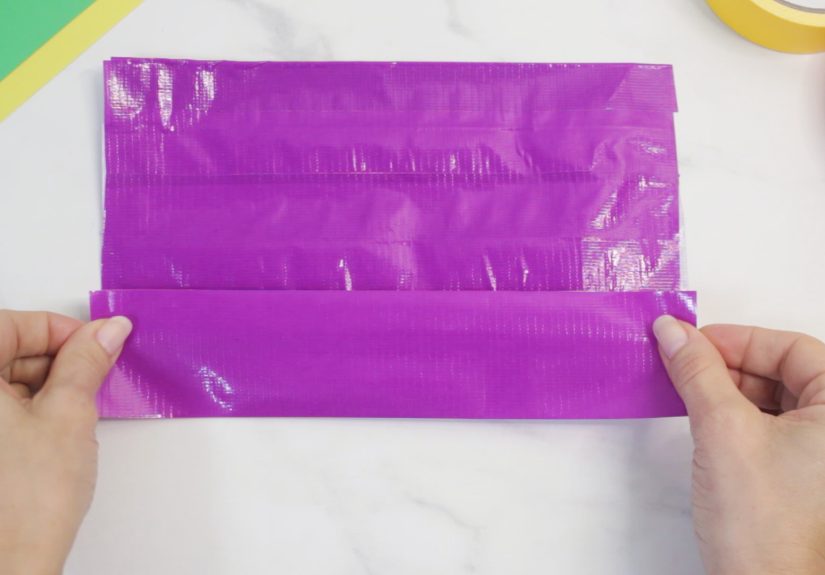
This is the foundation. You’re building a double-sided panel so the sticky parts stay hidden inside.
-
Tear or cut 4 strips of duct tape, each about 9–10 inches long.
(If you prefer a roomier wallet, go closer to 10.) -
Lay the strips sticky-side up on your wax paper, slightly overlapping each strip (about 1/4–1/2 inch overlap).
You’re making one wide sticky rectangle. -
Add another set of strips on top, but sticky-side down, lining them up so you trap the stickiness inside.
Press firmly as you go to avoid bubbles. -
Trim the edges into a clean rectangle. Aim for something around 8.5–9 inches wide and 7–8 inches tall
before folding. (Exact size can vary; the fold matters more.)
Pro tip: Press the sheet flat using a spoon or an old gift card. The more you press now, the less your wallet will look
like a crumpled tape burrito later.
Step 2: Fold the Wallet Body
Now you’ll turn that panel into a bi-fold shape.
- Place the sheet in front of you horizontally (wider side left-to-right).
- Fold it in half like a book. Don’t crease too hard yetjust line up edges.
- Open it back up and lightly mark the center fold with your fingernail. This helps you align pockets later so the wallet opens smoothly.
Step 3: Build the Bill Pocket (The “Money Tunnel”)
The bill pocket is basically a sleeve. You’ll create it by sealing the sides while leaving the top open.
- With the wallet folded shut, make sure edges are aligned and squared off.
-
Cut two strips of duct tape long enough to run along each side edge (about the wallet’s height). Fold each strip over the edge to seal it.
Press firmly. - Seal the bottom edge the same way with one long strip, folded over the bottom edge. Leave the top edge openthat’s where bills go.
Clean-finish trick: For the smoothest look, use half-width strips (torn lengthwise) as edge binding. It reduces bulk and looks sharper.
Step 4: Make Card Pockets (Simple, Stackable, and Actually Useful)
Most duct tape wallets use 3–4 card slots. We’ll build three stacked pockets on one side, plus one “hidden” pocket behind them.
-
Create a pocket panel by sticking two short strips together sticky-side to sticky-side (so it’s double-sided).
Make it slightly wider than your card. -
Use your old gift card as a guide and trim the panel so it’s about 1/4 inch wider than the card on both sides.
This breathing room helps cards slide in without peeling tape. -
Make three more panels the same width. For height, each pocket piece should be tall enough to hold a card securely
while leaving a finger-friendly “grab zone” at the top. -
To build a stacked set, trim the top pockets a bit shorter than the bottom one, creating a staircase effect.
(Think: “credit card pockets,” not “trapdoor surprise.”) - Place the largest pocket first, then stack the next two above it. Align them neatly and leave a small gap from the center fold so the wallet can close.
- Attach pockets using thin strips of tape along the sides and bottom onlydo not tape across the top openings.
Hidden pocket option: Before you attach the stacked pockets, you can add a full-width panel behind them and tape only the sides and bottom.
That creates a “secret” pocket for a little cash or a backup card. Not secret like spy-movie secret, but secret like “I forgot I put this here.”
Step 5: Repeat on the Other Side (Or Customize)
You have choices:
- Classic build: 3 card slots on one side, 1–2 on the other.
- Minimalist build: 2 slots total, plus hidden pockets.
- Student-friendly build: Add an ID window on one side.
Step 6 (Optional): Add an ID Window
If you want an ID holder, you’ll use a rectangle of clear plastic and frame it with duct tape.
- Cut a clear plastic rectangle slightly bigger than your card (about 1/4 inch extra on each side).
- Place it where you want the ID window on the inside of the wallet.
-
Tape three sides of the plastic down using thin strips of duct tapeleft, right, and bottomso the top remains open for sliding an ID in.
Keep tape off the “viewing area.” - Add a thin duct tape border around the outside edges if you want a finished frame look (and extra reinforcement).
Step 7: Reinforce Stress Points (So It Lasts)
Duct tape wallets fail in predictable places: corners, pocket edges, and the center fold. Fix that before it happens.
- Corner caps: Add small diagonal patches to inside corners to stop peeling.
- Center spine strip: Apply a thin strip along the inside fold to reinforce the “hinge.”
- Pocket lips: Add thin strips along pocket edges (not over openings) to prevent stretching and curling.
Step 8: Trim, Press, and “Test Drive”
- Trim any uneven edges for a clean rectangle shape.
- Press the wallet flat on a table and burnish all seams firmly.
- Slide cards in and out a few times. Add a tiny reinforcement strip if a pocket edge starts to lift.
- Fold bills and test the bill pocket. If it feels tight, you can widen the wallet next time by starting with longer strips.
Common Mistakes (And How to Avoid Them)
1) The wallet won’t close flat
This usually happens when pockets are too close to the center fold or the layers are too thick. Leave a small margin near the fold
and use half-width tape for bindings to reduce bulk.
2) Pocket openings curl or get sticky
If sticky edges are exposed, add a thin “binding” strip folded over the lip. Also, be sure your pocket panels are truly double-sided
(sticky trapped inside).
3) Edges peel after a week
Corner reinforcement is the difference between “handmade” and “held together by optimism.” Add corner patches and press seams firmly.
4) Cards are too tight (or too loose)
Use a gift card as a sizing template and leave about 1/4 inch extra width. For snug pockets, tape only the sides and bottom tightly.
For looser pockets, leave a hair more room or use fewer layers.
Design Upgrades That Make Your Wallet Feel “Store-Bought”
Use a two-tone pattern
Make the outer shell one color and the inside pockets another. This looks intentionaland “intentional” is what we’re going for here.
Add a quick closure
A small Velcro dot or strap can keep the wallet closed, especially if you carry a lot of cards. Keep it subtle so it doesn’t snag fabric.
Make a travel version
If you want a travel wallet, build a taller base panel and add a long side pocket sized for a passport or extra receipts. You’ll basically be making a
duct tape “mini folder” with pocketsstill a duct tape wallet, just with more ambition.
Care and Maintenance
- Cleaning: Wipe with a damp cloth. Avoid harsh cleaners that can weaken adhesive over time.
- Heat caution: Don’t leave it on a hot dashboard. Adhesive softens in heat, and nobody wants a wallet that re-invents itself.
- Quick repair: If a corner lifts, trim the loose bit and apply a small patch with rounded edges for a cleaner repair.
Real-World Experiences: What You Learn After Making a Few (Yes, Even If You Swear You’ll Only Make One)
The first time you make a duct tape wallet, it’s mostly about discovery. Discovery of how sticky duct tape can be. Discovery of how fast a roll disappears.
Discovery of the fact that “I’ll just tear it straight” is a lie we tell ourselves for emotional comfort.
One of the biggest lessons is that the duct tape fabric stage determines almost everything. If your first sheet is bumpy, wrinkled,
or slightly crooked, the wallet will still functionbut it might look like it survived a minor hurricane. Taking two extra minutes to press the sheet flat
(burnish it with a spoon or card) makes the whole build feel smoother, cleaner, and more “I meant to do that.”
Pocket placement is the second “aha” moment. Early attempts often put card slots right up against the center fold, because it seems logical:
put the pockets where the wallet opens, right? But that’s how you get a wallet that won’t close and tries to spring open like a pop-up book.
Leaving a small gap near the fold makes the wallet flex naturally, and your pockets won’t fight the hinge every time you open it.
Then there’s the pocket tightness debate. A pocket that’s too tight makes you yank cards out like you’re trying to start a lawnmower.
Too loose, and your cards slide out when you least want them tolike when you’re casually removing your wallet and accidentally releasing
three loyalty cards into the wild. The best “real life” method is building one pocket first, testing it with a card, and adjusting the width or seam tape
before making the rest. That tiny test saves a lot of rework.
You’ll also notice that edges are everything. Corners are the stress points: they hit the inside of pockets, rub against fabric, and get pulled during use.
The fix isn’t complicatedsmall corner patches and clean edge bindingbut it’s the difference between a wallet that lasts a month and one that lasts a year.
Rounded patches (instead of sharp square ones) tend to peel less because there’s no pointy corner waiting to lift.
Finally, the most fun part: personalization. People start with “I’ll make a simple wallet,” and suddenly they’re creating a themed masterpiece:
a two-tone outside/inside, a patterned strip down the center, a hidden pocket for emergency cash, and an ID window framed like a tiny picture frame.
The best experiences happen when you treat the first wallet as a prototypeuse it, notice what annoys you, then build version two with smart upgrades.
That’s when your duct tape wallet stops feeling like a craft project and starts feeling like a genuinely handy everyday item.
Conclusion
Making a duct tape wallet is one of those DIY projects that’s equal parts practical and oddly satisfying. With a clean duct tape fabric sheet,
well-placed card pockets, and reinforced corners, you can build a wallet that holds up to daily useand looks good doing it. Start with the classic bi-fold,
then level up with an ID window, extra pockets, and a two-tone design once you’ve got the basics down. And if your first one isn’t perfect?
Congratulationsyou’ve made a prototype. The next one will be even better (and you’ll cut straighter, we believe in you).