Table of Contents >> Show >> Hide
- Why Riding Two-Up Changes Everything (Even If Your Bike Pretends It Doesn’t)
- Before You Ever Start the Engine
- The Passenger Briefing (The 60 Seconds That Prevent 60 Minutes of Stress)
- Mounting and Dismounting Without Drama
- How to Ride Smoothly with a Passenger
- Common Mistakes (And How to Avoid Them)
- Building Skills: Practice Like a Pro (Without Pretending You’re in a Movie)
- Extra Safety Checks for Passenger Comfort
- What to Do If Something Feels “Off” Mid-Ride
- Quick Two-Up Safety Checklist
- of Real-World “Two-Up” Experience (What Riders Commonly Learn)
- Conclusion
Riding with a passenger (a.k.a. “two-up,” “with a pillion,” or “bringing a human backpack”) can be one of the best
parts of motorcyclingshared views, shared laughs, shared “WOW that was a pothole” moments. It can also be the
quickest way to learn that your motorcycle has feelings, and it expresses them through heavier steering, longer
stopping distances, and a strong opinion about sudden throttle inputs.
The good news: passenger safety isn’t magic. It’s preparation, communication, and smoother techniqueplus the right
gear and a motorcycle that’s actually set up for carrying someone. This guide walks you through practical, real-world
steps to ride with a passenger safely, with specific examples and a few jokes (because laughter is safer than panic).
Why Riding Two-Up Changes Everything (Even If Your Bike Pretends It Doesn’t)
Adding a passenger changes your motorcycle’s weight, balance, and braking needs. You’ll typically notice:
- More mass: Acceleration slows down, braking distances increase, and quick “oops” corrections get harder.
- Higher center of gravity: The bike can feel taller and more top-heavy, especially at low speeds.
- Different suspension behavior: Rear suspension compresses more; handling can feel softer or wallowy.
- More wind effect: Two helmets and two torsos catch more wind, especially at highway speeds.
- Passenger movement matters: A shift at the wrong time can make a corner feel… exciting. Not the good kind.
None of that means “don’t do it.” It means “do it on purpose.”
Before You Ever Start the Engine
1) Make Sure Your Motorcycle Is Passenger-Ready
A passenger ride should never begin with: “So… where do your feet go?” Confirm your bike is designed for two-up:
- Passenger seat: A real seat (not a decorative postage stamp).
- Passenger footpegs: Secure, usable, and positioned so the passenger can keep feet up and stable.
- Grab points: Passenger grab rails, a strap, or a safe hold position around your waist/hips.
- Weight limits: Check your owner’s manual for maximum load (rider + passenger + luggage).
2) Do a “Two-Up” Pre-Ride Check (Not the Lazy One)
With extra weight on board, small issues feel bigger. Do a quick but serious check:
- Tire pressure: Many bikes require higher pressure for passenger/load. Check your manual or swingarm sticker.
- Tire condition: Worn tires + extra weight = less traction margin.
- Brakes: Lever feel, pedal feel, and no obvious issues.
- Lights/signals: You want to be seenespecially since you’ll stop slower.
- Chain/belt: Correct tension and condition.
3) Adjust Suspension and Load Settings
If your bike has adjustable rear preload (many do), increase it for the passenger. This helps keep the bike from
squatting too much, improves cornering stability, and helps maintain proper headlight aim.
Some bikes also have damping adjustments or a “rider + passenger” setting. If you’re not sure, use the manual and
start conservativelybetter support is usually safer than a rear end that feels like a trampoline.
4) Gear Up Your Passenger Like You Actually Like Them
Passenger safety begins before the bike moves. Minimum recommended gear:
- Helmet: DOT-compliant at minimum; snug fit; chin strap properly fastened.
- Jacket: Motorcycle jacket with abrasion resistance and (ideally) armor.
- Gloves: Full-finger motorcycle gloves for grip and protection.
- Pants: Riding pants or at least durable, non-ripped, non-flimsy material.
- Boots: Over-the-ankle footwear with a firm sole (no sandals, no “but they’re my comfy slides”).
Bonus: ear protection. Wind noise fatigue is real for both of you.
The Passenger Briefing (The 60 Seconds That Prevent 60 Minutes of Stress)
What to Explain Before the Ride
Your passenger doesn’t need a TED Talkbut they do need a plan. Cover these points clearly:
- Mounting and dismounting: Only when you say it’s okay, and only with the bike stable.
- Feet rule: Feet stay on pegs at all times while moving. No surprise “ground taps.”
- Hands rule: Hold the grab rail/strap or hold you around the waist/hips. No shoulder tug-of-war.
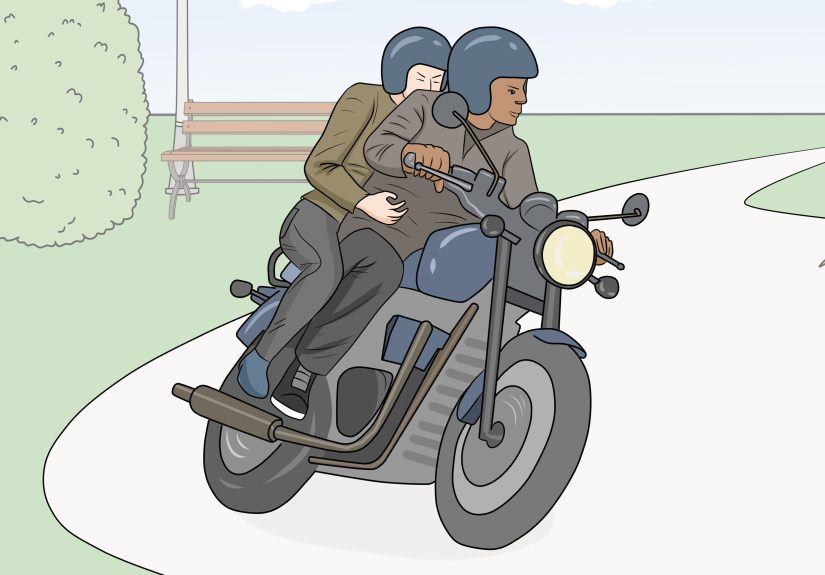
- Lean rule: Look over your inside shoulder and stay aligned with the bikedon’t fight the lean.
- No sudden moves: If they need to adjust, they do it smoothly and preferably on a straight section.
- Communication: Simple signals (tap on shoulder, thumbs up, etc.) or an intercom if you have one.
A Simple Communication System That Works
Keep it ridiculously simple:
- One tap: “Are you okay?” (rider asks) or “I’m okay” (passenger respondsagree on direction).
- Two taps: “Slow down / I need a break.”
- Repeated taps: “Pull over safely as soon as you can.”
If you use a Bluetooth intercom, still agree on a backup signal in case the battery dies at the exact moment you hit
the windiest bridge in your county.
Mounting and Dismounting Without Drama
Rider’s Job: Make the Bike Stable
Before your passenger gets on:
- Choose flat ground if possible.
- Use both feet down if needed; keep the front brake applied.
- Be ready for the bike to rock slightly as the passenger climbs on.
Passenger’s Job: Move Smoothly and Follow Your Cue
A safe method:
- Passenger stands on the left side (unless your situation requires otherwise).
- Passenger places a hand on a stable grab point (not the throttle, not your shoulder like you’re a coat rack).
- Passenger steps on the left peg (if appropriate for the bike) and swings the leg over smoothly.
- Passenger settles gentlyno “cannonball into the seat.”
- Passenger places both feet on pegs and confirms ready.
Dismounting is the reverse: you stop, stabilize, say “okay,” passenger steps off smoothly, and then you relax.
How to Ride Smoothly with a Passenger
1) Start Slower Than You Think You Need To
Two-up riding is not the time to test your “I watched a video once” skills. Plan a low-stress route:
familiar roads, lighter traffic, minimal tight U-turns, and plenty of safe pull-off spots. Your first goal is
comfort and controlnot speed.
2) Use Gentle Throttle and Progressive Braking
Abrupt throttle can jerk the passenger backward; abrupt braking can shove them into you. Aim for:
- Progressive acceleration: Roll on smoothly, especially from stops.
- Earlier braking: Start braking sooner, with steady pressure.
- More following distance: Give yourself extra space to react and stop safely.
Specific example: If you normally start braking at a certain landmark (say, a mailbox or sign), move that decision
point earlier when carrying a passenger. It’s not “being cautious.” It’s physics doing its thing.
3) Cornering: Keep It Predictable
The biggest cornering issue two-up is often passenger surprise. Help them out by riding clean lines and staying smooth.
- Set your speed before the turn: Heavy mid-corner braking can unsettle the bike.
- Look through the corner: Your head and eyes lead your line; confidence steadies everything.
- Maintain steady throttle: Smooth power helps stability.
- Tell the passenger to stay with you: Same lean as the bike; no “counter-lean” panic move.
If you feel the passenger shifting nervously, slow your pace and choose gentler curves until they relax.
4) Low-Speed Maneuvers: Be Extra Patient
Parking lots and tight turns are where two-up riding can feel most awkward. Tips that help:
- Keep your head up: Look where you want to go, not at the ground.
- Use smooth clutch control: Avoid sudden on/off power changes.
- Ask for “statue mode”: Passenger stays still at very low speeds unless you cue otherwise.
- Take wider turns: Don’t force tight U-turns if the space is questionable.
5) Bumps, Potholes, and Road Hazards: Call Them Out Early
You and your passenger are sharing suspension now. When you see rough pavement:
- Slow down before the hazard, not during it.
- Keep the bike as upright as possible over bumps.
- If you can, give a quick “bump” warning through the intercom or a simple pre-agreed signal.
6) Wind and Trucks: Expect the Push-Pull Effect
Passing trucks and gusty crosswinds can move you around more with a passenger. The safe approach is boringand
that’s a compliment:
- Hold a relaxed, steady grip (don’t death-clamp the bars).
- Leave extra space when passing large vehicles.
- Reduce speed if winds are strong enough to make your line inconsistent.
Common Mistakes (And How to Avoid Them)
Rider Mistakes
- Riding the same pace as solo: Two-up requires extra margin.
- Skipping setup: Wrong tire pressure or preload can make the bike feel unstable.
- Late braking: Extra weight means extra stopping distanceno negotiating with gravity.
- Not briefing the passenger: Silence is not a strategy.
- Showing off: If your passenger is uncomfortable, you’re not “impressing” themyou’re scaring them.
Passenger Mistakes
- Feet off pegs: This is a big onecan cause balance issues and injuries.
- Sudden leaning or shifting: Especially mid-corner.
- Holding the rider’s shoulders: This can unintentionally steer or destabilize you.
- Overreacting to turns: The bike is supposed to lean. That’s literally the point.
Building Skills: Practice Like a Pro (Without Pretending You’re in a Movie)
Start with Short Rides
Choose a quick, calm loop. Stop and check in: “How did that feel? Any pressure points? Need adjustments?” Comfort
is safety, because an uncomfortable passenger moves more and distracts both of you.
Practice Smooth Stops and Starts
Find an empty parking lot and practice:
- Gentle takeoffs without jerking.
- Progressive braking to a smooth stop.
- Stable stops with both feet down if needed.
The goal is to make the passenger think, “Wow, that was easy,” not “Wow, I need a chiropractor.”
Consider Rider Training
If you’re newer to riding, passenger riding should wait until your basics are solid. Many rider training programs
and safety organizations emphasize mastering low-speed control, scanning, and braking before adding complexity.
Two-up riding is an advanced version of “do the fundamentals well.”
Extra Safety Checks for Passenger Comfort
Heat and Exhaust Awareness
Passengers can get uncomfortable near exhaust pipes or engine heat. Make sure:
- Clothing won’t melt or snag near hot parts.
- Passenger knows where not to touch when dismounting.
- Boots and pant legs provide coverage.
Passenger Fit and Seating Position
A passenger who’s sliding forward under braking will press into you repeatedlydistracting and uncomfortable.
If your seat design causes this, consider:
- A grippier seat cover.
- A passenger strap or backrest (when compatible with your bike).
- Adjusting your braking smoothness and timing.
What to Do If Something Feels “Off” Mid-Ride
If the bike feels unstable, the passenger seems nervous, or you’re not enjoying the ride, the safest move is simple:
slow down and stop somewhere safe. Re-brief, adjust gear, check tire pressure, and decide whether to continue.
There is no rule that says a passenger ride must be completed. The only rule that matters is returning home safely.
Quick Two-Up Safety Checklist
- Bike has passenger seat, pegs, and safe handholds.
- Tire pressure and suspension adjusted for load.
- Passenger geared up: helmet, jacket, gloves, pants, boots.
- Passenger briefing: mount/dismount, feet on pegs, lean with bike, no sudden moves.
- Communication plan: taps or intercom.
- Smooth technique: early braking, gentle throttle, stable corners.
- Extra space: following distance and time to react.
- Short practice ride first.
of Real-World “Two-Up” Experience (What Riders Commonly Learn)
Riders who start carrying passengers often describe the first few miles as a mix of excitement and hyper-awareness.
The bike feels familiar, but not quitelike your motorcycle put on a backpack full of textbooks and now wants you to
be polite about it. The most common “aha” moment? Braking. Even experienced riders say the first stop sign with a
passenger feels different, because your timing has to change. You don’t necessarily brake harderyou brake earlier
and smoother. When you do it right, the passenger stays relaxed. When you do it late, you feel that gentle (or not
so gentle) bump as they shift forward, and suddenly you’re both having a conversation with inertia.
Another frequent lesson is how much passengers appreciate narration. Not a constant play-by-play, but small heads-up
cues: “We’re slowing,” “Bumpy road,” or “Big turn coming.” Riders report that even simple warnings reduce passenger
surprise, which reduces sudden movements, which makes the whole ride calmer. Calmer is safer. Also, calmer is more fun.
Nobody wants to spend an afternoon clenching like they’re trying to crush a walnut with their knees.
Cornering is where many riders learn the value of a clear passenger rule: “Stay with me.” Passengers often don’t
understand that the motorcycle must lean to turn. If they try to sit upright while the bike leans, the mismatch can
feel unsettling. Riders who take one minute to explain “look over my inside shoulder, lean with the bike, and don’t
fight it” often say the difference is immediate. The passenger relaxes, the rider relaxes, and the corners become
smooth again instead of awkward. Some riders even practice this in a parking lot: slow circles in both directions,
with the passenger focusing on staying aligned and looking through the turn.
Comfort lessons show up quickly too. A passenger who’s uncomfortable will fidgetshifting weight, readjusting feet,
and moving at exactly the wrong time. Riders commonly solve this by making the first ride short and building up. They
stop after ten or fifteen minutes, check in, and adjust. Maybe the helmet fit is annoying. Maybe the passenger’s boots
make it hard to find the pegs. Maybe the jacket rides up in the wind. Fixing small issues early prevents the bigger
problem: distraction.
Finally, many riders learn that two-up rides are best when they’re not rushed. Leaving extra time means you can pick
easier roads, avoid stressful traffic, and pull over if anything feels off. And that’s the secret “experienced rider”
move: not bravado, not speed, not showing offjust calm decisions, smooth control, and a passenger who gets off the
bike smiling instead of sprinting toward the nearest solid wall for support.
Conclusion
Riding a motorcycle with a passenger safely is all about stacking the odds in your favor: set up the bike, gear up
properly, communicate clearly, and ride smoother than you would solo. Start with short practice rides, build comfort,
and keep a bigger safety margin for braking, turning, and traffic. Two-up riding can be incrediblewhen you treat it
like a skill, not a stunt.