Table of Contents >> Show >> Hide
- The two standard ways to say “Happy Birthday” in French
- Quick grammar that saves you from an awkward typo
- Make it personal: add a name (or a little extra warmth)
- Formal vs. informal: the “tu” and “vous” superpower
- Text-message French: short versions people actually write
- “Bonne fête”: birthday wish or not?
- Extra birthday phrases that sound natural (and not like a phrasebook)
- Belated and early birthday wishes
- How to reply when someone says “Joyeux anniversaire !”
- Ready-to-use examples for cards, texts, and emails
- Common mistakes (so you don’t accidentally invent a new dialect)
- Conclusion
- Experience Notes: What this sounds like in real life (and how to get comfortable fast)
Wishing someone a happy birthday in French is delightfully simpleuntil you overthink it and accidentally announce something like, “Congratulations on your anniversary!” (Don’t worry, we’ll prevent that linguistic plot twist.) In this guide, you’ll learn the go-to birthday greetings French speakers actually use, how to sound natural in texts and cards, what to say in formal situations, and a bunch of bonus phrases that make you sound like you didn’t learn French exclusively from a croissant.
The two standard ways to say “Happy Birthday” in French
If you memorize only two phrases from this entire article, make them these. They’re both widely used and understood across French-speaking regions:
1) “Joyeux anniversaire !” (The classic)
Joyeux anniversaire ! literally means “joyful birthday,” and it’s the most “default” way to say happy birthday in French. You’ll hear it at parties, see it on cakes, and read it on birthday cards.
Pronunciation tip: In everyday speech, French often links sounds between words (called a liaison). In joyeux anniversaire, the ending sound flows into the next word, so it comes out smoothly rather than like two separate LEGO bricks. An English-friendly approximation is: zhwah-yuh ah-nee-vehr-SEHR.
2) “Bon anniversaire !” (Also common)
Bon anniversaire ! literally means “good birthday.” It’s also a standard birthday wish and is very common in real life. If you say this, no one will clutch their pearls.
English-friendly approximation: bohn ah-nee-vehr-SEHR.
Quick grammar that saves you from an awkward typo
Here’s the tiny rule that prevents a surprisingly common mistake: anniversaire is masculine in French. That’s why it’s bon anniversaire (not bonne) and joyeux anniversaire (not joyeuse).
Also, yesanniversaire can mean birthday and anniversary. Context does the heavy lifting. If someone says “C’est mon anniversaire”, they mean “It’s my birthday.” If they say “Notre anniversaire de mariage”, that’s “our wedding anniversary.”
Make it personal: add a name (or a little extra warmth)
You can keep it short, or you can make it sound like you actually like the person (recommended).
- Joyeux anniversaire, Camille ! (Happy birthday, Camille!)
- Bon anniversaire, mon ami ! (Happy birthday, my friend!)
- Je te souhaite un très joyeux anniversaire. (I wish you a very happy birthday.)
Formal vs. informal: the “tu” and “vous” superpower
French has two ways to say “you,” and birthdays are a perfect time to use them correctly:
- Tu = informal (friends, family, close coworkers, people your age if that’s the vibe)
Example: Je te souhaite un joyeux anniversaire ! - Vous = formal/polite (a supervisor, a client, a teacher, someone you don’t know well)
Example: Je vous souhaite un joyeux anniversaire.
If you’re unsure, choose vous. It’s the linguistic equivalent of wearing nice shoes: rarely wrong, occasionally impressive.
Text-message French: short versions people actually write
When French speakers text birthday wishes, they often shorten words (because thumbs get tired too). Here are common casual options:
- Joyeux anniv ! (Short for anniversaire)
- Bon anniv !
- Bon annif ! (Also used in some regions)
- Joyeux anniv 🎉 (Add emoji for maximum friendliness)
Note: These are casual. If you’re emailing your boss, this is not the moment for ultra-short slang.
“Bonne fête”: birthday wish or not?
This one depends on where your French speaker is from.
- In France: bonne fête is commonly tied to a name day/saint’s day or used for holidays. For birthdays, joyeux anniversaire and bon anniversaire are the safer defaults.
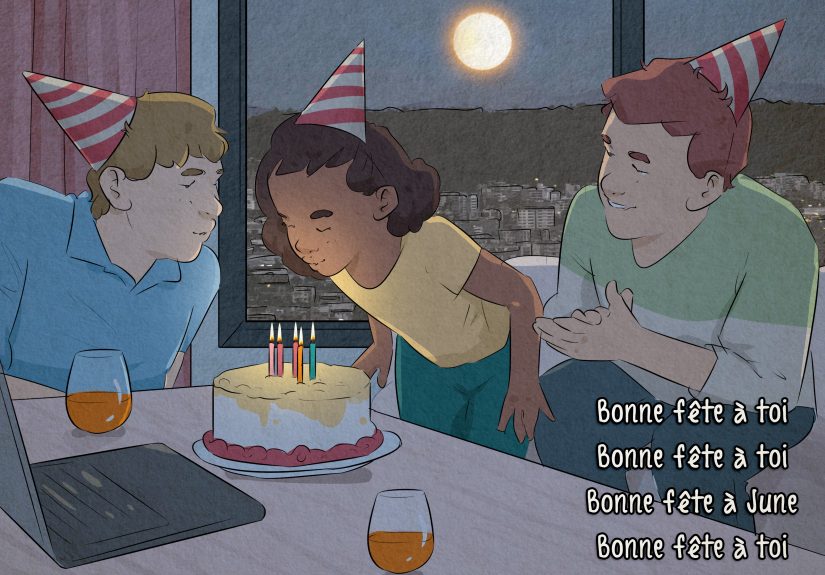
- In Canada (especially Quebec) and some North American French communities: Bonne fête ! is often used to mean “happy birthday.”
If you know the person uses Canadian French, Bonne fête ! can feel extra authentic. If you don’t know, go with Joyeux anniversaire !it works basically everywhere.
Extra birthday phrases that sound natural (and not like a phrasebook)
Want to level up from “Happy birthday!” to “Happy birthday and I’m emotionally available enough to add a second sentence”? Try these.
Wish them a great day
- Passe une excellente journée ! (Have an excellent day!)
- Profite bien de ta journée ! (Enjoy your day! informal)
- J’espère que tu passes une super journée. (I hope you’re having a great day.)
Wish them a great year
- Je te souhaite une merveilleuse année. (I wish you a wonderful year.)
- Que cette nouvelle année t’apporte joie et bonheur ! (May this new year bring you joy and happiness!)
- Santé et bonheur pour l’année à venir ! (Health and happiness for the year ahead!)
Birthday toast words (because cake deserves a supporting cast)
- Santé ! (Cheers!)
- À ta santé ! (To your health! informal)
- À votre santé ! (To your health! formal/plural)
Belated and early birthday wishes
Belated: “Happy birthday… sorry I’m late”
Forgot the date? It happens. Here are natural, commonly used options:
- Joyeux anniversaire en retard ! (Happy belated birthday!)
- Désolé(e) pour le retardjoyeux anniversaire ! (Sorry for the delayhappy birthday!)
- Je suis en retard, mais joyeux anniversaire ! (I’m late, but happy birthday!)
Early: “Happy birthday in advance”
You can say:
- Joyeux anniversaire en avance ! (Happy birthday in advance!)
- Bon anniversaire en avance !
Cultural note: some people consider early birthday wishes a bit “jinx-y,” depending on family or local tradition. If you want to play it safe, you can say something like: Je ne te le souhaite pas en avance, mais je pense à toi ! (I’m not wishing it early, but I’m thinking of you!)
How to reply when someone says “Joyeux anniversaire !”
The easiest response is the same in every language: say thanks like you mean it.
- Merci ! (Thanks!)
- Merci beaucoup ! (Thanks a lot!)
- Merci, c’est gentil ! (Thanks, that’s kind!)
- Oh, merci ! (Oh, thanks!)
Ready-to-use examples for cards, texts, and emails
Here are templates that sound human. Swap the name and you’re good.
For a friend (casual, warm)
Joyeux anniversaire, Alex ! Profite bien de ta journée et amuse-toi !
Happy birthday, Alex! Enjoy your day and have fun!
For a coworker you’re friendly with
Bon anniversaire ! Je te souhaite une excellente journée.
Happy birthday! I wish you an excellent day.
For a boss/client/teacher (polite)
Joyeux anniversaire. Je vous souhaite une très belle journée et une année pleine de succès.
Happy birthday. I wish you a wonderful day and a year full of success.
For a close family member
Joyeux anniversaire ! Je t’embrasse fort.
Happy birthday! Big hug/kisses.
Sign-offs (pick one)
- Amitiés, (Best regards / friendly)
- Bien à vous, (Sincerely / more formal)
- Bisous, (Kisses / very casual, close relationship)
Common mistakes (so you don’t accidentally invent a new dialect)
- Don’t write “Bonne anniversaire.” It’s bon because anniversaire is masculine.
- Don’t stress about “Joyeux” vs. “Bon.” Both are normal. Choose one and say it confidently.
- Watch the accents. Fête has a circumflex (ˆ). People will still understand without it, but correct spelling looks polished.
- Avoid copying long song lyrics. You can mention that French birthday songs often use the same melody as English, but it’s better to learn it from a trusted language-learning resource rather than pasting lyrics into a card.
Conclusion
If you want the simplest, most universally safe birthday wish in French, use Joyeux anniversaire ! If you want an equally common alternative, use Bon anniversaire ! Add tu or vous depending on how formal you need to be, sprinkle in a phrase like Passe une excellente journée !, and you’ve got a message that sounds naturalwithout sounding like you swallowed a dictionary. And if your friend is from Quebec? Bonne fête ! might win you bonus points.
Experience Notes: What this sounds like in real life (and how to get comfortable fast)
One of the funniest “real-life French” moments for learners is realizing that birthdays are less about delivering a perfect sentence and more about matching the vibe. In a group setting, people often keep it short“Joyeux anniversaire !”because it’s quick, warm, and everyone can say it at the same time without tripping over syllables. If you’ve ever tried to lead a group birthday greeting, you know the danger: one person gets fancy, everyone else panics, and suddenly you’re all mumbling in different time signatures. The simple version saves the day.
In texts, you’ll see the “thumb economy” kick in immediately. A friend might send “Joyeux anniv !! 🎉” or “Bon anniv 😄”, and it feels totally normal. If you reply with a formal paragraph worthy of a royal proclamation, it can seem oddly intenselike you’re applying for the position of Best Friend Intern. In casual situations, matching that short-and-cheery energy is usually the most natural move. Try replying with “Merci !!” or “Merci beaucoup 😄”, and you’ll sound fluent in the universal language of birthday gratitude.
Workplaces are where learners often hesitate, because French formality choices (especially tu vs. vous) can feel high-stakes. The good news is that birthday wishes are a friendly context, so polite formulas are easy: “Je vous souhaite un joyeux anniversaire.” If you’re friendly with the person and the office uses tu, swap it to “Je te souhaite…” and you’re set. When you’re unsure, using vous is rarely a mistake; it reads respectful, not distantmore “professional kindness” than “cold robot.”
Another common experience: pronunciation feels harder than it looks on paper. Joyeux anniversaire has that smooth flow between words, and learners sometimes pause in the middle like they hit a speed bump. A practical trick is to practice it as one musical chunk: joyeuxanniversaire. Say it slowly, then gradually speed up while keeping it connected. Recording yourself once or twice can be surprisingly helpful, not because you need perfection, but because you’ll notice improvement fastand confidence is half the battle.
Finally, cultural differences can create “wait, what?” momentsespecially with Bonne fête. Many learners first hear it from Canadian French, then try it with someone from France and get a polite-but-confused look. That’s not failure; that’s you discovering that French is a global language with regional habits. When in doubt, return to the universal option: Joyeux anniversaire ! It travels well, like a good jacket and a better attitude.