Table of Contents >> Show >> Hide
- Why sleep in a scarf at all?
- Pick the right scarf (so it actually stays on your head)
- Prep your hair before wrapping (takes 2 minutes, saves 20)
- 3 Easy Ways to Wrap Your Hair in a Scarf for Bed
- Common problems (and how to fix them without starting a midnight spiral)
- Extra bedtime upgrades (optional, but nice)
- Morning take-down: how to unwrap without wrecking everything
- Night-Scarf Experiences: What People Notice After a Week (and why it suddenly feels non-negotiable)
- Conclusion
Some people have a skincare routine. Some people have a bedtime tea. And some of us? We have a nightly fight with our haironly to wake up looking like we auditioned for “Haunted Attic: The Musical.” If you’re tired of frizz, flattened curls, or a blowout that taps out before breakfast, wrapping your hair in a scarf for bed can be a small habit that pays off in big “wow, you look put together” energy.
The goal is simple: protect your hair while you sleep. A scarf creates a smoother barrier that helps cut down friction (aka the sneaky culprit behind tangles, frizz, and breakage), helps styles last longer, and can support moisture retentionespecially if your hair is curly, coily, textured, or color-treated.
Below are three easy, reliable ways to wrap your hair in a scarf for bedtimeplus how to pick the right scarf, prep your hair, and troubleshoot the classic “why is my scarf on the floor again?” mystery.
Why sleep in a scarf at all?
When you toss and turn, your hair rubs against your pillow. Cotton (and other rougher fabrics) can grab strands, disturb curl patterns, and encourage tangling. A smooth scarfespecially satin or silkhelps hair glide instead of snag. That can mean:
- Less frizz and fewer tangles in the morning
- Better curl definition and longer-lasting styles
- Reduced breakage from nightly friction
- More consistent moisture (because some materials absorb less)
Pick the right scarf (so it actually stays on your head)
You don’t need a fancy, expensive scarf. You need the right type of scarf. Here’s what matters most:
Material: Satin vs. silk
Satin is a weave (often polyester) designed to feel smooth and slippery. Silk is a fiber (natural) that’s also smooth and often more breathable. Both can work. The “best” choice is the one you’ll actually wear nightly without feeling itchy, sweaty, or annoyed.
Size: Go bigger than you think
For most hair types, a 35×35 inch square scarf is a sweet spot. If you have thick hair, long curls, braids, or a big pineapple situation, size up to 40×40 or a long rectangular scarf you can wrap around twice.
Grip: The secret ingredient
Some scarves are so silky they’re basically professional escape artists. If yours slips:
- Choose a satin scarf with a slightly “grippier” finish (not ultra-glossy).
- Wear a thin velvet wig grip or soft headband underneath.
- Use 2–4 bobby pins at the edgesjust enough to anchor, not enough to create a metal helmet.
Comfort: Not too tight, not too loose
Your scarf should feel snugbut never painful. If you wake up with a headache, dents on your forehead, or your hairline feels stressed, loosen the wrap or change where you tie the knot. Hair protection should not come with a side of misery.
Prep your hair before wrapping (takes 2 minutes, saves 20)
Wrapping works best when your hair is calm before it’s contained. Here’s a quick routine that fits real life:
- Make sure hair is dry or mostly dry. Sleeping with wet hair can increase tangling and stress on strands.
- Detangle gently. Use fingers or a wide-tooth comb, especially for curls and coils.
- Light moisture, not a product party. A small amount of leave-in conditioner or a few drops of oil on the ends can helpjust don’t soak your hair.
- Pick a goal: Are you preserving curls? Smoothing straight hair? Reducing frizz? Your method should match your goal.
3 Easy Ways to Wrap Your Hair in a Scarf for Bed
Way #1: The Classic Triangle Wrap (aka “the reliable one”)
This is the easiest, most universal wrap. It works for natural hair, relaxed hair, braids, twists, curly hair, wavy hair, and “I don’t know my hair type, I just know it has opinions.”
Best for
- Loose hair (straight, wavy, curly, coily)
- Protecting ends
- Reducing frizz and tangles
How to do it
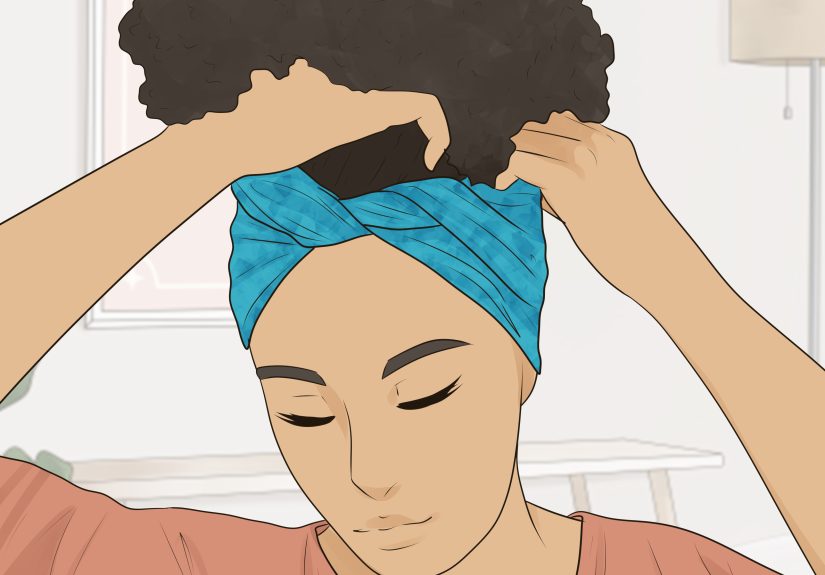
- Fold the scarf into a triangle. Lay it flat, then fold corner-to-corner.
- Position the long edge at your hairline. Place the folded edge along your forehead, with the triangle point hanging down the back of your head.
- Bring the two ends around. Pull the left and right ends back around your head and meet them either at the nape or up at the frontyour choice.
- Tie a knot that won’t annoy you. If you sleep on your back, tie near the front or side so you’re not lying directly on the knot.
- Tuck the triangle point. Tuck the back point up into the tied area or under the wrap so it’s snug.
- Optional: pin the edges. If you slip at the hairline, add a bobby pin above each temple.
Quick tips
- If you have shorter hair, keep everything flatter and use pins at the sides.
- If you have long hair, lightly twist it into a loose low bun first, then wrap.
- If your scarf leaves forehead dents, shift the edge slightly back from your hairline and loosen the knot.
Way #2: The Pineapple + Scarf Halo (curly hair’s best friend)
If your curls get crushed overnight, the pineapple method helps keep them lifted and less disturbed. Adding a scarf around the base helps keep the ponytail secure and reduces friction at the hairlinewithout flattening your curl pattern.
Best for
- Curly and wavy hair
- Preserving volume and definition
- Second- or third-day hair
How to do it
- Flip your head forward. Let your curls fall toward the floor.
- Gather hair high on your head. Aim for the crownlike a high ponytail that’s intentionally a little chaotic.
- Secure with a soft scrunchie. Keep it loose. The goal is “supported,” not “scalped.”
- Fold your scarf into a long band. Fold into a wide strip (about 4–6 inches thick).
- Wrap the band around your head at the hairline. Think of it like a headband that covers your edges and the base of the pineapple.
- Tie in front or to the side. Choose a spot that won’t bother you while you sleep.
Quick tips
- If your curls are shorter and won’t gather, try two small “mini pineapples” (one on each side) and wrap the scarf around both.
- If the ponytail stretches out overnight, use a smaller scrunchie or loop it one more timestill loose, still comfy.
- If volume is your priority, avoid flattening the curls with a full head wrap; stick to the “halo” band style.
Way #3: The Smooth “Doobie” Wrap + Scarf (for straight hair, blowouts, and silk presses)
This method is popular for keeping straightened hair sleek overnight without heat. The idea is to wrap hair around the head in a smooth circle, pin it, then cover it with a scarf so it stays in place. It looks a little mysterious (in a “spa villain” way), but it works.
Best for
- Straight hair or heat-styled hair
- Blowouts and silk presses
- Reducing dents, waves, and frizz
How to do it
- Start with dry, detangled hair. If needed, smooth lightly with a brush.
- Part your hair as you normally wear it. This helps the wrap lay correctly and look right in the morning.
- Wrap hair around your head. Brush the hair around your scalp in one direction (like you’re forming a smooth “helmet” of hair).
- Use long bobby pins or roller pins to secure. Pin along the wrap where neededusually near the sides and back.
- Cover with a scarf. Use the classic triangle wrap or a band wrap. Tie so it’s snug, then tuck in any loose ends.
- Optional: add a second scarf or a bonnet if you’re a restless sleeper. You’re not being dramaticyou’re being prepared.
Quick tips
- Use fewer pins than you think. Too many pins can create bumps you’ll see later.
- If your hair is thick, wrap in sections: top half first, then smooth the bottom half over it.
- If your hair reverts easily, keep the wrap dry and avoid heavy products at night.
Common problems (and how to fix them without starting a midnight spiral)
“My scarf falls off every night.”
- Tie it at the front (or side) and double-knot. The nape tie is comfy, but can loosen if you move a lot.
- Add a grip layer (velvet wig grip, soft headband, or even a cotton headband under the scarf).
- Use strategic pins at both temples and one at the back edge.
- Try a bigger scarf. Tiny scarves have the overnight survival rate of a cookie near a toddler.
“I wake up with dents or a headache.”
- Loosen the knot and avoid tying directly over your forehead pressure points.
- Switch to a wider band fold so the tension spreads out.
- If you’re doing the doobie wrap, reduce pin pressure and re-place pins so they’re not poking your scalp.
“My hair looks flat in the morning.”
- For curls: switch from a full wrap to the pineapple + halo scarf.
- For straight hair: keep the wrap smooth and avoid bulky knots at the back of the head.
- For waves: try a loose braid under the scarf, then shake out in the morning for soft texture.
“My edges feel stressed.”
Hair protection should never involve tight pulling. If your scarf or ponytail is tugging at your hairline, loosen it. Consider tying the scarf slightly behind the hairline and using a satin pillowcase as backup so you don’t need extreme tension to keep it on.
Extra bedtime upgrades (optional, but nice)
- Satin or silk pillowcase backup: If your scarf slides off, your hair still has a smoother surface than cotton.
- Loose braid or twists: Great for long hair and for reducing tangles.
- Light oil on ends: Helps reduce drynessespecially for curly, coily, or color-treated hair.
- Keep it clean: Wash scarves regularly. Hair products + sweat + time = not the vibe.
Morning take-down: how to unwrap without wrecking everything
- Untie gently. No yanking. You’re not starting a lawnmower.
- Let hair “breathe” for a minute. Give it 30–60 seconds to settle.
- Fluff strategically. For curls, lift at the roots with fingers or a pick. For straight hair, smooth with a soft brush.
- Refresh only where needed. A little water mist, leave-in, or a drop of oil on ends beats redoing the whole head.
Night-Scarf Experiences: What People Notice After a Week (and why it suddenly feels non-negotiable)
Most people don’t become “scarf-to-bed people” on night one. Night one is usually you standing in front of the mirror like, “This is cute,” followed by you waking up like, “Why is my scarf on the lamp?” Totally normal. A week later, though, things start to clickand the results tend to show up in small, satisfying ways.
Days 1–2: The learning curve. The first couple nights are basically training sessions. You try the classic triangle wrap, and it feels secure… until you roll over and your knot becomes a tiny rock under your cheek. So you move it to the front. Then it slips because you tied it like you were politely asking it to stay. The fix is usually simple: a double-knot, a bigger scarf, or two bobby pins at the temples. Once you solve that, your scarf starts staying put like it pays rent.
Days 3–4: “Wait… my hair is calmer.” This is when people notice the morning difference: fewer tangles, less frizz, and less time spent negotiating with a brush. Curly and wavy hair often looks more “intact,” like your curl pattern didn’t spend the night in a wrestling match. If you’re doing the pineapple + halo scarf, the biggest surprise is volumeyour curls don’t get flattened, and your roots don’t wake up plastered to your scalp. Straight-haired folks doing the doobie wrap often notice fewer weird bends and dents, especially around the ends.
Days 5–6: Styles last longer (and mornings get easier). This is the “I could actually skip a full restyle” phase. Your blowout might survive another day. Your twist-out might look like a twist-out, not a “twist-out-but-make-it-random.” People who wear braids, twists, or protective styles often realize their hair feels less fuzzy at the roots and along the lengthbecause it’s not rubbing against cotton for eight hours. This is also when you start appreciating the scarf as a moisture-friendly barrier: your ends don’t feel as crispy, and your hair looks shinier with less effort.
Day 7: You become slightly smug (in a healthy way). By the end of the week, the routine is fasttwo minutes, maybe less. You’ll probably have a favorite method (most do): classic triangle for general protection, pineapple + halo for curls, and doobie wrap for sleek styles. You also get better at the tiny details that make it work: placing the knot where it won’t bother you, folding the scarf to the right width, and choosing a scarf that feels good and stays on. And then one night you forget to wrapand the next morning you remember exactly why you started. The frizz returns like an uninvited guest, and you’re back to the scarf that night, humbled but wiser.
The best part? Wrapping your hair isn’t about perfection. It’s about stacking small advantages in your favor while you sleep. Your hair gets less friction, your style gets more life, and your mornings get a little more peaceful. Which, honestly, is the closest thing we have to magic.
Conclusion
Wrapping your hair in a scarf for bed is one of those simple habits that can make your hair look like it has its life togethereven if you absolutely do not. Choose a satin or silk scarf you’ll actually wear, prep your hair quickly, and pick the method that matches your goal: the classic triangle wrap for everyday protection, the pineapple + halo for curls and waves, or the doobie wrap for sleek styles. Once you troubleshoot slipping and knot placement, you’ll likely find your hair is smoother, less tangled, and easier to stylebecause you stopped letting your pillow run the night shift.