Table of Contents >> Show >> Hide
Baby names are tiny time capsules. Open one, and out pops a whole era: CD players, flip phones, Y2K panic, frosted lip gloss, and at least one family member insisting the computer would stop working at midnight. If you map the most popular baby names by state from the year 2000, you don’t just get a list of namesyou get a snapshot of what America sounded like at the turn of the millennium.
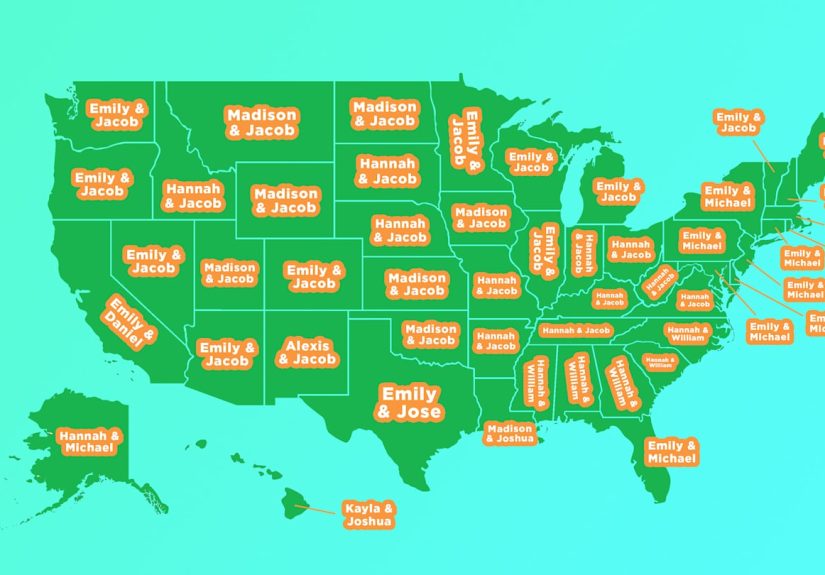
This article breaks down the state-by-state naming map for births in 2000 (the “25 years ago” reference used in many recent roundups), using Social Security baby name records as the foundation. We’ll look at which names dominated, where the outliers lived, what regional patterns stand out, and how naming culture has changed since then. Spoiler: Emily and Jacob were basically the Beyoncé and LeBron of baby names.
What This Map Actually Measures
Before we zoom in on the fun stuff, here’s the data reality check. The map is based on Social Security Administration baby name records for births in 2000, using a full sample of Social Security card application data. The SSA’s state tables list the top five names for girls and boys in each state (plus Washington, D.C.). That means this is not a poll, not a vibes-based guess, and not “my cousin’s preschool class.” It’s actual registration data.
There are two important caveats:
- The SSA suppresses very rare names in state-level files to protect privacy.
- The popular-name tools emphasize top names, so niche names don’t show up unless you use the deeper downloadable datasets.
In other words, what you’re seeing is the mainstream naming soundtrack of 2000what was broadly popular, not every inventive spelling created after a sugar-fueled trip to a baby naming book.
The 2000 State Map at a Glance
When you map the #1 name in each state for the year 2000, the pattern is striking: a small handful of names dominate nearly everything. This is especially true for boys’ names, where one name steamrolls the map.
Girls’ Top Names by State in 2000
| Name | Number of states/DC as #1 | Notable examples |
|---|---|---|
| Emily | 23 | California, Texas, New York, Pennsylvania, Washington |
| Hannah | 17 | Alabama, Georgia, Tennessee, Virginia, West Virginia |
| Madison | 8 | Iowa, Kansas, Oklahoma, Utah, Wyoming |
| Kayla | 2 | Hawaii, Washington, D.C. |
| Alexis | 1 | New Mexico |
The girls’ map is the perfect example of a transitional naming era. Emily is classic and polished. Hannah feels biblical and soft. Madison is the new-school, modern surname-style pick that defined the late 1990s and early 2000s. Put together, they tell the whole Y2K story in three names.
Boys’ Top Names by State in 2000
| Name | Number of states/DC as #1 | Notable examples |
|---|---|---|
| Jacob | 31 | Arizona, Illinois, Ohio, Oregon, Utah |
| Michael | 8 | Alaska, Florida, New York, New Jersey, Pennsylvania |
| William | 5 | Alabama, Georgia, Mississippi, North Carolina, South Carolina |
| Joshua | 2 | Hawaii, Louisiana |
| Matthew | 2 | Massachusetts, Rhode Island |
| Other one-state leaders | 3 total | Daniel (California), John (D.C.), Jose (Texas) |
If the girls’ map shows a three-name tug-of-war, the boys’ map is more like a landslide election. Jacob takes 31 states plus appears near the top almost everywhere else. It’s not just popularit’s a full-blown naming regime.
Regional Patterns You Can Actually See
A good map is more than color blocks. It reveals patterns. And the 2000 baby-name map has several.
1) The South leaned Hannah and William
In the South and parts of Appalachia, Hannah and William show serious strength. States like Alabama, Georgia, Tennessee, and the Carolinas reflect a preference for names that feel familiar, traditional, and durable. These names don’t sound flashyand that’s exactly the point. They carry a “works at any age” vibe.
It’s also a reminder that naming isn’t just trend-following. Families often choose names that fit local culture, church traditions, and multigenerational usage. In many communities, a name that feels timeless beats a name that feels trendy.
2) Coasts and big-population states helped Emily dominate
Emily wins in a broad mix of places, including large states like California, Texas, New York, and Pennsylvania. That matters because big-population states can shape the national conversation around names even when state maps show local variation.
Emily’s success also makes sense in the context of the era. It sounded classic without feeling old-fashioned, feminine without sounding overly frilly, and familiar without being boring. It was the “safe but not sleepy” pickbasically the naming equivalent of choosing a great white T-shirt that somehow works with everything.
3) Madison ruled the interior in a very 2000s way
Madison doesn’t win as many states as Emily or Hannah, but it punches above its weight in the Plains and Mountain West. In places like Iowa, Kansas, North Dakota, Oklahoma, Utah, and Wyoming, Madison’s modern surname energy really lands.
This is peak late-90s/early-2000s naming style: polished, upbeat, and a little preppy. Madison’s rise also fits the broader story of surname-style and gender-flexible names gaining momentum in the modern era.
4) Texas and California stand out on the boys’ side
Two of the biggest state-level outliers for boys are impossible to miss:
- California: Daniel is #1, with Anthony and Jose also in the top five.
- Texas: Jose takes the top spot, with Jacob, Joshua, Michael, and Christopher close behind.
These aren’t random quirks. They reflect the demographic makeup of the period, especially in states with large Hispanic populations. Census 2000 data shows how concentrated Hispanic populations were in the West and South, with especially large numbers in California and Texas. Naming patterns don’t map one-to-one onto demographics, but the connection is absolutely visible in the regional data.
5) D.C. and Hawaii did their own thing
Washington, D.C. and Hawaii look like they got the “regional uniqueness” memo before everyone else. In 2000:
- D.C. had Kayla for girls and John for boys.
- Hawaii had Kayla for girls and Joshua for boys.
Hawaii’s girls’ top five is especially memorable, including names like Kiana. It’s a nice reminder that state maps can reveal local flavor even in years dominated by national mega-names.
Why These Names Won in 2000
Baby names become popular for a mix of reasons: sound, culture, family influence, religion, media, and timing. The year 2000 sits at a fascinating crossroads, where old-school favorites and modern “rising” names shared the spotlight.
Classic names were still running the room
On the boys’ side, names like Michael, William, Matthew, and Joshua show how strong classic naming still was. Even when Jacob dominates, the backup names are mostly traditional. This fits the longer SSA trendline: male names tend to change more slowly at the top.
In fact, the SSA’s long-range view notes that Michael held the #1 spot more often than any other male name across the last 100 years. By 2000, Michael wasn’t always #1 anymore, but it still had serious chart power.
Girls’ names were shifting faster
The girls’ map feels more transitional because it was. Names like Emily and Hannah were strong, but Madison represented a newer style that had exploded in the late 1990s. And just behind the leaders, you can already see the 2000s future: Emma, Olivia, Isabella, Alexis, and Abigail.
That tracks with later decade data too. Across the 2000s, the SSA’s most popular girls’ names included Emily, Madison, Emma, Olivia, and Hannahbasically the exact cast you’d expect from this state map. The map is the trailer; the decade rankings are the full movie.
Pop culture and media didn’t choose everything, but they amplified trends
Pop culture rarely invents a top baby name from scratch, but it often pours gasoline on a spark that’s already there. Later trend coverage has pointed to how TV, celebrities, and social media influence names across eras. That helps explain why some names linger or accelerate after they break into the mainstream.
In the 2000s, names like Jacob, Madison, Emma, and Olivia had the perfect formula: familiar roots, easy spelling, broad appeal, and a “current” sound. They worked in preschool, on a college diploma, and on a future law-firm nameplate. Parents love versatility almost as much as grandparents love saying, “We had that name in the family already.”
Then vs. Now: What Changed in American Baby Names
Here’s where the map gets really interesting. Compare the year 2000 state map to modern baby-name rankings, and one big pattern jumps out: today’s naming culture is more varied.
The top names are still popular, but the field is wider
The SSA’s current national top 10 (for 2024) is led by Olivia and Liam, with familiar names like Emma, Amelia, Noah, and Oliver close behind. Some names from the 2000 map are still in the mixespecially Emma, Olivia, and Isabellabut the balance has shifted.
Newer state-level coverage also shows more geographic variety now than you’d expect from the 2000 map. For example, recent state-by-state lists show names like Oliver, Ezra, Waylon, and Santiago appearing in state top rankings, which feels much more diverse than the “Jacob Everywhere Tour” of 2000.
Girls’ names continue to evolve faster
Trend analysts keep noticing the same thing: girls’ naming trends often move faster and more dramatically than boys’ names. That pattern shows up in modern data stories and trend reports, and you can already see the early version of it in 2000. The girls’ map has more stylistic movement, while the boys’ map leans heavily classic.
Modern naming trend reports also show parents borrowing inspiration from everywherenature, pop culture, vintage revivals, global naming styles, and gender-neutral picks. In other words, the 2000 map looks cohesive because it came from a more concentrated naming era; today’s map looks more like a playlist with 17 genres and somehow it still works.
How to Read a Baby Name Map Like a Pro
If you’re using this topic for content, research, or even baby naming inspiration, don’t just look for the #1 name. Look for the patterns under it:
- Dominance: How many states does one name control?
- Clusters: Does a name trend in the South, Northeast, or West?
- Outliers: Which states break from the national pattern?
- Future clues: Which names in the top five later become national #1 names?
- Cultural context: What demographic or linguistic factors might shape regional favorites?
The 2000 map is a great case study because it has all of these features: a massive boys’ #1 (Jacob), a three-way girls’ race (Emily/Hannah/Madison), and standout states like California, Texas, Hawaii, and D.C. that immediately make you ask, “Okay, what’s going on there?” That’s exactly what a good map should do.
Common Experiences People Have When They See This 2000 Baby Name Map
There’s a reason baby-name maps get shared so much: they trigger instant recognition. People don’t just read a name like Emily or Jacob and think “statistics.” They think, “That was my class.” And honestly, that reaction is the best part of the whole topic.
One common experience is the classroom flashback. Someone sees the 2000 map and immediately remembers a third-grade attendance sheet that sounded like a roll call for this exact article: Jacob, Michael, Matthew, Emily, Hannah, Madison. Then they remember the chaos that followed. Which Jacob? “Jacob S. or Jacob M.?” Which Emily? “Tall Emily or soccer Emily?” If you grew up in that era, duplicate names weren’t a possibilitythey were a scheduling issue.
Another experience is family recognition. Parents and grandparents often react to these maps by realizing how much naming decisions are shaped by the moment, even when they felt deeply personal at the time. A parent might say, “We didn’t choose Hannah because it was popular. We just liked it.” And they’re probably telling the truth. That’s how trends work: they don’t feel like trends while you’re living inside them. They feel like independent decisions that somehow thousands of other people are also making.
There’s also a regional pride effect. People love spotting their state and noticing whether it followed the national pattern or went rogue. Californians see Daniel and nod. Texans see Jose at #1 for boys and say, “Yep, that tracks.” Hawaiians notice Kayla and Joshua and feel the local flavor. New Mexico jumps out with Alexis for girls. These moments turn a data graphic into a conversation about identity, migration, language, and community.
For younger parents and name nerds, the map creates a different kind of experience: the nostalgia-vs.-freshness debate. Some people look at 2000 names and think, “No way, that’s too millennial.” Others think, “Wait… Emily actually sounds classy again.” That tension is exactly how naming cycles work. A name can go from overused to dated to charming again, and the timeline is shorter than most people expect.
Content creators have their own version of this experience too: pattern hunting. Once you start comparing state maps across years, you can’t stop. You notice when a name goes national, when it retreats to a region, and when an “outlier” quietly becomes mainstream a decade later. It’s part sociology, part linguistics, part pop culture, and part detective work.
And maybe the most universal reaction of all is simple: people laugh. Not because the data is silly, but because it’s weirdly intimate. A map of baby names shouldn’t feel like a memory machineand yet it does. It brings back school photos, youth sports rosters, mall food courts, and old yearbooks. It reminds us that every era has a naming soundtrack, and if you were born around 2000, there’s a very good chance your name was on heavy rotation.
Conclusion
The state-by-state baby name map for births in 2000 is more than a curiosityit’s a compact cultural history of the United States at the turn of the millennium. Emily, Hannah, Madison, and Jacob didn’t just top charts; they defined a generation’s first names in classrooms, sports teams, and yearbooks across the country.
What makes this map so useful (and so shareable) is the combination of scale and nuance. National trends explain the big picture, but the state-level winners reveal local identity: California and Texas look different from New England, the South has its own rhythm, and places like Hawaii and D.C. leave distinct signatures.
And when you compare it to today’s naming trends, you can see the shift clearly: modern names are more diverse, more stylistically experimental, and more influenced by a wider range of cultural inputs. But the core truth hasn’t changedparents still want names that feel right for their family, their moment, and the future they imagine.