Table of Contents >> Show >> Hide
- What osteoporosis actually changes
- What Pilates does well for people with osteoporosis
- What Pilates does not do especially well
- Is Pilates safe for osteoporosis?
- Movements that may be risky in Pilates for osteoporosis
- Safer Pilates strategies for people with osteoporosis
- Who should talk to a healthcare professional before starting?
- How Pilates fits into the best exercise plan for osteoporosis
- What a bone-smart Pilates session might look like
- Experiences people commonly have with Pilates and osteoporosis
- Final verdict: Is Pilates good for osteoporosis?
If your doctor just said the word osteoporosis and your brain immediately replied, “Cool, so am I still allowed to move like a normal human?” welcome. That is a very reasonable question. And if Pilates is your exercise of choice, or the only workout that doesn’t make you feel like you’re auditioning for a sports drink commercial, you may be wondering whether Pilates is helpful, risky, or somewhere in the awkward middle.
The good news is that Pilates for osteoporosis can absolutely have a place in a smart exercise routine. It may improve posture, balance, body awareness, core strength, flexibility, and confidence. That matters because stronger muscles, better coordination, and fewer falls can lower fracture risk over time. The not-so-magical news? Pilates is not a cure, and it is not usually the best standalone method for building bone density. Some common Pilates movements also need to be modified or avoided when bones are fragile.
In other words, Pilates is not the villain, and it is not a fairy godmother either. It is a tool. Used well, it can be helpful. Used carelessly, it can be risky. This guide breaks down the real benefits, safety tips, and risks of Pilates for osteoporosis, plus how to make a Pilates routine more bone-smart and less spine-angry.
What osteoporosis actually changes
Osteoporosis makes bones weaker and more likely to break, especially in the spine, hip, and wrist. It becomes more common with age, particularly after menopause, but men can develop it too. Many people do not realize they have it until a scan shows low bone density or a fracture happens after what seemed like a minor movement or fall.
That last part is what makes exercise advice tricky. With osteoporosis, movement is still important really important but the exercise needs to match the person’s bone health, fall risk, pain level, fracture history, and technique. A workout that feels “light” can still be a bad idea if it repeatedly rounds the spine forward under load. A workout that looks simple can be surprisingly useful if it improves posture, leg strength, and balance.
That is exactly where Pilates enters the chat.
What Pilates does well for people with osteoporosis
Pilates focuses on controlled movement, alignment, breathing, core activation, and body awareness. Depending on the class, it may involve mat work, small props, or equipment such as a reformer. For people with osteoporosis, that can offer several meaningful advantages.
1. It can improve posture
Posture is not just a “sit up straight” lecture from the universe. In osteoporosis, posture matters because spinal compression fractures and age-related changes can contribute to a rounded upper back, forward head position, and reduced spinal stability. Pilates often emphasizes spinal alignment, shoulder positioning, and trunk control, which may help people stand taller, move more efficiently, and reduce the slumped shape that puts extra stress on the spine.
2. It can strengthen muscles that protect movement
Pilates does not simply target “abs.” Good Pilates trains the trunk, hips, glutes, back, and legs to work together. That can help with getting out of a chair, climbing stairs, carrying groceries, and staying steady on uneven ground. Stronger muscles do not make brittle bones invincible, but they do improve support and movement quality, which is a big deal for daily function.
3. It can improve balance and reduce fall risk
One of the biggest dangers in osteoporosis is not just bone loss itself. It is the fall that turns bone loss into a fracture. Pilates often includes single-leg stability work, controlled transitions, foot awareness, and coordination. These may improve balance and confidence, which can help lower the risk of falls.
4. It may help pain, mobility, and quality of life
Research on Pilates in people with low bone density is still limited, but some studies and reviews suggest it may improve pain, physical function, and quality of life. That does not mean everyone will suddenly float out of class feeling ten years younger and emotionally repaired by core engagement. But it does suggest Pilates can support day-to-day comfort and movement when appropriately modified.
5. It tends to be approachable
Not everyone wants to deadlift. Not everyone should. Pilates often appeals to people who want structured movement without pounding, jumping, or high-speed chaos. That matters because the best exercise plan is not just scientifically respectable. It also has to be something you can keep doing.
What Pilates does not do especially well
Here is the honest part: Pilates is not usually the top exercise for increasing bone mineral density. Bone responds best to mechanical loading especially weight-bearing exercise, resistance training, and impact that is appropriate for the individual’s risk level. Walking, stair climbing, resistance work, and supervised strength training often do more for bone loading than a gentle mat class.
That does not make Pilates useless. It just means it works best as part of a broader osteoporosis exercise plan, not as the whole plan. Think of Pilates as the excellent coworker who handles posture, control, and balance, while resistance training and weight-bearing activity handle more of the heavy bone-building workload.
Is Pilates safe for osteoporosis?
Yes, Pilates can be safe for osteoporosis with the right modifications, the right instructor, and the right exercises. The biggest issue is that many traditional Pilates movements involve spinal flexion, rolling, or twisting, which may not be ideal for people with low bone density, osteopenia, or vertebral fracture risk.
Safety depends on questions like these:
- Do you have osteoporosis, osteopenia, or a history of fragility fracture?
- Have you had a spine fracture or significant height loss?
- Are you in pain now?
- Is the class general fitness, or is it adapted for bone health?
- Does the instructor understand osteoporosis precautions?
- Can you maintain neutral alignment and control, or are you forcing range of motion?
If those questions are being taken seriously, Pilates becomes much safer. If nobody in the room knows your diagnosis and everyone is doing roll-ups like synchronized gymnasts from 2008, that is not ideal.
Movements that may be risky in Pilates for osteoporosis
This is the section people usually want in plain English: what should you be careful with?
Forward bending of the spine
Repeated or loaded spinal flexion is one of the biggest concerns. In practical terms, that means exercises where the back rounds deeply forward, especially against resistance or momentum. Examples may include:
- Roll-ups
- Roll-overs
- Teaser variations with spinal rounding
- Crunches or curl-ups performed aggressively
- Toe-touching with a rounded spine
These are classic crowd-pleasers in some Pilates classes, but for someone with osteoporosis, they may increase stress on the front of the vertebrae and raise fracture risk.
Forceful twisting
Twisting is not automatically forbidden, but end-range or forceful spinal rotation can be risky, especially when combined with flexion. The spine prefers respect. Not drama.
High-impact or jerky transitions
Fast, uncontrolled movements, jumping-based sequences, or anything that feels unstable can be a problem if balance is limited or fracture risk is high.
Exercises that encourage poor alignment
Even safe-looking exercises can become risky if you are collapsing through the spine, jutting the head forward, gripping the neck, or using momentum instead of control. Technique matters a lot more than exercise names.
Safer Pilates strategies for people with osteoporosis
A bone-friendly Pilates approach does not need to be boring. It just needs to be smarter.
Prioritize neutral spine
Choose exercises that encourage a long spine rather than a rounded one. Gentle core work in neutral, supported bridging, hip strengthening, postural retraining, and scapular stabilization are often better choices.
Focus on extension and upright work
Back extensor strength is especially valuable in osteoporosis. Exercises that gently strengthen the muscles along the back and help counter forward posture may be useful when done correctly.
Train hips, legs, and glutes
These muscle groups matter for walking, standing, climbing stairs, and balance recovery. Side-lying leg work, sit-to-stand training, heel raises, and controlled standing exercises can all support function.
Use equipment only if the setup is appropriate
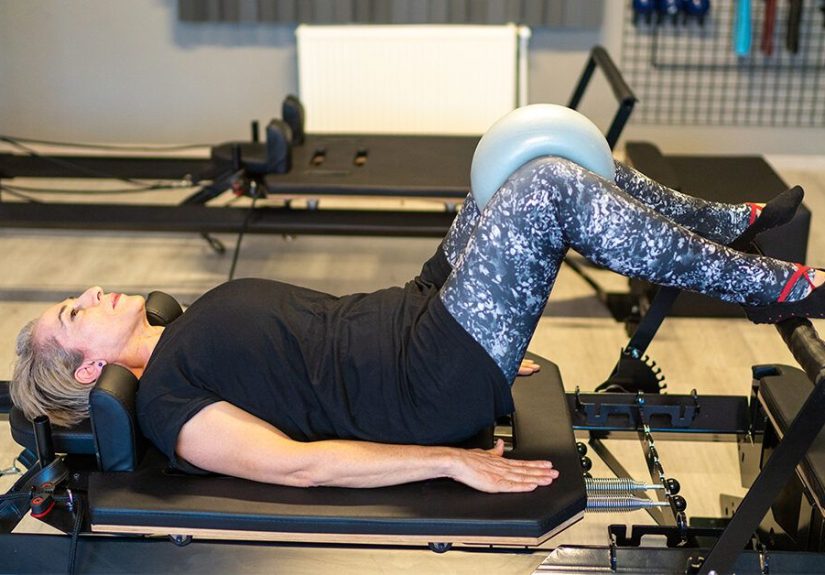
Reformer Pilates can be helpful, but equipment is not automatically safer just because it looks expensive and polished. Springs add resistance. Resistance adds demands. A knowledgeable instructor should select exercises that match your diagnosis and skill level.
Start with private sessions if possible
If you are newly diagnosed, have pain, or have had fractures, a one-on-one session with a physical therapist or Pilates instructor experienced in osteoporosis can be far better than jumping into a large mixed-level class.
Who should talk to a healthcare professional before starting?
Honestly, most people with diagnosed osteoporosis should check in before beginning a new exercise program. That is especially true if you:
- Have had a vertebral compression fracture
- Have severe osteoporosis or very low T-scores
- Have significant back pain
- Feel unsteady or have fallen recently
- Have other conditions affecting movement, such as arthritis, neurologic disease, or recent surgery
- Are unsure whether your current class is safe
A physician or physical therapist can help determine what movements are appropriate, what to avoid, and whether you need supervised progression.
How Pilates fits into the best exercise plan for osteoporosis
If you want the most practical answer, here it is: the best exercise program for osteoporosis usually combines multiple types of exercise.
- Weight-bearing activity: walking, stair climbing, or other upright activity
- Resistance training: weights, bands, or supervised strength work
- Balance training: to reduce falls
- Posture and movement training: where Pilates can shine
That means Pilates may be one very useful pillar of your routine, especially for movement quality, trunk control, and confidence. But if your only weekly exercise is one gentle mat class and a vague intention to stand better at the sink, your bones may want a little more from the arrangement.
What a bone-smart Pilates session might look like
A safer session for someone with osteoporosis might include breathing work, posture cues, standing alignment drills, hip and glute strengthening, supported leg exercises, balance challenges near a stable surface, gentle back extension, and neutral-spine core training. It may skip dramatic roll-downs, loaded flexion, aggressive twists, and any move that causes pain or loss of control.
It should also feel progressive, not punishing. Good instruction makes you feel worked, not wrecked.
Experiences people commonly have with Pilates and osteoporosis
Many people who try Pilates after an osteoporosis or osteopenia diagnosis go through the same emotional arc. First comes panic: “Can I still exercise?” Then confusion: “Why does one website say movement helps, while another basically tells me not to sneeze with enthusiasm?” Then, if they find a good teacher or physical therapist, something better happens: movement starts to feel possible again.
One of the most common experiences is improved body awareness. People often say Pilates teaches them how to move with more intention. Instead of folding forward from the waist to pick something up, they learn to hinge at the hips, bend the knees, and keep the spine long. Instead of yanking themselves out of bed like a magician escaping a trunk, they learn safer transitions. That kind of daily-life awareness can be just as valuable as the class itself.
Another frequent experience is increased confidence. Osteoporosis can make people afraid of movement, and that fear is understandable. A diagnosis that involves “your bones are weaker than you’d like” does not exactly inspire spontaneous cartwheels. Pilates, when adapted well, often helps people feel steadier and more in control. They notice they can stand longer, walk with better posture, and feel less fragile doing ordinary tasks.
Some people also report less back discomfort, less stiffness, and better breathing mechanics. That may be partly because Pilates encourages trunk strength and alignment, and partly because regular movement often makes the whole body feel less rusty. For older adults especially, improved balance can be a major win. Feeling more stable when turning, climbing stairs, or stepping over clutter is not glamorous, but it is deeply practical.
That said, not every experience is positive right away. Some people discover that a standard Pilates class includes too many flexion-heavy exercises, too much speed, or cues that do not fit their bone health needs. Others realize that an instructor may be talented but not trained in osteoporosis precautions. When that happens, the class can feel stressful instead of supportive. People may leave wondering whether Pilates is “bad” for them, when the real problem was often the program design, not Pilates itself.
There is also the expectation issue. Some people begin Pilates hoping it will dramatically rebuild bone density on its own. Usually, that is not how the story goes. The people who seem to do best often treat Pilates as one part of a larger plan that also includes resistance training, weight-bearing activity, adequate nutrition, medical follow-up, and fall prevention. In that role, Pilates can be excellent. It helps many people move better, trust their bodies more, and stay active enough to support long-term bone health.
So the lived experience is often less about “Pilates fixed my osteoporosis” and more about “Pilates helped me feel stronger, steadier, and less afraid.” And honestly, that is not a small thing. When exercise feels safe and sustainable, people are more likely to stick with it. And in the world of bone health, consistency beats heroic one-week motivation every single time.
Final verdict: Is Pilates good for osteoporosis?
Pilates can be good for osteoporosis when it is modified appropriately. Its biggest strengths are posture, balance, controlled strength, movement quality, and confidence. Its biggest limitation is that it usually does not provide the same bone-loading stimulus as more targeted weight-bearing and resistance exercise. Its biggest risk is that traditional flexion-heavy or twisting exercises may be unsafe for people with fragile bones, especially in the spine.
So yes, Pilates can belong in an osteoporosis routine. Just do not hand it the entire job description. Pair it with resistance work, regular upright activity, and professional guidance when needed. Your bones are asking for smart loading, not blind loyalty to one workout style.
And if a class tells you to do ten fast roll-ups while you have known spinal osteoporosis, that is your cue to channel your inner mature adult and say, “No thanks, my vertebrae have standards.”