Table of Contents >> Show >> Hide
- What Is the Meteor-M Weather Satellite Series?
- Why Meteor-M No.2-3 Got Hobbyists Excited
- Meteor-M No.2-4: Another Weather Eye in Orbit
- How Weather Satellite Images Reach Everyday Listeners
- LRPT vs. NOAA APT: Why Meteor Images Feel Different
- Why This Matters Beyond the Hobby
- Specific Examples of What Users Can See
- Common Problems When Receiving Meteor-M Images
- Why Reused Satellite Names Are Not as Weird as They Sound
- The Bigger Picture: Weather Data in a Changing World
- Experience Section: Lessons From Chasing a Russian Weather Satellite Signal
- Conclusion
Some satellite names sound like polished science fiction: Voyager, Landsat, Aqua, Terra. Others sound like somebody opened a filing cabinet, shrugged, and said, “Meteor-M No.2-3 should do.” Yet behind that wonderfully bureaucratic name is a surprisingly exciting story: a Russian weather satellite series with reused names, fresh launches, open radio signals, and images that ordinary people can pull from space with budget hardware and a little patience.
The phrase “Russian Weather Satellite Reuses Name, Yields Images” points to a real corner of the satellite hobby world: the Meteor-M series, especially Meteor-M No.2-3 and Meteor-M No.2-4. These spacecraft are part of Russia’s polar-orbiting meteorological fleet, designed to observe clouds, oceans, land, snow, ice, and the atmosphere. The fun twist is that “Meteor 2” has been attached to multiple spacecraft across the family, which can make the naming feel like a sequel series where every movie is somehow called Part Two.
For weather watchers, radio hobbyists, educators, and curious makers, the real magic is not the naming puzzle. It is the fact that these satellites can transmit Earth imagery directly down to the ground. With a software-defined radio, a proper antenna, tracking software, and decoding tools, a person standing in a backyard can receive data from a satellite hundreds of miles overhead. That is not just cool. That is “tell everyone at dinner even if they did not ask” cool.
What Is the Meteor-M Weather Satellite Series?
Meteor-M satellites are Russian polar-orbiting weather satellites built for operational meteorology and environmental monitoring. Unlike geostationary satellites that hover over one region from far above the equator, Meteor-M spacecraft fly in low Earth orbit, circling the planet from pole to pole. As Earth rotates beneath them, each pass reveals a new strip of the planet.
This orbit style is valuable because it allows regular coverage of large areas, including high-latitude regions that geostationary satellites see at awkward angles. Polar-orbiting satellites are especially useful for tracking storm systems, sea ice, snow cover, cloud patterns, vegetation, ocean conditions, and other environmental details. Meteor-M belongs to the same broad weather-observation universe as NOAA’s POES and JPSS programs, Europe’s Metop satellites, and other Earth-observing missions.
Why the Name Gets Confusing
The “reuses name” part comes from the way the Meteor-M No.2 line has been labeled. There is Meteor-M No.2, Meteor-M No.2-2, Meteor-M No.2-3, Meteor-M No.2-4, and so on. To a space agency, this is a logical sequence of flight units. To a normal human, it sounds as if someone named every dog in the neighborhood “Buddy,” then added numbers after the vet complained.
The confusion gets even stronger because hobbyists often shorten these names. Meteor-M No.2-3 becomes Meteor M2-3. Meteor-M No.2-4 becomes Meteor M2-4. Older discussions may refer simply to “Meteor M2,” which can mean a specific older spacecraft or the broader generation depending on context. For searchers trying to find setup guides, frequencies, or pass reports, that little naming tangle matters.
Why Meteor-M No.2-3 Got Hobbyists Excited
Meteor-M No.2-3 launched in June 2023 from the Vostochny Cosmodrome. After launch, satellite hobbyists quickly began watching for its signals. The reason was simple: earlier Meteor satellites had developed problems, and people missed the thrill of receiving clean digital weather images directly from orbit.
When Meteor-M No.2-3 began transmitting LRPT imagery, it became a fresh target for the software-defined radio community. LRPT stands for Low Rate Picture Transmission, a digital weather-image broadcast format. Unlike NOAA’s older analog APT signals, LRPT can provide multi-channel image data with a sharper, more modern look. It is still “low rate” compared with high-end professional satellite data streams, but do not let the phrase fool you. For a backyard antenna project, the results can look fantastic.
Many hobbyists used RTL-SDR dongles, Raspberry Pi setups, SatDump, and simple satellite antennas to record passes and decode images. The workflow often looked like this: predict the satellite pass, record the signal while the spacecraft crosses the sky, run the recording through decoding software, and watch an image of Earth appear line by line. It is part science, part radio craft, and part waiting for the clouds to stop being rude.
Meteor-M No.2-4: Another Weather Eye in Orbit
Meteor-M No.2-4 launched on February 29, 2024, which already gives it a charming space-history footnote: a leap-day launch. It flew on a Soyuz-2.1b/Fregat-M mission from Vostochny with additional small satellites riding along. Soon after launch, reports indicated that its instruments had begun returning first images, including data from its MSU-MR scanner and KMSS imaging system.
Like other Meteor-M satellites, No.2-4 was built for hydrometeorology, climate monitoring, ocean and land observation, and space-weather-related work. In plain English, it helps observe the moving, messy, beautiful system we call Earth. Its data can support weather analysis, environmental monitoring, and broader scientific understanding.
For radio hobbyists, the big question was whether Meteor-M No.2-4 would transmit decodable LRPT images. During early operations, there were periods when transmitters appeared off or inconsistent, which caused plenty of speculation. In the satellite hobby world, a quiet signal can produce more rumors than a group chat at midnight. Later explanations pointed to testing and instrument work rather than immediate mission failure. That distinction matters: new spacecraft often go through commissioning, calibration, transmitter changes, and operational checks before settling into routine service.
How Weather Satellite Images Reach Everyday Listeners
The basic idea is elegant. A weather satellite scans Earth while passing overhead and broadcasts selected data toward the ground. A receiver on Earth captures the radio signal. Software then demodulates, corrects, and decodes the data into an image.
For the Meteor-M series, hobby-level reception usually focuses on VHF LRPT signals around the 137 MHz band. Frequencies can change, and users must check current pass and frequency information before attempting reception. Typical setups include a V-dipole, turnstile, or quadrifilar helix antenna; an SDR receiver; optional filtering and amplification; and software such as SatDump. The satellite is moving fast, so Doppler shift, antenna placement, timing, and local radio interference all affect results.
The payoff is worth the tinkering. A successful image can show coastlines, cloud bands, snowfields, deserts, mountain ranges, storm spirals, and ocean textures. It feels different from downloading a satellite picture from a website. You did not just look at an image. You caught it from space as it flew over your roof.
LRPT vs. NOAA APT: Why Meteor Images Feel Different
NOAA’s classic APT weather satellite transmissions became legendary among radio hobbyists because they were forgiving and accessible. APT is analog, and even imperfect reception can produce recognizable cloud images. Many beginners started with NOAA-15, NOAA-18, and NOAA-19 because the equipment requirements were modest and the signals were robust.
LRPT is different. It is digital, which means it can deliver cleaner multi-channel imagery when the signal is strong, but it may also fail more abruptly when reception is poor. Think of analog APT as a scratched but readable postcard. LRPT is more like a digital photo file: beautiful when complete, cranky when bits go missing.
That tradeoff is part of the challenge. Meteor-M images can look sharper and more colorful than basic NOAA APT captures, especially after proper channel composition. But they reward careful setup. Good antenna orientation, a low-noise signal path, clear sky view, accurate satellite tracking, and correct decoder settings can make the difference between a gorgeous Earth portrait and a digital lasagna.
Why This Matters Beyond the Hobby
At first glance, receiving Russian weather satellite images may sound like a niche pastime for people who own too many adapters. It is that, lovingly. But it is also a powerful demonstration of open science, radio literacy, and Earth observation.
Weather satellites are not abstract machines. They help society understand storms, drought, floods, ice, ocean temperatures, wildfire smoke, vegetation health, and atmospheric structure. The same basic principles that let agencies monitor global weather also let students and hobbyists experience remote sensing firsthand. A backyard satellite station turns invisible infrastructure into something tangible.
There is also educational value. A Meteor-M reception project teaches orbital mechanics, radio frequency behavior, antennas, modulation, data compression, image processing, and meteorology. That is a full STEM buffet, and nobody even had to say “synergy.”
Specific Examples of What Users Can See
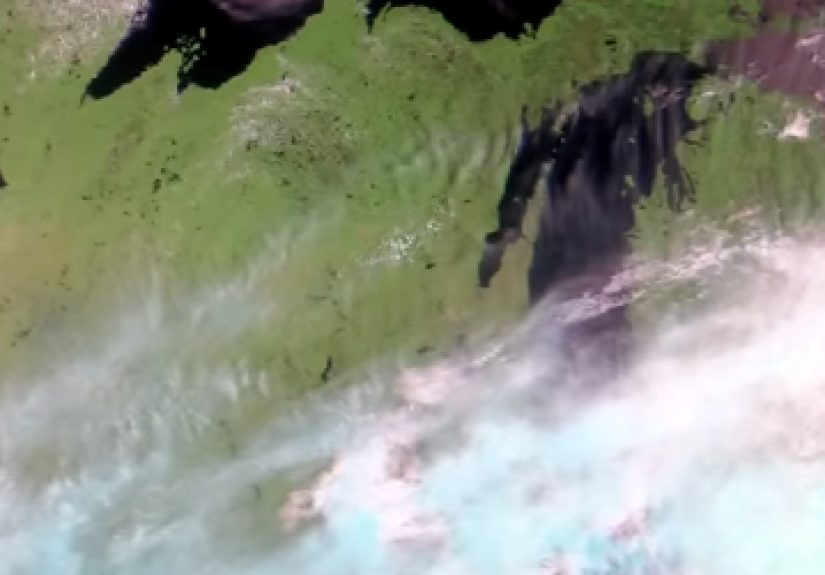
A successful Meteor-M pass may reveal a long swath of Earth beneath the satellite’s track. Over North America, a listener might see the curve of the Great Lakes, cloud streets over the plains, snow cover in the Rockies, or the swirl of a developing storm system. Over Europe, a pass may show the Mediterranean, the Alps, the Baltic region, or broad Atlantic cloud shields. Near polar regions, sea ice and snow boundaries can stand out dramatically.
Color composites depend on which channels are active and how the decoder maps them. Some images emphasize natural-color land and cloud features. Others highlight infrared or near-infrared details. The result is not always a postcard-perfect NASA press image, but that is part of the charm. These pictures are raw, local, and earned.
Common Problems When Receiving Meteor-M Images
1. Weak Signal
A weak signal usually comes from poor antenna placement, too much coax loss, low satellite elevation, or local interference. Raising the antenna, shortening cable runs, adding a proper low-noise amplifier, or choosing higher-elevation passes can help.
2. Wrong Frequency or Mode
Meteor-M satellites may use different frequencies or switch modes during testing. Always verify the current frequency, symbol rate, and modulation settings before recording. Yesterday’s perfect settings can become today’s mysterious silence.
3. Doppler Shift
Because the satellite is moving rapidly relative to the ground station, the received frequency shifts slightly during the pass. Some software handles this automatically; other setups require manual correction or wider recording bandwidth.
4. Decoder Confusion
Digital satellite decoding depends on correct software settings. If the selected pipeline, symbol rate, or channel configuration is wrong, the image may fail even if the recording contains a real signal. The radio gods are strict but not unfair.
Why Reused Satellite Names Are Not as Weird as They Sound
Space programs often use family names for generations of spacecraft. NOAA, GOES, Landsat, Meteor, Metop, Sentinel, and many others follow naming patterns that combine program identity with unit numbers. The name tells engineers, mission planners, and catalog systems where a spacecraft belongs in the larger fleet.
So while “Meteor-M No.2-4” may not win a poetry contest, it communicates lineage. It says this is a Meteor-M spacecraft, part of the No.2 generation, and a later flight unit in that line. For a satellite catalog, that is useful. For a blog title, it is comedy gold.
The Bigger Picture: Weather Data in a Changing World
Weather satellites are more important than ever. Extreme weather, climate variability, changing ice conditions, and growing demand for accurate forecasts all increase the value of satellite observation. No single nation’s satellite system sees everything perfectly. Global weather monitoring depends on a web of spacecraft, ground stations, data-sharing systems, forecasters, researchers, and engineers.
Meteor-M is one part of that web. Its existence also reminds us that weather does not respect borders. A storm system can form over an ocean, cross a continent, disrupt aviation, flood communities, and alter shipping routes. Satellites provide the wide-angle view humans need to prepare, respond, and learn.
Experience Section: Lessons From Chasing a Russian Weather Satellite Signal
Anyone who has tried to receive a weather satellite learns the first lesson quickly: space is punctual, but humans are not. The satellite pass starts whether your laptop is updated, your cable is connected, your battery is charged, or your neighbor has decided this exact minute is ideal for running noisy equipment. That is part of the adventure.
A typical Meteor-M reception session begins with planning. You check pass predictions and look for a high-elevation pass, because a satellite skimming the horizon gives you more atmosphere, more buildings, more trees, and more reasons to grumble. A pass that climbs high overhead is your best friend. It gives the antenna a clearer view and the receiver a stronger signal.
Then comes the hardware ritual. The antenna goes outside or near a clear window. The SDR connects to the computer. The software opens. The gain is adjusted. The frequency is checked twice because nobody wants to record seven minutes of very confident wrongness. If you use a Raspberry Pi, you may record the pass first and decode later. If you use a more powerful computer, you might decode live and enjoy the drama in real time.
When the satellite rises above the horizon, the waterfall display begins to show a signal. It may be faint at first, then stronger as the spacecraft climbs. At that moment, the project stops feeling theoretical. A machine built in another country, traveling around Earth at orbital speed, is sending radio energy into your antenna. It is hard not to grin.
The pass lasts only minutes. During that time, every little detail matters. If the antenna is directional, you track the satellite’s path across the sky. If it is fixed, you hope your pattern is forgiving. Wind may move the antenna. A cable may wiggle. Software may freeze because computers enjoy comic timing. Still, the signal continues, indifferent and magnificent.
After the pass, decoding begins. This is where patience becomes a scientific instrument. Sometimes the first output looks like a clean satellite image, and you feel like a wizard with a USB dongle. Other times the image is broken, striped, or missing chunks. You inspect the recording, adjust settings, try another decoder pipeline, and learn a little more each time. Failure is not the opposite of success here. It is the tutorial.
The first recognizable image is unforgettable. Maybe it shows a coastline you know. Maybe it captures a cloud deck stretching across several states. Maybe it reveals snow in mountains you have driven through. The image is not just data; it is a receipt from orbit. You asked the sky a question, and the sky answered in pixels.
Over time, the experience becomes addictive in the best possible way. You start checking satellite passes the way other people check sports schedules. You learn which parts of your yard have the cleanest radio view. You discover that cheap coax can be a villain. You learn that “low-resolution” is a humble phrase for imagery that can still make your jaw drop. You also develop deep opinions about antenna mounts, which is how every respectable hobby quietly becomes a hardware problem.
The best part is that the project scales. A beginner can start with a modest SDR and a simple antenna. A more serious hobbyist can add better filtering, automated scheduling, improved antennas, rotators, and image processing workflows. Educators can turn the activity into a classroom demonstration of Earth science and radio communication. Makers can build automated receiving stations that collect passes while they sleep. The satellite does the flying; you do the listening.
That is why Meteor-M No.2-3 and Meteor-M No.2-4 matter to more than catalog watchers. They keep alive the thrill of direct weather satellite reception. They prove that space does not have to be distant, sealed away, or reserved only for institutions. Sometimes, it arrives at 137 MHz, passes overhead for a few minutes, and leaves behind a picture of Earth that you caught yourself.
Conclusion
The story of a Russian weather satellite reusing a name and yielding images is more than a quirky headline. It is a window into how modern meteorological satellites work, how naming systems can confuse newcomers, and how accessible space technology has become for everyday experimenters. Meteor-M No.2-3 and Meteor-M No.2-4 show that serious Earth observation and hands-on curiosity can overlap beautifully.
Yes, the names are clunky. Yes, the setup can be fussy. Yes, the first decoded image may look like it lost an argument with a barcode. But when everything lines up, a weather satellite flying hundreds of miles above Earth can deliver a fresh view of clouds, land, ocean, and ice directly to a small receiver on the ground. That is not just a technical achievement. It is a reminder that the planet is constantly broadcasting its story, and with the right tools, we can listen.
Note: This article is based on synthesized public information from reputable satellite, meteorology, spaceflight, amateur radio, and Earth-observation sources, including U.S.-based and international reference materials. No raw source links or unnecessary citation artifacts are included in the publishable HTML body.