Table of Contents >> Show >> Hide
- Why Neighborhood Safety Is a Health Issue (Not Just a Crime Issue)
- What “Safe” Actually Means (Hint: It’s More Than Police or Patrol Cars)
- How We Got Here: History Still Lives on the Block
- How Unsafe Neighborhoods Increase Health RisksStep by Step
- What Actually Works: Safer Blocks Without the Fantasy Solutions
- Safety Without Displacement: The “Don’t Fix It and Flip It” Rule
- What You Can Do (Even If You’re Not a Mayor, a Surgeon, or Batman)
- Experiences: What Safety Feels Like in Real Life (And Why It Changes Everything)
- Conclusion
If “location, location, location” is the real-estate mantra, public health’s version is:
“zip code, zip code, zip code.” Where you live shapes what you breathe, how you sleep, how far you walk,
what you fear, and what you can realistically do to stay healthy. And in the United States, the simple fact is
that neighborhood safety is not distributed evenlyespecially for Black communities.
This isn’t about blaming people or romanticizing “toughness.” It’s about recognizing that safety is a life-saving
resource. Safer neighborhoods reduce preventable deaths, lower chronic stress, support healthier childhoods,
and make everyday routinesschool drop-offs, evening walks, grocery runsless risky and more doable.
When safety improves, life expectancy and quality of life can improve too. That’s not a slogan. That’s the math of
how environments affect bodies.
Why Neighborhood Safety Is a Health Issue (Not Just a Crime Issue)
Public health agencies increasingly describe safe housing, transportation, and neighborhoods as core “social
determinants of health”the non-medical conditions that strongly influence health outcomes. In plain English:
a doctor can prescribe medication, but your neighborhood can prescribe your daily stress level.
Safety affects health in at least three big ways:
- Direct harm: Injuries and deaths from violence, unsafe streets, and environmental hazards.
- Chronic strain: Long-term stress that raises risk for high blood pressure, heart disease, and depression.
- Opportunity and access: Whether healthy choices (parks, clinics, groceries, schools) are realistically available.
When a neighborhood feels unsafe, people adapt. They stay indoors. They avoid parks. They skip evening exercise.
They choose longer routes to dodge trouble spots. Kids lose free outdoor play. Seniors stop walking. Those changes
aren’t “bad choices”they’re rational survival strategies. But over time, those strategies carry a health cost.
What “Safe” Actually Means (Hint: It’s More Than Police or Patrol Cars)
A safe neighborhood is not just “low crime.” It’s a place where daily life is predictable enough that people can plan,
rest, and move without feeling on edge. Safety has layers:
1) Physical safety
Fewer assaults, fewer shootings, fewer robberies, fewer fights that spill into homes and sidewalks. But also fewer
traffic injuries because streets are designed for people, not just speed. Crosswalks, lighting, and traffic calming
can be as life-saving as anything that comes with sirens.
2) Environmental safety
Clean air. Lower exposure to industrial pollution. Homes without lead dust. Streets without illegal dumping.
Many Black neighborhoods have been historically overburdened by highways, industrial zoning, and aging housing
which means “safety” includes what’s in the air, soil, and paint.
3) Social and institutional safety
People need to trust that help will arrive when they call, that schools are stable, that landlords will maintain safe
housing, and that public servicestrash pickup, lighting repairs, safe sidewalksdon’t require an act of Congress.
(If your streetlight has been out since the previous presidential administration, your neighborhood is running on
vibes, not infrastructure.)
How We Got Here: History Still Lives on the Block
Neighborhood safety disparities didn’t appear out of thin air. They’re connected to decades of housing and lending
policies that shaped where Black families could live, buy, and build wealth. Residential segregationdriven by
discriminatory practices and reinforced by disinvestmenthas been widely linked to uneven neighborhood conditions,
including concentrated poverty and under-resourced public infrastructure.
One of the most referenced examples is historic “redlining,” where neighborhoods were graded for mortgage risk in
ways that routinely penalized Black communities. Those areas often experienced long-term underinvestment.
Today, research continues to find associations between redlining patterns and health outcomesthink asthma,
preterm birth, heat exposure, and other preventable harms. In other words: yesterday’s map can still show up in
today’s emergency room statistics.
How Unsafe Neighborhoods Increase Health RisksStep by Step
Pathway 1: Preventable deaths and injuries
Community violence is a population health issue because it increases injury and death risk and ripples outward:
witnesses are traumatized, families are destabilized, and daily routines change. National health data consistently show
that injuries and violence are leading causes of death for young people, and homicide has been among the leading
causes of death for Black youth and young adults in multiple recent analyses.
Even when violence is not fatal, it can produce long-term health impacts: chronic anxiety, disrupted sleep,
hypervigilance, and increased risk of substance use as a coping mechanism. “Not being harmed” is only the first
level; “being able to relax” is the next leveland it matters for the heart, immune system, and mental health.
Pathway 2: Stress that becomes biology
Living with persistent threat changes the body’s stress response. Over time, elevated stress hormones can contribute to
high blood pressure, inflammation, and metabolic problems. Emerging research links neighborhood violence exposure
to cardiovascular risk and outcomes. Stress is not “in your head”; it’s in your blood vessels.
Pathway 3: The “indoors penalty”
When neighborhoods feel unsafe, outdoor activity drops. That means less walking, fewer trips to parks, and fewer
“incidental” movements that keep bodies strong. Kids lose play. Adults lose routine exercise. Seniors lose mobility
and independence. A neighborhood can unintentionally prescribe sedentary living.
Pathway 4: Environmental hazards that cluster with disinvestment
Safety also includes the home itself. Lead exposureespecially from older housingremains a serious concern for
children. Lead dust is associated with lifelong harms to learning and behavior, and exposure risks often concentrate in
older, under-maintained housing stock. Stronger standards and enforcement matter, but so do repairs and resources
that actually reach families.
Air pollution is another “silent safety” issue. Studies have found higher average exposures to fine particulate matter
for people of color across the U.S., even across income levels. That means higher risk for asthma and heart disease
harms that are “neighborhood-shaped,” not “individual-failure-shaped.”
Pathway 5: Access to care and healthy basics
In a safer neighborhood, you’re more likely to see people walking to a clinic, heading to a pharmacy, or pushing strollers
toward a grocery store. In an unsafe neighborhood, even basic errands can feel like a risk calculation. Add fewer nearby
clinics, less reliable transit, or unstable housingand health care becomes harder to use consistently.
What Actually Works: Safer Blocks Without the Fantasy Solutions
The most effective safety improvements are typically multi-layered. No single program is a magic shield.
But evidence supports several practical strategies that can reduce harm and improve well-beingespecially when
residents help shape decisions.
1) Fix the physical environment (yes, really)
One of the most compelling findings in recent years: remediating blight can reduce violence and fear of crime.
Research from Philadelphia found that cleaning and greening vacant lots reduced residents’ perceptions of crime and
was associated with reductions in certain violent outcomes in treated areas.
It’s not mystical. It’s about removing spaces where harmful activity hides and creating places where community presence
grows. A maintained lot signals, “People care here,” and that social signal changes behavior.
2) Invest in street design and traffic safety
Traffic violence is a public safety problem that often gets less attention than crime headlines, but it can be deadly.
Sidewalks, lighting, safe crossings, speed management, and protected bike infrastructure reduce injury risk. When kids
can walk to school without playing “dodge-the-speeding-SUV,” families gain freedomand health.
3) Treat community violence like a public health challenge
National public health experts and the National Academies have emphasized approaches that prevent violence upstream:
credible messenger outreach, conflict interruption, trauma-informed supports, and strong partnerships among
residents, schools, health systems, and local government. When you reduce retaliation cycles and increase support for
high-risk moments, you can reduce harm without relying solely on punishment.
4) Reduce toxic exposures in homes
Lead hazard control is safety. Mold remediation is safety. Stable heating and cooling during heat waves is safety.
Programs that repair older housing, enforce code standards, and fund healthy home upgrades can protect children’s
development and reduce chronic illness triggers.
5) Strengthen opportunityand don’t ignore jobs and schools
Neighborhood safety improves when opportunity is real: stable employment pathways, youth programs, strong schools,
and reliable public services. Research on economic mobility highlights how neighborhood conditions can shape
long-term outcomes across generations. Safer neighborhoods aren’t just quieter; they’re more future-friendly.
Safety Without Displacement: The “Don’t Fix It and Flip It” Rule
Here’s the complication nobody should dodge: neighborhood improvements can raise property values. If protections
aren’t in place, long-time residents can be priced out and lose the very benefits they helped build.
“Safety investments” should be paired with anti-displacement strategies, such as:
- Affordable housing preservation and repair funds for existing units
- Property tax relief programs for long-time homeowners on fixed incomes
- Tenant protections and legal support against unfair eviction
- Community land trusts and shared-equity homeownership models
- Local hiring tied to neighborhood improvement projects
The goal is not “a nicer neighborhood for somebody else.” The goal is “a safer neighborhood for the people who already live here.”
What You Can Do (Even If You’re Not a Mayor, a Surgeon, or Batman)
Safety is built through budgets and boring detailslighting contracts, code enforcement staffing, park maintenance schedules
plus community trust. If you want to support safer Black neighborhoods, focus on practical levers:
- Support local organizations doing credible outreach, youth programming, and trauma-informed services.
- Advocate for “small” infrastructure fixes (lighting, sidewalks, vacant lot remediation) that add up fast.
- Back healthy housing policies that reduce lead and other hazards in older homes.
- Ask for data transparency on 311 response times, streetlight repairs, and environmental complaints.
- Push for anti-displacement protections whenever neighborhood improvements are proposed.
If safety is a public good, then the public has to insist it be shared fairly.
Experiences: What Safety Feels Like in Real Life (And Why It Changes Everything)
The most revealing details about neighborhood safety often sound “small” until you stack them day after day.
The experiences below are compositespatterns commonly reported in community meetings, public health discussions,
and journalismshared here to illustrate how safety (or the lack of it) shapes daily decisions.
It starts with time. In safer neighborhoods, people choose the fastest route. In unsafe ones, many people choose the
“least complicated” route: better-lit streets, familiar corners, bus stops with more foot traffic. That can mean leaving
earlier for work or school every single day. The health effect isn’t just the commute; it’s the constant planning and
vigilance. Your brain is running background apps all day, and the battery drains.
Then it becomes movement. Parents who would love to send kids outside to play instead keep them indoors, because
“outside” doesn’t feel like a playgroundit feels like a question mark. Adults skip evening walks, not because they don’t
care about exercise, but because exercise should not require courage. Seniors may avoid walking to the corner store
or taking public transit if stops feel unsafe. Over months and years, that loss of movement shows up as weight gain,
diabetes risk, joint stiffness, and isolation.
Sleep becomes a battlefield you never signed up for. Loud late-night conflicts, frequent sirens, and the stress of
uncertainty can chip away at rest. And when rest goes, everything else gets worse: mood, blood pressure, immunity,
concentration at school, patience at work. People often describe sleeping “light,” with one ear open. That isn’t a
personality traitit’s an adaptation.
Kids absorb the environment even when adults try to hide it. In communities facing chronic stressors, children may
learn early which routes to avoid, which adults to trust, and how to read a room quickly. Some become remarkably
perceptivean unfair superpower. Others become anxious, withdrawn, or quick to react. Schools then carry an
additional load: they’re asked to teach reading and math while also serving as stabilizers, counselors, and safe havens.
Small improvements can feel huge. Residents often describe the impact of a single repaired streetlight, a cleaned-up
vacant lot, or a newly active park as “a weight lifting.” People start walking again. Families sit on porches. Neighbors
talk. Kids ride bikes. Those changes may look like simple quality-of-life upgrades, but they’re actually public health
interventions. When public space becomes usable, community bonds strengthenand that social connection itself can
deter harm.
But people also worry about what comes next. In many places, residents have seen a painful cycle:
improvements arrive, property values rise, landlords raise rents, and the original families are pushed out. So safety can
become emotionally complicated: people want it, need it, deserve itand also fear becoming strangers in the
neighborhood they held together. That’s why safety and stability must travel as a pair.
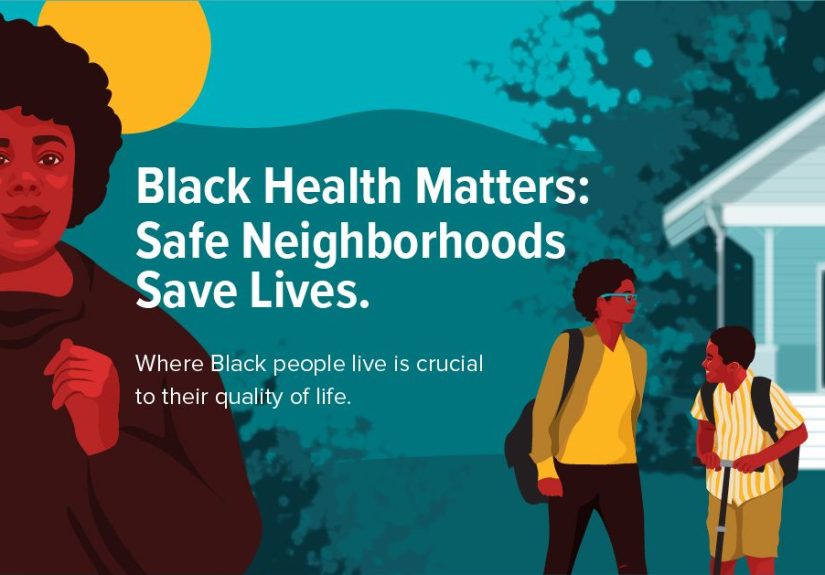
Ultimately, “safe neighborhoods save lives” is not just about avoiding tragedy. It’s about enabling ordinary health:
consistent sleep, daily movement, calmer nervous systems, healthier homes, and real opportunity. For Black
communitieswho have too often been asked to carry the burdens of disinvestment while being blamed for its
outcomessafe neighborhoods are not a luxury. They’re life support.
Conclusion
Safer neighborhoods reduce preventable injuries and deaths, but their benefits go further: they lower chronic stress,
protect kids’ development, support heart health, and expand access to the routines that keep people well.
The evidence points to practical, community-informed solutionsvacant lot remediation, healthy housing investments,
safer street design, and public health approaches to violence preventionpaired with anti-displacement protections
so residents can stay and benefit. When safety is treated as infrastructure, not privilege, it becomes a powerful tool
for saving lives.