Table of Contents >> Show >> Hide
- What Exactly Is a Solar Flare?
- How Do Solar Flares Make Gamma Rays?
- “Toward Us” vs. “At Us”: A Helpful Reality Check
- The Famous “Long-Lasting” Gamma-Ray Flares
- So What’s Actually Risky for Earth?
- How We Know Gamma Rays Happened (Because Your Eyes Can’t)
- Space Weather Forecasting: Why It’s Hard (and Why It’s Getting Better)
- Specific Examples: What “Impacts” Can Look Like
- What You Should (and Shouldn’t) Worry About
- Conclusion: Gamma Rays Are the Clue, Not the Catastrophe
- Experiences: What It’s Like Living Under a Star That Occasionally Yells (500+ Words)
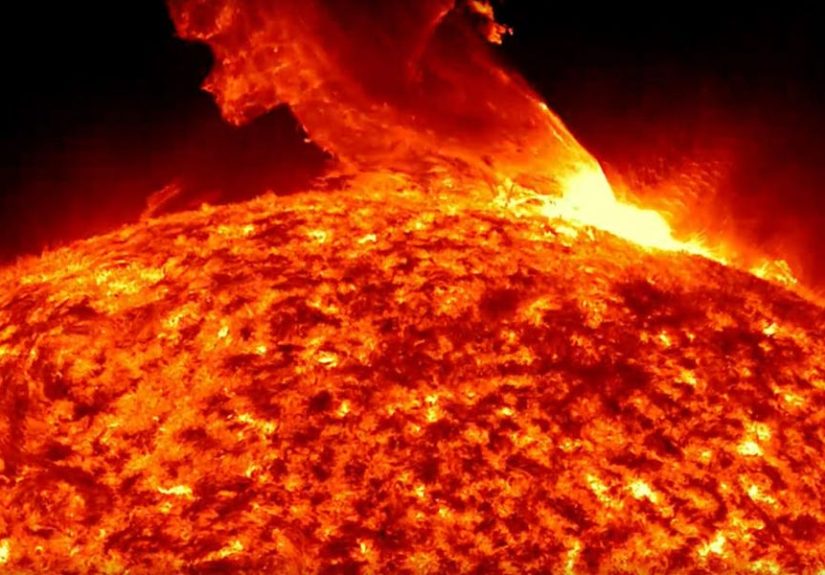
The Sun is a friendly neighborhood starright up until it decides to throw a magnetic tantrum and
briefly become the universe’s loudest flashlight. When that happens, we call it a solar flare:
a rapid, explosive release of energy in the Sun’s atmosphere. And yes, some flares can include
gamma rays, the highest-energy light we know. If that sounds like a sci-fi villain attack,
take a breath: Earth’s atmosphere is an excellent bouncer, and gamma rays don’t stroll down to the
sidewalk to harass your afternoon plans.
Still, the phrase “gamma rays toward us” isn’t totally wrongit’s just a little dramatic. A solar flare
doesn’t usually “aim” gamma rays like a laser pointer. The Sun emits radiation in many directions,
and if the flare happens on the side of the Sun facing Earth, that high-energy light can travel our way.
Spacecraft can detect it, scientists can study it, and your phone can keep pretending it’s not at 12% battery.
What Exactly Is a Solar Flare?
Solar flares happen when twisted magnetic fields above sunspots suddenly reconnectthink of it like
a cosmic rubber band snapping into a new shape. That rapid reconfiguration releases a burst of energy
across the electromagnetic spectrum, from radio waves to X-rays and (sometimes) gamma rays.
Flares are commonly categorized by their strength using lettersA, B, C, M, and Xwhere each step up
is roughly a tenfold increase in intensity. X-class flares are the heavyweight champions. An X2 flare
is about twice as intense as an X1. When the Sun starts tossing around M- and X-class flares, space weather
forecasters get busy, satellite operators get cautious, and aurora fans get… emotionally invested.
How Do Solar Flares Make Gamma Rays?
Gamma rays require extreme conditions, and solar flares deliver. During a flare, charged particlesespecially
electrons and protonscan be accelerated to enormous energies. When those particles slam into dense regions
of the Sun’s atmosphere, they can produce gamma rays through a few key processes:
-
Bremsstrahlung (“braking radiation”): High-speed electrons decelerate near atomic nuclei and emit
high-energy photons. -
Nuclear interactions and gamma-ray lines: Energetic particles collide with solar material, exciting
nuclei that then emit gamma rays as they settle down. -
Pion decay (the big-league stuff): Very energetic protons can generate particles called pions;
neutral pions quickly decay into gamma rays. This is one reason very high-energy gamma rays are such an
important clue that protons were accelerated to truly wild speeds.
In other words: gamma rays are not just “extra bright sunlight.” They’re a signature that the Sun briefly ran a
particle accelerator in its upper atmosphereand then forgot to install guardrails.
“Toward Us” vs. “At Us”: A Helpful Reality Check
Here’s the nuance: gamma rays travel in straight lines. If the flare site is on the Earth-facing side of the Sun,
some of that gamma radiation can head our way. But this is not the same as a focused beam targeting Earth.
The Sun isn’t taking aim; it’s just being the Sunenergetic, messy, and occasionally dramatic.
Also, Earth’s atmosphere absorbs most high-energy radiation. That’s why solar flares are a bigger deal for
satellites, astronauts, and certain types of radio communication than they are for people on the ground.
If you’re reading this indoors, congratulations: you’re protected by walls, air, and a planet that came with a
conveniently thick atmosphere.
The Famous “Long-Lasting” Gamma-Ray Flares
One of the most fascinating discoveries in modern solar physics is that gamma-ray emission from some events can
last hourslong after the flare’s brightest flash. Scientists call this phenomenon sustained gamma-ray emission.
The big idea is that a fast coronal mass ejection (CME) can drive a shock wave through the solar atmosphere and
surrounding space, accelerating protons for a long time. Those protons can then find their way back toward the Sun
and collide with solar material, producing gamma rays well after the initial flare peak.
Translation: the flare might be the opening fireworks, but the CME shock can keep the party goinglike the neighbor who
won’t stop setting off leftovers from the Fourth of July until mid-August.
So What’s Actually Risky for Earth?
If gamma rays are the headline-grabber, the real troublemakers are often the flare’s cousins and sidekicks:
extreme ultraviolet (EUV) and X-rays (which disturb the ionosphere) and charged particles (which can batter
satellites and, in extreme cases, stress power systems).
1) Radio Blackouts (Ionosphere Disruption)
Strong flares can dump enough X-ray energy into Earth’s upper atmosphere to increase ionization on the sunlit side.
That can interfere with high-frequency (HF) radio signals, leading to short-term radio blackouts. Aviation, maritime
operations, and amateur radio folks notice this quicklysometimes with the emotional intensity usually reserved for
deleting a file you forgot to save.
2) Solar Radiation Storms (Energetic Particles)
When high-energy protons and other particles arrive, that’s a solar radiation storm. These are more concerning for
astronauts (less atmospheric shielding), satellites (electronics can get rattled), and polar-route flights (where Earth’s
magnetic field funnels particles toward the poles). Even then, risk depends on event strength and duration.
3) Geomagnetic Storms (CME Meets Earth)
A flare can happen without a CME, and a CME can happen with minimal flare. But when a strong, Earth-directed CME arrives
and its magnetic field couples effectively with Earth’s, you can get a geomagnetic storm. That can:
- Increase atmospheric drag on satellites (orbit nerds: this is where things get spicy)
- Disrupt GPS accuracy and some communications
- Create auroras that wander farther from the poles than usual
- Induce electrical currents that can stress long transmission lines in power grids
Important: most geomagnetic storms do not cause widespread power outages. But utilities plan for the low-frequency,
high-impact scenariobecause the grid is not a “learn by surprise” kind of system.
How We Know Gamma Rays Happened (Because Your Eyes Can’t)
Gamma rays don’t make it through the atmosphere in a way that lets you see them from the ground, which is probably for the best.
We detect solar gamma rays using space-based observatories. Instruments designed for high-energy astrophysics can also point their
attention (sometimes unintentionally) at the Sun when it flares.
These detections matter because gamma rays reveal the acceleration of particles to extreme energiesinformation that helps scientists
understand how solar eruptions work, how to model them, and how to improve space weather forecasting. A gamma-ray signal can be a clue
that protons reached energies high enough to create additional hazards for spacecraft and astronauts.
Space Weather Forecasting: Why It’s Hard (and Why It’s Getting Better)
Predicting flares isn’t like predicting rain. We can identify active regions with complex magnetic fields and say, “That looks… suspicious.”
But precisely forecasting when an active region will flareand whether it will launch a CME and whether that CME’s magnetic field will
be oriented in the “most annoying for Earth” directionis still an active science problem.
Forecasters use data from solar observatories and monitoring satellites, tracking sunspots, X-ray flux, and solar wind conditions. They also
use standardized scales for radio blackouts, solar radiation storms, and geomagnetic storms so that operators (satellite, aviation, power)
can respond appropriately without needing a PhD in plasma physics.
Specific Examples: What “Impacts” Can Look Like
Not every solar event is historicbut many are memorable in the “wow, my GPS is being weird” or “why is HF radio suddenly silent” sense.
Typical real-world outcomes from significant solar activity can include:
- Satellite operations: switching into safe modes, adjusting schedules, pausing sensitive maneuvers
- Navigation: occasional GPS errors during strong geomagnetic conditions
- Radio: short-lived communication disruptions on the sunlit side during strong flare-driven ionospheric changes
- Auroras: visible at lower latitudes than usualgreat for photographers, confusing for people who thought auroras were a myth
The key takeaway: the Sun’s electromagnetic burst (including gamma rays) is part of the story, but the bigger operational impacts often come from
the particle environment and magnetospheric responseespecially when a CME is involved.
What You Should (and Shouldn’t) Worry About
What to worry about (if you’re a satellite, astronaut, or grid operator)
- High-energy particles affecting electronics and sensors
- Radiation exposure outside Earth’s atmospheric shielding
- Geomagnetically induced currents during strong geomagnetic storms
What not to worry about (if you’re an average human on the ground)
- Gamma rays “zapping” you through the atmosphere
- Instant apocalypse every time an X-class flare happens
- Your skin suddenly glowing in the dark (that’s not how any of this works)
If anything, solar flare news is a reminder that modern life depends on invisible infrastructuresatellites, radio links, GPS timing, power
transmissionand that the Sun occasionally likes to test our engineering. Politely. With plasma.
Conclusion: Gamma Rays Are the Clue, Not the Catastrophe
Solar flares can indeed produce gamma rays, and when a flare erupts on the Earth-facing side of the Sun, some of that high-energy light travels
our direction. But “toward us” is best understood as “in our line of sight,” not “targeted.” The reason scientists care is that gamma rays are
a neon sign flashing: extreme particle acceleration happened here. That knowledge improves our understanding of solar eruptions and helps
refine space weather modelsthe stuff that protects satellites, supports aviation planning, and keeps the power grid from having a very bad day.
So the next time you hear “gamma rays from the Sun,” you can think: “Fascinating physics, good thing the atmosphere exists,” and then go back
to your regularly scheduled Earth activitieslike arguing with a printer.
Experiences: What It’s Like Living Under a Star That Occasionally Yells (500+ Words)
Most people’s “experience” of a solar flare is wonderfully anticlimactic: nothing happens, and your coffee remains the same temperature.
But the modern world is full of subtle systems that can feel the Sun’s mood swings, and that’s where the human side of space weather shows up.
Even if you’re not an astronaut, solar activity can sneak into your day through technology, travel, and the occasional headline that makes it
sound like the Sun is personally mad at your Wi-Fi.
For radio enthusiastsamateur operators, maritime communications, certain aviation channelsstrong flares can feel like someone flipped a switch.
On a normal day, you can bounce HF radio signals off the ionosphere and reach far beyond the horizon. During a strong flare-driven ionospheric
disturbance, that “bounce” can degrade or vanish on the sunlit side of Earth. People who rely on those signals describe it as eerie: the band goes
quiet, contacts drop, and the world’s invisible radio chatter suddenly sounds like an empty room. It’s a reminder that the sky is not just “air”;
it’s a layered, dynamic electrical environment.
If you’re a frequent traveler, especially on routes near polar regions, solar radiation storms can influence planning. Airlines may adjust polar
flights to avoid increased communication issues and higher radiation exposure at high latitudes. Passengers might never notice the behind-the-scenes
decision-making, but dispatch teams and space weather monitors absolutely do. The experience here is less “dramatic event” and more “quiet logistics,”
where someone, somewhere, is looking at alerts and thinking, “Let’s not tempt the universe today.”
Then there’s the aurora crowdthe people who treat geomagnetic forecasts the way sports fans treat playoff brackets. When solar activity ramps up,
they refresh dashboards, compare maps, and start texting friends in a tone that suggests they’ve discovered a secret portal in the sky. The experience
of seeing auroras farther south than usual can be genuinely emotional: curtains of light that look too alive to be real, shimmering and shifting in ways
that make even cynical adults whisper, “Okay… wow.” For many people, this is the most tangible “I felt the Sun” momentbecause it’s visual, communal,
and unforgettable.
On the professional side, satellite operators experience solar storms as a checklist with consequences. A flare or particle event can mean pausing
sensitive operations, rerouting tasks, protecting instruments, or preparing for increased atmospheric drag that changes orbital predictions. It’s a strange
blend of routine and awe: engineers calmly executing procedures because a star 93 million miles away decided to rearrange its magnetic field. Power grid
managers have a similar relationship with space weathermost days it’s a background risk, but during strong storms it becomes a real operational factor,
prompting monitoring and readiness steps that most of the public never sees.
Even the everyday tech user can have small “space weather moments.” GPS accuracy can wobble during severe geomagnetic activity, timing signals can be
noisier, and satellite communications can act up. You might not point at the sky and say, “Ah yes, a CME!” but you might experience a mild version of
modern confusion: navigation acting odd, a service glitching, a system being “temporarily unavailable” in a way that feels suspiciously cosmic.
The real experience of living under solar flares is often this subtle: you’re not dodging gamma raysyou’re noticing that the invisible scaffolding of
modern life depends on a stable space environment. And sometimes the Sun decides “stable” is overrated.
In the end, solar flare experiences are less about fear and more about perspective. We live under a protective atmosphere and magnetic field, on a planet
that’s remarkably good at keeping space drama outside. But we also built a civilization that reaches into space with satellites, aviation routes, and
global electrical networks. Solar flaresand their occasional gamma-ray signaturesare the Universe’s way of reminding us that Earth is not isolated.
We’re connected to our star. Most days, it’s a warm relationship. Some days, it’s… loud.