Table of Contents >> Show >> Hide
- Meet the Milky Way’s tiniest neighbors: ultra-faint dwarf galaxies
- What makes a galaxy “old,” anyway?
- A quick tour: ancient satellites in the Milky Way’s backyard
- How astronomers find galaxies that barely exist
- Why these tiny galaxies matter (yes, even if they look like nothing)
- What’s next: a deeper census of the Milky Way’s “orphan” galaxies
- Conclusion: big lessons from the smallest galaxies
- Experiences: how it feels to chase the universe’s oldest neighbors
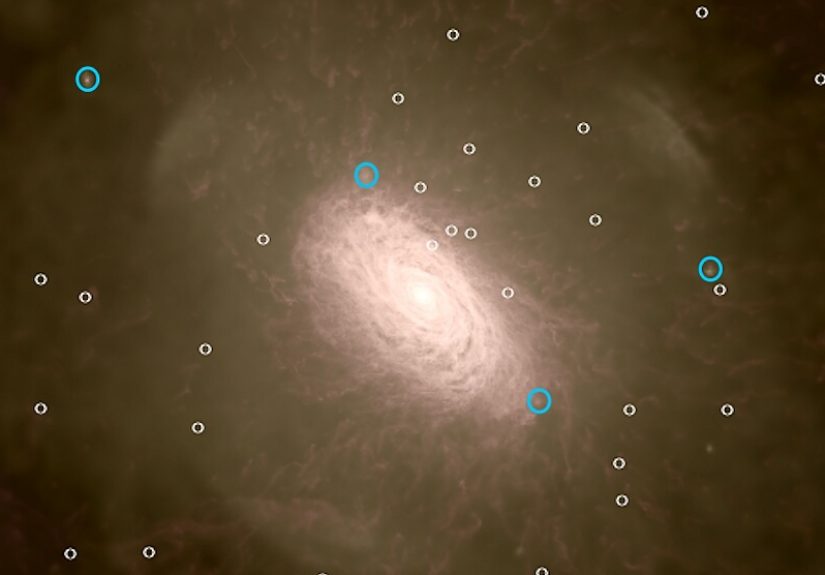
The Milky Way gets all the attention. It’s the big spiral in the family photoglowing arms, a central bulge,
and a supermassive black hole that absolutely refuses to be normal. But if you zoom out, our galaxy is also
a cosmic landlord. Dozens of much smaller galaxies orbit it, quietly circling like tiny moons around a giant
planet. And here’s the twist: some of those faint companions are likely among the oldest surviving galaxies we can study.
Think of them as the universe’s original “beta versions” of galaxiessmall, simple, and ancient. They formed
early, made a first batch of stars, and then (for reasons we’ll unpack) mostly stopped evolving. While the Milky Way
kept partying for billions of yearsmerging, growing, and forming new starsthese little satellites preserved
a snapshot of cosmic childhood.
Meet the Milky Way’s tiniest neighbors: ultra-faint dwarf galaxies
When astronomers say “some of the oldest galaxies,” they often mean ultra-faint dwarf galaxies
(UFDs). These are small satellite galaxies with very low brightness and very few stars compared with a big spiral
like the Milky Way. If the Milky Way is a bustling metropolis of hundreds of billions of stars, an ultra-faint dwarf
is more like a remote campground with a flickering lantern and a suspiciously large “beware of bears” sign.
UFDs are fascinating because they tend to be:
- Star-starved: often only thousands of stars, sometimes fewer.
- Dark-matter dominated: their gravity suggests far more mass than their starlight can explain.
- Metal-poor: many of their stars formed before the universe had time to cook up lots of heavy elements.
- Old: their stellar populations can be ancientmore than 12–13 billion years old.
In other words, they’re not flashy. They’re not trying to win “Galaxy of the Year.” They’re trying to survive as
fossil-like relics from the early universeand they’re doing a surprisingly good job.
What makes a galaxy “old,” anyway?
A galaxy isn’t like a rock you can carbon-date. Astronomers estimate a galaxy’s “age” by studying the ages of its
stars and its star formation history. If nearly all the stars in a galaxy formed very early and the galaxy later
stopped making new stars, it can act like a time capsule from cosmic dawn.
Clue #1: Ancient stars (the real antiques)
One of the cleanest ways to spot an ancient system is to find stars that are extremely old and chemically primitive.
Early stars formed mostly from hydrogen and helium, with tiny traces of heavier elements. Over time, stellar explosions
“seed” galaxies with more metals (astronomer-speak for elements heavier than helium). So when you see a population of
stars with very low metal content, you’re often looking at a system that started early and stayed simple.
Clue #2: A short, early burst of star formation
Many ultra-faint dwarfs appear to have formed most of their stars early and then shut down. A leading suspect is
cosmic reionizationa major phase transition in the early universe when the first generations of stars
and galaxies ionized hydrogen gas. After that, small galaxies may have struggled to cool gas and keep making stars.
Clue #3: “Fossil record” chemistry
Stellar chemistry is basically astrophysics’ version of checking someone’s passport stamps. The mix of elements inside a star
can reveal what kind of earlier stars enriched its birth gas. Ultra-faint dwarfs often show limited chemical “processing,”
which is consistent with a brief early star-forming era rather than billions of years of ongoing recycling.
A quick tour: ancient satellites in the Milky Way’s backyard
Not every Milky Way satellite is ultra-faint, and not every ultra-faint dwarf is confirmed to be a pristine relic.
But several are frequently discussed as candidates for “surviving first galaxies” or near-fossils from the earliest era
of galaxy formation.
Leo IV: a tiny galaxy with very old stars
Leo IV is a classic example of an ultra-faint dwarf galaxy. It’s faint, small, and hard to spotastronomers initially
identified it as a subtle clump of stars in survey data. Follow-up observations found it hosts only a few thousand stars.
Its stars’ ages are especially attention-grabbing: measurements using space-based observations showed stars in Leo IV (and
similarly faint companions) can be more than 13 billion years old, almost as old as the universe itself.
That’s the kind of number that makes cosmologists sit up straighter.
Segue 1, Boötes I, Tucana II, Ursa Major I: “first-galaxy” candidates
Several ultra-faint satellites are often discussed as exceptionally ancient systems, including Segue 1, Boötes I,
Tucana II, and Ursa Major I. These are the kinds of galaxies that make you appreciate how dramatic the universe can be
without using special effectsjust gravity, time, and a lot of darkness.
A key reason these galaxies show up in “oldest galaxy” conversations is that models and observations suggest their earliest
star formation began very soon after the cosmic dark ages, and their stellar populations can be extremely old. If your mental
image of a galaxy includes bright spiral arms, congratulations: these galaxies are here to humble you.
Ursa Major III / UNIONS 1: the “maybe a galaxy, maybe not” record-setter
Modern surveys are pushing so deep that astronomers are finding satellite systems that blur the line between a dwarf galaxy and
a star cluster. One example reported in late-2024 highlights a newly discovered Milky Way satellite (Ursa Major III / UNIONS 1)
with only a few dozen identified member stars and an extremely tiny stellar mass. The big question with objects like this is:
does it sit in a dark matter halo? If yes, it’s a galaxy. If not, it’s likely a star cluster. Either way, it shows we’re now
fishing in the universe’s faintest pond.
How astronomers find galaxies that barely exist
Discovering an ultra-faint dwarf galaxy is like trying to find a handful of fireflies in a stadium full of cellphone flashlights.
You don’t “see the galaxy” the way you see the Andromeda Galaxy. Instead, you spot a statistical overdensityan unusually tight clump
of stars moving together, at similar distances, and sharing similar stellar properties.
Big sky surveys do the scouting
Wide-field surveys (think: enormous digital maps of the sky) are the reason the known satellite population has grown so much since the
mid-2000s. Projects like the Sloan Digital Sky Survey and the Dark Energy Survey helped reveal many of the ultra-faint satellites now on
astronomers’ shortlists.
Spectroscopy does the interrogation
After a candidate is found, astronomers use spectroscopy to measure:
- Star velocities: are the stars gravitationally bound, and how much unseen mass is required to hold them together?
- Element abundances: are the stars extremely metal-poor, suggesting early formation?
- Membership: are these stars truly part of the system, or just passersby in the Milky Way foreground?
Space telescopes help date the stars
Deep imaging (especially from space) allows astronomers to build precise color–magnitude diagrams, comparing stellar populations to
well-understood benchmarks. This is how researchers can conclude that some ultra-faint dwarfs host stars older than 13 billion years,
pointing to star formation that started very early and shut down quickly.
Why these tiny galaxies matter (yes, even if they look like nothing)
Ultra-faint dwarf galaxies are small enough to fit inside a cosmic shoebox, yet they punch above their weight scientifically.
Here’s what makes them a big deal.
1) They’re a laboratory for dark matter
Because ultra-faint dwarfs have so little starlight relative to their inferred mass, they’re among the cleanest places to test ideas about
dark matter on small scales. If you want to understand how dark matter behaves in tiny gravitational systems, these galaxies are the closest thing
to a controlled experiment that the universe is willing to provide.
2) They’re a fossil record of the first galaxies
In the early universe, galaxies were small and metal-poor. Over time, many merged into bigger systems. Ultra-faint dwarfs that survived intact can
preserve information about that early erahow the first stars formed, how quickly heavy elements appeared, and how major events like reionization
affected star formation in low-mass halos.
3) They help solve the “missing satellites” puzzle
Standard cosmology predicts many more small dark-matter halos than the number of satellite galaxies we’ve historically observed. One possible resolution:
many satellites are simply too faint to detect with older surveys. As new instruments and surveys push deeper, the census keeps improvingsuggesting
the Milky Way may host more tiny companions than we’ve confirmed so far.
4) They connect to “stellar archaeology” inside our own halo
Not all ancient relics are intact galaxies. Some are shredded by the Milky Way’s gravity and leave behind streams and stars in the halo.
Recent work highlighting extremely ancient halo stars (formed 12–13 billion years ago) suggests some stars may be the last surviving members of small,
primitive galaxies that the Milky Way absorbed long ago. If ultra-faint dwarfs are the fossils still in one piece, these halo stars are the fossils
scattered across the floorstill informative, just harder to reassemble.
What’s next: a deeper census of the Milky Way’s “orphan” galaxies
The story here is still unfolding. Astronomers are actively debating which of the faintest new discoveries are true dwarf galaxies versus star clusters,
and how many satellites are still waiting to be found.
Upcoming and ongoing surveysespecially next-generation wide-field observatoriesare expected to reveal even more ultra-faint systems. With each new discovery,
scientists get more data points to test galaxy-formation theory, refine dark matter constraints, and understand how the earliest galaxies survived (or didn’t)
during the universe’s most dramatic transitions.
Conclusion: big lessons from the smallest galaxies
The Milky Way isn’t alone in the dark. It’s surrounded by a swarm of small companions, some so faint they can hide in plain sightuntil a careful survey
and a patient astronomer pull them out of the stellar crowd. Among these satellites, ultra-faint dwarf galaxies stand out as candidates for the universe’s
oldest surviving galaxies: dark-matter dominated, metal-poor, and packed with stars that formed near the beginning of cosmic time.
They’re not just astronomical trivia. They’re evidenceclose enough to study in detailthat the early universe left relics behind. And they’re reminders that
in astronomy, “small” doesn’t mean “unimportant.” Sometimes it means “ancient,” “pristine,” and “holding answers the big galaxies forgot.”
Experiences: how it feels to chase the universe’s oldest neighbors
If you’ve ever tried to spot a dim object in the night skysay, a faint nebula or a shy galaxyyou already understand the vibe of ultra-faint dwarf hunting:
patience, skepticism, and the occasional existential crisis when you realize your target is basically “a slightly suspicious clump of dots.”
For amateur stargazers, the experience usually starts with the Milky Way itself. You find a dark site, let your eyes adapt, and watch the galactic band
stretch overhead like spilled sugar across velvet. It’s easy to feel like you’re seeing “everything.” Then you learn that some galaxies orbiting the Milky Way
are so faint that even professional astronomers don’t see them directlythey infer them. That’s a humbling moment. It’s also kind of hilarious:
the universe has hidden DLC content, and it’s locked behind statistics.
The human experience on the research side is part detective story, part spreadsheet saga. Imagine combing through survey images that contain millions of stars,
searching for the tiniest, most unconfident-looking clustering of points. When researchers say, “We discovered a new satellite,” it can mean:
“We ran algorithms, checked the overdensity wasn’t a fluke, verified the stars share properties, and then spent a while arguing about whether this is a galaxy
or just a dramatic star cluster.”
Then comes follow-up spectroscopythe stage where the universe is politely asked, “So… what are you made of?” The experience is less like taking a snapshot
and more like doing a background check. You measure stellar velocities to see if dark matter is holding the system together. You measure elemental abundances to
see if the stars look chemically ancient. Each spectrum is a fingerprint, and the satisfaction comes from patterns emerging: a consistent motion, a shared origin,
a story that hangs together better than your group chat’s weekend plans.
There’s also a special kind of thrill in realizing how close these relics are, cosmically speaking. When scientists talk about “the first galaxies,” you might imagine
something impossibly distanttiny smudges at the edge of the observable universe. But some of the best clues to that era are orbiting our galaxy right now.
It’s like discovering that the oldest artifact in a museum isn’t in a locked vaultit’s in the gift shop, quietly minding its business.
For students and new researchers, the experience can be surprisingly hands-on: learning how to read spectra, how to model stellar populations, how to check orbital
motions, and how to treat every exciting result with a healthy dose of “Okay, but could this be wrong?” That mindsetequal parts wonder and rigoris the real
apprenticeship of modern astronomy.
And for anyone who loves the night sky, ultra-faint dwarfs add a new layer of appreciation. The Milky Way stops being just a pretty streak and becomes a living
ecosystem with ancient companions: relics, fossils, and fragments of galaxies that formed when the universe was young and weird and still figuring itself out.
If that doesn’t make you want to look up a little longer, you might actually be a black hole.