Table of Contents >> Show >> Hide
- What Is the Linkimals Musical Moose?
- Why This Toy Is Worth a Teardown
- Exterior Design: Cute, Rounded, and Hard to Defeat
- Battery Compartment and Safety Choices
- Opening the Moose: Not Exactly Repair-Friendly
- Inside the Electronics: A Two-Chip Surprise
- The Radio Module: The Moose Has a Social Life
- How the Synchronization Likely Works
- Audio and Light Design
- Educational Value: Simple, But Sensible
- Manufacturing Lessons from a Low-Cost Smart Toy
- Repairability, Hacking, and Practical Limits
- What the Teardown Reveals About Modern Toys
- Buying a Used Linkimals Musical Moose: What to Check
- Experience Notes: Living With a Musical Moose
- Final Verdict: A Surprisingly Smart Moose
- Conclusion
At first glance, the Fisher-Price Linkimals Musical Moose looks like a cheerful little forest friend whose main job is to blink, sing, and make a baby laugh. But underneath that rounded plastic body, soft antlers, and wobbly head is a surprisingly capable piece of low-cost consumer electronics. This is not just a toy that says “hello” when you press its belly. It is a battery-powered, audio-playing, light-flashing, wirelessly communicating baby gadget dressed as a moose.
That combination makes the Linkimals Musical Moose a perfect teardown subject. It sits at the intersection of early learning toy, embedded system, RF design, safety engineering, and mass-market manufacturing. In other words, it is what happens when a nursery toy quietly borrows ideas from the Internet of Things, then hides them behind a face that looks like it has never missed snack time.
This teardown-style analysis explores what the Linkimals Musical Moose is, how it works, what its internal design suggests, and why this small toy is more interesting than its sing-song personality lets on. We will look at its educational purpose, physical design, electronics, wireless behavior, safety choices, repair limitations, and the real-world experience of living with a moose that may or may not start a musical uprising in your living room.
What Is the Linkimals Musical Moose?
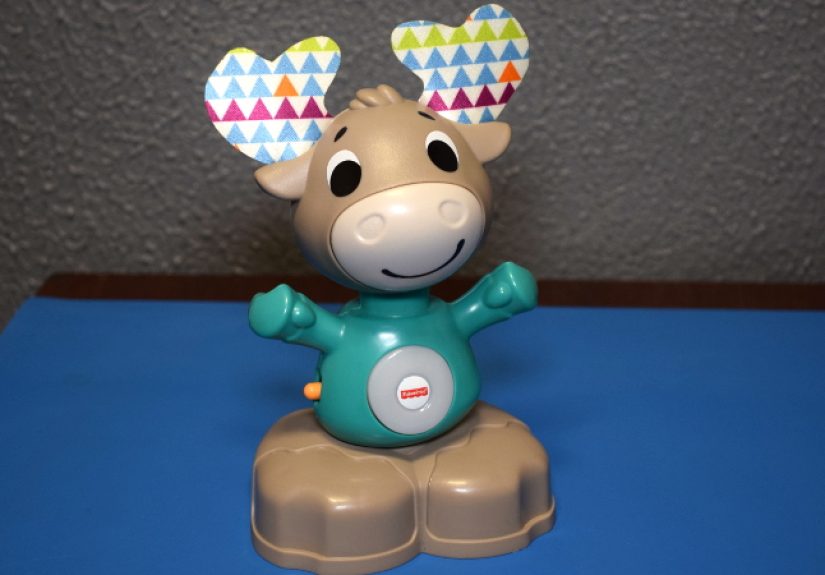
The Linkimals Musical Moose is part of Fisher-Price’s Linkimals line, a family of interactive baby and toddler toys designed to sing, light up, and respond to one another. The Moose model, commonly associated with product number GFG03, was released as an electronic learning toy for babies around 9 months and older. It uses three AA batteries and focuses on early academic concepts such as numbers, counting, colors, music, and cause-and-effect play.
Its most obvious interaction point is the light-up belly button. Press it and the toy responds with songs, phrases, sounds, and colorful lights. Add other Linkimals toys nearby, and the Moose can recognize them and participate in a synchronized music-and-light routine. That is the feature that turns it from a simple push-button toy into a tiny, antlered member of a wireless performance troupe.
From a parent’s perspective, the appeal is easy to understand. Babies like buttons. Babies like lights. Babies like songs. Babies especially like making adults hear the same songs repeatedly until everyone in the home starts negotiating with the coffee maker for emotional support. The Moose delivers all of that in a friendly package with rounded edges, soft fabric antlers, and a bobble head that invites batting and grabbing.
Why This Toy Is Worth a Teardown
Many electronic baby toys are simple devices: a button, a speaker, a small circuit board, a few LEDs, and a chip hidden under a black epoxy blob. The Linkimals Musical Moose is more ambitious. It includes audio playback, an RGB light effect, a physical switch input, a speaker, battery power management, and wireless communication that lets it coordinate with other Linkimals characters.
That matters because wireless synchronization is not free. It requires a radio system, antenna planning, firmware behavior, power budgeting, and some sort of signaling method. In a premium smart-home device, that would be expected. In a relatively inexpensive baby toy, it is a reminder that modern embedded electronics have become remarkably affordable.
The Moose is also interesting because it must satisfy two very different audiences. The baby audience wants instant feedback, bright colors, and sounds that reward simple actions. The adult audience wants durability, safe battery access, reasonable volume, easy cleaning, and enough educational value to justify buying yet another object that sings from the toy bin. The engineering challenge is to serve both groups without making the toy fragile, expensive, or irritating enough to “accidentally” disappear into a closet.
Exterior Design: Cute, Rounded, and Hard to Defeat
The outside of the Linkimals Musical Moose is clearly designed for infant handling. The body is rounded, the visible screw areas are recessed, and the overall shape avoids sharp corners. This is not decorative fluff; it is safety and usability engineering. A toy for babies must withstand drops, chewing, grabbing, banging, and the mysterious sticky forces that appear around high chairs.
The soft antlers add tactile variety, giving babies a fabric surface to explore while keeping the top of the toy friendly to small hands. The bobble head adds movement without requiring a motor, which is a clever choice. A motorized head would increase cost, complexity, power use, and potential failure points. A passive bobble mechanism gives the child a fun response while keeping the mechanism simple.
The belly button is placed front and center, which makes sense for the target age. A baby does not need to understand menus, modes, pairing screens, or tiny switches. The toy’s main action is “press here, something fun happens.” That simplicity is one of the strongest parts of the design. Good infant engineering often looks obvious after the fact, but it takes discipline to keep interaction that clean.
Battery Compartment and Safety Choices
The Moose runs on three AA batteries. That choice is practical for a toy with lights, sound, and wireless features. AA batteries are common, relatively easy for adults to replace, and capable of supplying enough current for short bursts of audio and LED activity. Unlike button batteries, AA cells are much larger, but safe access still matters because any battery-operated toy for young children must keep batteries away from curious fingers.
The battery compartment is secured with a screw and is not something a baby can casually open. This aligns with broader toy-safety expectations for battery-operated products, where children should not be able to access batteries during normal play. In teardown observations, the battery door area is also notable for sealing details, including gasket-like protection and sealant near terminals. That suggests the designers expected real-world mess: drool, spills, damp cleaning cloths, and the occasional journey through the land of applesauce.
Importantly, this does not mean the toy should be immersed in water. Electronic toys should be wiped clean according to instructions, not dunked like a scuba-certified moose. But the extra sealing around the battery area is a sensible defense against moisture and battery leakage, both of which are realistic threats in a baby environment.
Opening the Moose: Not Exactly Repair-Friendly
One of the most revealing teardown findings is that the Linkimals Musical Moose is not designed for easy non-destructive opening. The head and feet may come apart more readily, but the body section that houses the main electronics appears to be permanently joined. Teardown work suggests the body halves are held by internal pegs and may be glued, welded, or otherwise sealed in a way that discourages repair.
From a repairability perspective, that is disappointing. A toy with a dead speaker wire or failed switch might not be easy to fix without cutting plastic. From a manufacturing and safety perspective, however, the decision is understandable. A sealed body reduces loose parts, keeps internal components away from children, improves durability, and helps the toy survive rough handling.
This is the central trade-off of many children’s electronics: the more securely you seal the product for safety, the less friendly it becomes to hobbyist repair. The Moose is not built like a vintage radio with screws, clips, and service documentation. It is built like a modern mass-market infant toy: safe, cheap, tough, and not particularly interested in your soldering iron’s feelings.
Inside the Electronics: A Two-Chip Surprise
Once inside, the Linkimals Musical Moose becomes much more interesting. Instead of a primitive one-chip blob solution, teardown analysis found a compact board with a small number of major components. The key pieces include a main audio-capable microcontroller, a separate radio module, an RGB LED, a speaker connection, button input, and supporting passive components.
The main controller identified in teardown coverage is a Nuvoton N569S1K0, part of the company’s NuVoice family. Reference data for this chip class describes an ARM Cortex-M0-based microcontroller with modest RAM and ROM, audio-oriented features, and internal storage suitable for voice clips and sound playback. In practical terms, that makes it a good match for a talking toy: it can run the toy’s behavior, store audio content, manage button input, trigger light patterns, and drive sound output.
The presence of a 32-bit microcontroller in a baby toy may sound excessive until you consider modern manufacturing economics. Specialized audio microcontrollers let toy companies combine processing, sound playback, and control logic in a small, inexpensive package. The result is a toy that can hold multiple songs and phrases without needing a large or costly board.
The Radio Module: The Moose Has a Social Life
The second major component is the wireless radio module. This is what allows the Moose to coordinate with other Linkimals toys. In use, multiple Linkimals characters can recognize one another and join a synchronized light-and-music performance. Technically, that means the Moose is not only responding to its own button; it is also listening for nearby toy friends.
The wireless system operates in the 2.4 GHz range, a common band used by many short-range consumer devices. However, this does not necessarily mean the toy uses Wi-Fi or Bluetooth in the way a phone or smart speaker does. Teardown observations indicate a simpler custom communication approach, likely designed for low cost, short messages, and basic synchronization rather than general-purpose networking.
That is an important distinction. The Linkimals Musical Moose is “wireless,” but it is not a typical internet-connected smart toy. There is no reason to think it joins a home Wi-Fi network, sends recordings to a cloud server, or needs an app. Its wireless feature is local toy-to-toy communication. In plain English: the Moose is not spying on your kitchen. It is just trying to get the sloth, beaver, llama, or other Linkimals friends to sing on beat.
How the Synchronization Likely Works
The Linkimals concept depends on simple, reliable coordination. When one toy wakes up or begins a song, it can send a signal that nearby Linkimals recognize. The receiving toys can then respond with their own lights, phrases, or music. The communication does not need to carry complex data. It may only need to answer questions such as: “Is another Linkimal nearby?” “Should I wake up?” “Which sequence should I join?” and “Are we having a tiny plastic concert now?”
Teardown experiments suggest that the radio interface may be simpler than common serial protocols such as I2C, SPI, or UART. Instead, the module appears to expose multiple channel-like pins that can be triggered directly. This kind of design makes sense in a cost-sensitive toy. A simple signaling system can be easier to implement, cheaper to validate, and more than sufficient for synchronized songs and lights.
The result is a clever low-cost network effect. A single Moose is a musical learning toy. Two or more Linkimals become an interactive group. That encourages collecting additional toys while also giving the product line a feature that feels magical to parents and children. It is not magic, of course. It is RF engineering wearing antlers.
Audio and Light Design
The Moose’s audio personality is central to the product. The toy introduces counting, colors, songs, and playful phrases through its speaker. Its content is designed for repetition because babies learn through repeated exposure, predictable responses, and sensory feedback. Adults, meanwhile, learn through repeated exposure that they should never underestimate the staying power of a children’s jingle.
The RGB belly light works as both entertainment and feedback. When a child presses the button, the light confirms that the action did something. During songs, changing colors add visual rhythm. When synchronized with other Linkimals, the lighting helps create the impression of a coordinated show. For babies, that combination supports sensory development by linking touch, sound, color, and timing.
The speaker does not need hi-fi performance. In fact, a toy like this benefits from speech clarity, safe volume, low power consumption, and durability more than rich bass. Nobody expects a moose to deliver studio-grade audio. If it can make counting sound cheerful while surviving repeated collisions with the floor, it is doing its job.
Educational Value: Simple, But Sensible
The Linkimals Musical Moose teaches basic early-learning concepts such as counting, colors, and cause and effect. It is not a substitute for reading, conversation, outdoor play, or hands-on exploration. But as a supplementary toy, it has a clear developmental role. A baby presses the belly, hears a response, sees lights, and begins to understand that actions can produce predictable outcomes.
That cause-and-effect loop is powerful for infants and young toddlers. It rewards curiosity. It supports motor practice as babies reach, press, bat, and grasp. The songs and phrases expose children to rhythm, numbers, and simple vocabulary. The soft antlers and bobble head add tactile and physical interaction beyond the electronic features.
The toy’s best educational quality is not that it “teaches counting” in a formal academic sense. It is that it invites repeated interaction. For a 9-month-old, pressing a button and watching the world respond is a big deal. Adults call that interface design. Babies call it “again.”
Manufacturing Lessons from a Low-Cost Smart Toy
The Linkimals Musical Moose is a strong example of how much technology can fit into an affordable product. A 32-bit audio-capable microcontroller, a wireless module, lights, a speaker, sealed construction, child-safe battery access, and custom molded parts all come together in a toy often sold at a modest retail price.
That cost efficiency does not happen by accident. The design avoids unnecessary complexity. The bobble head replaces a motor. The interaction model uses one main button. The radio behavior appears purpose-built rather than overengineered. The body is sealed instead of serviceable. The electronics are compact. The audio system uses specialized silicon rather than a more expensive general-purpose platform.
For engineers and hardware hobbyists, the Moose is a reminder that mass-market toy design is brutally optimized. Every screw, gasket, wire, chip, and plastic feature has to earn its place. For parents, it is proof that a toy can be cute on the outside and surprisingly sophisticated on the inside. For the Moose, it is simply Tuesday.
Repairability, Hacking, and Practical Limits
Could a hobbyist hack the Linkimals Musical Moose? In theory, yes. The internal board offers interesting possibilities for signal sniffing, radio experimentation, audio study, and embedded analysis. A logic analyzer could help observe communication between the main controller and radio module. A careful teardown could reveal how button presses map to wireless activity. A creative hacker might even repurpose the shell, speaker, or LED system.
In practice, this is not an ideal beginner repair project. The sealed body makes access destructive. The radio module may not have public documentation. The audio content is likely stored and controlled in a way that is not meant for easy replacement. And because it is a toy for infants, any modification intended for actual child use should be treated with extreme caution. Once you cut, drill, solder, or reassemble it, you may compromise safety.
The best way to approach a Moose teardown is as an educational electronics project, not as a modification for a child’s daily toy. Buy a secondhand unit, remove the batteries before working, keep small parts away from children, and do not return a modified or damaged toy to infant play. The Moose may look friendly, but a compromised battery compartment or cracked shell is no joke.
What the Teardown Reveals About Modern Toys
The biggest takeaway from the Linkimals Musical Moose teardown is that modern toys are no longer simple mechanical objects with a few sounds added. Even affordable baby toys can contain microcontrollers, wireless systems, firmware logic, audio storage, and careful safety engineering. They are consumer electronics first and plushy-looking characters second.
This trend has advantages. Toys can be more responsive, more engaging, and more interactive. Product lines can create shared experiences between multiple characters. A child can press one toy and watch several others respond, which feels lively and surprising. For families, that can make playtime more dynamic.
But the trend also raises questions. Should toys be easier to repair? Should manufacturers publish more information about local wireless behavior? How can products balance safety with sustainability? The Moose does not answer all of these questions, but it brings them into focus. It is a small object with a big lesson: even the silliest singing toy is part of a larger technology ecosystem.
Buying a Used Linkimals Musical Moose: What to Check
Because the Linkimals Musical Moose has been on the market for years, many families encounter it secondhand through resale shops, online marketplaces, hand-me-downs, or toy bins that seem to reproduce at night. A used unit can be a good value, but it should be inspected carefully before being given to a baby.
Check the battery compartment first. Make sure the screw is present, the cover closes securely, and there is no corrosion from old batteries. Look for cracks around the body seams, loose plastic, damaged antlers, or rattling parts. Press the belly button to confirm the lights and speaker work. If you have another Linkimals toy, test whether the synchronization feature still responds.
Also clean the exterior according to safe toy-cleaning practices. A damp cloth is usually appropriate for electronic toys, while soaking is not. If a used Moose smells like basement, mystery juice, or the year 2019, give it a careful cleaning and a fresh set of batteries before judging its performance.
Experience Notes: Living With a Musical Moose
Using the Linkimals Musical Moose in a real home is different from reading a product description. On paper, it is an interactive educational toy. In daily life, it is a small plastic performer that can turn a quiet room into a woodland talent show with one belly press. That is both its charm and its warning label.
The first experience most people notice is how immediate the feedback feels. A baby presses the belly, the light turns on, the sound plays, and the toy becomes rewarding. There is no delay, no screen, no setup process, and no app asking for a password that nobody remembers. For young children, that instant response is exactly right. The interaction is clear enough for babies who are still figuring out that their own hands are attached.
The second experience is the surprise of the Linkimals group behavior. One Moose is cute. Several Linkimals together can feel like a tiny synchronized choir hiding in the playroom. When one toy triggers another, adults often react before children do. The child may simply enjoy the lights and sound, while the adult thinks, “Wait, did that beaver just answer the moose?” Yes. Yes, it did. Welcome to the future, where your nursery has a local area network with antlers.
From a durability standpoint, the Moose feels designed for the rough democracy of baby play. It can be grabbed, pushed, tipped, and batted without requiring delicate handling. The recessed screws and sealed construction help it feel sturdy. The soft antlers are a smart addition because they provide texture without turning the toy into a hard plastic sculpture from every angle.
The sound experience depends heavily on adult tolerance. For babies, repetition is valuable. For parents, repetition is how a cheerful counting song slowly becomes the soundtrack to making coffee at 6:12 a.m. The Moose is not unusually offensive compared with other musical baby toys, but any toy with repeated songs can become intense in a small apartment or quiet house. A good practical habit is to rotate it with quieter toys so the Moose does not become the mayor of the living room.
The educational experience is best when an adult joins in. Instead of letting the Moose do all the performing, parents can count along, name the colors, imitate the rhythm, or connect the phrases to real objects. If the toy sings about counting, count blocks. If it flashes colors, point to matching items nearby. That turns a battery-powered routine into shared play, which is far more valuable than passive listening.
The teardown experience adds another layer of appreciation. Once you know there is a microcontroller, a radio module, a speaker system, and careful battery sealing inside, the toy stops looking simple. It becomes a compact lesson in design compromises. It has to be inexpensive, safe, engaging, manufacturable, durable, and cute. That is a difficult checklist. Many adult gadgets fail at half of those goals and do not even have antlers.
For collectors, makers, and curious parents, the Linkimals Musical Moose is a fun reminder that learning toys can be technically fascinating. For babies, it remains what it should be: a friendly object that responds to touch with light, sound, and motion. The best experience comes from respecting both sides. Let the child enjoy the playful Moose, and let the adult quietly admire the engineering hiding inside the woodland karaoke machine.
Final Verdict: A Surprisingly Smart Moose
The Fisher-Price Linkimals Musical Moose is more than a musical baby toy. It is a small embedded system designed for early learning, sensory play, wireless synchronization, and child-safe durability. Its teardown reveals thoughtful engineering choices: a simple exterior interface, secure battery access, sealed construction, audio-focused microcontroller hardware, and a radio system that supports local Linkimals interaction.
It is not perfect. The sealed body limits repairability, the songs may test adult patience, and the wireless system is not especially transparent to curious hobbyists. Still, the Moose succeeds at its main mission. It gives babies an easy cause-and-effect toy, gives parents a recognizable educational angle, and gives hardware enthusiasts something unexpectedly rich to study.
In the end, the Linkimals Musical Moose proves that even a goofy singing toy can be a compact showcase of modern electronics. It counts. It flashes. It talks to its friends. It survives baby handling. And if you take it apart, it teaches one more lesson: never underestimate a moose with a microcontroller.
Conclusion
The Linkimals Musical Moose is a delightful example of how modern toy design blends child development, embedded electronics, and clever manufacturing. On the surface, it is a friendly musical moose that teaches counting, colors, and cause and effect through lights and songs. Inside, it is a compact electronic system with audio processing, wireless communication, and safety-minded construction. For parents, it is an engaging learning toy. For makers, it is a low-cost hardware lesson. For babies, it is simple magic: press the belly, start the party.