Table of Contents >> Show >> Hide
- What Titan’s Geologic Map Actually Reveals
- Why Titan Feels So Familiar, and So Alien
- Why the Map Matters for Dragonfly
- Why Titan Is an Astrobiology Superstar
- What Scientists Still Do Not Know
- Conclusion: Titan Earns Every Bit of the Hype
- An Experience-Based Reflection: What It Feels Like to Follow Titan Across a Map
Some moons are content to be frozen, cratered wallpaper in the background of the solar system. Titan is not one of them. Saturn’s largest moon behaves like it missed the memo about what a moon is supposed to do. It has a thick atmosphere, weather, rivers, lakes, seas, dunes, erosion, and a chemistry set so wild it sounds like science fiction written by a petroleum geologist with a poet’s soul.
That is exactly why Titan’s global geologic map matters so much. When planetary scientists assembled the first planet-wide geologic view of Titan from Cassini’s radar, visible, and infrared data, they did more than make a pretty poster for space nerds. They gave us a field guide to one of the strangest and most revealing worlds in the solar system. The map shows how Titan’s dunes, plains, lakes, craters, and maze-like terrains fit together as parts of one working planetary system. In other words, Titan is not random. It is organized, active, and gloriously weird.
For SEO purposes and for basic human curiosity, here is the big idea: Titan’s geologic map helps explain why Titan moon geology is such a major deal. This is the only moon besides Earth with stable liquid on its surface. It is the only moon with a truly substantial atmosphere. It is loaded with organic molecules. And it is the future home of NASA’s Dragonfly mission, which will use the map as a kind of alien road atlas, except the “car” is a nuclear-powered rotorcraft and the “road” is a frozen hydrocarbon wonderland. Casual stuff.
What Titan’s Geologic Map Actually Reveals
The new global map of Titan is important because it turns scattered snapshots into a coherent story. Before Cassini, Titan was mostly a blur hidden beneath a thick orange haze. Even after the mission began, scientists had to piece the moon together from repeated flybys, radar strips, and surface glimpses. The global geologic map brought those observations together and sorted Titan’s surface into major terrain types, showing where each one dominates and how they connect.
The result is a moon with surprisingly readable geography. Titan is not covered evenly in one kind of terrain. Instead, it is a patchwork with patterns that immediately hint at climate, history, and active surface processes. Roughly two-thirds of Titan appears to be broad plains, especially around the equatorial regions. About 17 percent is covered by dune fields. Another sizable chunk is made up of hummocky or mountainous terrain. Smaller but highly important fractions include labyrinth terrains carved by erosion and lakes or seas clustered near the poles.
Plains, but not boring plains
The plains on Titan are not just empty filler between the exciting parts. They are a clue that sediment has been moved, laid down, reworked, and spread around on a global scale. Titan looks like a world shaped by transport. Material does not stay politely where it started. Winds move it. Liquids move it. Time moves it. The map makes that clear by showing plains as the dominant backdrop against which Titan’s more dramatic landforms stand out.
This matters because geologic maps are not just catalogs. They are arguments. A world dominated by plains suggests long-term resurfacing, deposition, and sedimentary activity. Titan, in other words, looks less like a dead iceball and more like a place with environmental systems that have been running for a very long time.
Dunes that make Earth geologists do a double take
If Titan had a tourism slogan, “Come for the methane, stay for the organic sand seas” would be a strong contender. The moon’s equatorial regions are wrapped in vast dune fields that resemble terrestrial deserts in overall shape and distribution. The twist is that Titan’s dunes are not made of silicate sand like the Sahara or Namibia. They are thought to be composed largely of organic material, sculpted by wind under a dense, nitrogen-rich atmosphere.
That one detail alone would make Titan fascinating. But the map goes further by showing how extensive and organized these dunes are. They are not random blobs. They form huge belts, which tells scientists that Titan’s atmosphere and surface have been interacting in a steady, patterned way. Wind is not a side character on Titan. It is one of the main authors of the landscape.
Lakes, seas, and polar drama
Titan’s polar regions are where the moon really starts showing off. The geologic map highlights lakes and seas of liquid methane and ethane, concentrated mainly near the north pole. That makes Titan the only place other than Earth known to host stable surface liquids in lakes and seas. Just to be clear, that sentence is outrageous and true.
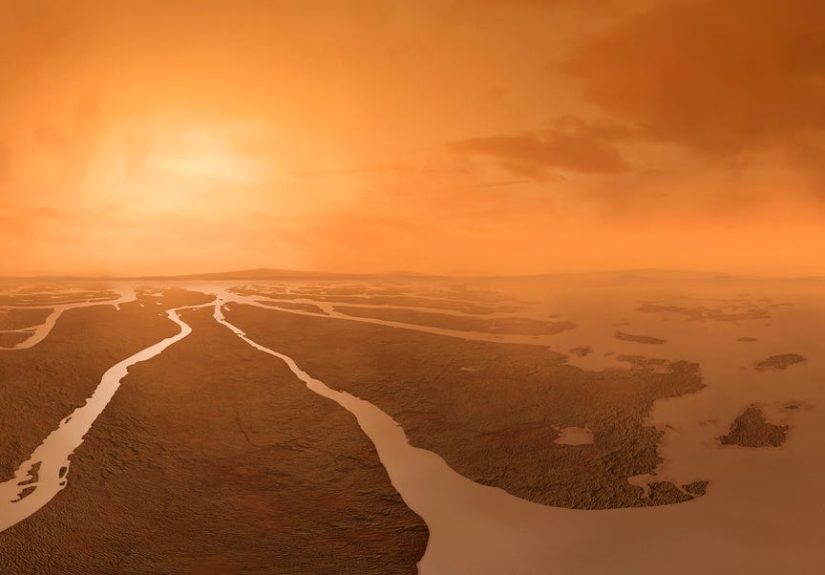
These polar liquids are not decorative puddles. They are part of Titan’s active methane cycle, which works in ways that are eerily similar to Earth’s water cycle. Methane evaporates, forms clouds, falls as rain, carves channels, and collects in lakes and seas. Same planetary logic, different chemistry, much colder weather, worse beach conditions.
Why Titan Feels So Familiar, and So Alien
The reason Titan keeps showing up on lists of the most exciting moons in the solar system is not just that it is strange. Plenty of worlds are strange. Titan is exciting because it is strange in a strangely recognizable way. It has the kinds of processes Earth scientists understand, but they are built from different ingredients and run at cryogenic temperatures.
That combination makes Titan a natural laboratory. Want to understand how landscapes evolve when rainfall, rivers, wind, and sediment all interact? Titan says hello. Want to see what a nitrogen atmosphere with methane weather looks like on a world far colder than any place on Earth? Titan has that too. Want to investigate prebiotic chemistry in a setting rich with complex organics? Titan is basically raising its hand from the back of the classroom and yelling, “Pick me.”
A weather system that rewrites the script
Titan’s atmosphere is one of the biggest reasons the map is so revealing. A geologic map makes more sense when you know what is shaping the ground, and on Titan the answer is not just impacts or tectonics. It is weather. Clouds form. Methane rains. Rivers cut channels. Liquids gather into lakes. Dunes shift under winds. Surface chemistry changes as atmospheric molecules break apart and recombine.
Recent observations have only made Titan more compelling. New work with the James Webb Space Telescope has helped pin down key atmospheric chemistry, including a missing step in how ethane forms. That matters because Titan’s surface and atmosphere are tightly linked. The map shows the results of those interactions in terrain. The chemistry explains why those terrains can exist at all.
The map shows a living climate record
One of the most interesting things about Titan’s geologic map is that it does not simply show where features are. It hints at when and how processes dominated. Dunes imply strong and persistent wind patterns. Labyrinth terrains imply prolonged erosion by liquid. The relative scarcity of obvious impact craters suggests resurfacing and weathering have been active enough to erase or soften older scars.
That gives Titan a kind of climatic memory. Its surface records shifting balances among rain, evaporation, wind, sediment transport, and maybe even changes in orbital forcing over long time scales. The map is exciting because it is not a still life. It is evidence of an evolving world.
Why the Map Matters for Dragonfly
A geologic map is especially valuable when you plan to stop admiring a world from afar and actually visit it. That is exactly where Titan is headed next. NASA’s Dragonfly mission, now targeting a 2028 launch and late-2034 arrival, will fly through Titan’s dense atmosphere and explore multiple sites on the surface. It is the first rotorcraft mission designed to explore another world, which sounds futuristic because it is.
Dragonfly is a big reason the Titan map feels more than historical. The map is now practical. It helps scientists choose targets, understand local context, compare terrains, and identify the most promising places to ask astrobiology questions. Without a global geologic framework, a landing site is just a dot. With the map, it becomes part of a system.
Selk Crater and the hunt for prebiotic chemistry
One of Dragonfly’s most compelling destinations is the area around Selk Crater, a major impact site that may preserve evidence of water interacting with organics in the past. That is catnip for scientists interested in how the chemistry that precedes life might develop. Impact craters can create temporary melt environments, and on Titan that means periods when liquid water and complex organics may have shared the same neighborhood. In planetary science, that is the equivalent of hearing dramatic music just before the plot thickens.
The geologic map helps place Selk in context. It shows how Titan’s impact features, dunes, plains, and channels relate to one another. Dragonfly will not explore a random patch of ground. It will investigate a site chosen because Titan’s geology suggests it could preserve a valuable chemical record.
Why a flying mission makes perfect sense on Titan
Titan is one of the few places in the solar system where flying is not just possible but smart. Its atmosphere is thick, its gravity is low, and its interesting sites are spread out. A traditional rover would crawl. Dragonfly can hop. That means scientists can compare multiple geologic settings instead of getting stuck with a one-location biography of a moon that clearly deserves a whole series.
The map makes that mobility scientifically powerful. It tells mission planners where dunes dominate, where crater materials might be exposed, where fluvial features are likely, and where surface composition could vary in meaningful ways. In simple terms, the map turns Dragonfly from a cool machine into a strategically brilliant one.
Why Titan Is an Astrobiology Superstar
No responsible scientist is claiming Titan is full of little hydrocarbon fish writing philosophy at the bottom of a methane sea. But Titan is still one of the best places to study chemistry relevant to life’s origins. Its atmosphere is rich in nitrogen and methane. Sunlight and energetic particles break molecules apart and allow them to recombine into more complex organics. Some of that chemistry settles onto the surface. Some may interact with liquids. Some may preserve stages of prebiotic evolution that are hard to study on Earth because Earth upgraded itself and erased too much of the early record.
That is why Titan’s geologic map matters beyond geology. It identifies the settings where chemistry and environment intersect. Dunes tell you about transported organics. Channels tell you where liquids moved material. Craters may mark places where heat and water once altered surface chemistry. Lakes and seas reveal where atmospheric products accumulate. The map is not just about rocks and landforms. On Titan, it is also about ingredients, transport, and opportunity.
What Scientists Still Do Not Know
For all its value, Titan’s geologic map does not solve every mystery. It sharpens them. Scientists still want to know how Titan’s methane is replenished over geologic time. They still debate the full story of its interior, including whether a simple global subsurface ocean model gives way to a more complicated slushy structure. They still want to pin down the ages of different terrains, the detailed composition of dune particles, and how Titan’s climate has shifted over long cycles.
That is another reason Titan is so exciting. The map is not a final chapter. It is an invitation. It tells researchers where the questions live.
Conclusion: Titan Earns Every Bit of the Hype
Titan’s global geologic map shows a world that is coherent, active, and deeply worth exploring. It reveals plains shaped by deposition, dunes built from organics, polar seas of methane and ethane, eroded labyrinths, and impact sites with astrobiological promise. It also shows why Titan refuses to fit neatly into one category. It is part icy moon, part climate system, part chemistry lab, and part time capsule for questions about how planetary environments become interesting enough for life’s ingredients to get ambitious.
That is why Titan is one of the most exciting moons in the solar system. It is not just exotic for the sake of being exotic. It is scientifically rich in ways that connect geology, atmosphere, climate, and prebiotic chemistry. The new geologic map proves that Titan is not merely a hazy curiosity orbiting Saturn. It is a world with structure, history, and momentum. And with Dragonfly on the way, Titan is about to go from one of the best-mapped mysteries in space to one of the best-investigated.
Not bad for a moon that once looked like an orange smudge.
An Experience-Based Reflection: What It Feels Like to Follow Titan Across a Map
There is something unusually powerful about looking at Titan through a geologic map instead of a glamorous artist’s rendering. A painting can make a moon beautiful. A map makes it real. The experience is different. You stop thinking of Titan as a distant object and start thinking of it as a place with neighborhoods, borders, patterns, and stories written across its surface.
Start at the equator and imagine those long dark dune fields stretching over the horizon. On Earth, dunes already feel abstractly oceanic, like sand turned into waves and then frozen mid-motion. On Titan, that sensation gets turned up several notches. These are not ordinary deserts. They are massive belts of organic grains laid out under a thick amber sky. The temperature is brutal, the light is dim, and the landscape would feel uncannily familiar anyway. That is one of Titan’s most unforgettable qualities: it keeps offering shapes your brain recognizes while filling them with substances your brain absolutely did not order.
Then the map pulls you north, toward the lakes and seas. The emotional effect is almost cinematic. Titan stops being “the moon with dunes” and becomes “the moon with coastlines.” You imagine standing at the edge of Kraken Mare or another polar sea and realizing that the shoreline in front of you is not metaphorical. It is a shoreline. There are liquids gathered there, weather cycles feeding them, and a climate system that has done the patient work of building an alien version of hydrology. The experience of reading that on a map is strangely intimate. It makes the solar system feel less like a display case and more like a collection of worlds with local weather reports nobody has fully learned to read yet.
The map also changes how you think about time. Craters, plains, channels, and labyrinth terrains are not just features. They are durations. They imply long eras of rain, wind, deposition, erosion, and resurfacing. When you follow those patterns with your eyes, Titan begins to feel less frozen in the ordinary sense and more suspended in a slow-motion kind of activity. It is cold, yes, but not lifeless in a geologic sense. It is busy at Titan speed.
There is also a deeply human experience buried in all this cartography: anticipation. A geologic map invites movement. You do not just look at it. You mentally travel across it. That is why Dragonfly feels so thrilling. The mission is not heading to a blank dot. It is heading into a mapped world where each landing site belongs to a larger narrative. When you know that dunes lead toward crater materials, and that crater materials may preserve a history of organics and past liquid water interactions, the map stops being static information and becomes a route through scientific possibility.
Maybe that is the most exciting thing of all. Titan’s map makes the moon feel explorable. Not conquered, not solved, not reduced to a tidy headline, but explorable. It reminds us that the solar system still contains places where the next close look could rearrange what we think planets and moons are allowed to be. And in an era when so much of Earth is already measured, named, and thoroughly photographed, there is something joyful about a map that still feels like the beginning of an adventure.