Table of Contents >> Show >> Hide
- How Animals “Quit” Eyes Without Quitting Life
- The Top 10 Eyeless (or Nearly Eyeless) Animals
- 1) Mexican Tetra Cavefish (Astyanax mexicanus)
- 2) Northern Cavefish (Amblyopsis spelaea)
- 3) Alabama Cavefish (Speoplatyrhinus poulsoni)
- 4) Toothless Blindcat (Trogloglanis pattersoni)
- 5) Widemouth Blindcat (Satan eurystomus)
- 6) Texas Blind Salamander (Eurycea rathbuni)
- 7) Kentucky Cave Shrimp (Palaemonias ganteri)
- 8) Alabama Cave Shrimp (Palaemonias alabamae)
- 9) Mammoth Cave Crayfish (Orconectes pellucidus)
- 10) Kauaʻi Cave Wolf Spider (Adelocosa anops)
- Common Themes: The “Cave Starter Pack”
- What “Not Needing Eyes” Really Means
- Experiences: Visiting the Eyeless World (Without Being That Person)
- Conclusion
Eyes are amazinguntil you move into a place where the lights are never coming back on.
In caves, deep aquifers, and lava tubes, vision can become the biological equivalent of paying for a streaming service you never open.
Over many generations, some animals living in perpetual darkness evolve reduced, non-functioning, or fully lost eyesand then double down on other senses
like touch, smell, vibration detection, and taste.
This isn’t evolution being “mean.” It’s evolution being practical. Eyes are complex tissues that take energy to build and maintain, and they can be
vulnerable to infection or damage. If sight stops helping you find food, mates, or safety, natural selection may no longer “protect” perfect vision.
Mutations that shrink or disable eyes can persistespecially if they come with side benefits (like better non-visual senses).
How Animals “Quit” Eyes Without Quitting Life
Scientists often describe eye loss in cave species as regressive evolutiontraits get reduced when they’re no longer useful.
But it’s not just “use it or lose it” in a motivational-poster sense. Eye reduction can happen because:
- Eyes are expensive: building retina and brain wiring costs energy that could go to growth, reproduction, or sensory upgrades.
- Mutations accumulate: if poor eyesight no longer hurts survival, “broken” eye-development genes can stick around.
- Pleiotropy happens: some genes influence multiple traits; tweaking “eye genes” can also boost non-visual traits that help in darkness.
- Development can reroute: in some classic cavefish, early changes in eye development cascade into smaller and smaller eyes.
The real magic is what replaces vision. Many cave-adapted animals develop heightened mechanosensation (feeling water movement or vibrations),
stronger chemosensation (smell/taste), and behaviors tuned for darknesslike slow movement, careful energy use, and “hugging” walls to navigate.
The Top 10 Eyeless (or Nearly Eyeless) Animals
Below are ten standout animals that illustrate how life thrives when sight isn’t on the job description.
Several are federally protected in the U.S., and many are extremely localizedsometimes confined to a single cave system.
1) Mexican Tetra Cavefish (Astyanax mexicanus)
If “eyeless evolution” had a celebrity spokesperson, this would be it. The cave form of the Mexican tetra is famous for having
degenerate or absent eyes and reduced pigmentation. What it lacks in eyeballs, it makes up for with enhanced senses
including a more sensitive lateral line system (detecting water movement) and behavioral strategies for feeding in darkness.
Researchers love this species because surface (eyed) and cave (eyeless) forms can be compared to reveal how eye loss evolves.
2) Northern Cavefish (Amblyopsis spelaea)
Found in subterranean waters in parts of the eastern U.S., the Northern cavefish is a classic American example of a fish that
lives where sunlight doesn’t RSVP. It’s described as eyeless and depigmented, with a pale, ghostlike appearance that’s
perfectly normal in a world where camouflage is basically irrelevant. Instead of scanning the horizon, it relies on non-visual cues
to find food and navigate underground streams.
3) Alabama Cavefish (Speoplatyrhinus poulsoni)
This is one of the rarest cavefish in the United States, restricted to an extremely limited habitat in Alabama.
It’s a troglobitic fish (obligate cave-dweller) with no eyes and almost no pigment, making it nearly transparent.
When your whole universe is a dark underground pool, “looking around” is just not part of the lifestyle.
4) Toothless Blindcat (Trogloglanis pattersoni)
Yes, the name sounds like a children’s book character who lost a fight with a toothbrush. But it’s realand it’s incredible.
This rare catfish lives deep in groundwater in Texas, in total darkness far below the surface. It’s described as eyeless,
and it’s thought to scavenge or graze on food sources in its subterranean ecosystem. In a place with no light, whiskers (barbels) and
touch-based sensing beat eyeballs every day of the week.
5) Widemouth Blindcat (Satan eurystomus)
The scientific name is dramatic (it’s “Satan,” after all), but the story is pure evolutionary logic:
a catfish adapted to deep, dark groundwater habitats under Texas. It’s described as eyeless and believed to feed on
invertebrates as an opportunistic predator. The “widemouth” part is not just brandingit reflects how feeding matters more than seeing down there.
6) Texas Blind Salamander (Eurycea rathbuni)
If you’ve ever wanted to meet a salamander that looks like it belongs in a fantasy novel, here you go.
The Texas blind salamander is adapted to underground waters and is described as having no functional eyes (often visible as
small dark spots beneath the skin), little pigment, and external gills. It lives in the Edwards Aquifer system, where stable underground conditions
shape everything from metabolism to movement. It’s also a reminder that “out of sight” should not mean “out of mind” for conservation.
7) Kentucky Cave Shrimp (Palaemonias ganteri)
This shrimp is a fully cave-adapted freshwater species found in the Mammoth Cave region. It’s described as
eyeless and typically lacks pigment, often appearing nearly transparent. In underground streams, shrimp can feed on organic material
carried in by watertiny edible “care packages” delivered by groundwater flow.
8) Alabama Cave Shrimp (Palaemonias alabamae)
Another cave-adapted shrimp, this species is described as colorless and largely transparent, reflecting life without sunlight.
Like its Kentucky relative, it depends on the subterranean ecosystem’s limited food webone where patience and efficiency are survival skills.
Cave shrimp also highlight a key truth: when habitats are extremely small and isolated, even minor pollution or groundwater changes can be catastrophic.
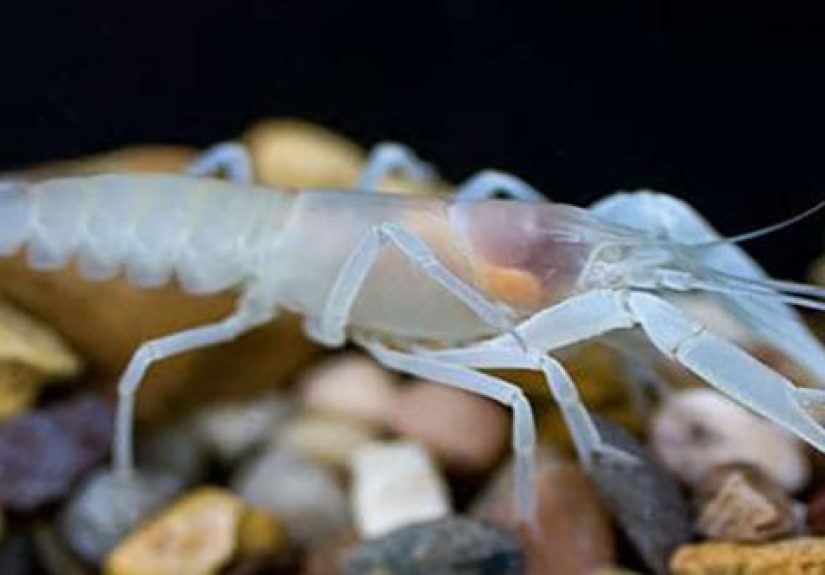
9) Mammoth Cave Crayfish (Orconectes pellucidus)
Often nicknamed the “eyeless crayfish,” this species is associated with karst landscapes in Kentucky and Tennessee.
It shows classic cave adaptations: reduced pigmentation and highly reduced or absent eyes.
Crayfish in caves often rely on touch and chemical cues, using antennae and sensory hairs to read their environment like a braille novel.
10) Kauaʻi Cave Wolf Spider (Adelocosa anops)
A predator that proves you don’t need eyes to be intimidating (or at least extremely efficient),
the Kauaʻi cave wolf spider is known as the “blind spider” and is described as having completely lost its eyes.
It lives in Hawaiian cave environments and hunts by sensing vibrations and chemical signals.
It’s a top-tier example of how evolution can strip away vision and still build a successful hunter.
Common Themes: The “Cave Starter Pack”
Even across different animal groups, cave evolution tends to rhyme. Here are traits you’ll see again and again:
- Depigmentation: Without sunlight, pigment is less useful, so many species become pale or translucent.
- Enhanced non-visual senses: Better smell/taste, vibration detection, and touch sensitivity are common.
- Energy efficiency: Many cave species grow slowly, reproduce less often, and conserve calories like it’s their job (because it is).
- Extreme endemism: Some species exist in only one cave or aquifermeaning one bad pollution event can be existential.
What “Not Needing Eyes” Really Means
“Eyeless” doesn’t always mean “zero eye tissue.” Some animals have tiny remnants hidden under skin, while others have eyes that form early in development
and then degenerate. In certain species, individuals may still detect light versus dark even without image-forming vision. Evolution isn’t flipping a single
“eyes: ON/OFF” switchit’s modifying development, anatomy, and behavior across time.
Experiences: Visiting the Eyeless World (Without Being That Person)
If this topic makes you want to grab a headlamp and sprint into the nearest cave like an over-caffeinated Indiana Jones, here’s the calmer (and more ethical)
way to “experience” animals that evolved beyond eyesight. Think of this section as your field-guide-to-wonderno cave kidnapping required.
Start aboveground: Many people’s first “eyeless animal” moment happens in aquariums, museums, or nature centers that feature cave species
educational displays. These exhibits are underrated because they let you watch behavior you’d never see in the wild: how a fish navigates by sensing water movement,
how shrimp graze in slow motion, or how pale coloration changes the whole vibe of an animal’s body plan. You also learn a big conservation lesson fast:
subterranean ecosystems are fragile because they’re basically nature’s sealed terrariumsexcept humans keep poking holes in the lid.
Visit protected cave parks the right way: Places like Mammoth Cave National Park in Kentucky (home region for cave-adapted shrimp and other troglobites)
offer guided tours where you can feel the “perpetual night” setting that drives eye loss. The real experience is sensory:
temperatures become steadier, humidity rises, and the world gets quiet in a way that makes your own footsteps feel loud. Your brain starts paying attention to
airflow, dripping water, and echoesexactly the kind of non-visual information cave animals use all the time. If you want a memorable moment,
turn off your light when guides allow it and notice how quickly your confidence depends on vision. Cave species didn’t just adapt; they built an entire lifestyle
without that dependency.
Try a “no-vision” challenge at home: A surprisingly good way to understand cave adaptation is to do something simplelike sorting objects by texture
with your eyes closed, or navigating a short, safe path in your home using touch and sound. (Emphasis on safe. No stairs. No furniture jousting.)
It’s not the same as living underground, but it’s a quick demo of why heightened touch and vibration sensing are such superpowers in the dark.
Go deeper with citizen science and conservation: Many of the animals on this list are threatened by groundwater pumping, contamination,
and habitat disturbance. Supporting groundwater protection policies, donating to cave and karst conservation groups, or even learning about local aquifers
is a real way to “participate” in this story. The biggest experience takeaway is this: eyeless animals aren’t just weird trivia.
They’re indicatorsliving proof that clean, stable groundwater systems exist… or a warning that they don’t.
Most important rule: Don’t collect, handle, or disturb cave wildlife. Don’t touch formations.
Decontaminate gear when appropriate (some caves have protocols to reduce spreading pathogens). If you remember one thing, make it this:
in an ecosystem where food is scarce and populations are tiny, “just one time” human interference can be a big deal.
Conclusion
Animals that evolved to not need eyes aren’t “missing” somethingthey’re specialized for a world where sight is optional and other senses run the show.
From cavefish and blind salamanders to transparent shrimp and eyeless spiders, these species demonstrate evolution’s ruthless efficiency and creativity.
They also come with a quiet message: protect the hidden habitatsbecause what happens underground doesn’t stay underground.