Table of Contents >> Show >> Hide
- What the Fusion Triple Product Actually Means
- Why Wendelstein 7-X Is Such a Big Deal
- The Record: What W7-X Achieved
- How W7-X Pulled It Off
- Why This Record Matters for Fusion Energy
- Tokamak vs. Stellarator: The Rivalry Gets More Interesting
- What W7-X Still Does Not Prove
- What Comes Next for Wendelstein 7-X and Fusion Research
- The Experience of Following a Record Like This
- Conclusion
- SEO Tags
Fusion researchers have a habit of talking about the future as if it is always just around the corner, standing there with a clipboard and a really expensive magnet. So when a machine called Wendelstein 7-X makes headlines for setting a new record for the nuclear fusion triple product, it is fair to ask two questions right away: what exactly happened, and should anyone outside a plasma physics conference care?
The answer to the first question is exciting. The answer to the second is yes, absolutely. Wendelstein 7-X, or W7-X for short, just delivered one of the clearest signs yet that stellarators, a twisty category of fusion machines, may be more than beautiful engineering sculptures for scientists with a love of complexity. In its latest campaign, the device sustained a record-setting triple product for long plasma discharges, holding elite fusion conditions for 43 seconds. In fusion terms, that is not a blink. That is a statement.
And what a statement it was. For decades, fusion has been a story of breathtaking temperatures and sobering caveats. W7-X did not solve fusion overnight, and it did not become a commercial power plant between breakfast and lunch. But it did show that researchers can maintain high-performance plasma in a stellarator for far longer than before. That matters because future fusion power plants will not need flashy seconds. They will need steady, disciplined endurance.
What the Fusion Triple Product Actually Means
The phrase fusion triple product sounds like something cooked up by a marketing team that wanted plasma physics to feel more premium. In reality, it is one of the most important benchmarks in fusion research. The triple product combines three factors: plasma density, plasma temperature, and energy confinement time. In plain English, scientists want a plasma that is hot enough, dense enough, and stable long enough for fusion reactions to become self-sustaining.
If one of those ingredients is weak, the whole recipe flops. You can have a plasma that is absurdly hot, but if it leaks energy faster than a cheap inflatable pool, fusion does not get very far. You can also trap plasma for longer, but if the particles are not dense enough, the reaction rate stays disappointing. The triple product ties all three conditions together into a single yardstick for performance.
That is why the latest Wendelstein 7-X result turned heads. It was not simply another temperature headline. It was a performance milestone that showed the machine could hold strong overall fusion conditions over a meaningful stretch of time. In the world of magnetic confinement fusion, duration is not a side note. It is the whole plot.
Why Wendelstein 7-X Is Such a Big Deal
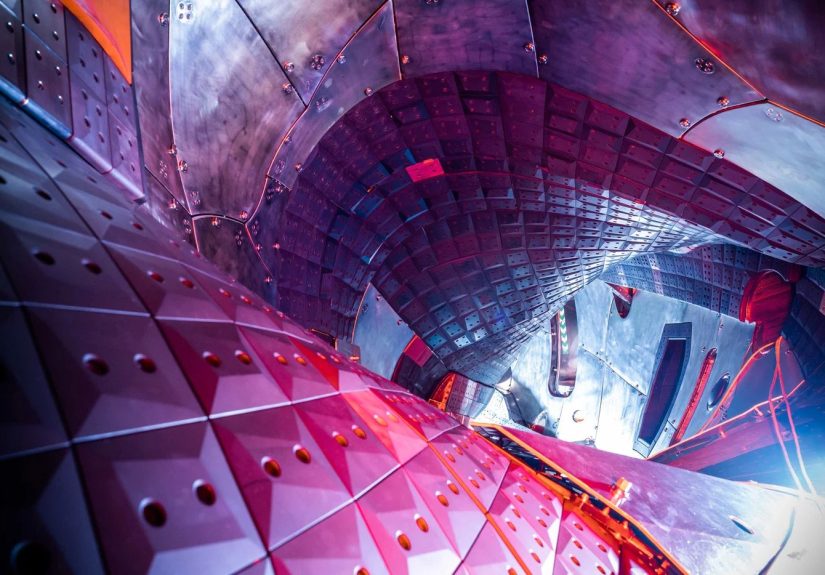
Wendelstein 7-X is the world’s largest stellarator, located in Greifswald, Germany and operated by the Max Planck Institute for Plasma Physics. Unlike a tokamak, which relies in part on a current driven through the plasma itself, a stellarator uses external magnetic coils to produce a carefully twisted magnetic cage. The goal is to confine plasma in a way that is naturally stable and suitable for steady-state operation.
That distinction is more important than it sounds. Tokamaks have led many of fusion’s most famous advances, but they also come with well-known engineering and stability challenges because their plasma current can trigger disruptions. Stellarators are designed to avoid some of those headaches. The catch is that stellarators are fiendishly complex to design and build. Their magnetic geometry looks like a donut that went to art school and then majored in topology.
For years, stellarators were often treated like the intellectually interesting cousin of tokamaks: impressive, elegant, and maybe just a little too complicated for mainstream success. W7-X has been changing that narrative. It was built to prove that an optimized stellarator can achieve strong plasma confinement without depending on the same internal-current tricks tokamaks use. With this latest record, that claim looks a lot more persuasive.
The Record: What W7-X Achieved
In its 2025 experimental campaign, Wendelstein 7-X set a new world record for the triple product in long plasma discharges. The machine sustained a high-performance plasma for 43 seconds, a duration that put it at the front of the pack for long-pulse fusion performance. That is especially notable because long-duration operation is much closer to what a future power plant would need than short bursts of brilliance.
Researchers also reported ion temperatures above 20 million degrees Celsius, with peaks around 30 million degrees Celsius. Those are serious fusion temperatures, well beyond anything politely described as warm. Even more impressive, W7-X achieved this with a plasma volume smaller than older tokamak giants and with less heating power than some of its better-known rivals.
The achievement was not just about surviving 43 seconds. According to scientists involved in the work, the plasma conditions were sustained long enough that the experiment entered a regime where the important physics could actually be studied in a stable way. That is a crucial point. Fusion research does not only need records. It needs repeatable, understandable performance that engineers can eventually turn into real machines.
How W7-X Pulled It Off
Pellet fueling made a major difference
One of the keys to the record was a pellet injector developed with support from Oak Ridge National Laboratory in the United States. The system fired frozen hydrogen pellets into the plasma core, helping maintain the density needed for strong performance. This matters because fueling the center of a hot plasma is tricky. Gas puffing from the edge is easier, but it is often less effective for producing the density profile researchers want.
With pellet fueling, W7-X could keep feeding the plasma while it was being heated. That combination allowed researchers to maintain high density and strong confinement for longer than earlier runs. In fusion, timing is everything. Too much fuel at the wrong moment can cool the plasma. Too little, and performance fades. The new campaign used carefully controlled fueling patterns to keep the machine in a sweet spot.
Microwave heating kept temperatures soaring
At the same time, powerful microwave heating pushed ion temperatures above 20 million degrees Celsius and up toward 30 million degrees at peak performance. That gave the plasma the heat needed to support a stronger triple product. Fusion devices live or die by balance: heat, density, confinement, and wall interactions all have to cooperate. W7-X looked much more like an orchestra than a science fair project in this run.
Diagnostics proved the record was real
Good science is not just about doing something impressive. It is also about measuring it properly. Princeton Plasma Physics Laboratory helped provide diagnostics, including systems used to measure key plasma conditions such as ion temperature. Those measurements were essential for calculating the triple product and validating the performance claim.
That international collaboration is one of the less flashy but most important parts of the story. Fusion progress increasingly depends on networks of labs, specialized instruments, and shared engineering know-how. The record was made in Germany, but it was absolutely an international effort.
Why This Record Matters for Fusion Energy
The biggest reason this breakthrough matters is simple: future fusion plants will need to operate continuously or for very long stretches. They cannot be machines that do something astonishing for three seconds and then need to lie down in a dark room. Long-pulse performance is where the commercial conversation gets real.
W7-X’s new record suggests that stellarators may be able to compete with tokamaks in the performance measures that matter most for power generation. That does not mean stellarators have won the fusion race. There is no trophy, no checkered flag, and no victory parade with superconducting confetti. But it does mean the stellarator pathway has become much harder to dismiss.
It also strengthens a broader lesson in fusion research: there may not be one single machine design that solves everything. Tokamaks remain central to the field, especially with ITER on the horizon. Inertial fusion continues to produce its own milestones. But stellarators now look increasingly like a serious contender rather than a backup plan with excellent geometry.
Tokamak vs. Stellarator: The Rivalry Gets More Interesting
The fusion world has long been dominated by tokamaks, and for good reason. They are better studied, more numerous, and have produced many of the field’s landmark achievements. But stellarators have a compelling advantage: they are inherently better suited to steady-state operation because they do not rely on a plasma current in the same way.
That gives them an attractive profile for future commercial reactors. In theory, a stellarator can be more stable and require less active intervention to keep the plasma behaving itself. In practice, the design challenge is brutal. W7-X exists partly to answer whether modern computing, optimization methods, and advanced manufacturing can make stellarators practical at scale.
This latest triple product record does not finish that argument, but it shifts the tone. The question is no longer whether stellarators can produce respectable results. The question is how fast they can be improved from here, and whether their long-pulse strengths can outweigh their engineering complexity.
What W7-X Still Does Not Prove
Now for the responsible grown-up part. Wendelstein 7-X is not a commercial reactor. It is not generating electricity for homes, charging electric cars, or making your toaster feel like it lives in the future. The machine is an experiment designed to validate the stellarator concept and explore whether it can support the conditions needed for a practical fusion plant.
It also does not mean fusion has crossed every critical threshold. Triple product records are enormously important, but they are still part of a larger roadmap that includes materials science, tritium handling, power extraction, maintenance, neutron-resistant components, and cost. Anyone who tells you fusion is solved because of one record is skipping several chapters and at least one engineering nightmare.
Still, this is exactly how real progress in hard science often looks. It is not one cinematic breakthrough followed by immediate deployment. It is a chain of advances, each reducing uncertainty, each proving a difficult thing can be done. W7-X just added a very strong link to that chain.
What Comes Next for Wendelstein 7-X and Fusion Research
The next challenge is obvious: extend these conditions further and do so reliably. If researchers can push W7-X from tens of seconds toward many minutes while maintaining strong plasma quality, the machine will become even more influential in the debate over what a future fusion plant should look like.
Scientists will also continue refining pellet fueling, heating coordination, wall conditioning, and plasma control. These may sound like technical footnotes, but they are the difference between a beautiful physics result and a technology platform that can scale. Fusion lives in those details.
At the same time, commercial fusion companies and public labs will be watching closely. Every major result from W7-X now carries significance beyond academia because it informs how investors, engineers, and governments think about the fusion landscape. Stellarators are no longer just academically interesting. They are commercially relevant.
The Experience of Following a Record Like This
There is a particular feeling that comes with watching fusion research mature, and the Wendelstein 7-X record captures it perfectly. For years, the public conversation around fusion has swung between two extremes. On one side, there is breathless optimism: unlimited clean energy is basically tomorrow’s problem. On the other side, there is the weary eye roll: fusion is always a few decades away, and always will be. Most people who follow the field seriously end up somewhere in the middle, carrying both excitement and caution at the same time.
The W7-X result feels different because it has texture. It is not just a big number tossed into a press release and left to bounce around social media. It tells a story about patient engineering, about teams solving one ugly practical problem after another, and about a machine proving that its strange, elegant design is not merely theoretical. If you care about science, that is satisfying in a very specific way. It feels less like hype and more like traction.
There is also something deeply human about this kind of milestone. Fusion research can seem abstract, full of acronyms, diagrams, and plasma parameters that make ordinary readers want to quietly back away from the page. But underneath all of that is a very recognizable drama: people trying to build something the world has never had before. They are wrestling with heat, magnetism, materials, timing, and measurement, all while knowing the bar for success is absurdly high. When a result like this lands, you can almost feel the collective exhale from the researchers who spent years chasing it.
For observers, the experience is a mix of awe and discipline. Awe, because a twisted magnetic machine held matter at tens of millions of degrees in a stable configuration long enough to set a meaningful world record. Discipline, because the smart response is not to declare victory but to ask what the result changes. And the answer is: quite a lot. It changes confidence. It changes design conversations. It changes what people in the field can now say with a straight face about stellarators.
It also changes the emotional rhythm of the fusion story. Instead of feeling like a collection of disconnected breakthroughs, the field starts to look cumulative. One experiment proves ignition in one approach. Another pushes long-duration confinement in another. A lab improves magnets. Another improves fueling. A machine like W7-X ties many of those threads together and shows how progress can become layered, not isolated.
That is why this record resonates beyond the plasma physics community. It offers a rare kind of scientific satisfaction: not the instant gratification of a miracle, but the sturdier pleasure of watching a difficult idea become more believable. Wendelstein 7-X did not hand the world a fusion power plant. What it did hand us is arguably more valuable at this stage: evidence that one of fusion’s most promising and most challenging designs is beginning to behave less like a dream and more like a future machine.
Conclusion
Wendelstein 7-X’s new record for the nuclear fusion triple product is not just another flashy science headline. It is a meaningful advance in the long campaign to make fusion practical. By sustaining high-performance plasma for 43 seconds, reaching temperatures above 20 million degrees Celsius, and demonstrating the strength of optimized stellarator design, W7-X has put itself at the center of the fusion conversation.
The machine still has plenty left to prove, and fusion still has plenty of obstacles left to clear. But this result shows that the stellarator approach is not just alive. It is gaining momentum. In a field where progress is measured in fractions of certainty and hard-won increments of control, that is a very big deal. The donut may be twisted, but the signal is clear.